



How to Hire an Asphalt Contractor in Southern Wisconsin and The Greater Milwaukee Area






No. This guide is educational information designed to help property owners ask better questions and evaluate proposals more carefully. Legal questions about home improvement contracts should be directed to a Wisconsin attorney. Engineering questions about pavement design, drainage, or structural loading should be directed to a licensed professional engineer. Permit questions should be directed to the municipality, county, or Wisconsin Department of Transportation office with authority over the road or right-of-way in question. Wisconsin's home improvement rules — including required written contract terms, permit responsibility, and lien waiver rights — are set out in Wis. Admin. Code ch. ATCP 110, which any property owner can read for themselves. [WI-ATCP-110.05] [WI-DATCP-HI]
Because "blacktop" is not a scope — it is a wish. The word can describe an overlay, a full-depth reconstruction, a patch, a mill and pave, a pulverize and pave, a sealcoat, or something in between, and each of those has a different price, timeline, base requirement, and lifespan. If you do not define the project up front, three contractors may each bid a different job, and you will end up comparing prices for work that is not comparable. DATCP's home improvement consumer guidance recommends deciding in advance what the job will involve, drawing sketches or clipping pictures to show prospective contractors, and making sure all contractors are bidding on exactly the same work. [WI-DATCP-HI]
Often yes — and it is decided by your municipality, not the state. The private pavement on your lot and the approach in the public right-of-way are usually treated differently: the approach, apron, curb cut, or culvert almost always needs a municipal permit, and some cities also require the contractor to be licensed or bonded with the municipality before touching the public way. [LOCAL-MKE-ROW] A driveway connecting to a county trunk highway adds a county access permit, and state highway frontage adds a WisDOT connection permit — they stack on the municipal permit rather than replacing it. One call to your permit desk answers it for your address; make the call before you sign, and get the contractor's permit answer in writing. [WI-ATCP-110.03]
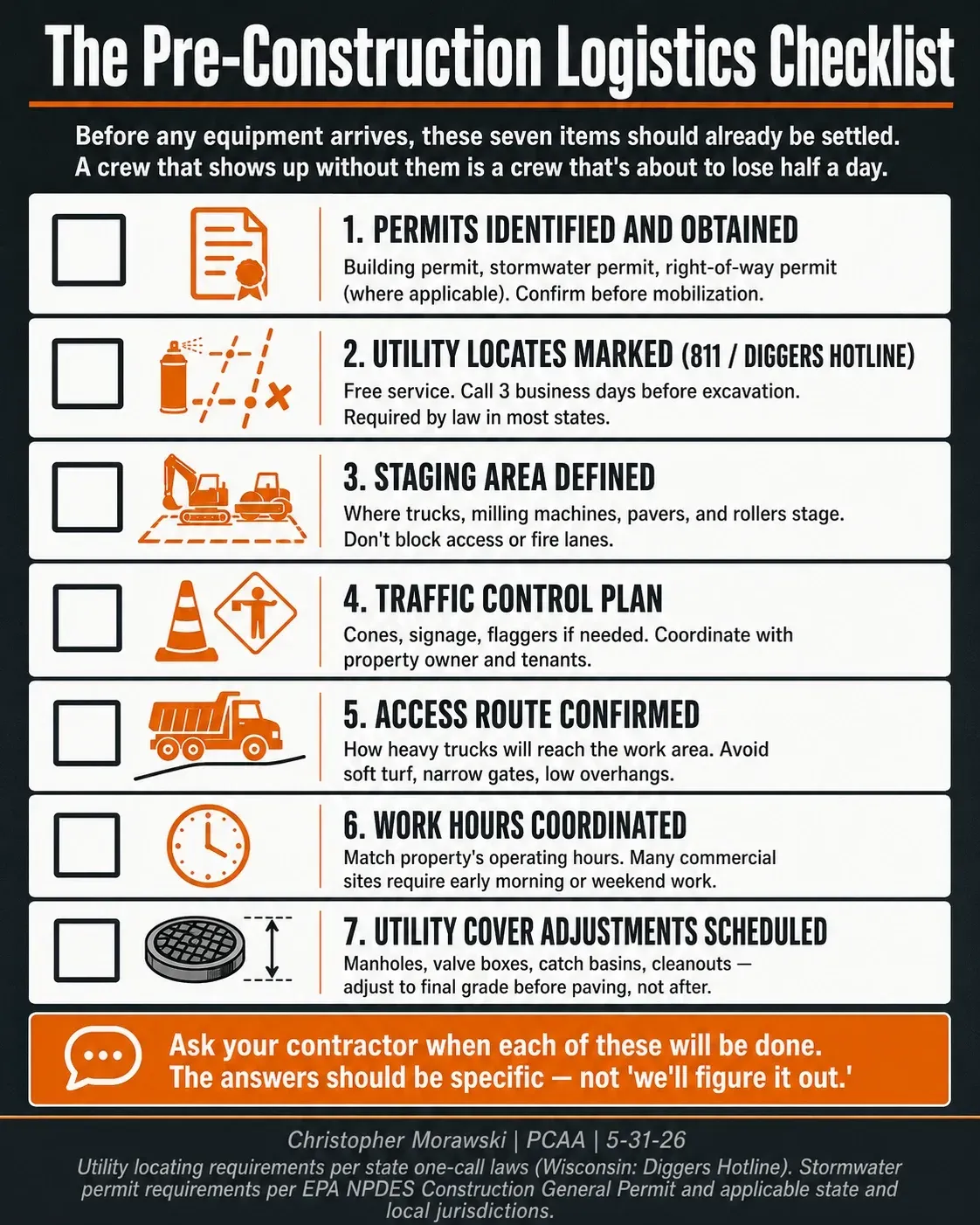
Diggers Hotline should be contacted before any excavation, grading, base repair, widening, culvert work, drain tile installation, saw-cut removal, or other digging associated with an asphalt project. Under Wisconsin Statute 182.0175, everyone — including homeowners working in their own yards — must contact Diggers Hotline at least three working days before digging, with weekends and state legal holidays not counted as working days. Depth is not the determining factor: utility lines can be shallower than expected because of erosion, previous digging, or uneven surfaces. There is no fee to use Diggers Hotline. The ticket number is your proof the request was made — but compliance also means honoring the wait, preserving the marks, and hand-digging within the 18-inch tolerance zone — and a ticket generally expires if digging does not begin within ten calendar days of the start date. [WI-DIGGERS] [WI-STAT-182]
Ask for the legal business name, any DBA, physical address, office phone, and the exact name that will appear on the contract. Search the legal entity in the Wisconsin DFI Corporate Records database and confirm the entity exists and shows active status. Remember its limits: sole proprietors and unregistered trade names are not searchable, and a registration proves only that paperwork was filed — nothing about insurance, competence, or honesty. Then check that the same identity appears everywhere: website, contract, insurance certificate, and payment channel. A business name that changes between the estimate, the contract, and the check request is a classic fraud marker. [WI-DFI-CORP]
No — Wisconsin has no state license for asphalt paving, sealcoating, or striping, and no statewide general contractor license. The DSPS Dwelling Contractor credential applies only to pulling building permits for one- and two-family dwellings, so a standalone driveway or parking lot job does not require it, and "no record found" in the DSPS License Lookup is the normal result for a legitimate paving contractor. What does exist: municipal licensing and bonding (the City of Milwaukee, for example, requires a licensed and bonded contractor for driveway-approach work in the public way), required credentials for electrical, plumbing, and HVAC trades on any project, and full application of Wisconsin's home improvement rules to residential paving regardless of licensure. Verify any credential a contractor actually claims, and ask your municipality what it requires. [WI-DSPS-DC] [WI-DSPS-LOOKUP] [LOCAL-MKE-ROW]
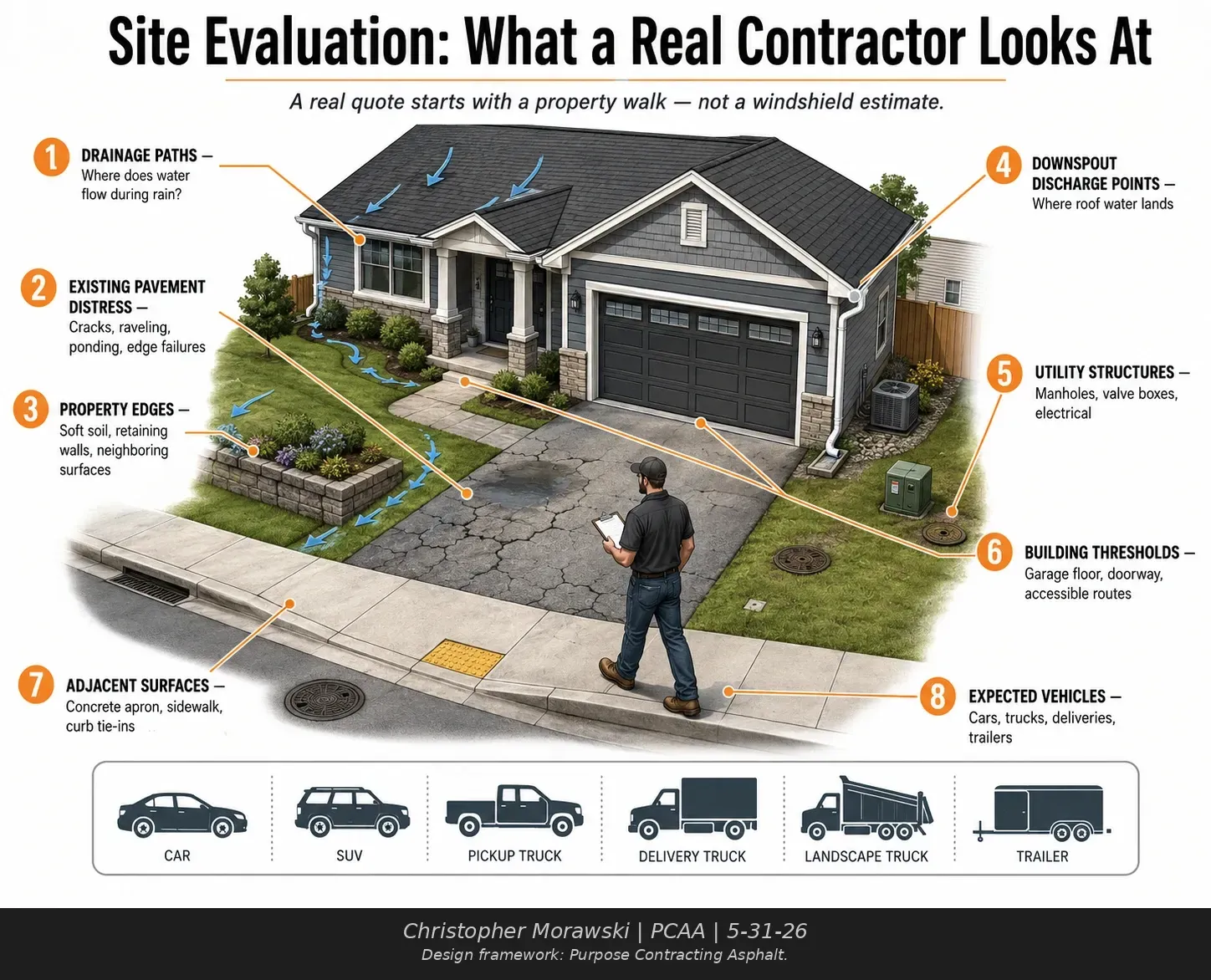
A site visit is what makes a proposal real. It lets the contractor inspect existing pavement condition, check drainage patterns, evaluate the subgrade at visible edges, measure the actual area, review the garage transition and road apron, note utility locations, plan equipment access, and confirm whether an overlay is realistic or removal and replacement is needed. The two things WAPA's guidance turns on — subgrade condition and a design matched to real vehicle loading — cannot be judged from a satellite image. [WI-WAPA-DRIVEWAY] A contractor who quotes a price without ever seeing the property is quoting a fictional job, and the difference between the fiction and the reality tends to become the owner's problem after the paver arrives.
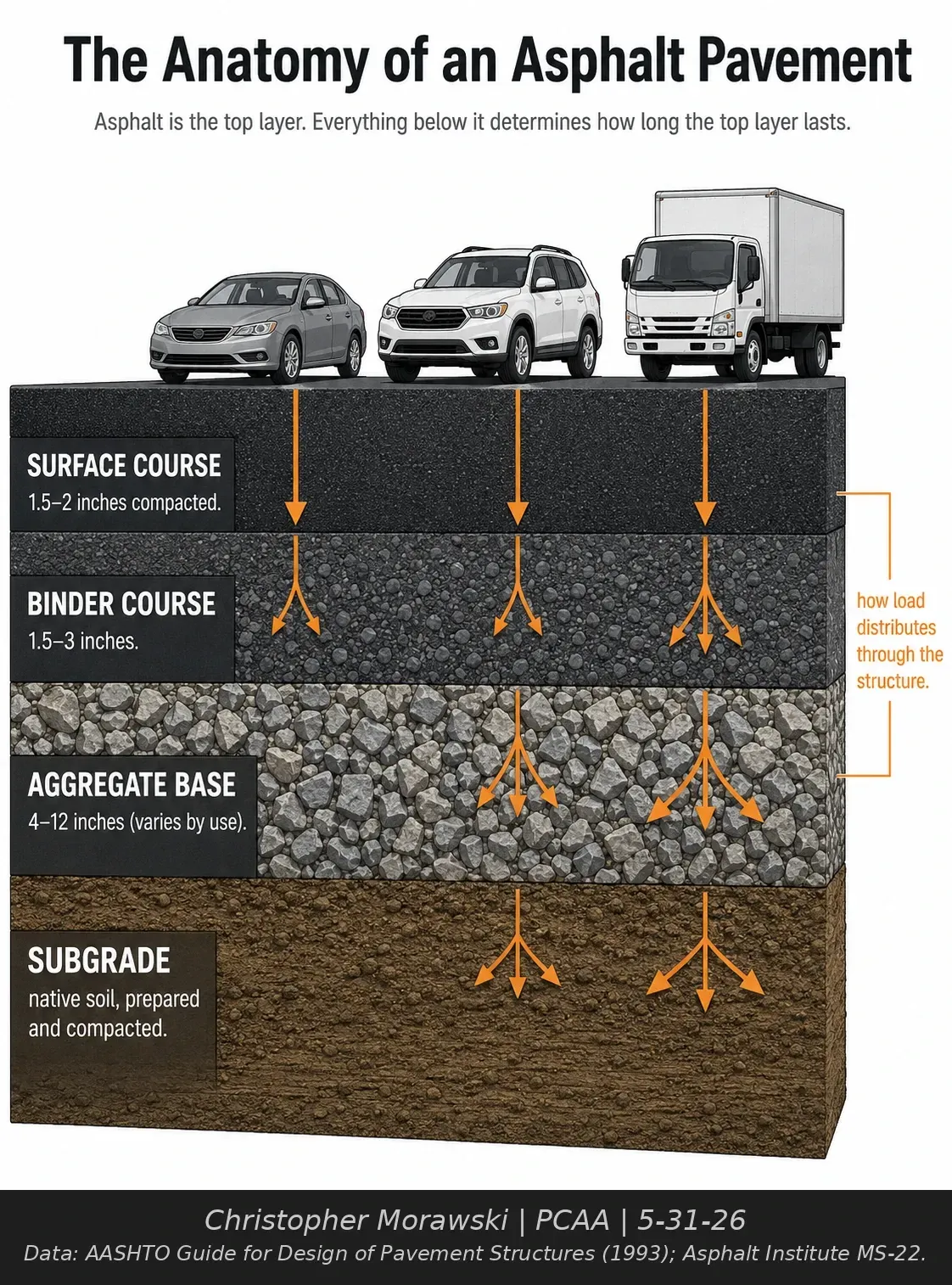
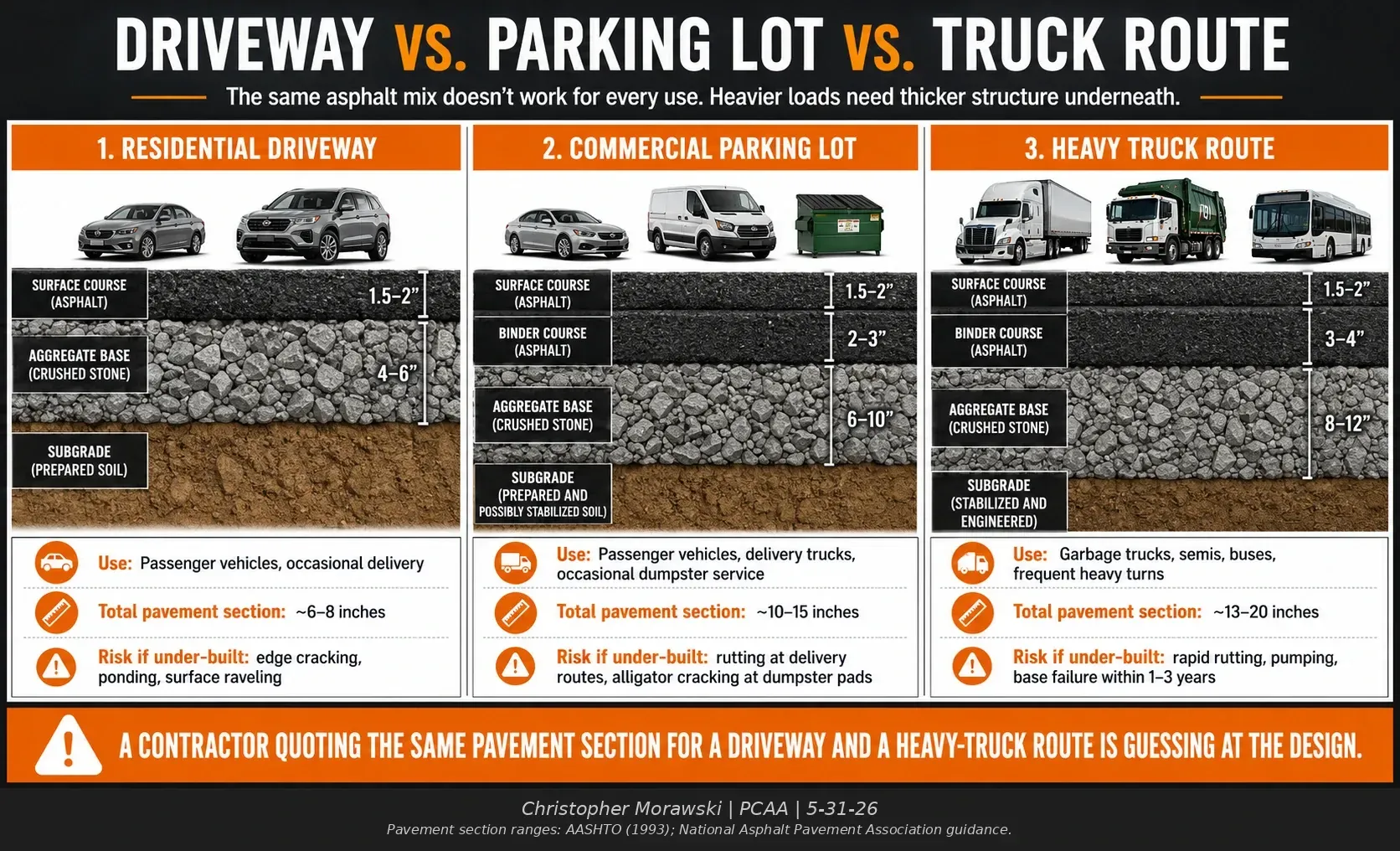
WAPA's Wisconsin design guide gives the reference points for residential-class pavement: 3.0 inches of compacted asphalt over 6 to 8 inches of aggregate base on good subgrade, 3.5 inches over 6 to 10 on medium subgrade, and 4.0 inches over 9 to 12 on poor subgrade. [WI-WAPA-DESIGN] But thickness alone cannot save a bad base — long-term performance depends on the whole structure: subgrade condition, drainage, base depth and compaction, mix design, lift structure, and edge support — which is exactly why WAPA's table scales with subgrade quality. [WI-WAPA-DRIVEWAY] Always confirm the quoted number is compacted thickness after rolling, not loose thickness — that difference alone can be half an inch or more of finished pavement.
Compare bids by scope first, price second. Fill in a line-by-line comparison (Appendix C) covering identity verification, insurance, permit and Diggers Hotline responsibility, removal and excavation depth, base material and depth, compacted asphalt thickness and lifts, drainage plan, apron work, striping, warranty terms, exclusions, and payment schedule — and only then look at total price. DATCP's consumer guidance specifically recommends making sure all contractors are bidding on exactly the same work and being leery of extremely low estimates, because an unusually low bid usually means something is missing from the scope rather than that the contractor is uniquely efficient. [WI-DATCP-HI]
Only in a specific situation: the sale was solicited (door knock, cold call, or mailer — you did not initiate it), the contract exceeds $25, and you signed somewhere other than the contractor's regular place of business. Meet all three and you may cancel until midnight of the third business day by mailing the signed cancellation notice — certified mail creates your proof — using the two copies of the notice the contractor was required to hand you at signing. Invite the bid yourself, and the right generally does not exist. There is no universal three-day undo in Wisconsin. [WI-DFI-CANCEL]
A lien waiver is a written document from a contractor, subcontractor, or material supplier giving up the right to file a construction lien against your property for the labor or materials covered by a specific payment. Request waivers before every payment on a larger project, and at minimum before final payment on any project — including proportional waivers when paying in installments. Wisconsin requires contractors to give buyers a separate written notice of this right before the contract is signed, and to provide the written waivers covering each payment from all contractors, subcontractors, and suppliers. [WI-DATCP-LIENS] [WI-ATCP-110.025]
A reasonable deposit at contract signing is normal, especially during busy paving season. Full payment before any work begins is not normal, and Wisconsin scam warnings repeatedly identify large upfront payment demands as one of the most consistent markers of paving fraud — the BBB specifically advises staggering payments so work can be inspected at each stage. There is no legally set deposit percentage, but as a working rule of thumb, anything approaching full payment — or much beyond roughly a third of the contract price before any work has occurred — deserves scrutiny and a written explanation. Any request for full payment upfront, any demand for cash only, and any pressure to pay before a contract is signed should each be treated as a serious warning sign. [NEWS-FOX6-BBB-2026] [NEWS-TMJ4-2026] [NEWS-CBS58-2026]
Ask for the legal business name, physical local address, years working in the area, insurance documentation direct from the agent, credential claims with numbers, permit responsibility, Diggers Hotline responsibility, who will actually be on site, and who the project manager is. Then verify independently — the legal name through Wisconsin DFI, any claimed credentials through the DSPS License Lookup, and insurance directly with the agent on the certificate. DATCP's consumer guidance specifically recommends contacting recent customers and checking whether complaints have been filed with the Bureau of Consumer Protection before hiring. [WI-DATCP-HI] [WI-DFI-CORP] [WI-DSPS-LOOKUP]
Look for patterns rather than star averages: detailed reviews mentioning specific work elements and multi-winter performance are strong signals; vague five-star walls, review spikes, and template language are weak ones. Read the negative reviews and judge the company by how it responds — a professional response to a legitimate complaint is often a stronger positive signal than the stars. Then go beyond reviews entirely: call recent customers using DATCP's recommended questions and the reference-call script in Appendix B. [WI-DATCP-HI]
The pitch usually opens with a claim that the crew is already working nearby with leftover asphalt from another job that must be used before it goes to waste — DATCP's 2023 Southeastern Wisconsin alert documented that exact pitch, along with crews taking upfront payments and doing no work at all. [WI-DATCP-SEWI-ALERT] The BBB and 2026 news reporting add the surrounding tells: a same-day discount, pressure to decide immediately, no written details, and payment demanded in cash or by check to an individual. [NEWS-FOX6-BBB-2026] The response: "Leave your written information. I do not hire same-day door-to-door contractors. I will verify the company, permits, insurance, and references before deciding." If solicited this way, DATCP advises turning the workers away and contacting local law enforcement with vehicle descriptions and plate numbers. [WI-DATCP-TRANSIENT]
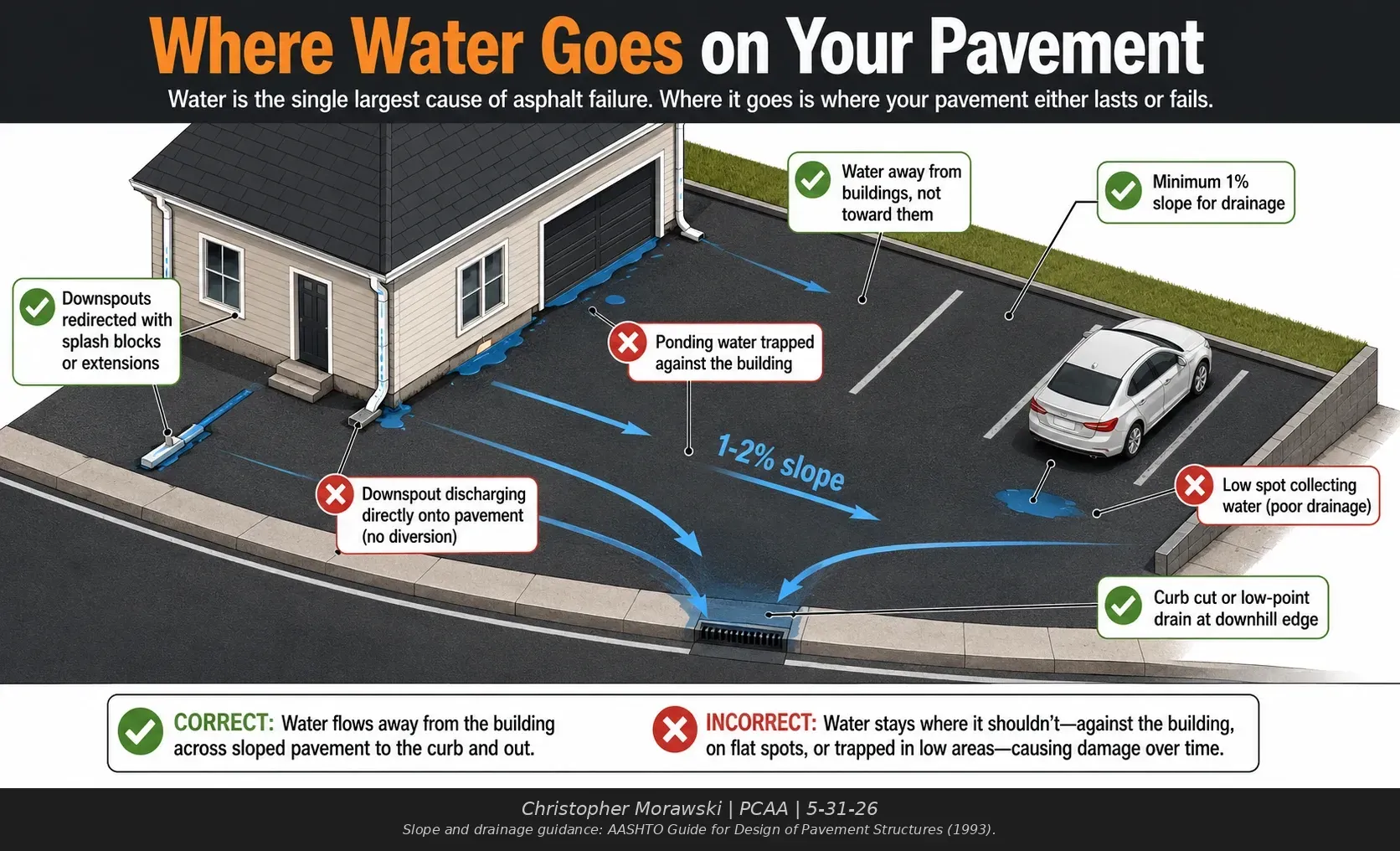
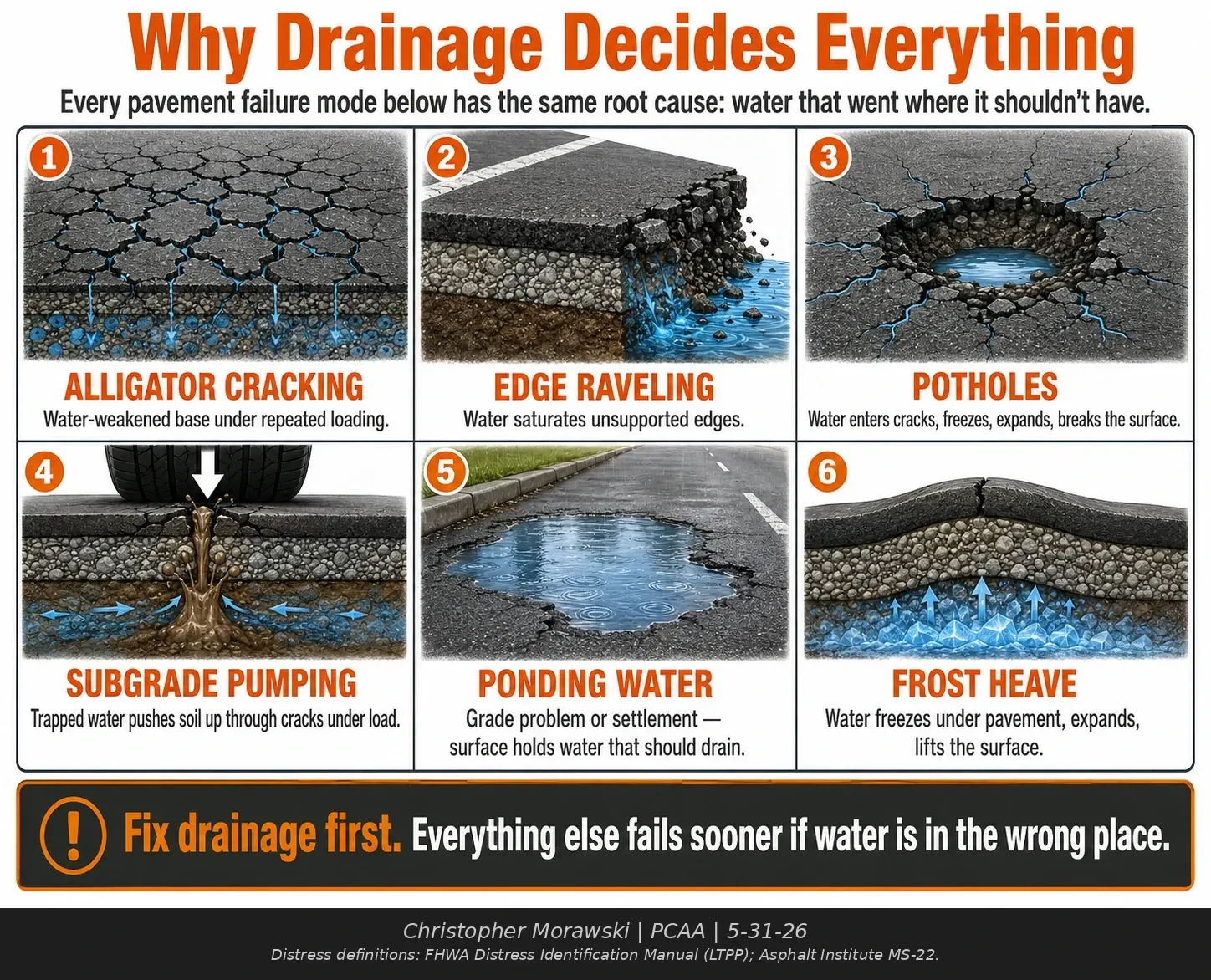
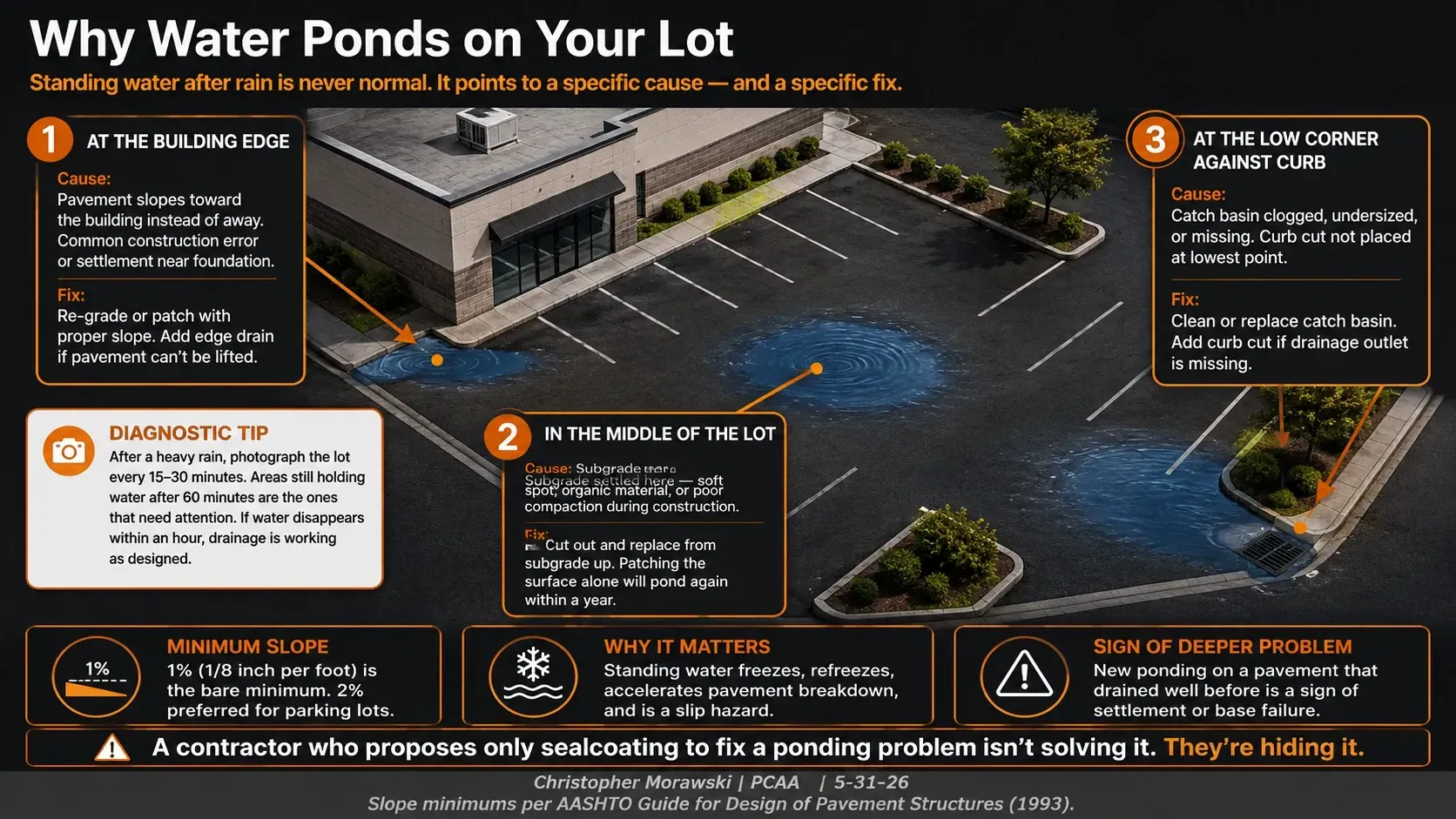
Water is one of asphalt's biggest enemies, and Wisconsin's freeze-thaw cycle turns trapped water into cracking, heaving, potholes, and base failure faster than in warmer climates. Asphalt alone cannot fix an underlying drainage problem — real correction may require regrading, ditching, culvert replacement, trench drains, catch basin repair, or in larger cases a formal stormwater review, and landowners are responsible for erosion-control and stormwater plans where required. [WI-DNR-STORMWATER] A contractor who quotes a price without tracing where the water goes is quoting the surface, not the problem.
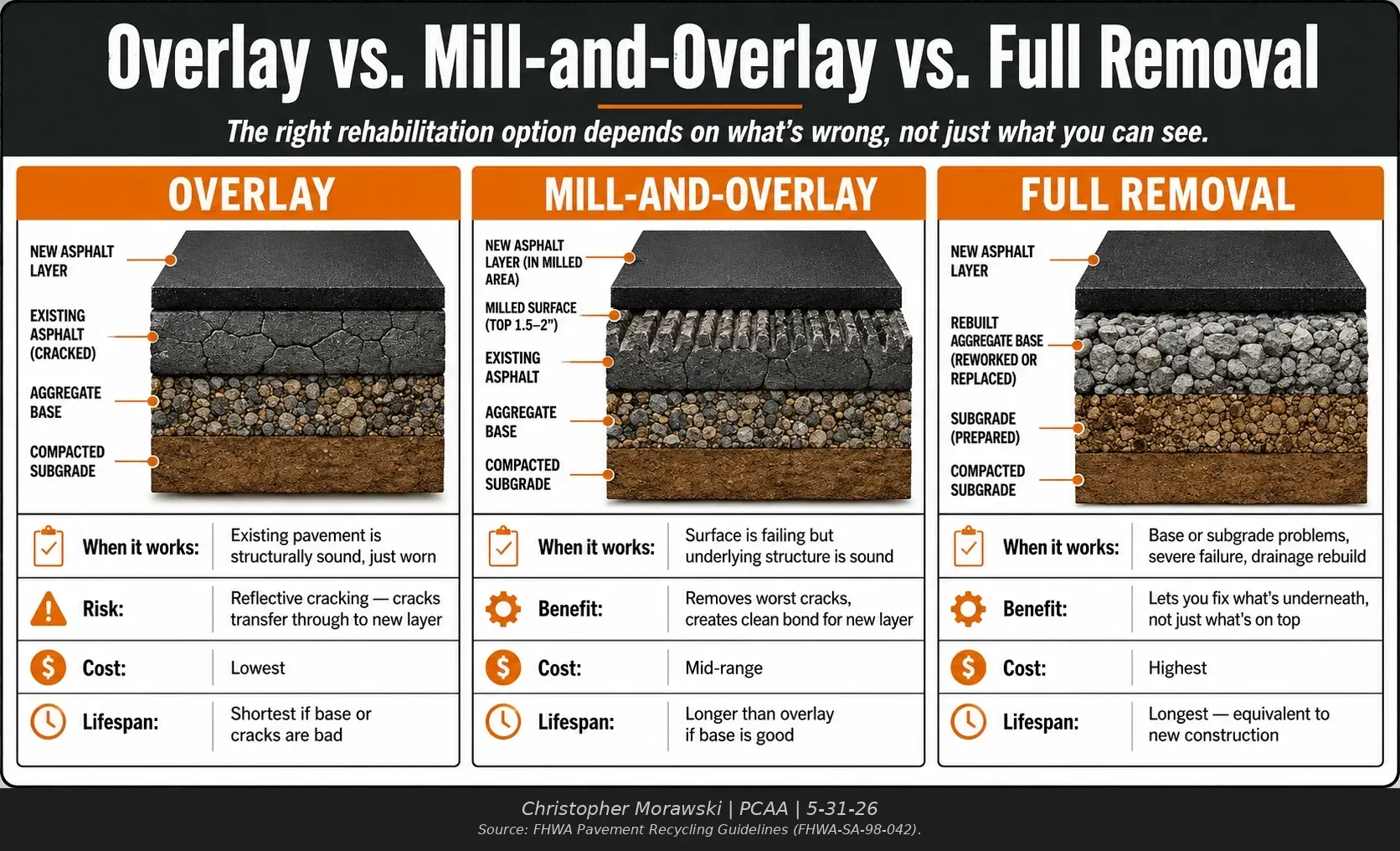
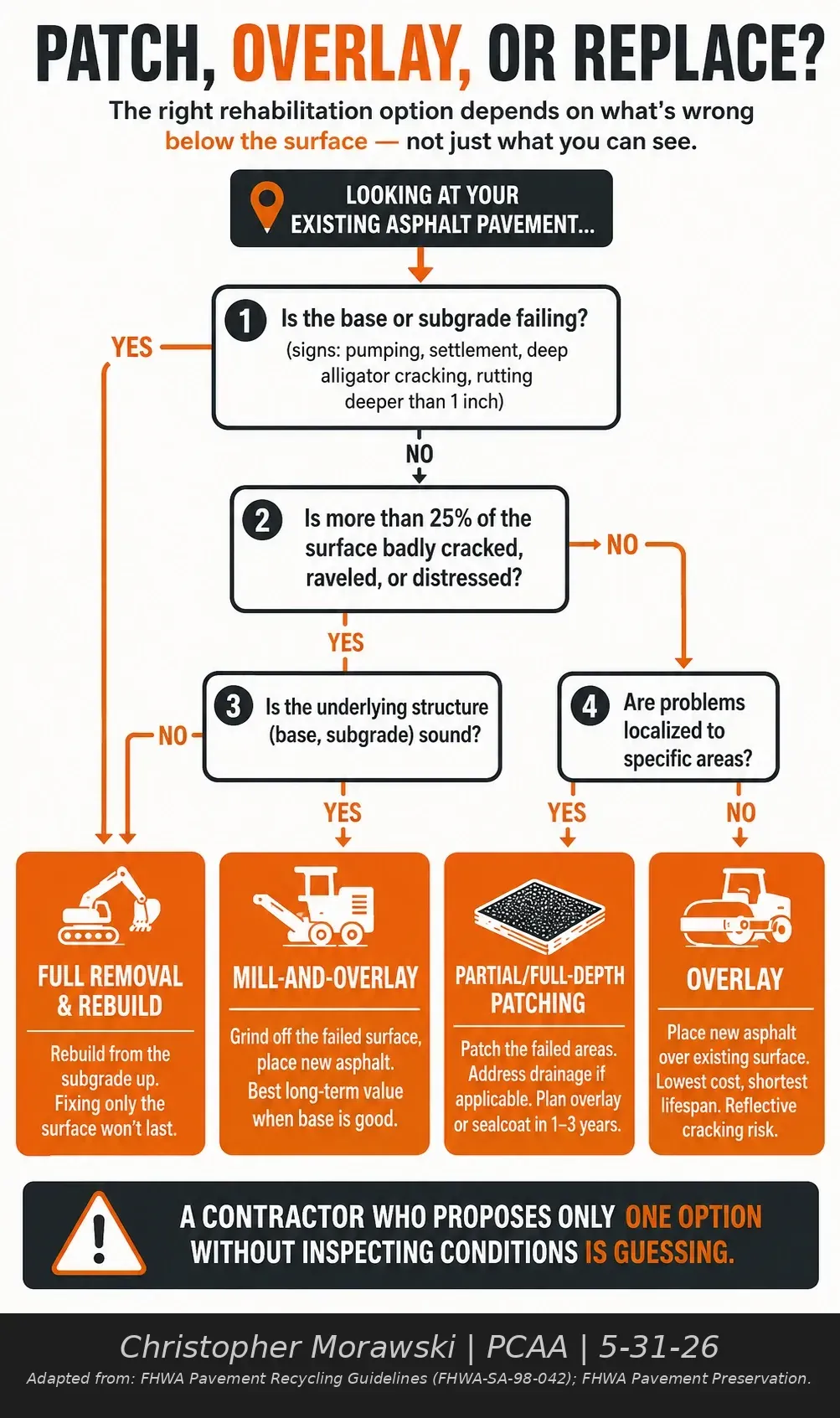
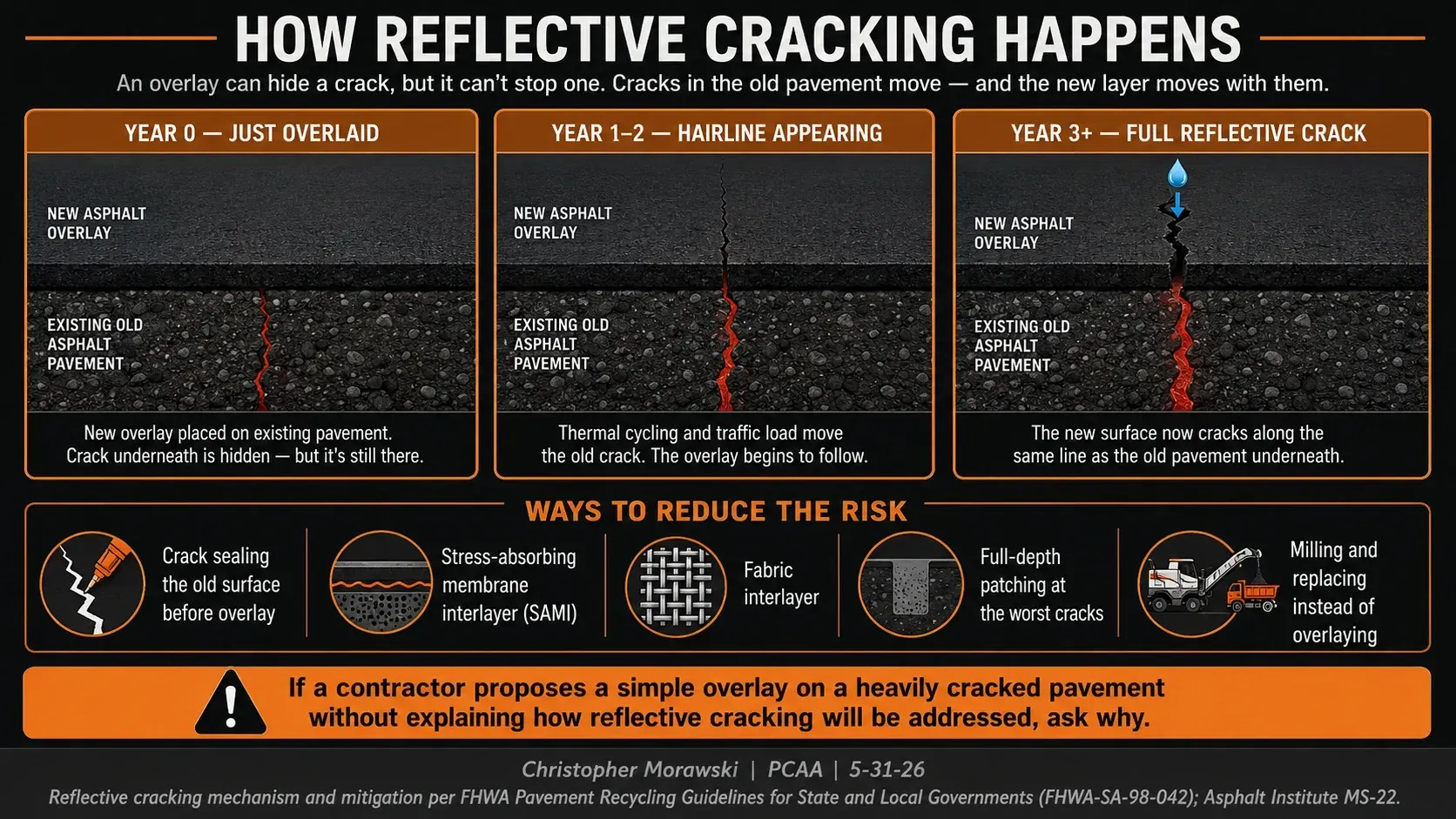
An overlay works when the bones are good: stable pavement and base, acceptable drainage, room for added height at garages and curbs, and defects that can be prepared before the new mat goes down. It fails when those conditions are missing — a failing base, trapped water, tight elevations, or widespread alligator cracking telegraphs through the new surface no matter how well it is placed. No method is one-size-fits-all; the right section depends on the site. [WI-WAPA-DESIGN]
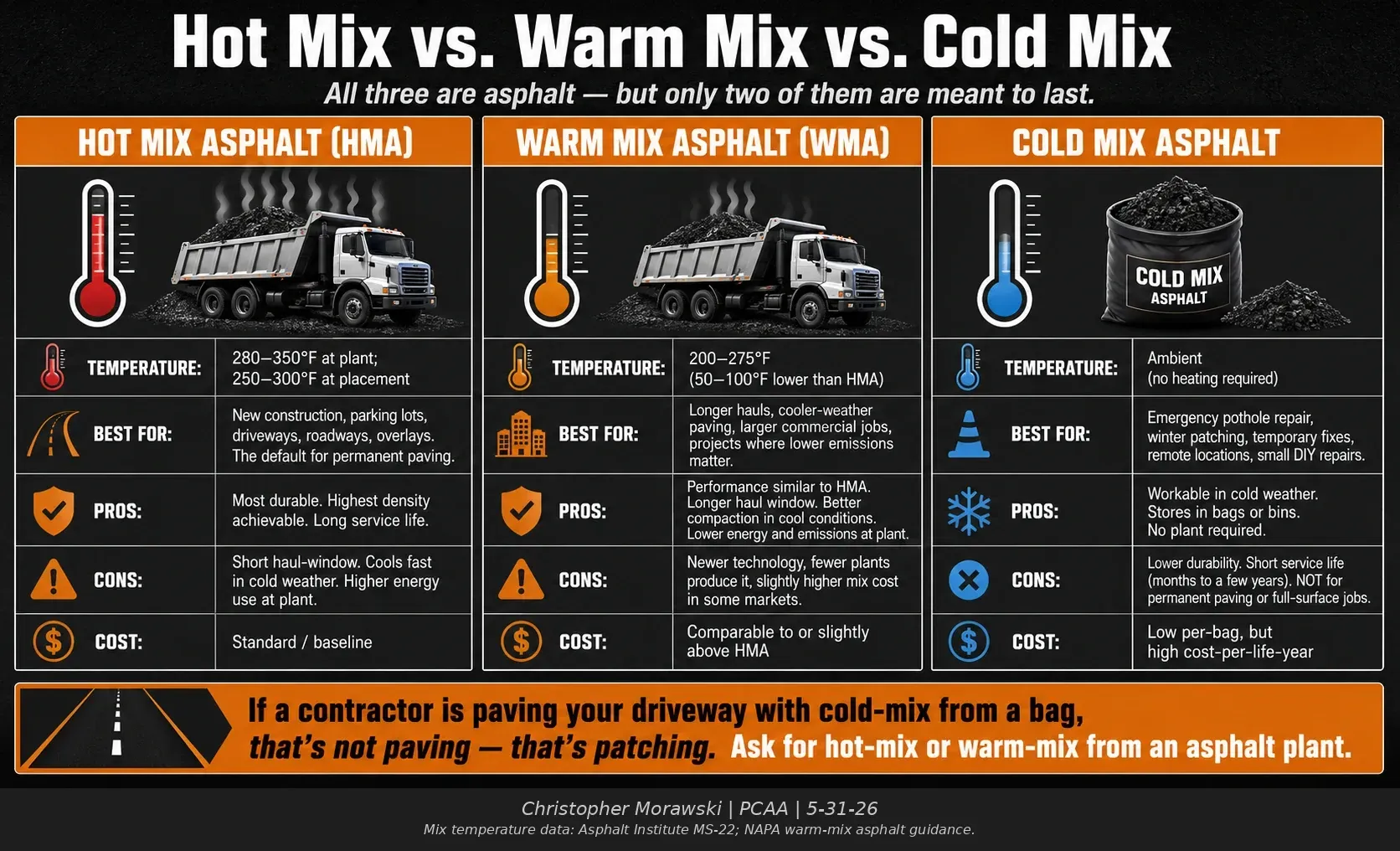
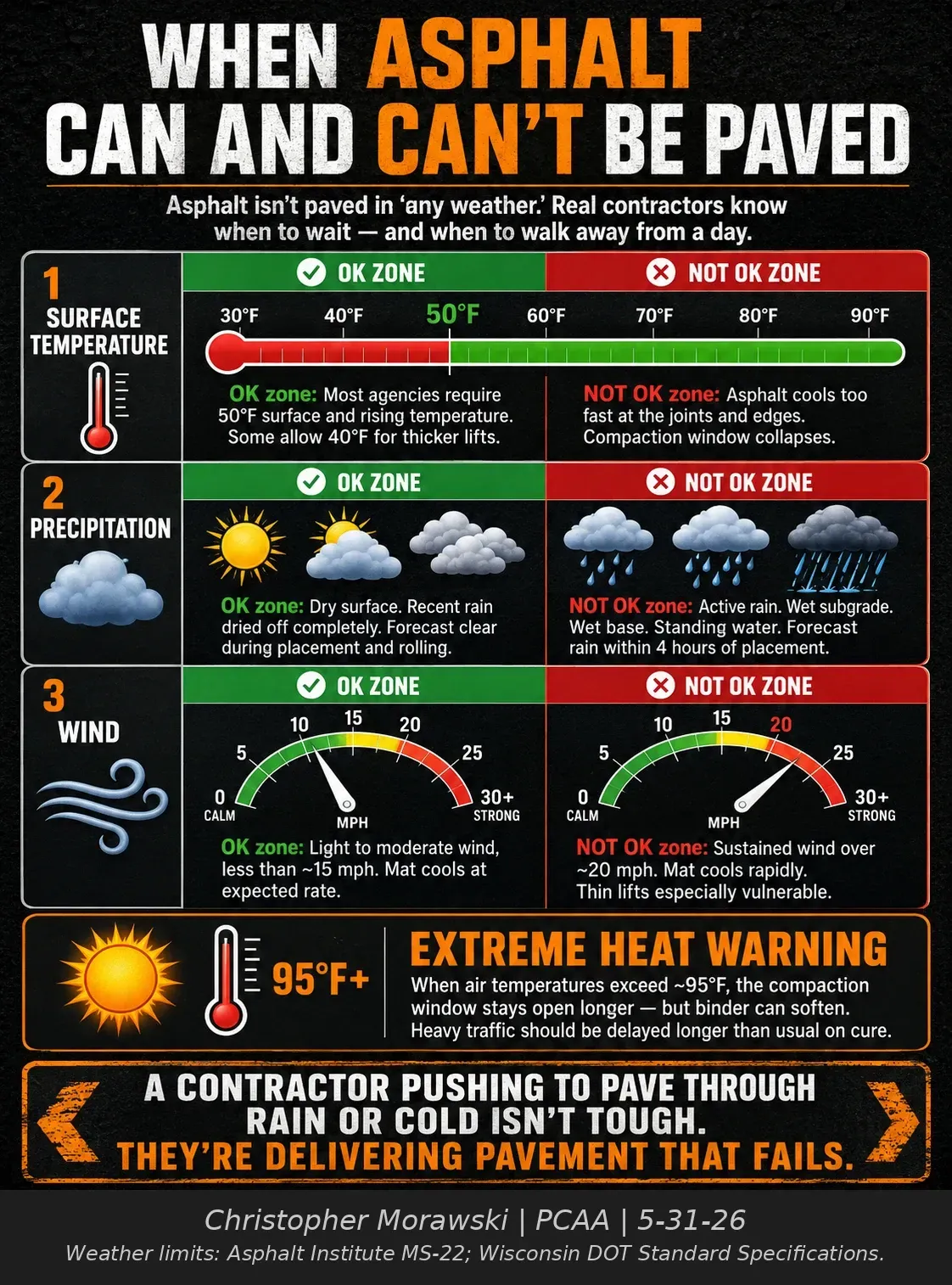
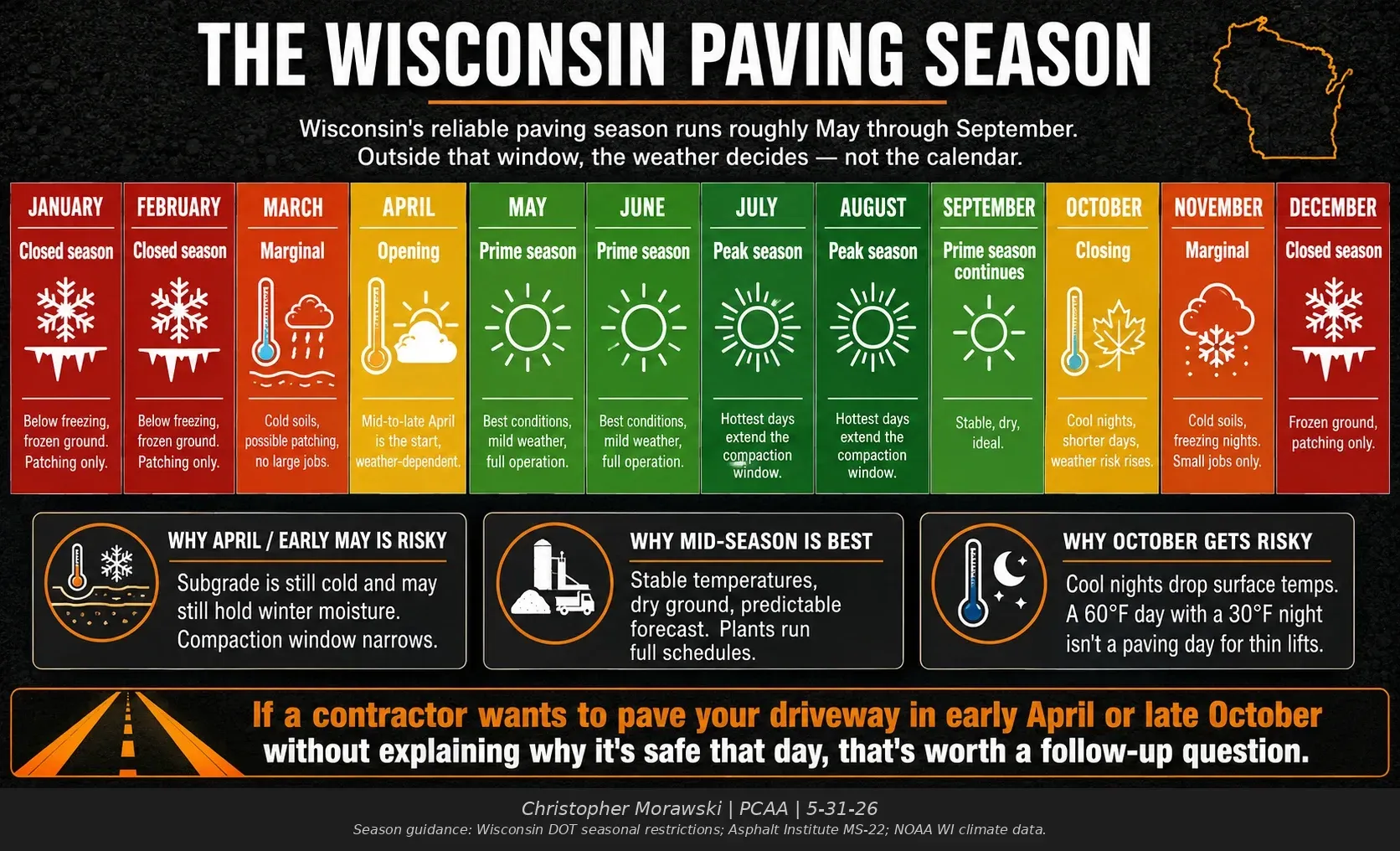
Roughly April 15 through November 1 in southern Wisconsin, and May 1 through October 15 in the north, per WAPA's design guide — with surface mixes placed at air temperatures of 36 degrees Fahrenheit and rising, and lower layers at 32 and rising. [WI-WAPA-DESIGN] The practical limit is the asphalt plants: once they close for the season, hot mix is unavailable no matter what the calendar says, so a late-October job that slips on weather often becomes a spring job. Plan fall projects with that cliff in mind.
Yes — photograph the project before work begins, after removal, during base preparation, at drainage adjustments, during placement, after compaction, and after cleanup. Dated photos protect both sides. Inspect from outside active work zones, ask the foreman when it is safe to look, and focus on the defined checkpoints: permits, locates, base depth, drainage, compacted thickness, transitions, and edges. If hidden conditions change the scope mid-job, get a written change order with the new cost and schedule before the extra work proceeds. [WI-ATCP-110.05]
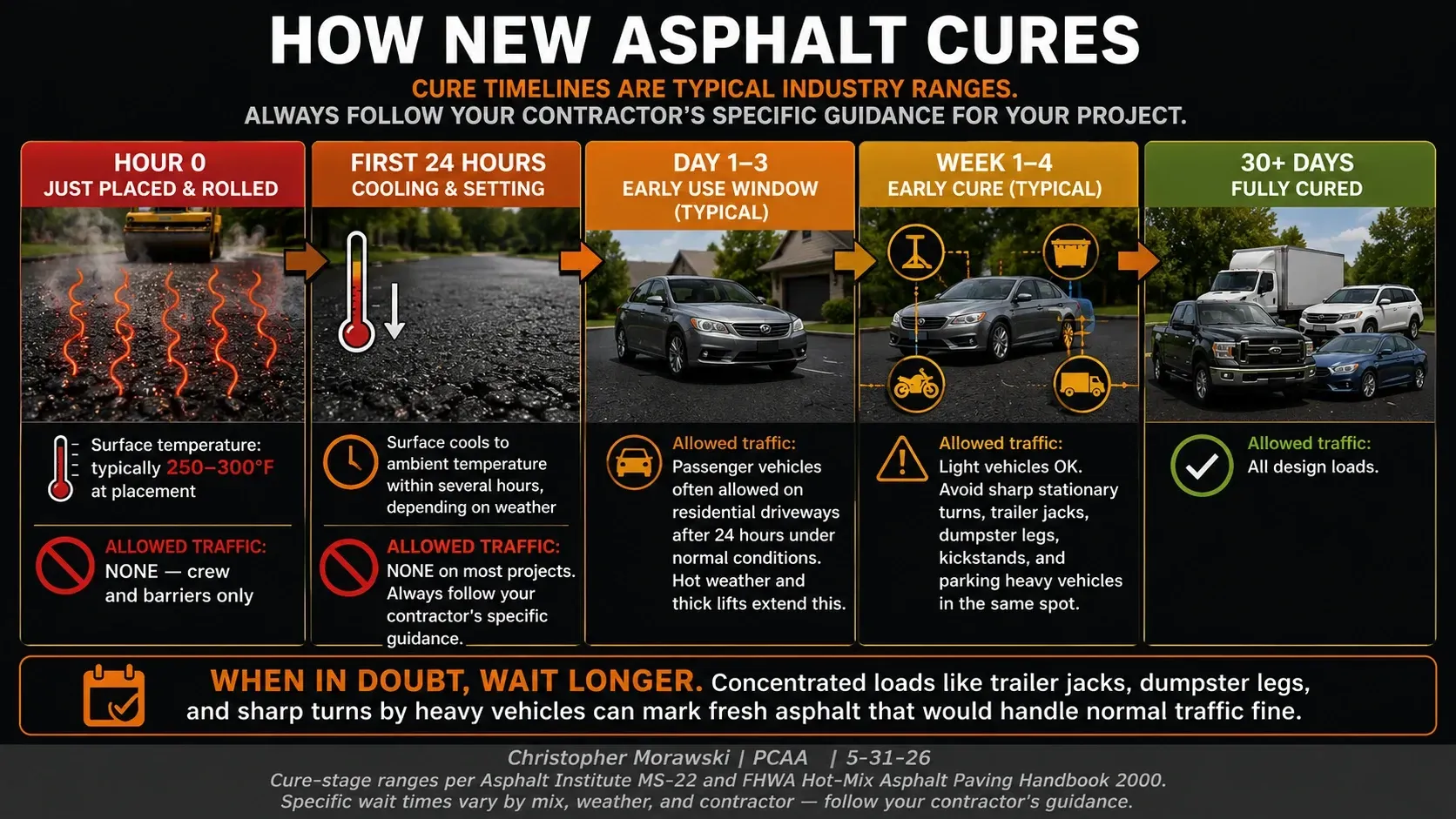
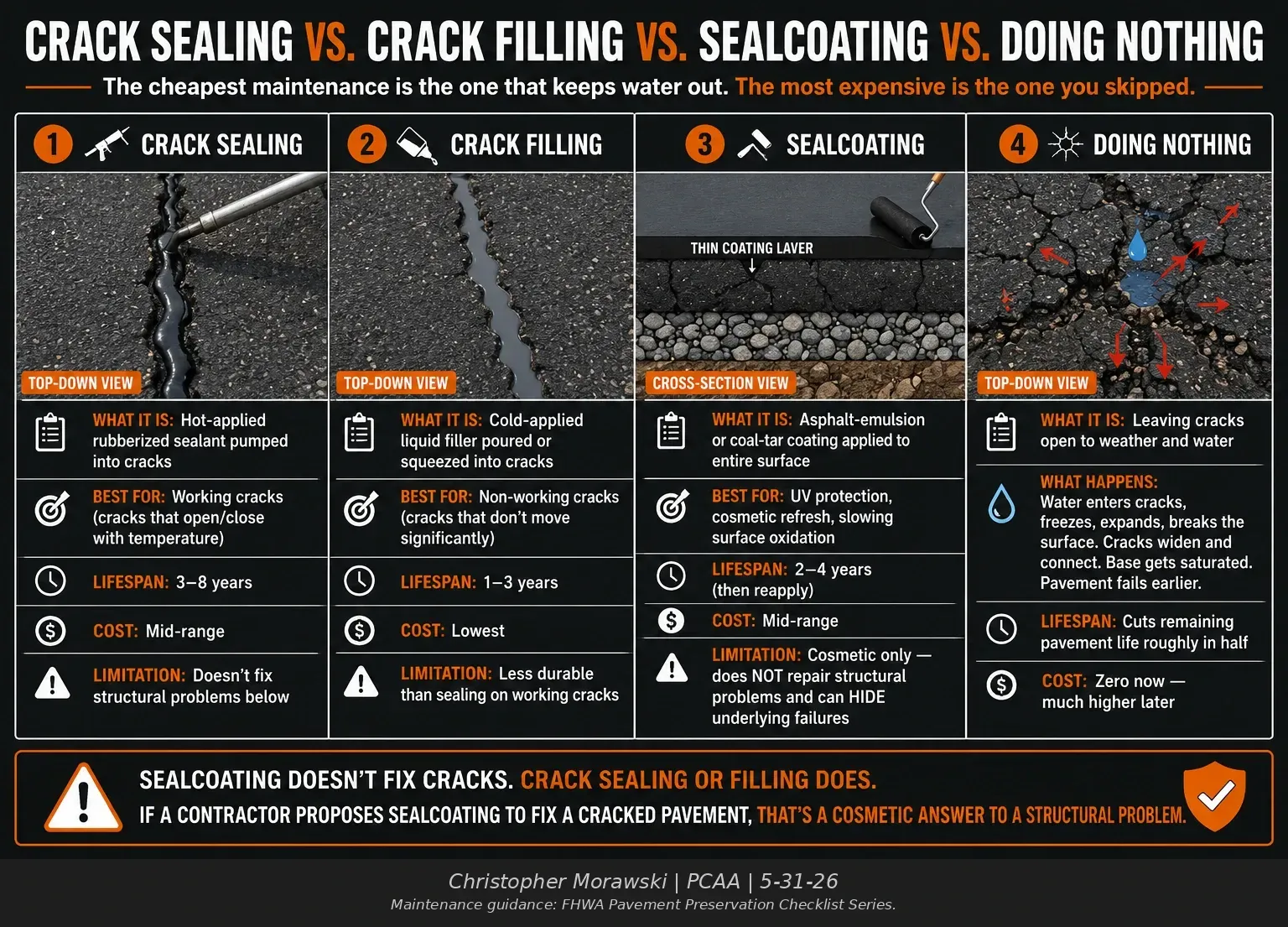
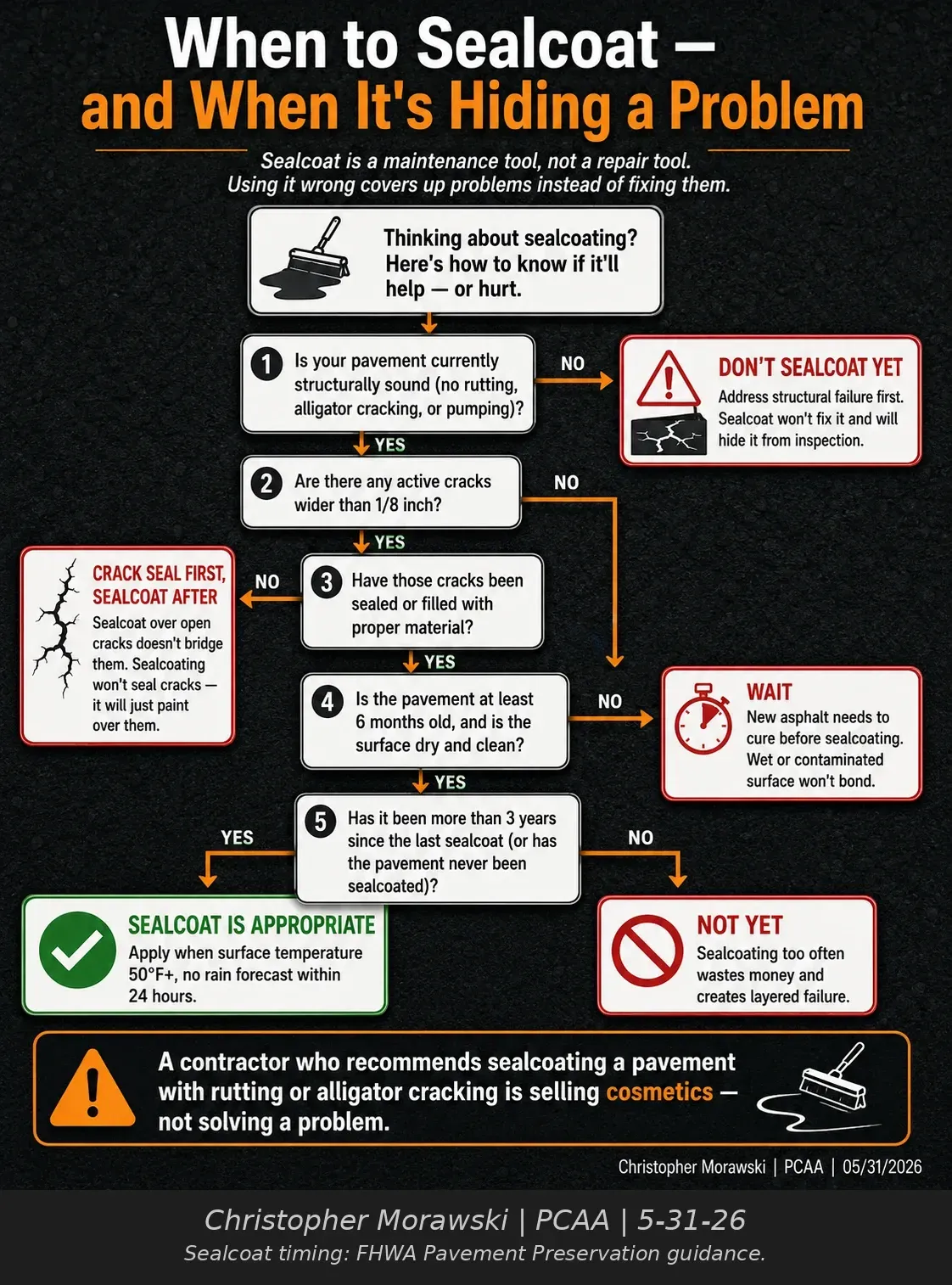
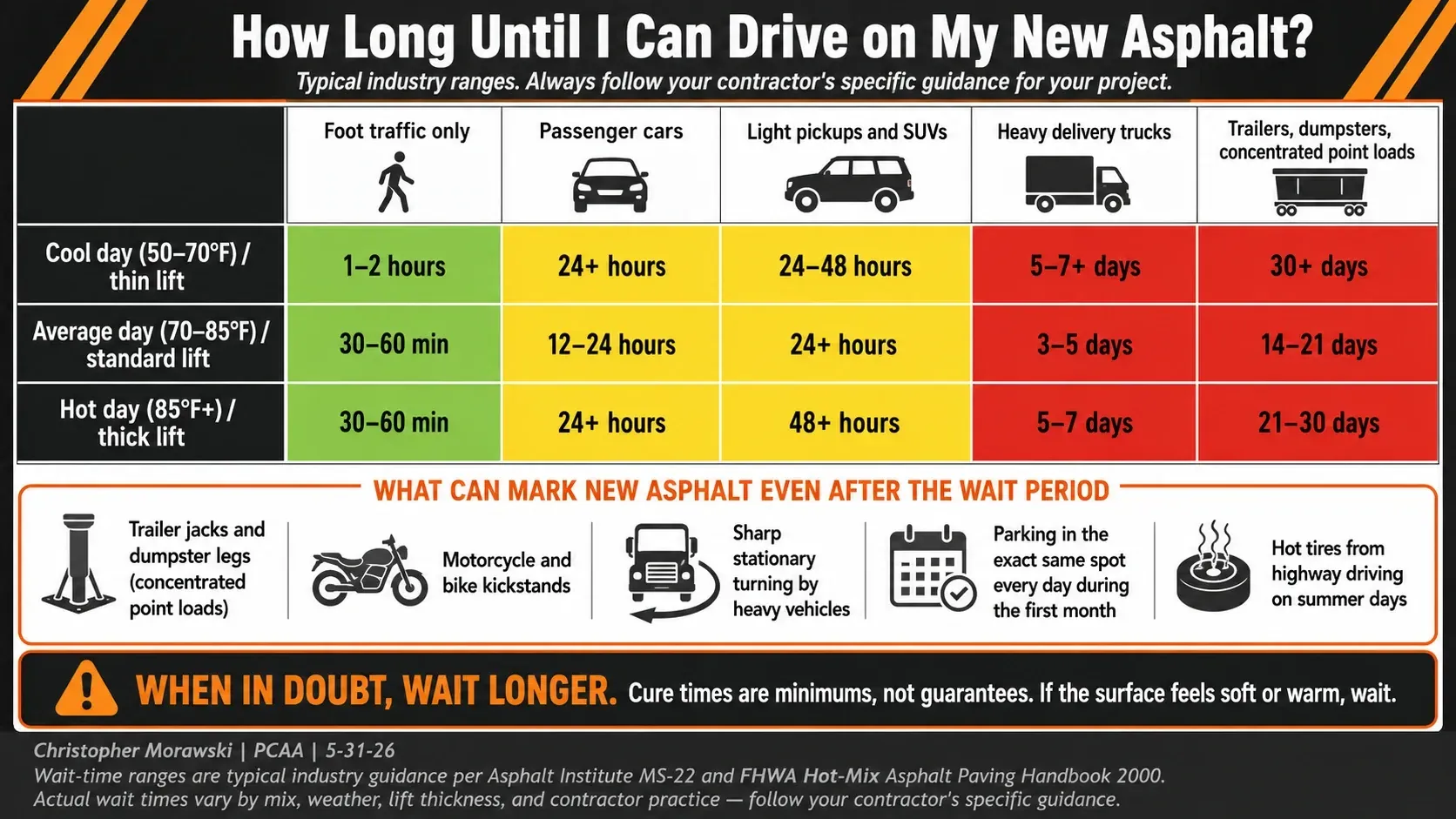
Written aftercare instructions tell you when it is safe to drive on the new surface, when heavy vehicles are allowed, how to avoid scuffing in hot weather, how to handle point loads, when sealcoating is appropriate, and how the first winter's plowing should be managed — and they prevent avoidable damage during the pavement's most vulnerable months. Sealcoating does not fix structural problems: it protects and refreshes a suitable surface but does not rebuild a failed base, restore missing thickness, or eliminate alligator cracking caused by movement below. WAPA treats sealants as protection against vehicle fluids, applied on professional advice about timing — if the pavement is failing structurally, a coating only delays the real repair. [WI-WAPA-DRIVEWAY]
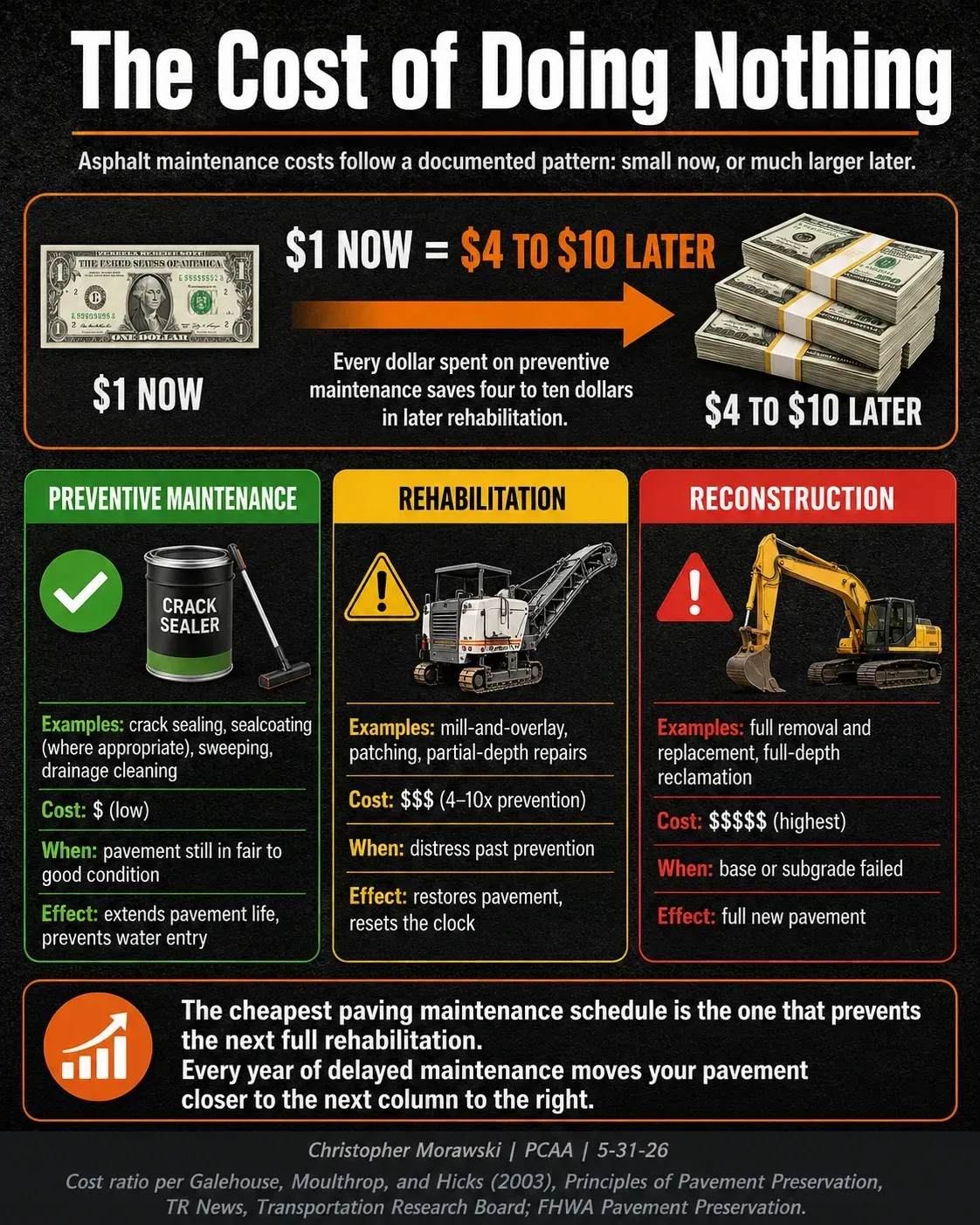
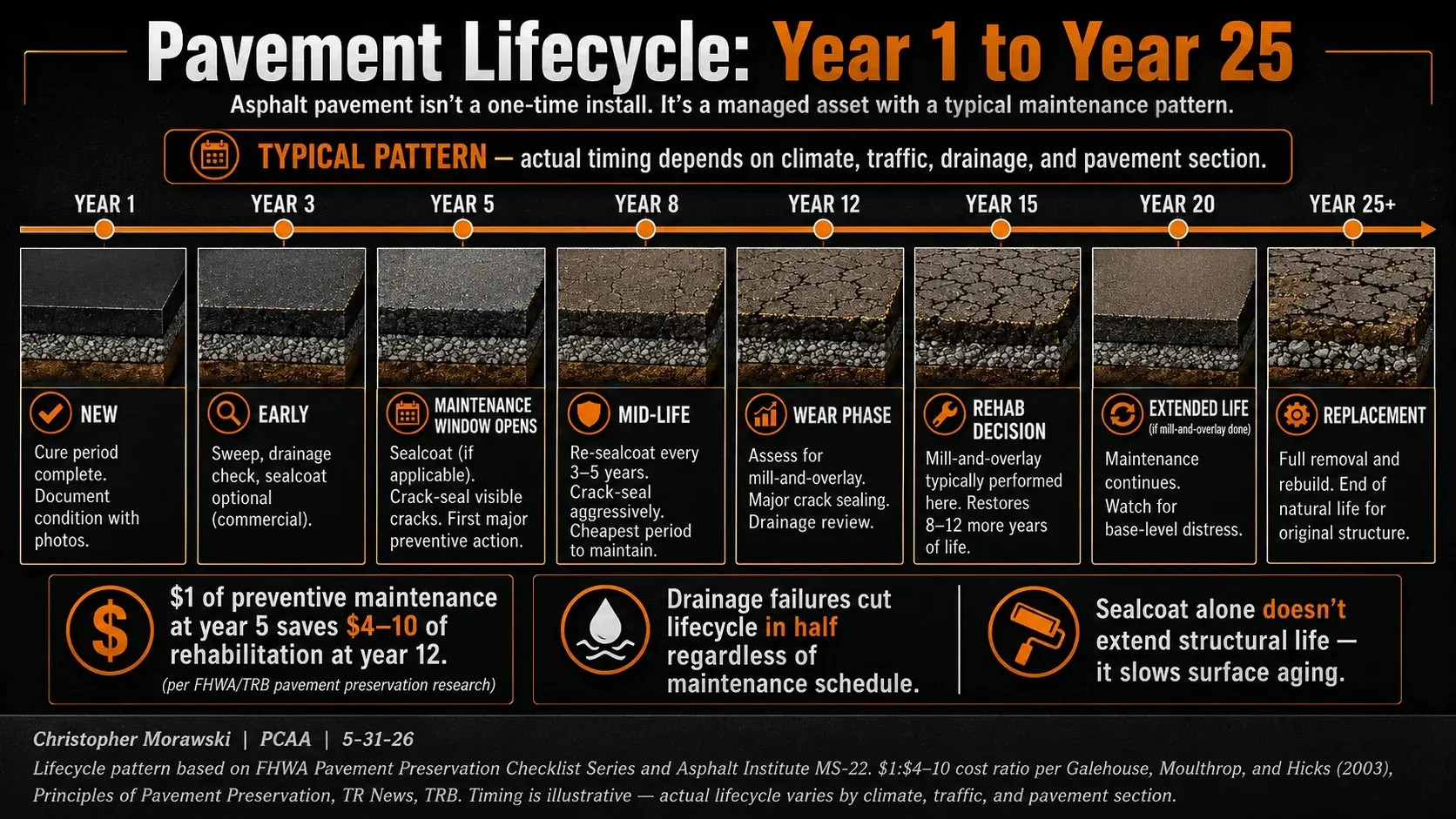
WAPA's guidance says a properly designed and built asphalt driveway can deliver virtually trouble-free service for up to 20 years. [WI-WAPA-DRIVEWAY] What shortens that: a weak or wet base, unresolved drainage, loads the pavement was never designed for — dumpsters, heavy trucks, trailer point loads — plow damage along unprotected edges, and neglected cracks that let water into the base through Wisconsin's freeze-thaw cycles. The design and drainage decisions made before paving matter more to lifespan than anything done after it.
It may mean the contractor is more efficient, but it more often means the bid is missing work that other contractors included. Common items that quietly disappear from cheap bids: base preparation depth, drainage correction, apron and right-of-way work, permit fees, catch basin adjustments, striping and ADA compliance, cleanup, warranty coverage, and subcontractor insurance. DATCP specifically warns consumers to be leery of extremely low estimates and to make sure all contractors are bidding on exactly the same work. Once the missing items return as change orders during construction, the "cheap" bid frequently ends up costing more than the bid it beat at signing. [WI-DATCP-HI]
Yes — before the bid is prepared. Pavement design depends on projected vehicle loading, and WAPA's guidance is explicit that the contractor should design for it. A driveway designed for passenger cars but used by work trucks, trailers, or dumpsters will fail sooner than it should, and the small cost of designing correctly up front beats the large cost of redoing an underbuilt driveway. [WI-WAPA-DRIVEWAY]
Yes — because the hardest-working corners of a commercial lot (catch basins, curb lines, dumpster pads, dock aprons, sidewalk ramps) concentrate point loads and truck weights that asphalt alone is not always the right material for. A contractor confident enough to recommend concrete where concrete belongs is showing you design judgment, not upselling. The proposal should state whether concrete work is included or excluded — and because Wisconsin's home improvement rules do not govern commercial contracts, that written scope is the commercial owner's real protection.
Step 1: Decide What Kind of Asphalt Project You Actually Have
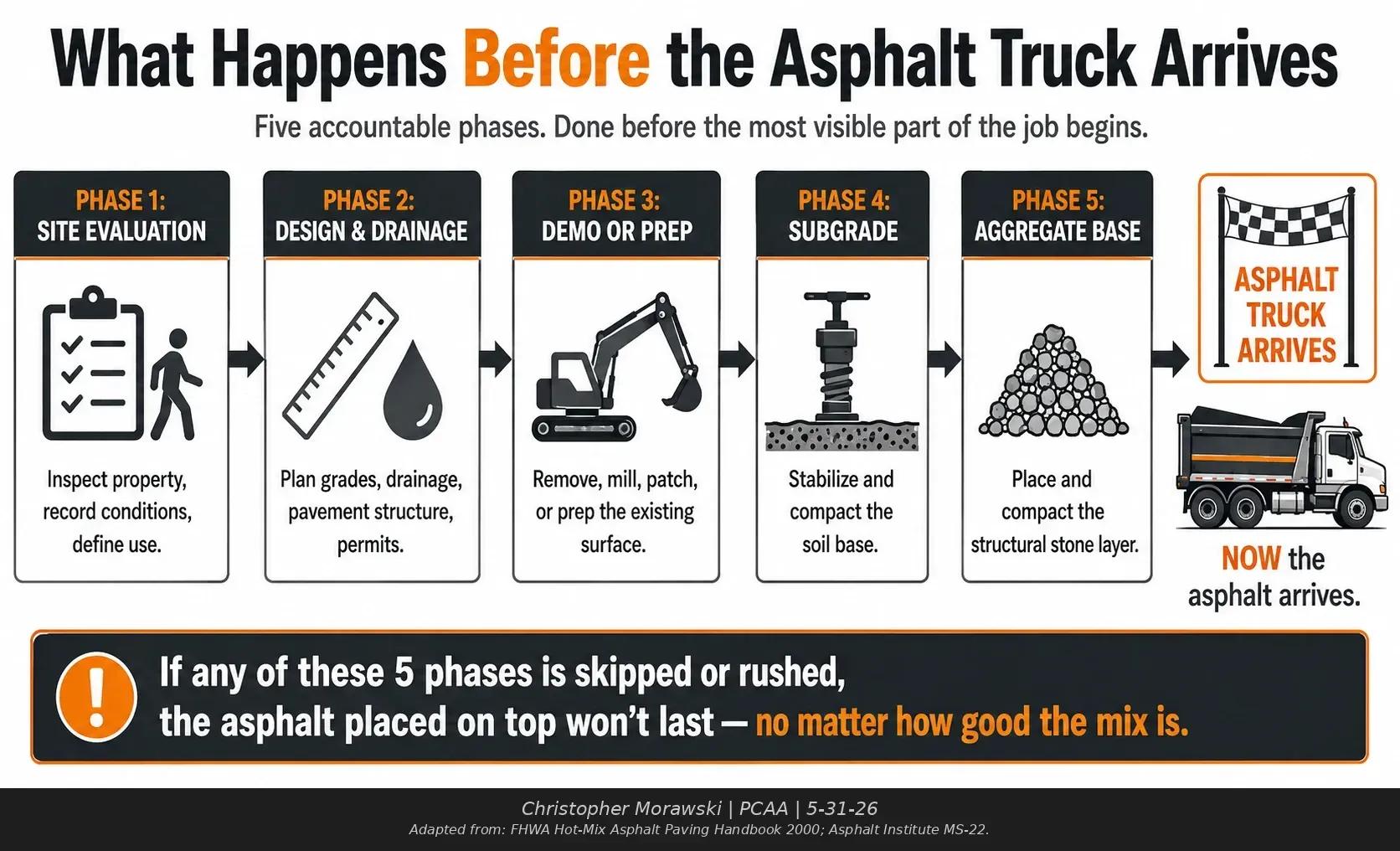
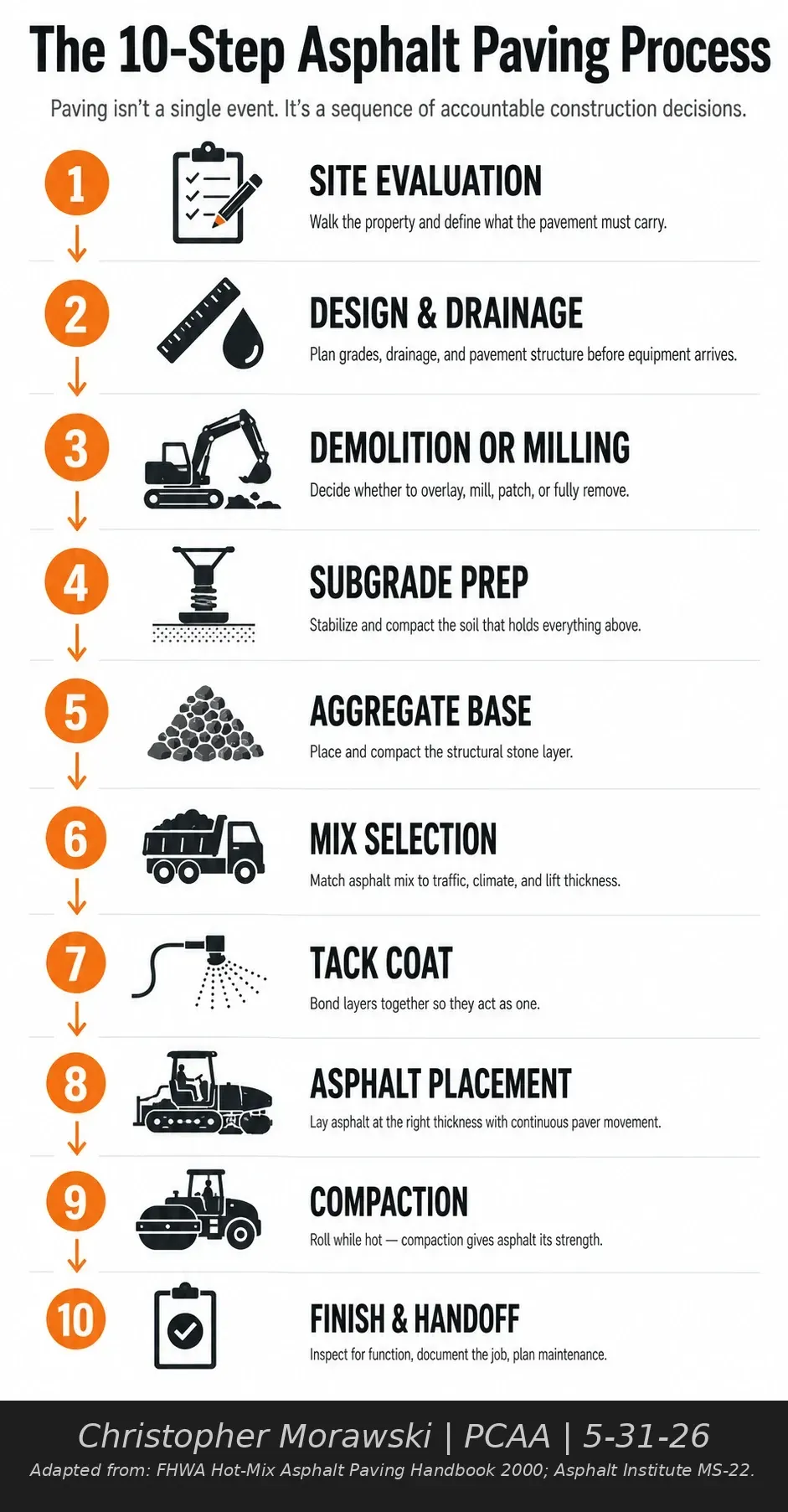
Before you call three contractors, define the project. Many owners ask for "blacktop," but that single word can mean a driveway overlay, a full removal and replacement, an isolated base repair, a commercial parking lot resurfacing, a spot patch, a saw-cut repair, milling, pulverizing, regrading, culvert work, drainage correction, sealcoating, crack filling, striping, ADA-compliant restriping, or any combination of these. A contractor who cannot separate those options may quote a cheap number that does not solve the real problem, and then charge extra for what should have been included in the first place. The first step in hiring is not getting a price. The first step is identifying the failure.
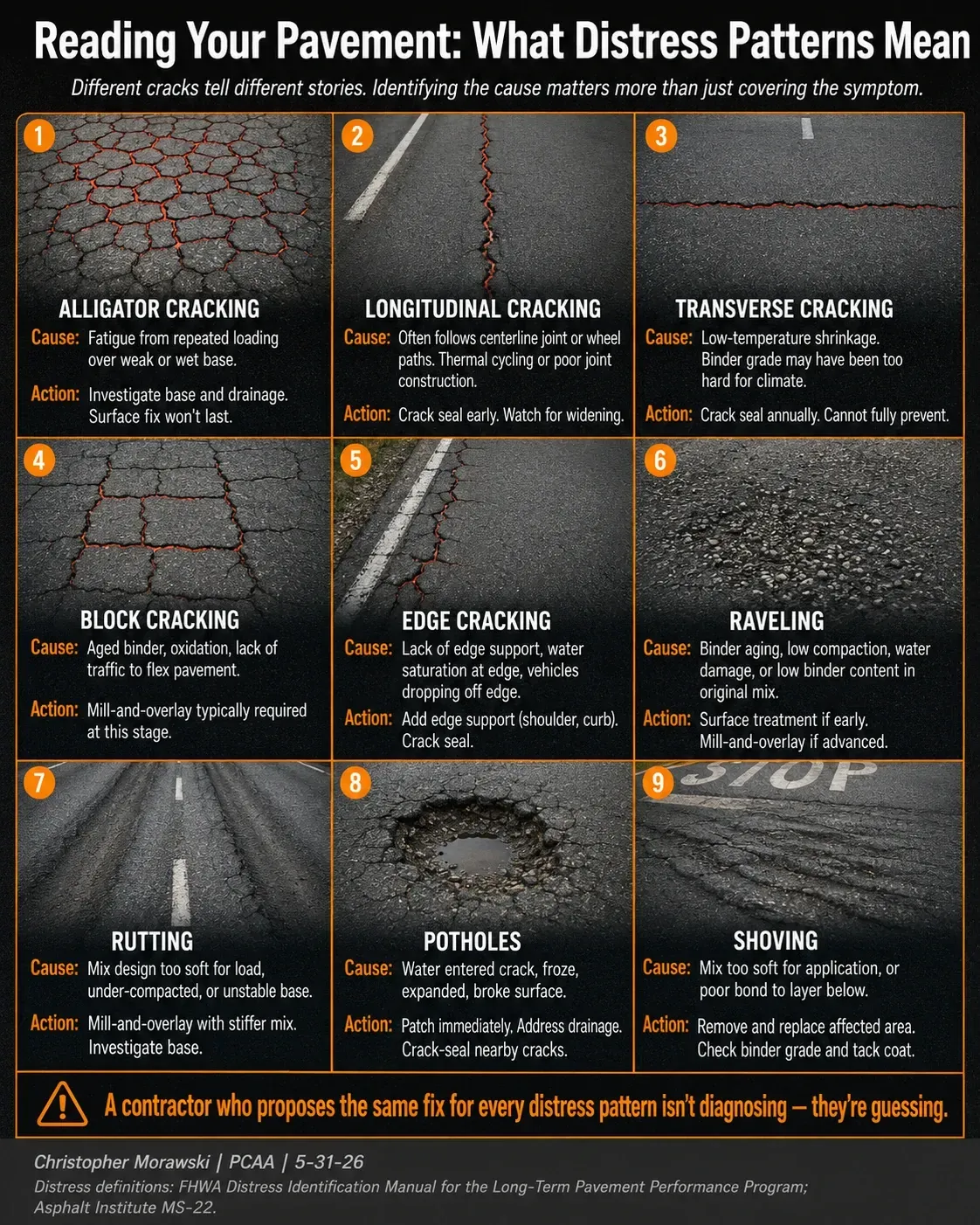
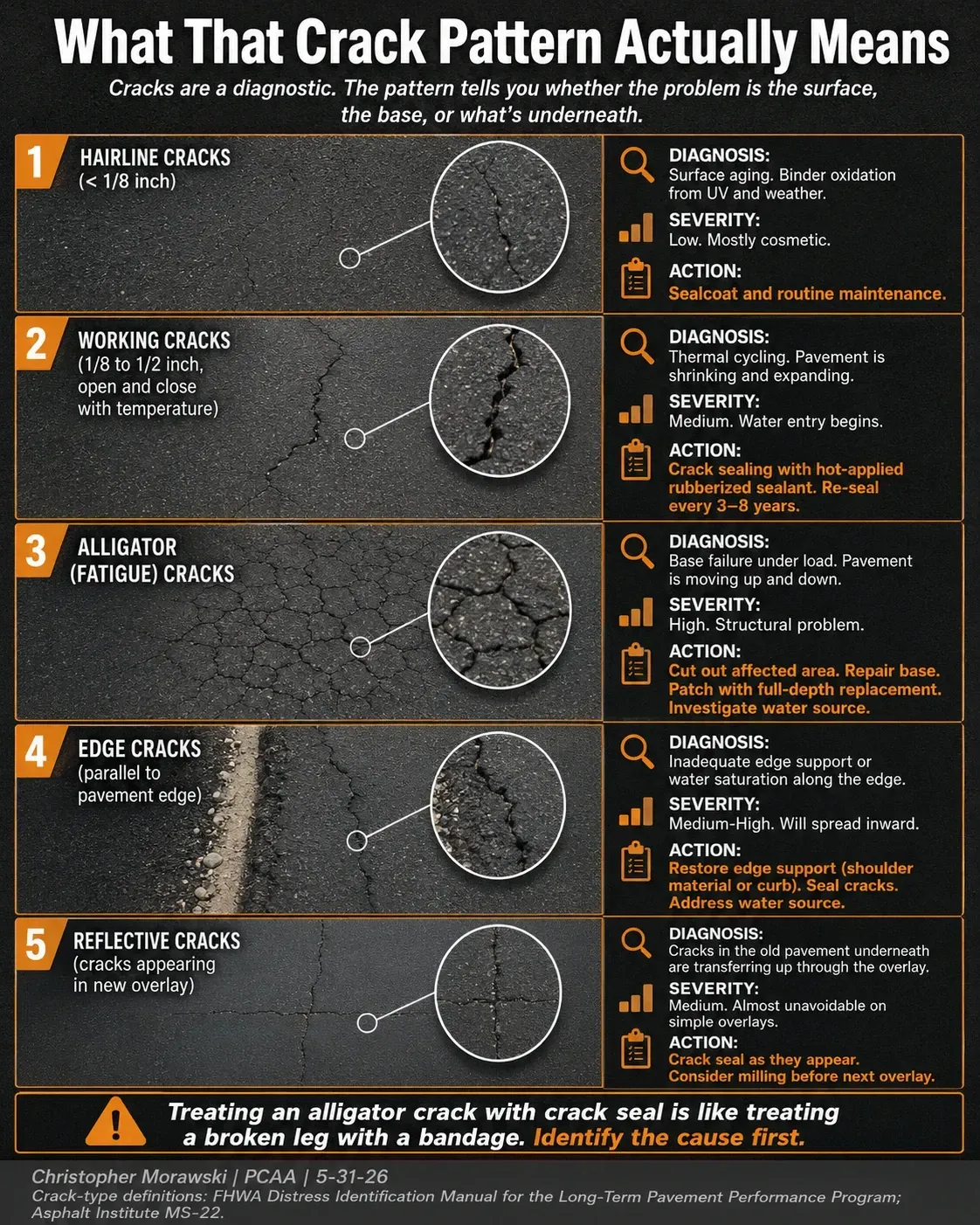
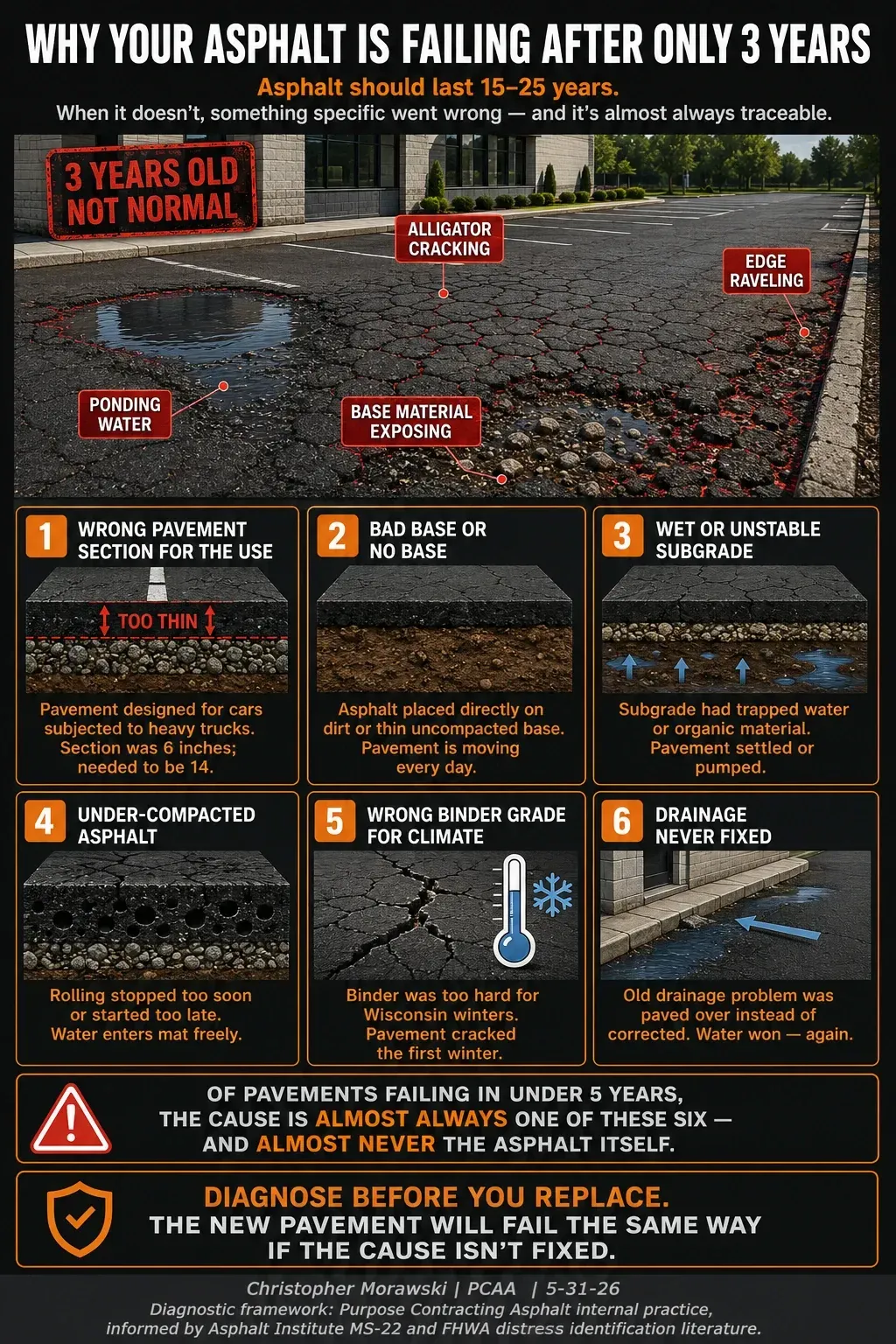
Walk the pavement slowly. Note whether the surface has isolated linear cracks, alligator cracking that looks like a dry lakebed, potholes, sinking near the garage door, ruts where vehicles routinely park, ponding water after rain, grass or weeds growing through the mat, broken and crumbling edges, heaving near tree roots, failed catch basins, or a driveway apron that meets the public road unevenly. Each observation points to a different scope. Thin surface cracking may be routine maintenance. A rut or pothole often signals base failure below the asphalt. Standing water is usually drainage, grading, or settlement. A crumbled edge frequently needs excavation and shoulder support, not just another layer of asphalt on top.
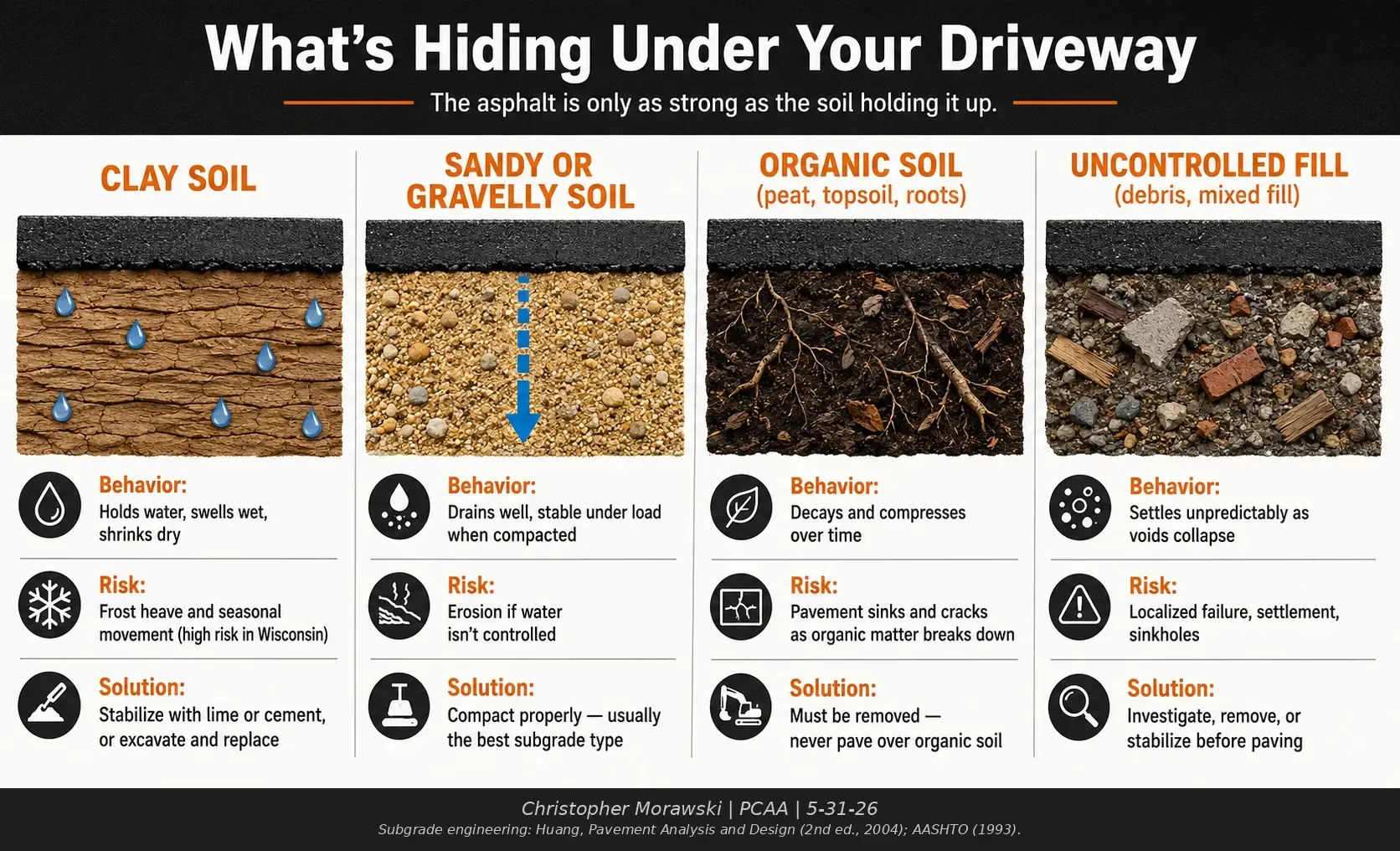
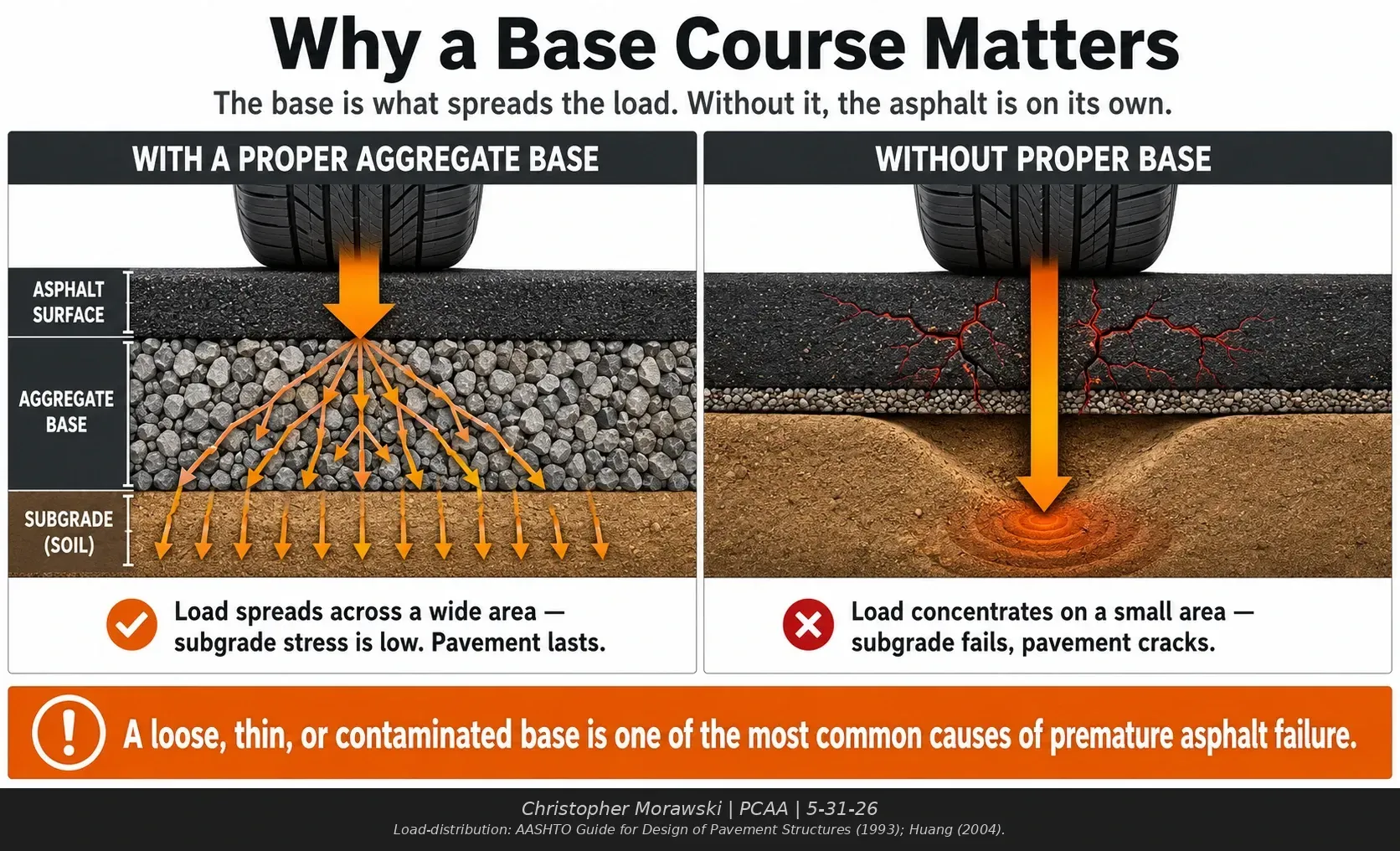
For a Wisconsin driveway, the Wisconsin Asphalt Pavement Association's homeowner guidance starts with the subgrade and base, not the surface. WAPA states that the subgrade — the ground on which the driveway is placed — should be smooth, firm, even, and contoured to match the layout of the driveway, and it should be free of organic material and topsoil. WAPA also emphasizes that a good contractor should design the pavement appropriate for local conditions and projected vehicle loadings, including proper thickness and compaction. [WI-WAPA-DRIVEWAY] That matters because a driveway used by two passenger cars is not the same as one used by dump trailers, delivery trucks, garbage trucks, plow trucks, work vans, RVs, or heavy commercial equipment.
Write a one-paragraph project description before requesting bids. A good example: "Residential asphalt driveway in Waukesha County, approximately 2,800 square feet. Existing asphalt is cracked and settled near the garage. Owner wants a long-term replacement, not a cosmetic overlay. Contractor should evaluate base, drainage, driveway apron, Diggers Hotline needs, and permit responsibility." That simple paragraph prevents three contractors from quoting three different jobs. For commercial and multi-family sites, the equivalent description should identify the property, total pavement area, current failures observed, whether the site must remain operational during construction, and any known constraints such as tenant hours, delivery windows, ADA compliance requirements, or scheduled events. The more specific the request, the more comparable the bids that come back.
A. Because "blacktop" is not a scope — it is a wish. The word can describe an overlay, a full-depth reconstruction, a patch, a mill and pave, a pulverize and pave, a sealcoat, or something in between, and each of those has a different price, timeline, base requirement, and lifespan. If you do not define the project up front, three contractors may each bid a different job, and you will end up comparing prices for work that is not comparable. DATCP's home improvement consumer guidance recommends deciding in advance what the job will involve, drawing sketches or clipping pictures to show prospective contractors, and making sure all contractors are bidding on exactly the same work. [WI-DATCP-HI]
Step 2: Understand the Wisconsin-Specific Risks Before You Buy
Wisconsin has a long-running seasonal problem with transient asphalt and home improvement crews. DATCP's consumer publication on transient home improvement workers warns that transient contractors specialize in blacktopping driveways, installing lightning rods, painting, roofing, and siding. The publication states that their work and materials are typically inferior, that consumers who pay a bargain price for blacktopping may soon have dandelions growing through their driveways, and that transients hit an area, take the money, and run — frequently knowing the quickest route to the banks in the area to cash the checks. [WI-DATCP-TRANSIENT]
DATCP has also issued an asphalt-specific alert for this region. On September 8, 2023, the agency reported numerous reports of a possible door-to-door asphalt scam in Southeastern Wisconsin, including in the Waukesha County area, warning that the workers involved are often unlicensed, from out of state, and able to move quickly from town to town — and that in some cases a crew takes an upfront payment and does no work at all. [WI-DATCP-SEWI-ALERT]
The pattern did not disappear after 2023. In April 2026, the Wisconsin Better Business Bureau's standing advisory on paving scams was republished by FOX6 Milwaukee and covered separately by CBS 58, warning about supposed discounts, large upfront payments, shoddy pavement, and non-working contact information. [NEWS-FOX6-BBB-2026] [NEWS-CBS58-2026] The clearest 2026 Wisconsin case came from TMJ4: a Franklin homeowner paid by check for paving work to be performed later, and the contractor never returned — with Franklin police saying they receive reports of this scam every spring. [NEWS-TMJ4-2026] The dollar figures, the full pitch, and the exact words that shut it down are all in Step 17.
The lesson is not "never buy asphalt." Wisconsin has many legitimate, skilled asphalt contractors who build durable driveways and parking lots every day. The lesson is "never buy asphalt under pressure." Real asphalt contractors can explain the scope, measure the area, identify the mix, discuss base conditions, provide a written proposal, confirm permit responsibility, provide insurance documentation, and schedule the work like a normal construction project. Scam crews rush the decision because their business model collapses the moment a customer takes time to verify identity, insurance, references, or credentials.
Step 3: Check Local Permit Rules Before the Contractor Starts
In Wisconsin, driveway and paving permit rules are largely local. The state does not issue every driveway owner a universal, statewide "yes" or "no" answer. Your city, village, town, county, or the Wisconsin Department of Transportation may have authority depending on whether the driveway connects to a municipal road, county highway, or state highway; whether the work touches the public right-of-way; whether curb, gutter, sidewalk, culvert, storm sewer, or drainage features are affected; and how much land will be disturbed during construction.
On residential work, Wisconsin's home improvement code is clear: before a buyer enters into a home improvement contract, the seller must inform the buyer of all building or construction permits that are required, and no seller may start work until all required state and local permits have been issued. The rule's one carve-out is for multi-permit projects — each subproject requires its own permits before that subproject starts, which is a tightening, not a loophole. [WI-ATCP-110.03] So never accept a vague "don't worry about permits" answer. The proposal should state who is responsible for permits, what permits may be required, whether the quoted price includes permit fees, and how right-of-way work, culvert replacement, or restoration will be handled.
Local examples show how much the details vary. The Village of Menomonee Falls requires a permit for all new, repaired, or replaced driveway approaches, curbs, and gutters located within the Village right-of-way — residential, commercial, industrial, and multi-family alike — with separate fees for approach construction and curb work, and culvert responsibility split by whether the road is village, county, or state. [LOCAL-MF-PERMIT] The City of Richland Center requires a driveway permit to construct, alter, or replace any driveway that connects to a public street, crosses a sidewalk or curb, or changes access to public roadways. [LOCAL-RC-PERMIT] And the City of Milwaukee requires no permit for paving on your own lot — but any work affecting the public way, including the driveway approach, requires Department of Public Works permits, and the contractor performing that work must hold a City license for concrete construction in the public way, backed by a $5,000 performance bond that guarantees the work for three years. [LOCAL-MKE-ROW]
Rules like these vary block to block across Southeastern Wisconsin. Milwaukee, Wauwatosa, West Allis, Greenfield, Franklin, Oak Creek, Greendale, Waukesha, New Berlin, Brookfield, Menomonee Falls, Muskego, Racine, Kenosha, West Bend, and Lake Geneva each handle driveway approaches, permit fees, contractor bonding, and culverts differently — some municipalities license paving contractors directly, some hold insurance certificates and bonds on file, and neighboring suburbs can charge several-fold different fees for the same approach permit. A municipality-by-municipality Southeastern Wisconsin driveway permit guide is being published as a companion to this document; use it to find your city's exact rules, then confirm them with your permit desk before signing. The step-by-step action for any address: call or email the building inspection, engineering, public works, or zoning department and ask plainly whether your project needs a permit if it replaces the apron, widens the driveway, touches the sidewalk, changes drainage, adds or replaces a culvert, or performs any work in the right-of-way. Then ask the contractor to confirm the answer in writing.
Larger projects can also involve the Wisconsin DNR: construction that disturbs one acre or more of land generally requires a stormwater discharge permit before land-disturbing activity begins. That rarely affects a single-family driveway, but it can absolutely affect a multi-parcel commercial project — Step 19 covers it. [WI-DNR-CONSTRUCTION]
A. Often yes — and it is decided by your municipality, not the state. The private pavement on your lot and the approach in the public right-of-way are usually treated differently: the approach, apron, curb cut, or culvert almost always needs a municipal permit, and some cities also require the contractor to be licensed or bonded with the municipality before touching the public way. [LOCAL-MKE-ROW] A driveway connecting to a county trunk highway adds a county access permit, and state highway frontage adds a WisDOT connection permit — they stack on the municipal permit rather than replacing it. One call to your permit desk answers it for your address; make the call before you sign, and get the contractor's permit answer in writing. [WI-ATCP-110.03]
Step 4: Contact Diggers Hotline Before Excavation or Base Work
Any asphalt project that includes excavation, grading, base repair, widening, culvert work, drain tile installation, saw cutting followed by removal, or soil displacement should trigger a utility-locate conversation. In Wisconsin, Diggers Hotline is clear on the rule: the safe digging process starts when you contact Diggers Hotline — dial 811 or 1-800-242-8511, or file the request online. By law, everyone — including a homeowner working in their own yard — must contact Diggers Hotline at least three working days before digging, and weekends and state legal holidays do not count as working days. [WI-DIGGERS] The requirement is codified in Wisconsin Statute 182.0175, and it applies regardless of how deep the project will go. The depth of buried utility lines varies for reasons including erosion, previous digging projects, and uneven surfaces, so even shallow work carries risk.
Do not treat utility locates as paperwork nonsense. Asphalt work often happens near natural gas lines, electric service feeds, communication and fiber lines, private irrigation systems, low-voltage lighting circuits, invisible pet fence wires, agricultural drain tile, culverts, and buried downspout extensions. Diggers Hotline coordinates locates for public utility facilities that are members of the one-call system, but private utilities on the property — the electric line running from the house to a detached garage, a propane line from a yard tank, an underground sprinkler system — are the landowner's responsibility to locate. That distinction should be discussed with the contractor before any equipment arrives.
Know how the ticket actually works. The ticket number documents that the locate request was made — but full compliance also means waiting out the notice period, keeping the marks preserved, and hand-digging within the 18-inch tolerance zone on either side of any mark. Timing matters more than most owners realize: the notice period is counted in working days, but a ticket's validity runs in calendar days — excavation generally must begin within ten calendar days of the ticket's start date, and work interrupted for more than ten calendar days needs a fresh locate. Asphalt schedules slide with weather, so when a paving date slips a week or two, ask the contractor directly whether the locate ticket is still live. [WI-STAT-182] [WI-DIGGERS]
A responsible proposal will not simply say "excavate as needed." It should say whether excavation is part of the base bid, how deep, where on the site, and what happens if soft or failed base areas are discovered once equipment is on site. If the answer is "we will figure it out," slow down. One more reason to put Diggers Hotline responsibility in the written contract: the statute's penalty carve-out for a residential owner digging on their own property does not extend to anyone in the business of excavating — your contractor gets no exemption, and hitting an unmarked gas or fiber line is not a small mishap. Establish who calls in the ticket, in writing, before the paver rolls onto the property.
A. Diggers Hotline should be contacted before any excavation, grading, base repair, widening, culvert work, drain tile installation, saw-cut removal, or other digging associated with an asphalt project. Under Wisconsin Statute 182.0175, everyone — including homeowners working in their own yards — must contact Diggers Hotline at least three working days before digging, with weekends and state legal holidays not counted as working days. Depth is not the determining factor: utility lines can be shallower than expected because of erosion, previous digging, or uneven surfaces. There is no fee to use Diggers Hotline. The ticket number is your proof the request was made — but compliance also means honoring the wait, preserving the marks, and hand-digging within the 18-inch tolerance zone — and a ticket generally expires if digging does not begin within ten calendar days of the start date. [WI-DIGGERS] [WI-STAT-182]
Step 5: Verify the Contractor's Legal Identity
Before you worry about price, verify that the contractor exists as a real business. Ask for the legal business name, any DBA ("doing business as") name, physical street address, office phone number, website, email domain, name of the owner or authorized representative, and the exact name that will appear on the contract. Then check the Wisconsin Department of Financial Institutions corporate records search for the legal entity — DFI does not index trade names, so search the legal name behind the DBA. The DFI search can show the legal entity name, effective date of registration, entity type, registered agent, registered office address, DFI entity ID, filing history, and current status. [WI-DFI-CORP]
Understand what a DFI record does and does not prove. DFI does not record telephone numbers, sole proprietors operating under their own names, unregistered trade names, or domestic LLC member names — so a missing record is not automatic proof of fraud, and a sole proprietor may legitimately not appear at all. More important: a DFI registration proves only that paperwork was filed. Anyone can register an LLC online in minutes, including a fly-by-night paver. Registration verifies nothing about licensing, insurance, bonding, workmanship, or honesty. Use it as the first identity layer — a real business should have a consistent, findable legal identity — not as a qualification. A dissolved or delinquent status on an entity that claims to be active, though, is a genuine warning sign. [WI-DFI-CORP]
Also run a plain internet search on the company name, the owner's name, the phone number, and the address. Look for consistency across the website, Google Business Profile, DFI record, Better Business Bureau profile, social media, proposal document, and truck lettering. If a salesperson quotes under one name, the contract arrives under another, and the check is requested under a third, something is wrong. And if the salesperson says "just make the check out to me personally," treat that as a major red flag: the Wisconsin BBB has specifically identified cash-only demands, checks made out to individuals, and payment-app requests as recurring markers of paving fraud. [NEWS-FOX6-BBB-2026] Legitimate contractors can accept checks to the business, credit cards through a real merchant account, or ACH to the verified company account.
Finally, do not skip this step because the contractor was recommended by a friend, a neighbor, or a family member. Recommendations are valuable — DATCP points to friends, family, insurance agents, and neighbors as good sources of trusted referrals — but a recommendation does not replace verification. Even a well-meaning neighbor may have used a company that has since changed hands, changed names, or lost its registered status. [WI-DATCP-HI]
A. Ask for the legal business name, any DBA, physical address, office phone, and the exact name that will appear on the contract. Search the legal entity in the Wisconsin DFI Corporate Records database and confirm the entity exists and shows active status. Remember its limits: sole proprietors and unregistered trade names are not searchable, and a registration proves only that paperwork was filed — nothing about insurance, competence, or honesty. Then check that the same identity appears everywhere: website, contract, insurance certificate, and payment channel. A business name that changes between the estimate, the contract, and the check request is a classic fraud marker. [WI-DFI-CORP]
Step 6: Verify Credentials and Licensing Claims — and Learn What Wisconsin Does Not License
Start with the fact that surprises most owners: Wisconsin issues no state license for asphalt paving. There is no state paving credential, no sealcoating credential, no striping credential, and no statewide general contractor license — for residential or commercial work. The credential people usually have in mind, the DSPS Dwelling Contractor certification, attaches to exactly one thing: obtaining a building permit for a one- or two-family dwelling under Wis. Stat. § 101.654. A standalone driveway or parking lot is not a dwelling and does not require a dwelling building permit, so a paving contractor working on your driveway generally does not need that credential — and holding one says nothing about paving competence. [WI-DSPS-DC]
That reframes how to read the DSPS License Lookup. For a legitimate paving contractor, "no record found" is the normal, expected result — it is not a red flag. The lookup matters in two situations. First, if the paving is part of a larger dwelling construction or remodeling project where the contractor pulls the dwelling building permit, then the Dwelling Contractor credential (held by the business) and the Dwelling Contractor Qualifier credential (held by the qualifying individual) must both show current status. Second, if a contractor claims any credential in its marketing, the claim should verify — ask for the credential type, number, and holder name, and check it. A status of expired, surrendered, suspended, or revoked is not a valid basis for the claim. Licensed trades are the exception to all of this: electrical, plumbing, and HVAC work always require their own DSPS credentials, on any property type. [WI-DSPS-LOOKUP] [WI-DSPS-DC]
Where paving licensing actually lives is municipal. The City of Milwaukee requires contractors doing driveway-approach and other concrete work in the public way to hold a City license backed by a $5,000 three-year performance bond, and other municipalities require contractor bonds or insurance certificates on file before right-of-way work. [LOCAL-MKE-ROW] Ask your permit desk whether your municipality licenses or bonds paving contractors — and if it does, ask the contractor for its number before signing.
Two more claim-checks worth knowing. First, there is no such thing as a "DATCP approved" or "state approved" contractor: DATCP is a consumer protection agency and does not endorse, certify, or approve contractors, so a crew claiming state approval is borrowing a phrase the agency does not use. Second, be careful with owner-pulled permits. Sometimes owner-pulled permits are normal in a municipality; sometimes they are used to shift compliance and warranty responsibility away from the contractor. If a contractor asks you to pull the permit because "it is easier," ask the municipality directly whether that changes liability, inspection responsibility, or code obligations.
A. No — Wisconsin has no state license for asphalt paving, sealcoating, or striping, and no statewide general contractor license. The DSPS Dwelling Contractor credential applies only to pulling building permits for one- and two-family dwellings, so a standalone driveway or parking lot job does not require it, and "no record found" in the DSPS License Lookup is the normal result for a legitimate paving contractor. What does exist: municipal licensing and bonding (the City of Milwaukee, for example, requires a licensed and bonded contractor for driveway-approach work in the public way), required credentials for electrical, plumbing, and HVAC trades on any project, and full application of Wisconsin's home improvement rules to residential paving regardless of licensure. Verify any credential a contractor actually claims, and ask your municipality what it requires. [WI-DSPS-DC] [WI-DSPS-LOOKUP] [LOCAL-MKE-ROW]
Step 7: Confirm Insurance Before You Let Equipment on the Property
Asphalt work is heavy work. Dump trucks, low-boy trailers, pavers, steel-drum rollers, skid steers, mini excavators, wet saws, propane torches, hot mix at 300 degrees, open excavations, and traffic control equipment create genuine risk of property damage and personal injury. Before scheduling any work, ask for a current certificate of insurance sent directly from the insurance agent or agency, not a screenshot from the contractor's phone. At minimum, discuss general liability, commercial auto for the trucks and trailers, and workers' compensation for the employees. For commercial and multi-family sites, also ask about additional insured status, waiver of subrogation, primary and noncontributory wording, umbrella coverage, and whether traffic-control and striping subcontractors are covered.
The insurance conversation should happen before the truck arrives, not after equipment hits a garage door or a customer trips over an unfinished edge. Ask directly: "Are your employees covered by Wisconsin workers' compensation? Are your subcontractors covered by their own policies? Are your dump trucks and trailers insured commercially? Can I be named as an additional insured on the certificate?" A legitimate contractor may need a day or two to request the certificate from the agent, but the request itself should never offend a professional.
If the contractor answers "we are fully insured," ask them to define that in writing — fully insured against what, up to what limit, and for how long? For scale: even Wisconsin's dwelling contractor registration — a credential paving contractors generally do not need (Step 6) — sets its financial floor at $250,000 per occurrence in general liability insurance or a $25,000 surety bond. [WI-DSPS-DC] Note that those are alternatives, not equivalents: a contractor who satisfied the requirement with a bond may carry no liability insurance at all, and a $25,000 bond is not remotely comparable protection to a real liability policy. Treat any statutory floor as a floor. For a sense of real-world scale, look at what municipalities demand before letting a contractor work in their own right-of-way: the City of Franklin, for example, requires $1 million per occurrence and $2 million aggregate in general liability, with the City named as an additional insured. [LOCAL-FRANKLIN-ROW] That is a useful benchmark for what "fully insured" should mean on a serious paving job. For paving, the meaningful proof is the certificate itself, direct from the agent, with limits that fit your project.
If the contractor uses subcontractors — for milling, sweeping, striping, traffic control, or specialty work — those subs should have their own coverage or be endorsed onto the primary policy, in writing. And remember that insurance is not a warranty. Insurance covers accidents, injuries, and third-party losses. It does not cover poor workmanship, premature pavement failure, or an abandoned job. Those are contract and warranty issues, and they need to be addressed separately in the written proposal.
Step 8: Ask for a Site Visit, Not a Drive-By Guess
An asphalt proposal should be based on a real physical inspection. For a residential driveway, that means walking the garage edge, the road approach, the drainage path, low spots, soft areas, visible cracking, existing thickness where visible at edges, landscaping constraints, utility locations, and equipment access. For a commercial or multi-family lot, it means reviewing traffic patterns, loading and delivery areas, dumpster pads, catch basins, curb lines, ADA-designated stalls, trip hazards, roof drain discharge points, snow storage areas, striping layout, and whether the site can remain operational during construction. A price given without a site visit is not a proposal — it is a guess, and the risk of that guess is loaded onto the owner.
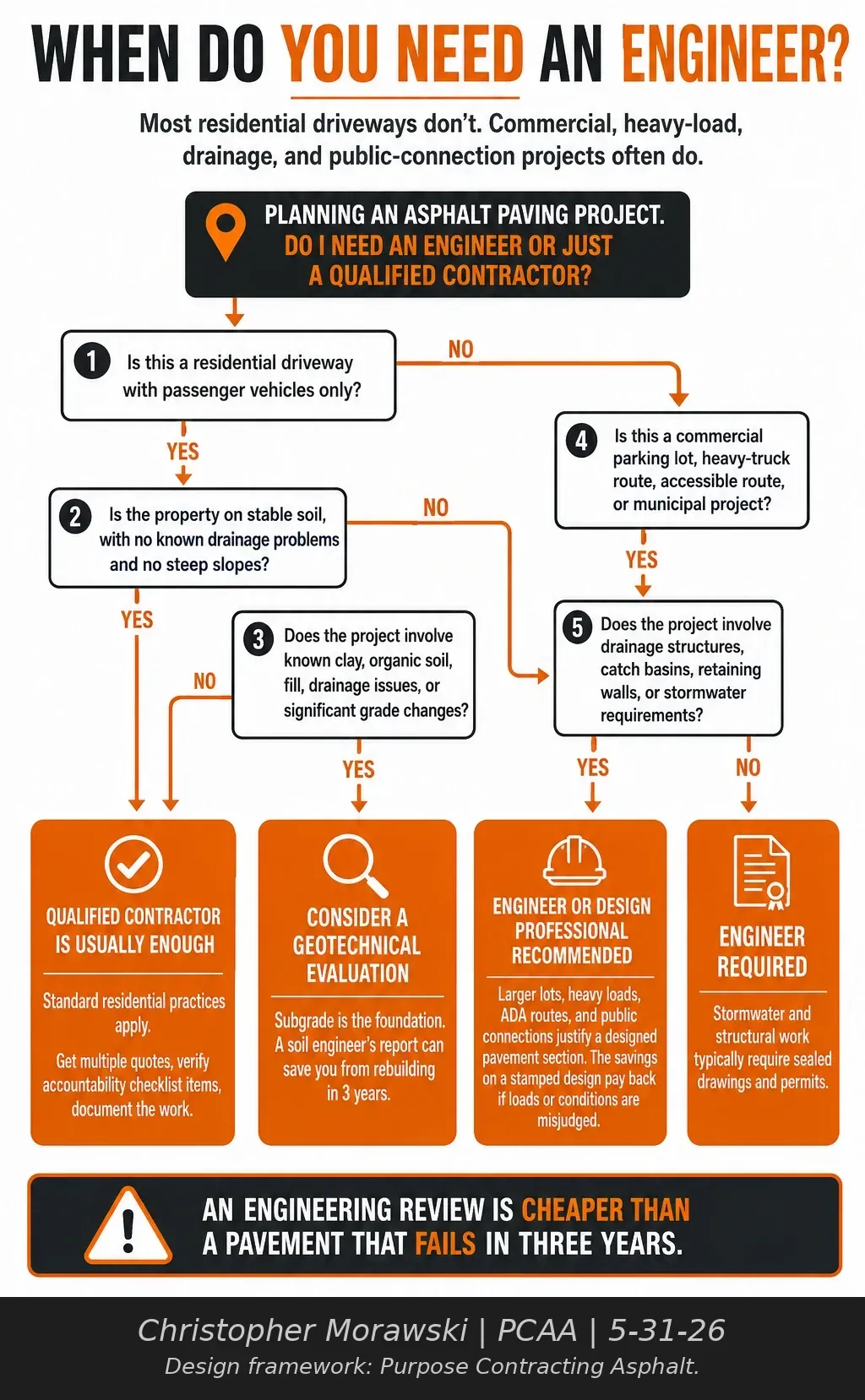
During the site visit, ask the contractor to explain what they see. A good contractor should separate surface wear from structural failure, be willing to say when an overlay is a bad idea for the specific pavement in front of them, point to where water will actually go after the work, discuss grades at garages and property lines, identify whether the apron or right-of-way section is subject to different permit rules, mention utility locates when excavation is included, and be honest when an engineer, surveyor, municipal approval, or stormwater review may be needed first.
For Wisconsin work, base and drainage deserve special attention during the visit. WAPA's driveway guidance makes the ground the star of the show: a firm, even, properly prepared subgrade, and a design matched to how the pavement will actually be used. [WI-WAPA-DRIVEWAY] If the contractor does not talk about the ground under the asphalt during the site visit, they may only be selling you the black surface you can see. That is where cheap pavement gets expensive, because the base fails first — and the failure shows up as ruts, cracks, potholes, and sinking within one or two winters.
The site visit is also your opportunity to explain how the property is used. A driveway that parks two sedans is a different design conversation from one that parks a work truck, dumpster, boat trailer, or fifth-wheel camper; a lot lane that receives semi tractor-trailers at a dock needs a different section than the customer parking area. The contractor cannot design correctly without that information. Take notes on what the contractor recommends, what they say the risks are, and what they include and exclude — those notes will help you compare bids and spot inconsistencies if the written proposal does not match what was said on site.
A. A site visit is what makes a proposal real. It lets the contractor inspect existing pavement condition, check drainage patterns, evaluate the subgrade at visible edges, measure the actual area, review the garage transition and road apron, note utility locations, plan equipment access, and confirm whether an overlay is realistic or removal and replacement is needed. The two things WAPA's guidance turns on — subgrade condition and a design matched to real vehicle loading — cannot be judged from a satellite image. [WI-WAPA-DRIVEWAY] A contractor who quotes a price without ever seeing the property is quoting a fictional job, and the difference between the fiction and the reality tends to become the owner's problem after the paver arrives.
Step 9: Require a Written Scope That Separates the Parts of the Job
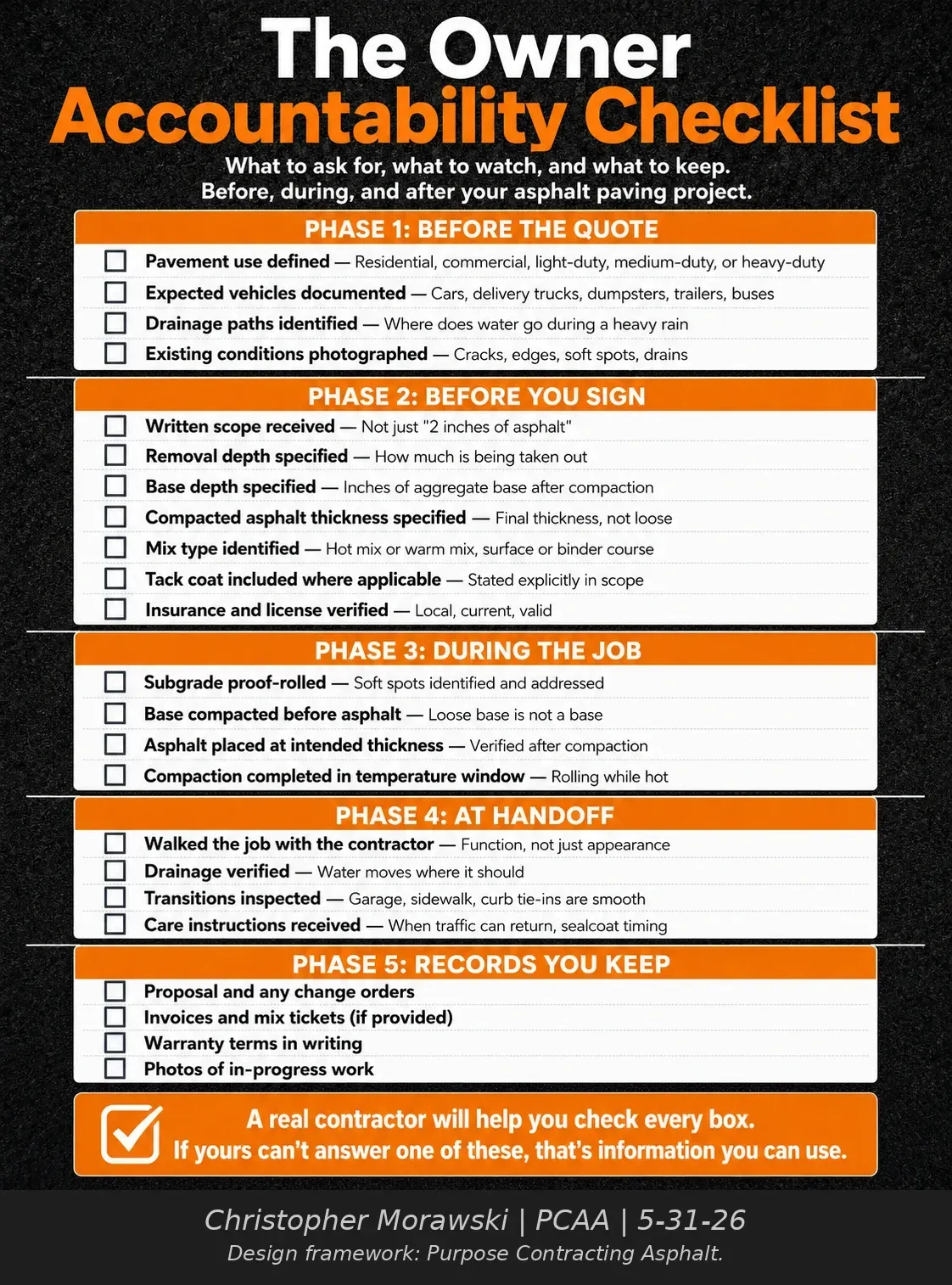
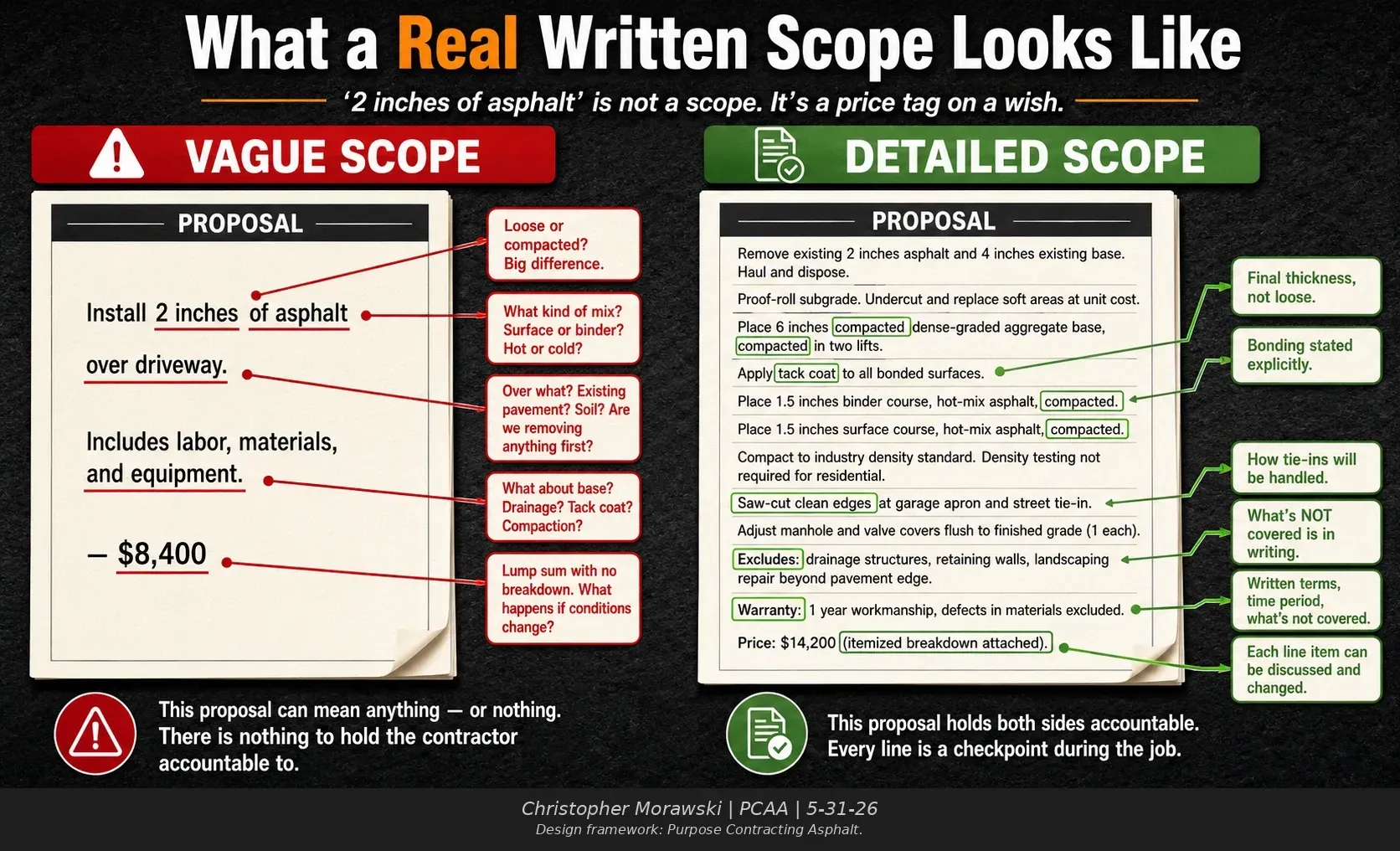
A serious asphalt proposal should be broken down in enough detail that an owner can understand what is included and what is not. At minimum, ask for separate written language covering:
- Preparation, removal, and excavation, with depths
- Base material and depth, grading, and base compaction
- Asphalt thickness after compaction, mix type where known, and number of lifts
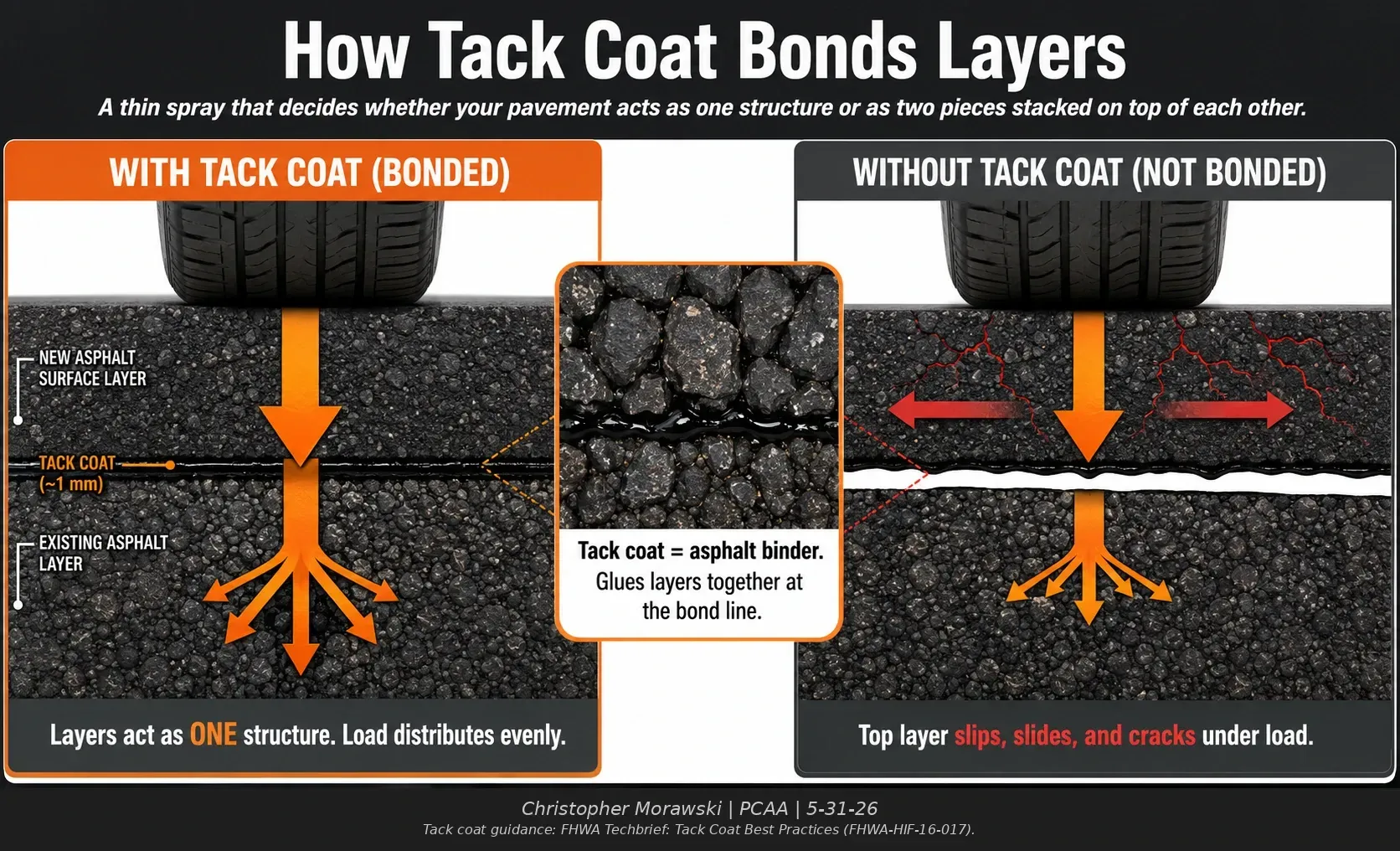
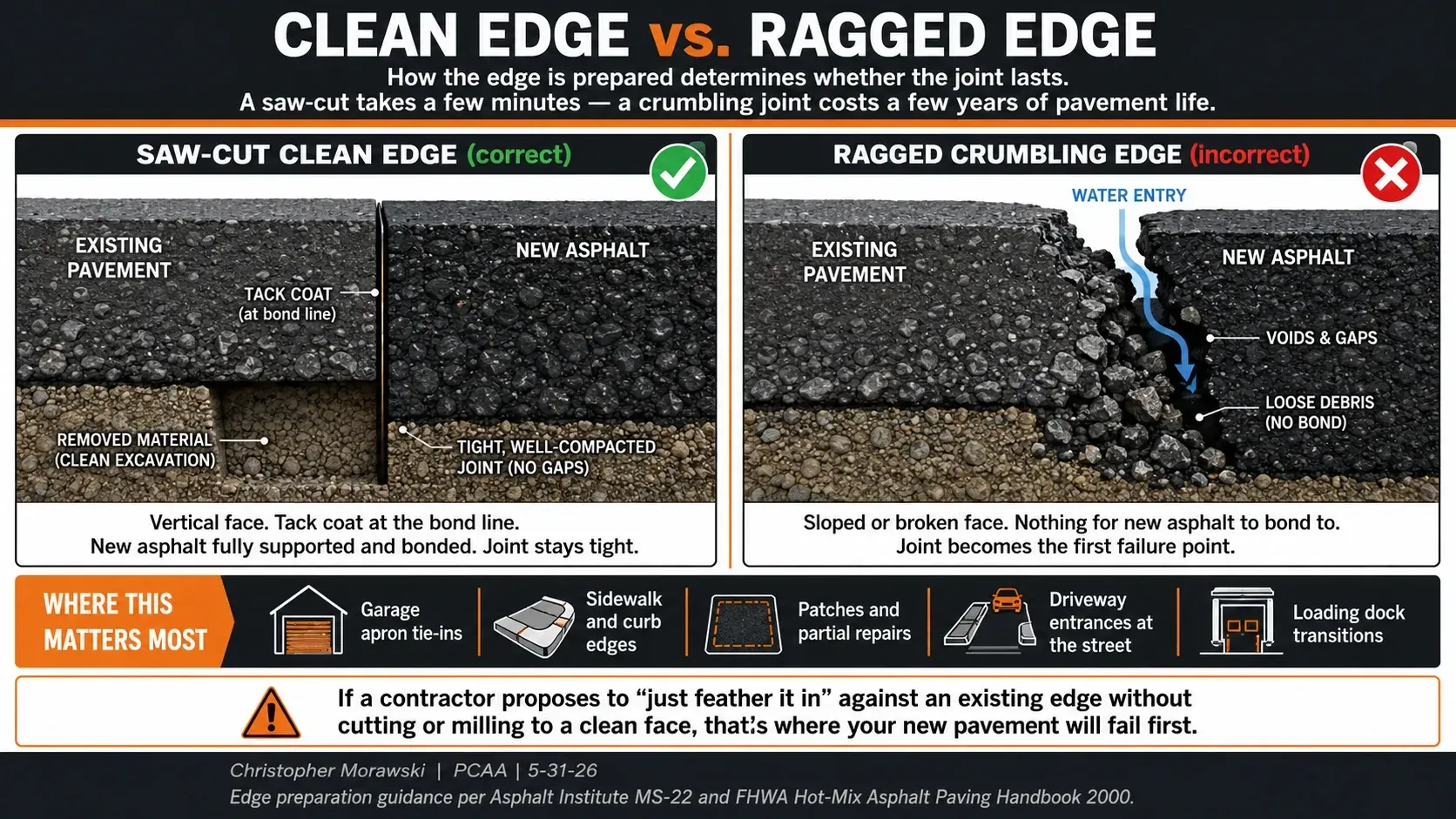
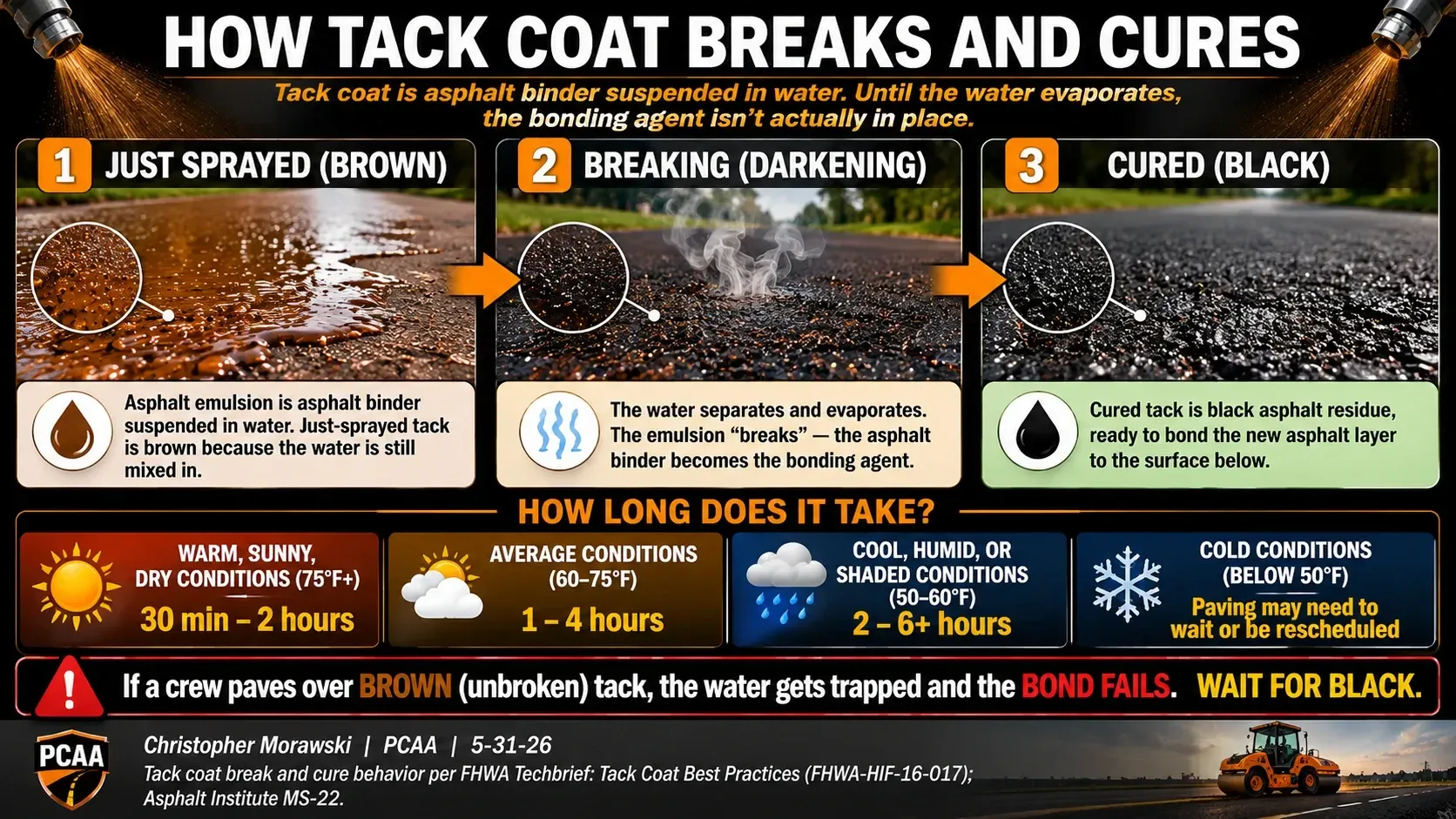
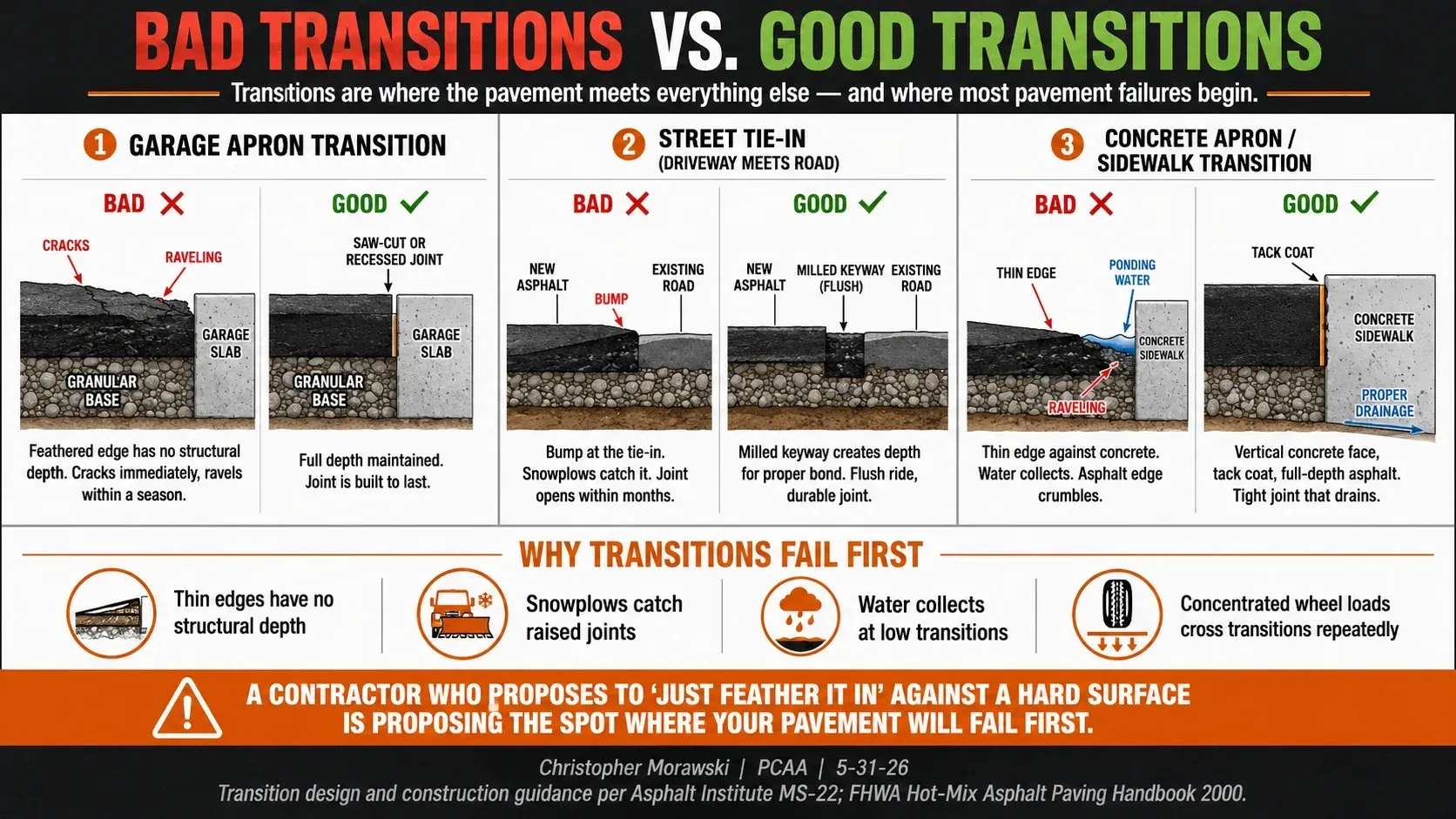
- Saw cuts, tack coat, edge treatment, and transitions at the garage and road
- Drainage plan
- Permits and permit responsibility; Diggers Hotline responsibility
- Traffic control, striping, and ADA compliance work where applicable
- Cleanup, warranty, exclusions, and the change-order process for hidden conditions
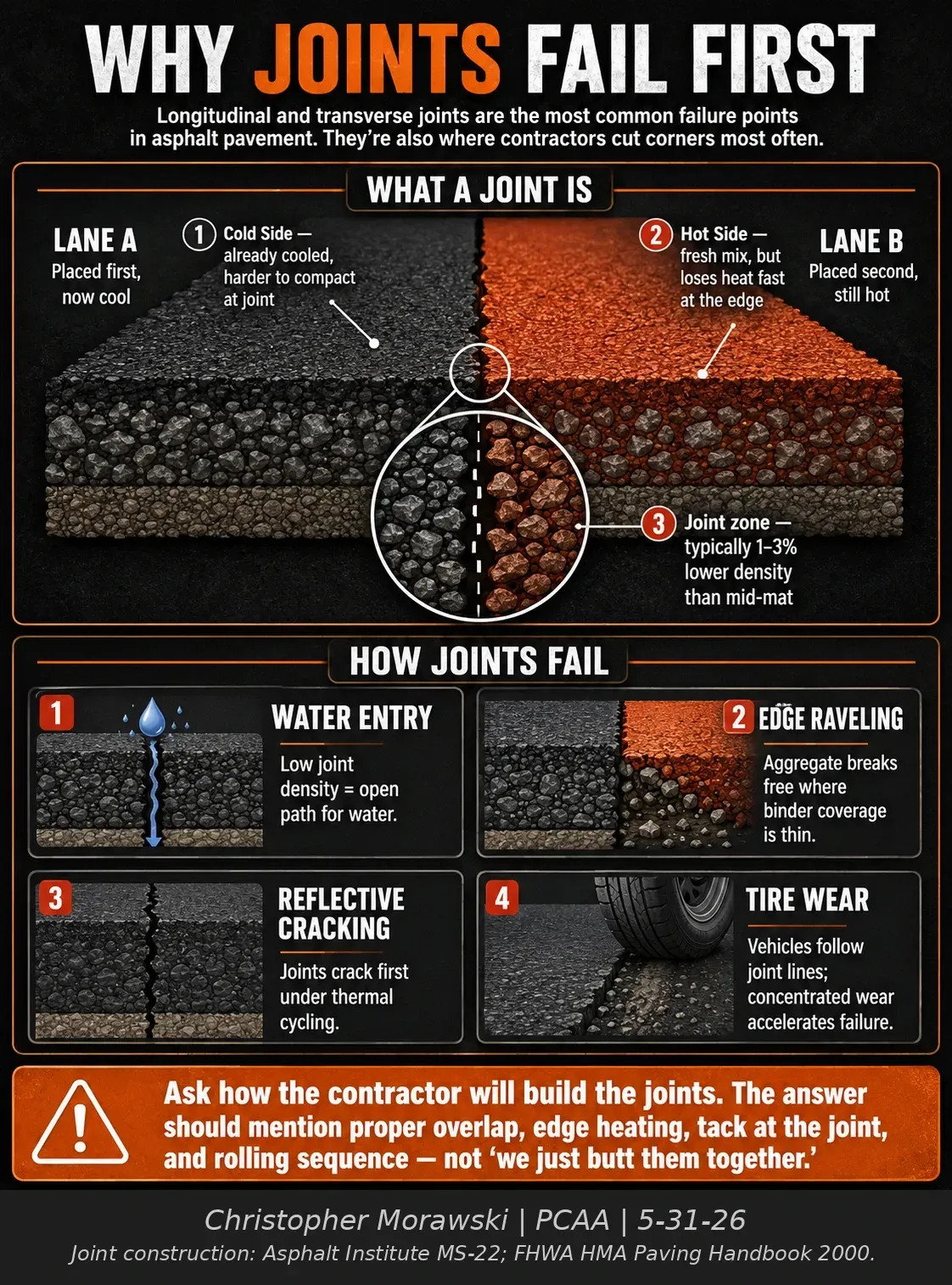
Avoid proposals that say only "blacktop driveway" or "pave parking lot" — a one-line scope puts every later dispute onto the owner. For a replacement driveway, a better scope reads: remove existing asphalt, inspect base, excavate failed areas as specified, install compacted crushed aggregate base to stated depth, fine grade for drainage, pave with stated compacted asphalt thickness in stated lifts, compact with appropriate rollers, taper at the garage and the public road, clean the site, and provide a written warranty subject to specific listed exclusions. For a commercial lot, a better scope also identifies milling depth, patch areas with square footage, leveling and surface courses, catch basin adjustments, curb repair, striping layout with stall count, ADA markings, and phasing.
Wisconsin's consumer guidance is blunt about why: do not rely on oral agreements. [WI-DATCP-HI] And Wis. Admin. Code ATCP 110.05 backs the written scope with legal force — Step 12 covers the contract rules in full. [WI-ATCP-110.05] The written scope protects the contractor as much as the owner: when both sides have written down what is included, the job runs smoother and warranty questions have a clear reference point.
A useful practice: ask each contractor to prepare the proposal as if it were the only document ever referenced in a dispute — because a Wisconsin court will look at what was written, not what was said in the driveway. And make sure the scope identifies what is not included. Common exclusions in asphalt work include stump grinding, retaining wall repair, landscaping restoration beyond touch-ups, drainage failures outside the paved area, culvert replacement, sidewalk and concrete work, sealcoating, and striping if not in the base bid. Exclusions are not a red flag on their own — but the owner should know them, so they can add them, source them separately, or knowingly accept the risk.
Step 10: Understand Thickness, Base, and Compaction Without Becoming an Engineer
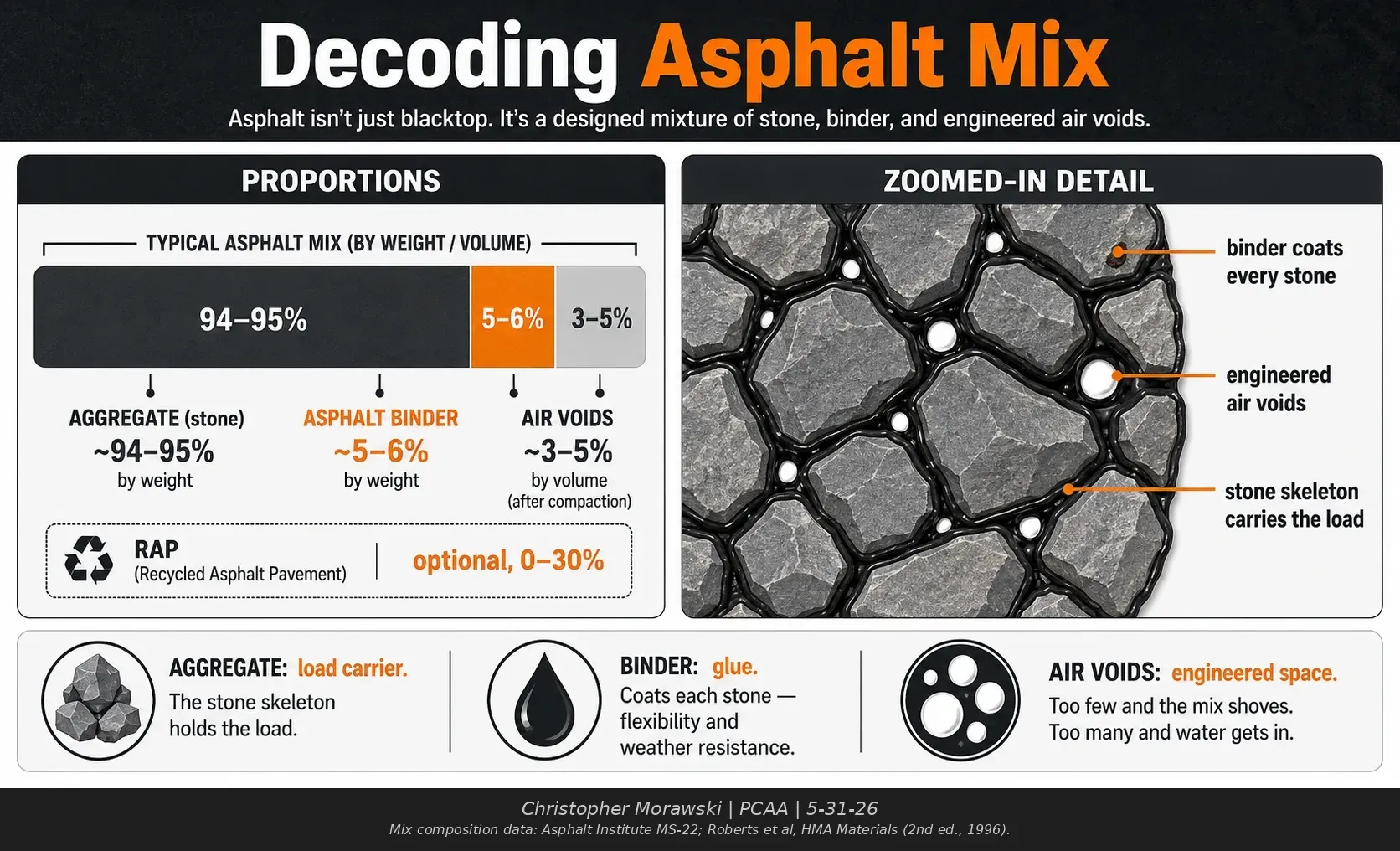
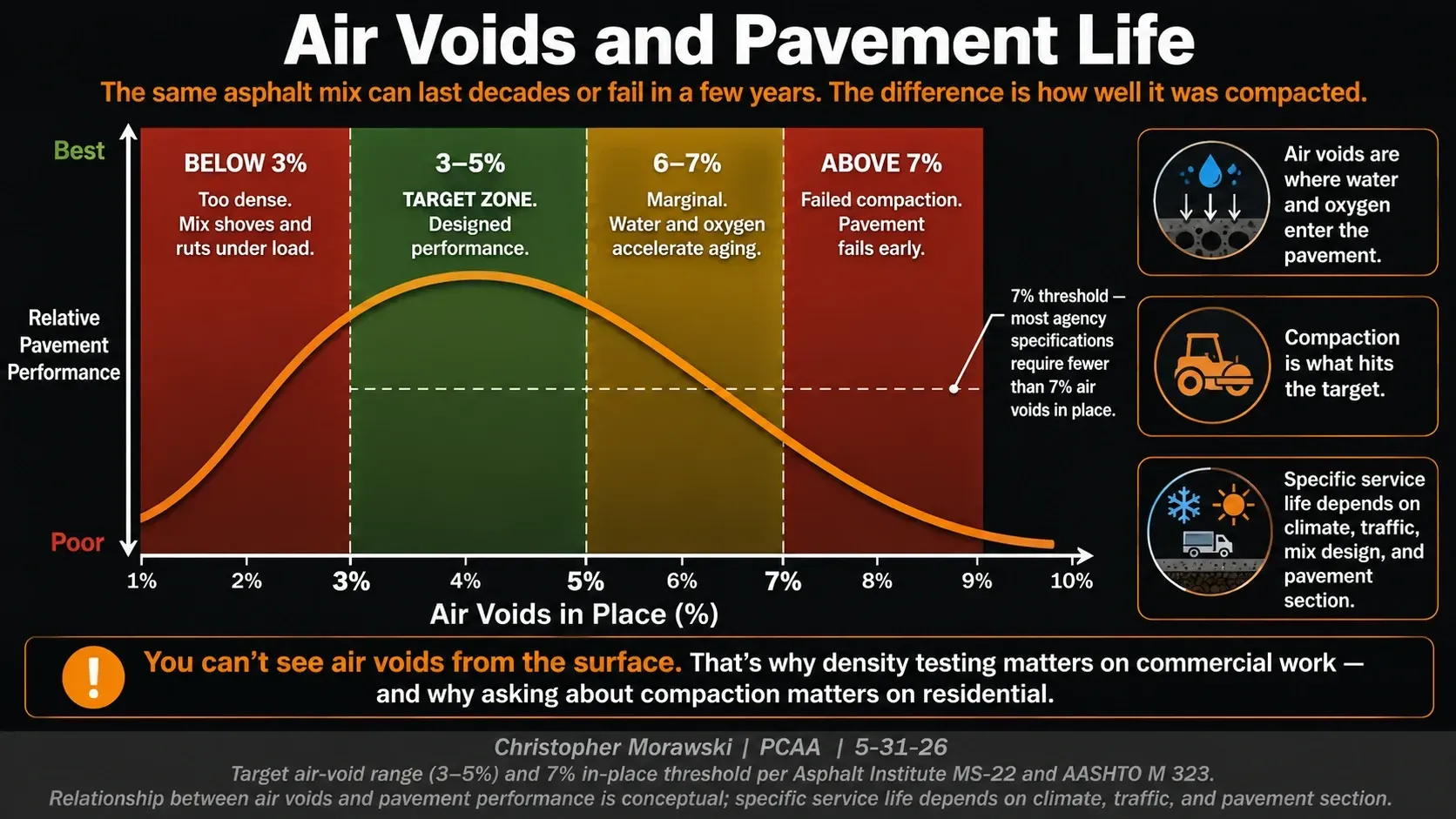
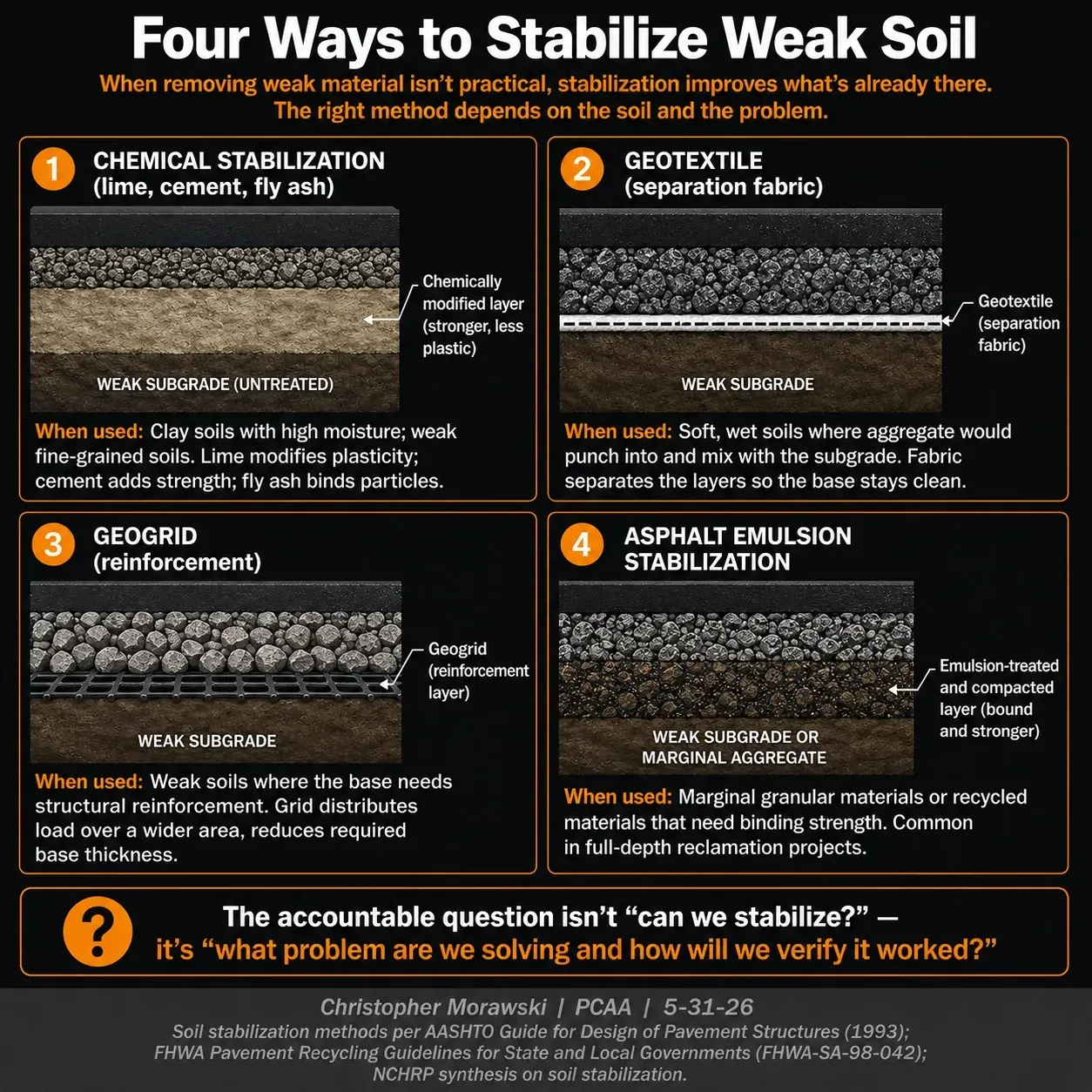
You do not need to become a pavement engineer to hire an asphalt contractor competently, but you do need to know enough to ask useful questions and detect obvious shortcuts. Asphalt performance comes from the whole structure: subgrade, drainage, aggregate base, mix design, asphalt thickness, lift thickness, compaction density, edge support, and maintenance. A beautiful black surface placed over soft, wet, organic, or poorly compacted material is lipstick on a pothole — it will look right on day one and fail well before it should.
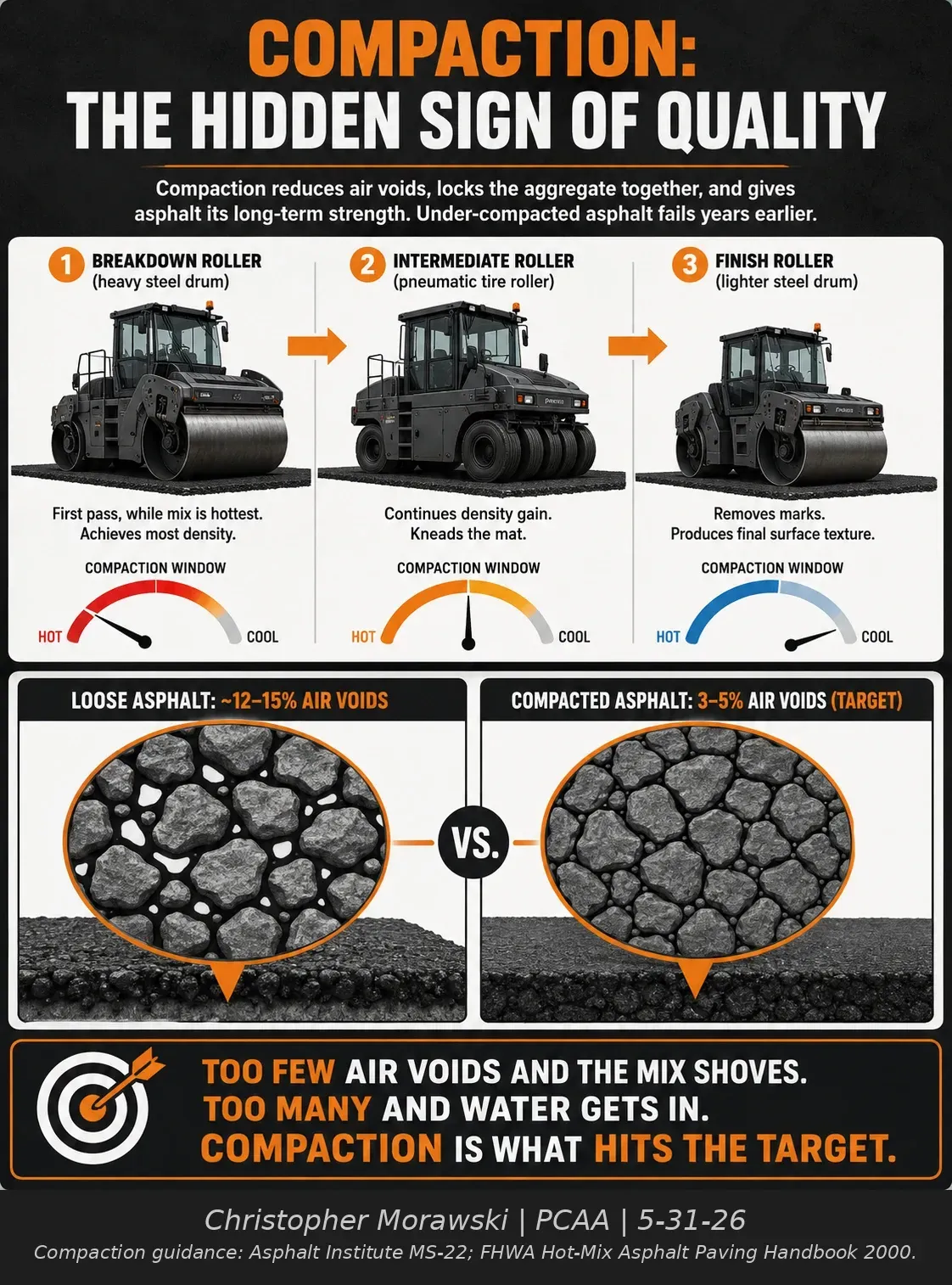
Ask the contractor a defined set of questions and listen for defined answers. What is the existing condition? Are you recommending an overlay, remove-and-replace, partial excavation, full-depth reconstruction, milling, pulverizing, or patching? What compacted asphalt thickness are you proposing after rolling? In how many lifts? What aggregate base depth is included in the base bid? What happens if the base is discovered to be soft or organic underneath? How will the base and the asphalt be compacted, and with what equipment? How will you handle tight spots a large roller cannot reach?
WAPA's Asphalt Pavement Design Guide — intended for architects, engineers, developers, owners, and governmental officials, and built on Wisconsin DOT standard specifications — divides the state into a Southern Asphalt Zone and a Northern Asphalt Zone with different binder recommendations, and its companion homeowner guidance puts the design burden squarely on the contractor: proper thickness and compaction, matched to the site. [WI-WAPA-DESIGN] [WI-WAPA-DRIVEWAY]
The design guide also publishes actual reference numbers for residential-class pavement (driveways and parking lots under roughly 50 stalls). On good to excellent subgrade: 3.0 inches of compacted asphalt over 6 to 8 inches of aggregate base. On medium subgrade: 3.5 inches over 6 to 10 inches of base. On poor subgrade: 4.0 inches over 9 to 12 inches of base. [WI-WAPA-DESIGN] Wisconsin's clay-heavy soils often push toward the deeper end of those base ranges. These are design-guide reference points, not a substitute for a site-specific recommendation — but a bid whose numbers land far below them should come with a clear engineering explanation, and "that's how we always do it" is not one.
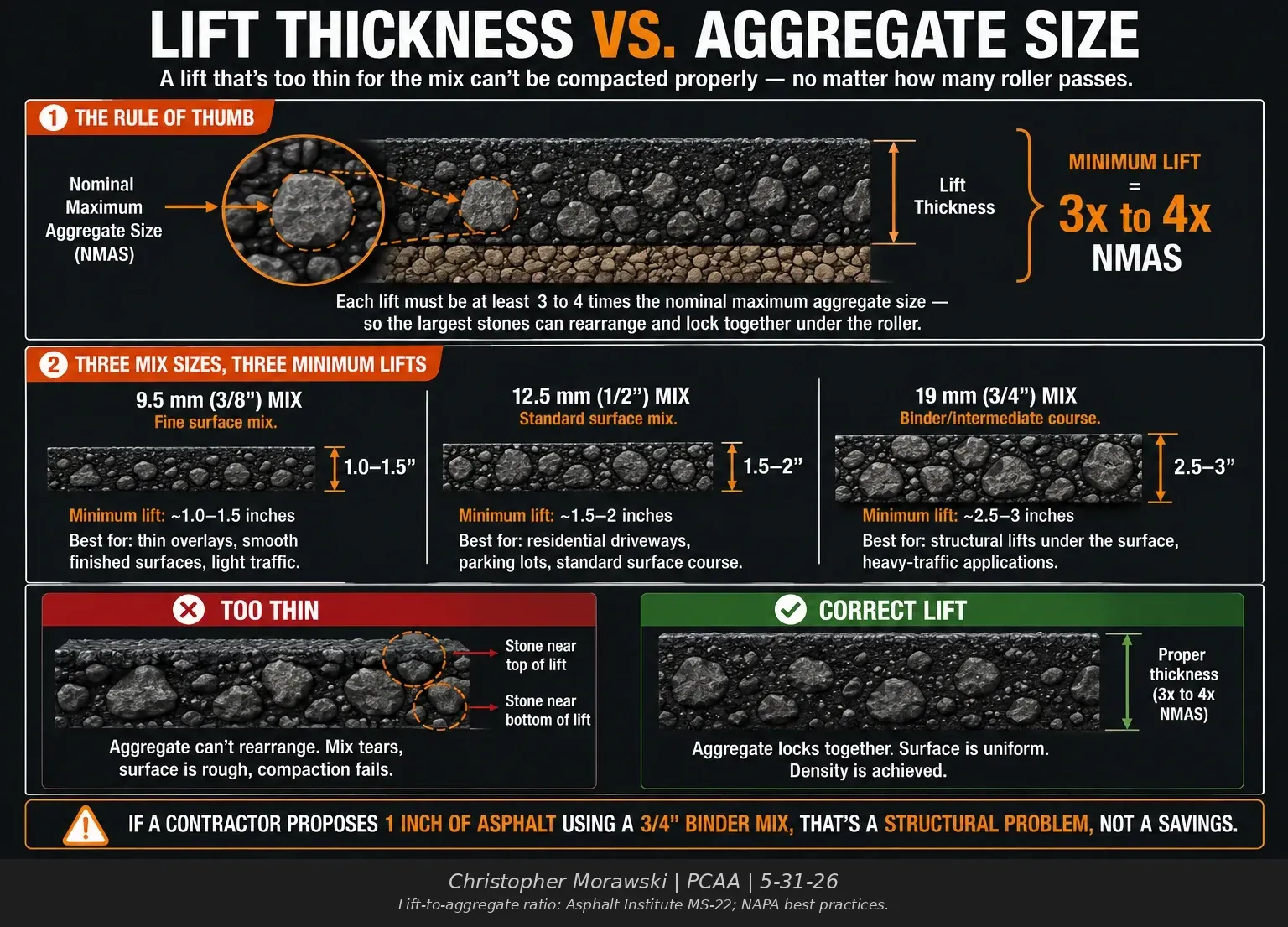
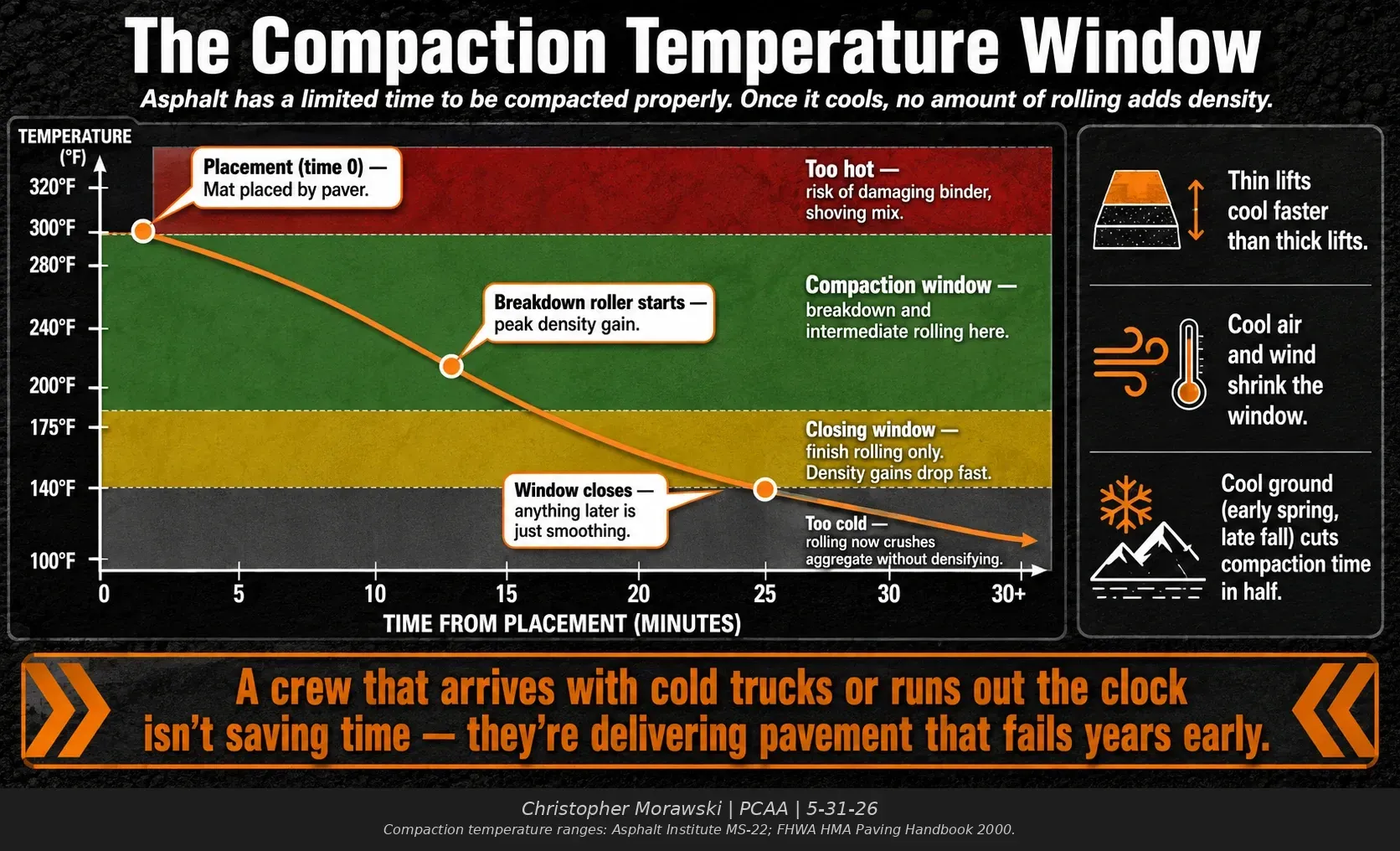
Two traps to avoid. First, "same price, more asphalt" pitches: adding thickness helps only when the base and drainage underneath are right — piling asphalt on a bad base does not save the pavement, and a thinner section over a solid, well-drained base can be perfectly fine for passenger cars. Ask for the reason behind the design. Second, compacted versus loose thickness: hot asphalt comes out of the paver thicker than the finished mat, and the rollers compact it down. When a proposal says "three inches of asphalt," ask whether that is compacted thickness after rolling or loose thickness before rolling — a three-inch loose specification may produce only two to two-and-a-half inches of finished pavement, which changes the structural capacity of the surface.
A. WAPA's Wisconsin design guide gives the reference points for residential-class pavement: 3.0 inches of compacted asphalt over 6 to 8 inches of aggregate base on good subgrade, 3.5 inches over 6 to 10 on medium subgrade, and 4.0 inches over 9 to 12 on poor subgrade. [WI-WAPA-DESIGN] But thickness alone cannot save a bad base — long-term performance depends on the whole structure: subgrade condition, drainage, base depth and compaction, mix design, lift structure, and edge support — which is exactly why WAPA's table scales with subgrade quality. [WI-WAPA-DRIVEWAY] Always confirm the quoted number is compacted thickness after rolling, not loose thickness — that difference alone can be half an inch or more of finished pavement.
Step 11: Compare Apples to Apples, Not Apples to Cheap Mystery Gravel
When proposals arrive, do not immediately choose the lowest number. First, line up the scopes. Bid A may include removal, excavation, nine inches of compacted aggregate base, three inches of compacted asphalt in two lifts, permit coordination, and apron work in the right-of-way. Bid B may be a two-inch overlay with no excavation, no permit responsibility, no drainage correction, and a warranty that expires within a year. Bid B is not "cheaper" than Bid A. It is a different project. Choosing Bid B because it is $2,000 lower may buy you a pavement with a materially shorter life — and the second replacement comes out of your pocket, not the contractor's.
Build a comparison sheet — the full row-by-row worksheet is in Appendix C — and fill it in as bids arrive. Leave missing items blank: a blank is real information, not a reason to assume the best. Then ask each contractor to clarify the blanks in writing. You are not being difficult; you are making the bids comparable. Good contractors appreciate clean scope questions because they are tired of losing to vague low bids whose shortcuts are hidden. A contractor who gets irritated by detail questions is telling you something about how they will respond when a problem arises during the job.
Look at the total price only after every other row is filled. If two contractors quote essentially the same scope within ten to fifteen percent of each other, either can probably do the work. If a third price is dramatically lower, the interesting question is not "why are they so cheap" but "what did they leave out" — the answer is rarely superior efficiency and far more often a missing scope item. The highest price is not automatically the best bid either: it may include more than the job requires, or margin padding for work the contractor does not really want. Bid comparison is not about picking the cheapest, middle, or most expensive number. It is about matching scope against price and choosing the written proposal that solves your actual problem for a defensible price.
A. Compare bids by scope first, price second. Fill in a line-by-line comparison (Appendix C) covering identity verification, insurance, permit and Diggers Hotline responsibility, removal and excavation depth, base material and depth, compacted asphalt thickness and lifts, drainage plan, apron work, striping, warranty terms, exclusions, and payment schedule — and only then look at total price. DATCP's consumer guidance specifically recommends making sure all contractors are bidding on exactly the same work and being leery of extremely low estimates, because an unusually low bid usually means something is missing from the scope rather than that the contractor is uniquely efficient. [WI-DATCP-HI]
Step 12: Know the Wisconsin Contract Rules That Matter to Homeowners
Wisconsin's home improvement consumer guidance is emphatic: do not rely on oral agreements. Get the deal in writing. The DATCP consumer publication instructs owners to insist on a written contract that includes the seller's name and address (including the sales representative), a full description of the job, a detailed list of materials, total price plus any finance charges, and starting and completion dates. [WI-DATCP-HI] Wisconsin Administrative Code ATCP 110.05 provides the underlying rule: a written home improvement contract must be signed by all parties and clearly, accurately, and legibly set forth all material terms and conditions. [WI-ATCP-110.05] The writing requirement attaches whenever the buyer pays anything before the work is complete or the seller initiated the sale by solicitation — which, since deposits are standard, reaches nearly every real paving job.
For asphalt work, that means the contract should not simply read "pave driveway." It should identify the parties by legal name, the property address, the total price, the payment terms, the scope of work, the materials, the start and completion timing or scheduling window, the warranty terms, the exclusions, the permit responsibility, and how change orders will be handled. If the contractor promised a specific compacted thickness, base depth, apron repair, or warranty term, put it in the contract. If a term is important enough to affect your decision to hire, it is important enough to write down.
Do not sign a contract with blank spaces. Do not sign a contract that lets the contractor change materials, thickness, price, or completion timing without written owner consent. Do not sign if the company name at the top does not match the entity you verified in DFI. If the project is large or the language is complicated, consider having a Wisconsin attorney review it first — the review may cost a few hundred dollars; a bad contract on a five-figure project can cost far more.
Know the real shape of the three-day cancellation right, because it is narrower than most people think. If the contractor solicited you — came to your door, called you, or mailed you — and you signed a contract for more than $25 at your home or anywhere away from the contractor's regular place of business, the Wisconsin Consumer Act (Wis. Stat. §§ 423.201 to 423.203) gives you until midnight of the third business day to cancel. The contractor must give you two copies of a written "Customer's Right to Cancel" notice at signing, and cancellation is done by mailing the signed notice — certified mail with return receipt gives you proof. [WI-DFI-CANCEL] [WI-DATCP-HI] The limit matters as much as the right: if you called the contractor and invited the bid, the cancellation right generally does not apply. Do not sign at the kitchen table assuming you can undo it later — the three-day window is a shield against door-to-door pressure, not a universal undo button.
A. Only in a specific situation: the sale was solicited (door knock, cold call, or mailer — you did not initiate it), the contract exceeds $25, and you signed somewhere other than the contractor's regular place of business. Meet all three and you may cancel until midnight of the third business day by mailing the signed cancellation notice — certified mail creates your proof — using the two copies of the notice the contractor was required to hand you at signing. Invite the bid yourself, and the right generally does not exist. There is no universal three-day undo in Wisconsin. [WI-DFI-CANCEL]
Step 13: Request Lien Waivers the Wisconsin Way
A lien waiver is one of the most important consumer protections an owner can request on a construction project, and it is regularly overlooked. DATCP explains that consumers can request lien waivers from the prime contractor and from each subcontractor and material supplier any time up to final payment, and that when payments are made in installments, owners may request proportional lien waivers with each partial payment. Lien waivers prevent a subcontractor or supplier from placing a construction lien on the property if the prime contractor fails to pay them. [WI-DATCP-LIENS] Under Wis. Admin. Code ATCP 110.025, when a payment is made, the contractor must provide written lien waivers from all contractors, subcontractors, and material suppliers for the proportionate value of the work covered by that payment. [WI-ATCP-110.025]
The scenario a lien waiver protects against sounds unfair at first, but it is a routine construction risk. You hire Prime Contractor A. Prime Contractor A hires a striping subcontractor, orders asphalt from a hot-mix plant, and rents equipment. You pay Prime Contractor A in full. Prime Contractor A cashes your check and, for whatever reason, does not pay the striping sub or the plant. The sub and the plant now have a legal right to place a lien on your property, because Wisconsin lien law protects labor and material suppliers. You have already paid — but they can force you to pay again to clear the lien, and then chase Prime Contractor A yourself, which is often uncollectible.
Build the request into your payment process, in writing. A clause can read: "The customer may request lien waivers from the contractor, subcontractors, and material suppliers before each progress payment and before final payment. The contractor shall provide requested lien waivers within a reasonable time." Have a Wisconsin attorney look over any clause language before it goes into your contract — this guide is not a substitute for that review.
Wisconsin also requires the contractor to tell you about this right before the deal is signed. ATCP 110.025 requires a separate written "Notice of Consumer's Right to Receive Lien Waivers" before the parties enter the home improvement contract — a separate document, in a clear and conspicuous font, in a format you can keep, with the contractor retaining evidence that you acknowledged receiving it. The rule even prescribes the notice's wording, ending with DATCP's contact line: 1-800-422-7128 or datcp.wi.gov. [WI-ATCP-110.025] If the notice you received does not contain that language — or you never received one — the contractor is out of step with Wisconsin's home improvement rules, which is itself useful information about how carefully they operate.
For small residential jobs the contractor may use no subcontractors, and the material chain may only involve the asphalt plant and the aggregate supplier. Ask for lien waivers anyway. For large parking lot projects, ask for waivers from the milling contractor, the striping contractor, the traffic-control contractor, and the hot-mix supplier at each payment stage. Paying the prime in full does not prove the prime paid everyone below them.
A. A lien waiver is a written document from a contractor, subcontractor, or material supplier giving up the right to file a construction lien against your property for the labor or materials covered by a specific payment. Request waivers before every payment on a larger project, and at minimum before final payment on any project — including proportional waivers when paying in installments. Wisconsin requires contractors to give buyers a separate written notice of this right before the contract is signed, and to provide the written waivers covering each payment from all contractors, subcontractors, and suppliers. [WI-DATCP-LIENS] [WI-ATCP-110.025]
Step 14: Use a Sensible Payment Schedule
Payment terms should match the actual risk and the actual work. It is normal for some contractors to require a deposit at contract signing, particularly during busy paving season, to secure scheduling, order materials, and mobilize equipment. It is not normal to demand full payment before work begins. The Wisconsin BBB advisory republished by FOX6 in April 2026 specifically advised consumers to stagger payments so work can be inspected at various stages, and warned that full payment upfront is a strong marker of paving fraud. [NEWS-FOX6-BBB-2026] TMJ4's report repeated the BBB guidance to compare prices, get multiple bids, get everything in writing, and never pay in full upfront. [NEWS-TMJ4-2026] CBS 58's coverage recommended paying by credit card rather than cash whenever possible, so the payment method itself creates a record. [NEWS-CBS58-2026]
A reasonable residential structure for a driveway project: a deposit at signing, a progress payment after removal and base preparation are complete, and a final payment after paving, cleanup, and lien-waiver paperwork. A commercial structure might add mobilization, milling, base repair, binder course, surface course, and striping payments, with retainage held until punch-list completion. The exact schedule varies by job size and contractor policy, but the principle is constant: money follows documented, inspected progress. If the pavement is not yet placed, the money for the pavement is not yet due — and "we need it to make payroll on Friday" is a cash-flow problem, not a payment milestone.
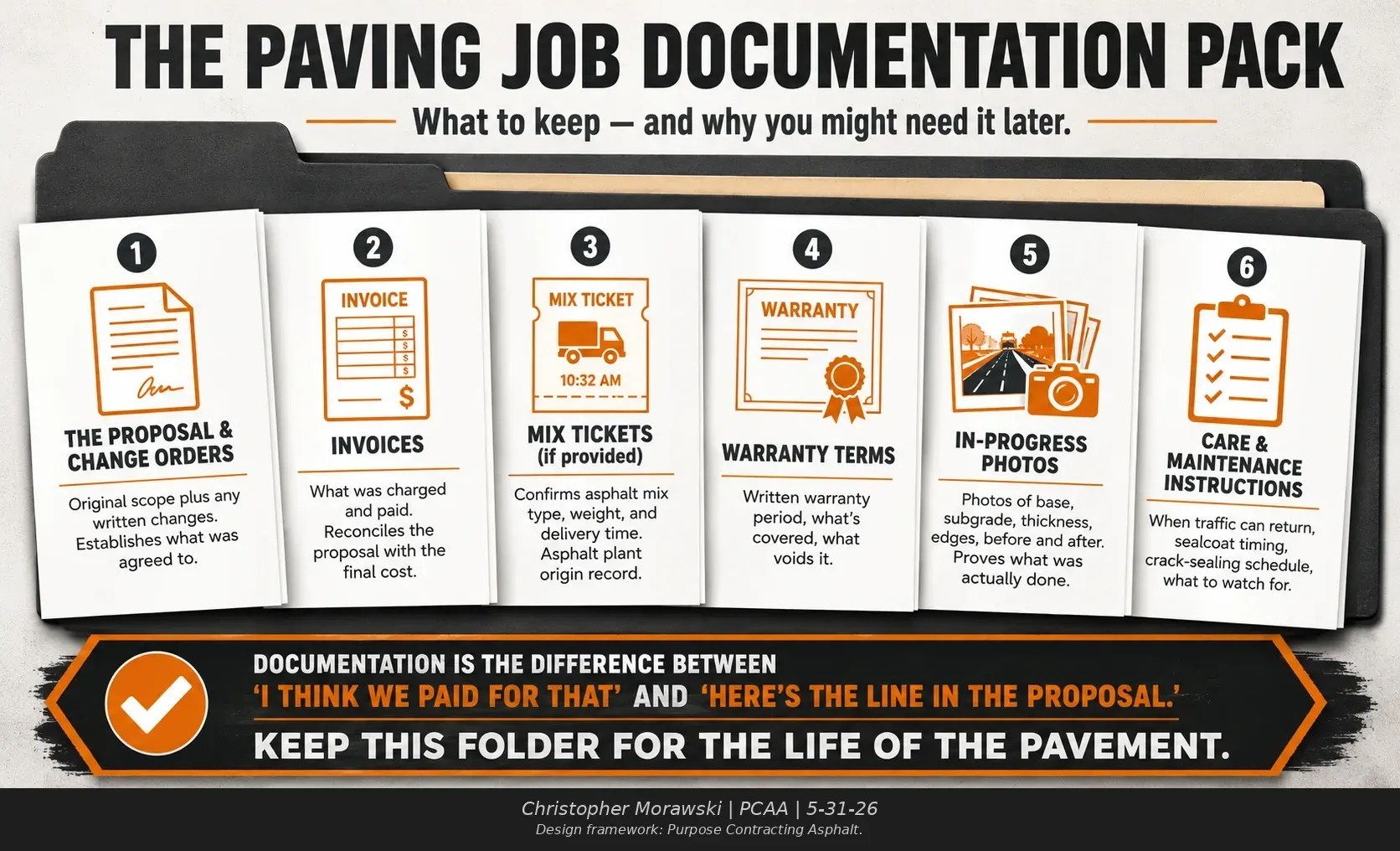
Use payment methods that create records: checks payable to the legal business name (never to an individual salesperson), credit cards through a legitimate merchant account, or ACH to the verified company account. Do not send money to a personal payment app because a salesperson texted a link. Keep copies of the signed contract, invoice, payment receipts, permit, lien waivers, emails, texts, and photos of the work.
For commercial and multi-family projects, retainage is a normal and useful tool — commonly five to ten percent of contract value held until punch-list items are complete. Retainage gives the owner leverage to ensure minor items (a restriped stall, a catch basin cover, a corner detail) are actually finished rather than deferred indefinitely once the money is out the door. If your contract does not include retainage, ask whether it can be added, with the percentage and release conditions clearly written.
A. A reasonable deposit at contract signing is normal, especially during busy paving season. Full payment before any work begins is not normal, and Wisconsin scam warnings repeatedly identify large upfront payment demands as one of the most consistent markers of paving fraud — the BBB specifically advises staggering payments so work can be inspected at each stage. There is no legally set deposit percentage, but as a working rule of thumb, anything approaching full payment — or much beyond roughly a third of the contract price before any work has occurred — deserves scrutiny and a written explanation. Any request for full payment upfront, any demand for cash only, and any pressure to pay before a contract is signed should each be treated as a serious warning sign. [NEWS-FOX6-BBB-2026] [NEWS-TMJ4-2026] [NEWS-CBS58-2026]
Step 15: Ask the Right Questions Before You Hire
Use a defined set of questions before you sign anything.
Business questions:
- What is your legal business name, and are you local to Wisconsin or traveling from out of state?
- How long have you worked in this specific area, and can I verify the business through Wisconsin DFI?
- What credentials or licenses do you claim, and can I verify them through DSPS or the municipality?
- Who pulls permits? Does this project touch the municipal right-of-way, curb, gutter, sidewalk, apron, culvert, or storm sewer?
- Who contacts Diggers Hotline, and do private utilities need separate locating?
Technical questions:
- What has failed on the existing pavement, and why? Overlay or replacement — and why one and not the other?
- What aggregate base depth and material are included in the base bid?
- What compacted asphalt thickness are you proposing, and in how many lifts?
- How will the base and the asphalt be compacted, and how will edges be supported?
- How will water drain during and after construction? What happens if soft base is discovered during excavation, and what is the change-order process?
Operations questions:
- Who will actually be on site — employees or subcontractors — and who is the foreman?
- What is the schedule window, what weather delays paving, and what happens if the plant is down or rain hits the paving day?
- What warranty is included, and what is specifically excluded?
- Can you provide recent local references for similar work — same property type, same scale, same municipality where possible?
A good contractor does not need perfect answers immediately, but they should not dodge. The best answer to a hard question is often "Let me verify that with the municipality" or "I need to check the base condition before I can promise that thickness." Honest caution beats fake certainty — a contractor who answers everything with confident specifics and never needs to look anything up is either extraordinarily prepared or making things up, and the second is far more common.
One more revealing question: "How much time did you spend putting this proposal together?" A legitimate contractor invests real hours in a serious proposal — measuring, evaluating base, drafting scope, checking permit requirements — and behaves like someone protecting that investment. A crew that quoted on the spot with no time invested has nothing to lose by disappearing, which is precisely how scam operators can hit dozens of homes in a week without any follow-up.
A. Ask for the legal business name, physical local address, years working in the area, insurance documentation direct from the agent, credential claims with numbers, permit responsibility, Diggers Hotline responsibility, who will actually be on site, and who the project manager is. Then verify independently — the legal name through Wisconsin DFI, any claimed credentials through the DSPS License Lookup, and insurance directly with the agent on the certificate. DATCP's consumer guidance specifically recommends contacting recent customers and checking whether complaints have been filed with the Bureau of Consumer Protection before hiring. [WI-DATCP-HI] [WI-DFI-CORP] [WI-DSPS-LOOKUP]
Step 16: Read Reviews Like a Contractor, Not Like a Tourist
Online reviews are useful, but only when read correctly. Do not glance at the star average and pick the highest number. Look for patterns. Good signs: detailed reviews that mention specific elements of the work — communication, punctuality, cleanup, drainage results, base preparation, crew professionalism, and how the pavement is performing after one or two winters. Weak signs: many vague five-star reviews with no project detail, sudden review spikes clustered in a short window, repeated template language across reviews, or reviews referencing services the company does not appear to offer.
Read the negative reviews carefully too. Every contractor with real history eventually has a conflict, a delay, a weather problem, or an unhappy customer — construction is not a business where every project ends perfectly. The important question is how the company responds. Does it answer professionally, explain what happened, and offer to fix legitimate issues? Or does it attack the reviewer, blame the customer, or ignore the review entirely? A contractor's response pattern to problems tells you more about how it will treat you when a problem arises on your job than any five-star review ever will.
Ask for references that match your specific project. A commercial lot with catch basins and ADA striping needs commercial references; a steep driveway on clay soil needs references on similar slopes and soils; a phased occupied-site job needs a comparable occupied-site reference. References should prove relevant capability, not just prior existence of any work at all. When you call them, use the reference-call script in Appendix B — specific questions like "How is the pavement holding up after this many winters?" draw out far more than "How did it go?"
DATCP's consumer guidance recommends calling recent customers directly and asking whether they were satisfied, whether the contractor showed up on time, whether the crew cleaned up afterward, whether the contractor followed through with warranties, and whether the customer would hire the contractor again. [WI-DATCP-HI] Those questions work because they surface the contractor's actual pattern of behavior rather than a testimonial.
A. Look for patterns rather than star averages: detailed reviews mentioning specific work elements and multi-winter performance are strong signals; vague five-star walls, review spikes, and template language are weak ones. Read the negative reviews and judge the company by how it responds — a professional response to a legitimate complaint is often a stronger positive signal than the stars. Then go beyond reviews entirely: call recent customers using DATCP's recommended questions and the reference-call script in Appendix B. [WI-DATCP-HI]
Step 17: Learn the Scam Script So You Can Shut It Down Fast
The common asphalt scam script is not subtle once you know it. A crew shows up uninvited. They say they are already working nearby. They claim they have leftover asphalt that must be used before it cools or goes to waste. They offer a major discount if you decide right now. They avoid written details and refuse to provide a written scope. They may ask for cash, a check made out to an individual, or a large deposit before any work is done. They may begin work before a contract is signed. They may later demand more money mid-job, claiming the situation is more complicated than they thought.
The state documentation matches the script. DATCP's September 2023 Southeastern Wisconsin alert documented the core pitch — a crew claiming its truck broke down with leftover asphalt that needs to be used before it goes to waste — along with crews taking upfront payments and doing no work at all, and workers who are often unlicensed, from out of state, and quickly gone. [WI-DATCP-SEWI-ALERT] DATCP's transient-worker publication adds the longer-running warning: these crews specialize in blacktopping driveways among other trades, their work and materials are typically inferior, and they hit an area, take the money, and run. It also offers advice worth taking literally: do not let them into your home — they are experts at finding and taking valuables — and note their vehicles and license plate numbers. [WI-DATCP-TRANSIENT]
The 2026 reporting adds detail. FOX6's April 8 article describes a contractor who leaves a pamphlet or shows up at the door, claims to have been doing work in the area with extra paving supplies, offers a discount for that reason, asks for a large percentage of the fee upfront, and shows hesitancy or evasiveness when asked about the price or the business's location; the Wisconsin BBB has documented cases in which homeowners lost more than $8,000. [NEWS-FOX6-BBB-2026] TMJ4's report on the Franklin Police warning covered the leftover-material-from-a-neighbor's-driveway pitch and the $1,500 Franklin case, with BBB guidance to compare prices, get multiple bids, and get everything in writing. [NEWS-TMJ4-2026] CBS 58 described the same script: after collecting a large upfront payment, the contractor either disappears or delivers shoddy work. [NEWS-CBS58-2026]
Your response should be boring and firm. Memorize one line: "Leave your written information. I do not hire same-day door-to-door contractors. I will verify the company, permits, insurance, and references before deciding." That sentence removes the urgency the scam depends on. If the crew keeps pushing, end the conversation and go inside. And know that DATCP sets the escalation bar low: its 2023 alert advises that if you are solicited at your home or business about paving or sealing services, turn the workers away and contact local law enforcement, sharing a description of the vehicles and license plate numbers if possible. [WI-DATCP-SEWI-ALERT] Its transient guidance adds: call the police immediately if a crew begins a job without your authorization. [WI-DATCP-TRANSIENT]
Report attempts even when no money changed hands. Franklin police say they receive reports of this scam every spring and treat reporting as a judgment-free zone — the point of reporting is to warn others before there is further victimization. [NEWS-TMJ4-2026] DATCP's Consumer Protection Hotline is 1-800-422-7128. [WI-DATCP-COMPLAINT] And share this script with older relatives and neighbors before the season starts: door-to-door crews concentrate on people who are home during the day and answer the door, and a two-minute conversation in April is cheaper than a driveway in June.
A. The pitch usually opens with a claim that the crew is already working nearby with leftover asphalt from another job that must be used before it goes to waste — DATCP's 2023 Southeastern Wisconsin alert documented that exact pitch, along with crews taking upfront payments and doing no work at all. [WI-DATCP-SEWI-ALERT] The BBB and 2026 news reporting add the surrounding tells: a same-day discount, pressure to decide immediately, no written details, and payment demanded in cash or by check to an individual. [NEWS-FOX6-BBB-2026] The response: "Leave your written information. I do not hire same-day door-to-door contractors. I will verify the company, permits, insurance, and references before deciding." If solicited this way, DATCP advises turning the workers away and contacting local law enforcement with vehicle descriptions and plate numbers. [WI-DATCP-TRANSIENT]
Step 18: Check Drainage Before Price
Drainage is where many cheap asphalt jobs die. Water should move off the pavement and away from buildings, garages, sidewalks, neighboring properties, and low edges. It should not pond in the middle of the driveway, run into the garage, dump onto the neighbor's yard, undermine a culvert, or sit around catch basins. In Wisconsin, freeze-thaw cycles turn trapped water into ice, expansion, heaving, cracking, potholes, and base failure. What might be a cosmetic issue in a warmer climate becomes structural damage after one Wisconsin winter.
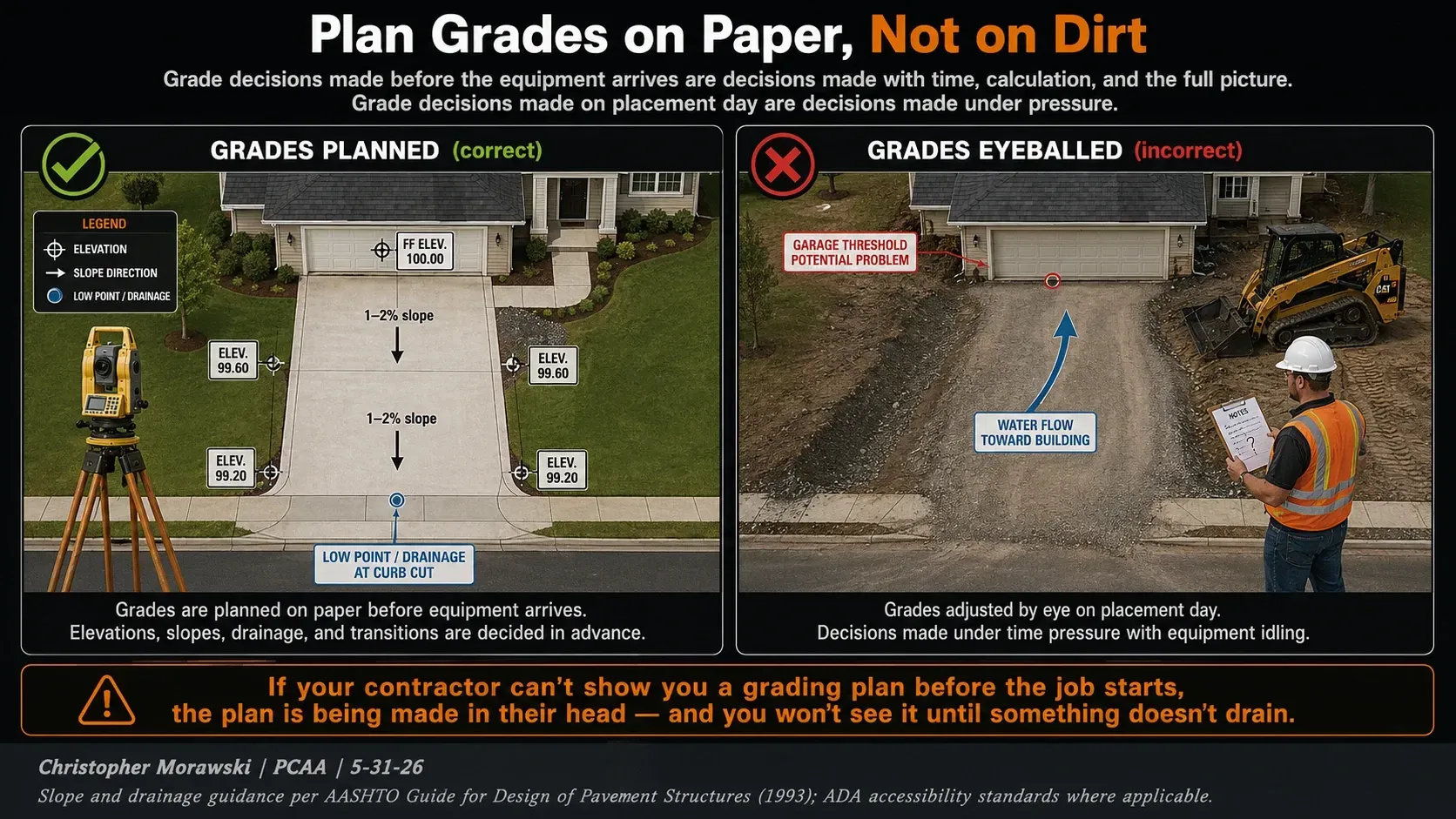
Ask the contractor to physically show you the drainage path. Not with vague words — literally ask, "When it rains hard, where does the water go?" and expect them to trace it with a finger. If the contractor cannot explain the existing drainage pattern and the proposed pattern after the work, they may not have actually thought through the job. On commercial lots, ask about catch basin elevations relative to finished pavement, curb flow lines, roof drain discharge points, dumpster areas, snow storage, ADA-compliant slopes across accessible routes, and whether the paving plan will accidentally create shallow "birdbaths" that hold water.
On residential driveways, ask about the garage door threshold, the side yard grade, culvert conditions at the road, and how water moves across the apron. A driveway that pitches even slightly toward the garage moves water toward the interior — a serious issue with an attached garage, where water can migrate under the foundation. A driveway that pitches away from the garage but ponds midway holds water long enough to accelerate freeze-thaw damage.
Drainage correction may require more than asphalt work: regrading adjacent yards, base reconstruction, ditching along the road frontage, culvert replacement, trench drains, catch basin repair, or a formal stormwater review. Wisconsin DNR guidance is clear that landowners are responsible for site-specific erosion control and stormwater management plans and best management practices where required, and those plans must account for local municipal ordinances. [WI-DNR-STORMWATER] For projects disturbing one acre or more, a DNR construction site stormwater permit is generally required before land-disturbing activity begins. That can absolutely capture a large commercial redevelopment or subdivision paving job. If a contractor says the DNR is not involved on a project disturbing multiple acres, verify that independently before signing. [WI-DNR-CONSTRUCTION]
A. Water is one of asphalt's biggest enemies, and Wisconsin's freeze-thaw cycle turns trapped water into cracking, heaving, potholes, and base failure faster than in warmer climates. Asphalt alone cannot fix an underlying drainage problem — real correction may require regrading, ditching, culvert replacement, trench drains, catch basin repair, or in larger cases a formal stormwater review, and landowners are responsible for erosion-control and stormwater plans where required. [WI-DNR-STORMWATER] A contractor who quotes a price without tracing where the water goes is quoting the surface, not the problem.
Step 19: For Commercial Parking Lots, Add ADA, Traffic, and Business Operations
Hiring for a commercial parking lot is not just a larger driveway. A commercial lot involves customer access, employee parking, delivery trucks, dumpster pickup routes, emergency vehicle access, loading dock activity, pedestrian routes, ADA-designated spaces and access aisles, signage, striping, curb ramps, traffic control during construction, tenant coordination, phasing, after-hours work, and safety for both workers and customers. The written proposal should identify which of those items are included in the base bid and which are excluded or handled separately.
Ask whether striping is included. Ask whether the ADA layout — accessible stalls, access aisles, pavement symbols, van-accessible spaces and signage, and accessible routes — is included in the base bid or requires a separate scope or professional review. Ask whether catch basin adjustments to the new pavement elevation are included. Ask whether concrete curb, gutter, sidewalk, or dumpster pads are included. Ask whether the contractor will maintain access to entrances, whether the job will be phased so the business stays open, and how closures will be communicated to tenants, customers, delivery drivers, and emergency responders.
ADA compliance deserves its own attention, because it is federal law and it is specific. The 2010 ADA Standards for Accessible Design govern parking lot requirements: a minimum number of accessible stalls based on total count, at least one van-accessible space for every six accessible spaces (minimum one), maximum slope in any direction across accessible parking and access aisles (1:48, about two percent), stall and aisle dimensions, and signage. [ADA-2010] A qualified paving contractor should identify these up front, but the property owner remains ultimately responsible for compliance — a lot with striping that does not match ADA requirements exposes the owner to complaints and civil liability even after full payment. If the scope is unclear about ADA responsibility, get it clarified in writing before signing.
Because ch. ATCP 110 does not reach commercial contracts, the written scope is the protection on a commercial lot — there is no home improvement rulebook standing behind you. On a commercial project, a detailed scope prevents the property manager, tenants, owner, paving crew, striping sub, and municipality from each assuming something different. And for sites disturbing one acre or more, DNR construction site stormwater permitting applies, with the erosion control and stormwater management plans completed before the permit application is filed — details in Appendix E. [WI-DNR-CONSTRUCTION]
Step 20: Understand Overlays, Removal, Milling, Pulverizing, and Patching
Owners frequently ask, "Can't we just pave over the existing surface?" Sometimes yes. Sometimes absolutely not. An overlay can be appropriate when the existing pavement and base are structurally stable, drainage is acceptable, elevations allow additional height at garages and curbs, and cracks can be properly prepared before the new mat is placed. An overlay is a poor choice when the base is failing, water is trapped in the existing pavement, elevations are already tight at a garage door or curb, cracking is severe (particularly alligator cracking), or the pavement is actively moving under load.
Removal and replacement takes out the existing asphalt and rebuilds the surface, often with base correction — the most invasive and typically most expensive method, but the only one that fully addresses base failure. Milling removes a controlled depth of existing asphalt — one and a half or two inches, for example — often to hold elevations at curbs, garages, and sidewalks before an overlay; "mill and pave" is common on commercial lots where elevations must be preserved. Pulverizing grinds the existing asphalt and part of the base together into a recycled aggregate base that is regraded, compacted, and paved over — a middle ground that addresses base issues without hauling the old pavement away, when the equipment and conditions are right. Patching repairs failed areas only; it is often the right call for isolated potholes or preparation ahead of an overlay, but it does not solve widespread failure.
One more product to understand before comparing methods: recycled asphalt millings. Properly spread and compacted, millings can be a legitimate budget surface for a rural drive or a temporary lot — but they are a granular recycled material, not hot-mix pavement, and they do not perform like it. A "discount asphalt driveway" that turns out to be a thin dump of loose millings is a documented variation of the leftover-material pitch in Step 17. If a bid says asphalt, confirm in writing that it means hot-mix asphalt, placed and rolled to a stated compacted thickness — not millings.
Ask the contractor why they chose the method they are recommending. If one bid is an overlay and another is full removal and replacement, they are not comparable proposals — they are different projects with different lifespans and costs. Ask what risk remains after the recommended method. A trustworthy contractor can say, "This overlay is cheaper up front, but reflective cracking will likely return within a few years as the underlying cracks telegraph through," or "This section needs true base repair or the pothole will come back next spring." That honesty lets the owner choose based on risk profile rather than sticker price. No method is a magic fix, and a contractor who sells one method as always right regardless of site conditions should worry you — the entire point of WAPA's design guidance is that the right section depends on the site in front of you. [WI-WAPA-DESIGN]
A. An overlay works when the bones are good: stable pavement and base, acceptable drainage, room for added height at garages and curbs, and defects that can be prepared before the new mat goes down. It fails when those conditions are missing — a failing base, trapped water, tight elevations, or widespread alligator cracking telegraphs through the new surface no matter how well it is placed. No method is one-size-fits-all; the right section depends on the site. [WI-WAPA-DESIGN]
Step 21: Do Not Ignore Weather and Seasonality
Wisconsin asphalt is seasonal. Weather affects scheduling, compaction, base stability, plant availability, hauling logistics, and how quickly pavement can be opened to traffic. Rain delays excavation and paving. Cold air shortens the time available to place and compact hot mix before it cools past the point of effective compaction. Spring thaw can reveal soft subgrade that was invisible during cold-weather bidding — and seasonal spring load restrictions on Wisconsin roads can limit when heavy loads of mix and equipment can be hauled. Any contractor who promises perfect results in any weather is selling confidence, not quality.
WAPA's design guide reflects the climate directly. It divides Wisconsin into a Southern Asphalt Zone and a Northern Asphalt Zone with different binder grades — the two numbers in a grade are the pavement's high-temperature rutting limit and low-temperature cracking limit. Southern Zone upper layers typically use 58-28 binder; the Northern Zone uses 58-34 for the upper layers of new construction, reconstruction, and replacement projects, while lower layers are 58-28 in both zones and overlays in either zone typically use 58-28. [WI-WAPA-DESIGN] Owners do not need to memorize designations — but they should recognize that the mix has real climate-driven differences and is not a one-size-fits-all product.
The design guide also publishes Wisconsin's normal paving windows: roughly April 15 through November 1 in the Southern Zone, and May 1 through October 15 in the Northern Zone, with minimum air temperatures of 36 degrees Fahrenheit and rising for surface mixes and 32 degrees and rising for lower layers. [WI-WAPA-DESIGN] Once asphalt plants close for the season, hot mix is unavailable regardless of what the calendar says — so a late-October project that slips on weather may not resume in November; it may become a spring project. Understanding that risk before signing is the difference between a difficult conversation and a surprise.
Ask each contractor what conditions will delay the work, what happens if the base is wet on the scheduled day, and whether a late-season job is handled differently from a mid-summer job. A weather delay is not automatically contractor failure — it is often careful quality control. The real problem is poor communication, and Wisconsin's rules address it directly: Wis. Admin. Code ATCP 110.027 requires a home improvement contractor to give the buyer timely notice of any impending delay, with the reasons and proposed new deadlines, and whenever a written contract is required or signed, no change in a performance deadline is effective unless the buyer agrees to it in writing. The rule's list of automatic excuses is short — delay caused by the buyer, a destructive act of nature such as a tornado, flood, or fire, or disruptive civil disorder. Ordinary rain and cold are not on that list; they are handled through notice and written schedule changes, which is exactly why the contract needs a realistic window in the first place. [WI-ATCP-110.027]
A. Roughly April 15 through November 1 in southern Wisconsin, and May 1 through October 15 in the north, per WAPA's design guide — with surface mixes placed at air temperatures of 36 degrees Fahrenheit and rising, and lower layers at 32 and rising. [WI-WAPA-DESIGN] The practical limit is the asphalt plants: once they close for the season, hot mix is unavailable no matter what the calendar says, so a late-October job that slips on weather often becomes a spring job. Plan fall projects with that cliff in mind.
Step 22: Inspect the Job During Construction Without Micromanaging the Crew
Once the job is under way, document it calmly. Take before photos from consistent angles. Take photos after removal showing the exposed base, during base preparation, at soft areas that were undercut, at drainage changes, during asphalt placement, at final compaction, and after cleanup. Do not stand behind operating equipment or walk into an active work zone — ask the foreman when it is safe to look, and respect the answer. Good photos protect both the owner and the contractor, because they establish exactly what was done and when.
Compare the work to the proposal at defined checkpoints. If the contract specifies nine inches of compacted aggregate base, photograph the base before it is covered. If the scope calls for saw-cut edges, verify them before new material goes down. If the scope includes catch basin adjustment, confirm it happens before the final lift. If something changes mid-job — a soft spot not in the base bid, an unexpected utility, drainage different from what the site visit suggested — get a written change order documenting what changed, the new cost, and the schedule effect. Verbal changes are where a large fraction of construction disputes begin.
Do not panic when the site looks messy mid-construction. Piles of milled material, exposed base, tracked mud, and oddly parked equipment are normal on an active job. Focus on the checkpoints that matter: permits pulled, locates placed and marks preserved, base depth as specified, drainage as designed, compacted thickness placed and rolled, transitions formed at the garage and road, edges supported, and the site cleaned before demobilization. If you have a concern, raise it with the foreman or project manager calmly and factually — "I noticed the base looks softer near the corner; can you take a look?" — rather than interrupting the crew mid-pour, which creates more problems than it solves.
For commercial and multi-family projects, coordinate inspection points with the property manager and municipal inspector as applicable. Some municipalities require inspection of subgrade before base, base before paving, or final compaction before opening to traffic. The contractor should communicate scheduled inspection points in advance, and the owner should confirm required inspections actually happened before authorizing the progress payment tied to that milestone.
A. Yes — photograph the project before work begins, after removal, during base preparation, at drainage adjustments, during placement, after compaction, and after cleanup. Dated photos protect both sides. Inspect from outside active work zones, ask the foreman when it is safe to look, and focus on the defined checkpoints: permits, locates, base depth, drainage, compacted thickness, transitions, and edges. If hidden conditions change the scope mid-job, get a written change order with the new cost and schedule before the extra work proceeds. [WI-ATCP-110.05]
Step 23: Final Walkthrough Before Final Payment
Before you make the final payment, walk the completed project with the contractor and check:
- Water ponding after the first rain that follows completion
- Open seams between paving passes, and transitions at the garage and public road
- Loose edges that could crumble under tire traffic
- Cleanup of debris, and damage to grass or landscaping beyond the agreed scope
- Damaged curb or sidewalk not previously identified
- Utility covers sitting above or below the new pavement surface
- Striping and ADA markings, if in the scope
- Any scope item that appears incomplete or skipped
For a commercial lot, also check striping alignment against the layout, access aisles and van-accessible signage, traffic arrows, fire lane markings, and whether truck access to dumpsters and loading docks still functions. A lot that paves beautifully but blocks a required emergency access is not complete, and striping that misses the ADA layout exposes the owner to compliance liability even after full payment. [ADA-2010]
Ask for the final paperwork before releasing the final balance: a paid invoice or receipt, the warranty document if separate from the contract, lien waivers from the contractor and from all subcontractors and material suppliers, permit closeout or inspection documentation, and written aftercare instructions. On residential work, two Wisconsin rules back this up directly: lien waivers requested at payment protect against liens filed after you have already paid [WI-DATCP-LIENS] [WI-ATCP-110.025] , and where the work required permits, ATCP 110.03 requires the seller to furnish the buyer the certificates of inspection before final payment is due. [WI-ATCP-110.03]
Final payment should mean the project is complete according to the contract — not merely that the black surface looks new. If a punch-list item remains, document it in writing with a specific completion date, and consider holding a reasonable retainage if your contract allows it. Be fair, but do not give up leverage before punch-list items and paperwork are done: once the final check clears, the practical ability to get small items finished drops sharply. Take extra care with final payment timing if the contractor is not local or recently changed names or ownership — a local contractor with a shop, employees, and a decade of Wisconsin work has strong reasons to come back for a small fix; a crew that will be in another state next week does not.
Step 24: Get Aftercare Instructions in Writing
New asphalt requires proper care during its early life. Ask the contractor, in writing: when vehicles may drive on the new pavement, when heavier vehicles and trailers may use it, when sealcoating is appropriate (typically not immediately — waiting six months to a year for the pavement to cure is the common industry guidance), how to avoid tire scuffing in hot weather, how to handle point loads from trailer jacks, kickstands, and dumpsters, and how snowplowing should be handled the first winter. Ask what is normal early wear and what is not: some texture variation, tire marks, and slight color differences are normal in the first months; standing water, severe rutting, loose edges, and first-year cracking usually are not.
Aftercare instructions should also identify warranty exclusions clearly. One thing that does not exist is a standard Wisconsin asphalt warranty: warranty terms are whatever your contract says, which is why the comparison worksheet in Appendix C carries rows for warranty term, coverage, and exclusions. In practice, a written residential workmanship warranty is a reasonable expectation, a warranty measured in years rather than months is worth asking for, and a warranty that exists only verbally should be treated as no warranty at all — while remembering that any warranty is only as strong as the company's likelihood of answering the phone in year three. Common exclusions in asphalt work include damage from:
- Fuel or oil spills, and deicing chemicals
- Sharp turning under load, and heavy point loads (dumpsters, trailer tongues, jacks)
- Garbage trucks or other repeated heavy loads on residential pavement not designed for them
- Snowplow blades set too low
- Base movement outside the paved scope, and drainage conditions not corrected by the paving work
- Settlement from private utility work below the pavement, and extraordinary acts of nature
WAPA's homeowner guidance explains why some early marking is normal: asphalt is a flexible pavement whose binder stays somewhat pliable for the life of the pavement, softening and hardening as temperatures rise and fall. In hot weather, and in spring during the freeze-thaw cycle when pavement is most susceptible to marking, turning the steering wheel while the vehicle is not moving can scuff the surface — especially with front-wheel drive vehicles or low-profile tires — and WAPA notes most such marks disappear over time. [WI-WAPA-DRIVEWAY] They are generally cosmetic, not a workmanship defect. Understanding what is normal prevents unnecessary warranty disputes.
Do not assume sealcoating fixes structural problems. WAPA's guidance treats sealants as protection — helping shield the surface from vehicle fluids, applied on a maintenance contractor's advice about product and timing. [WI-WAPA-DRIVEWAY] No coating rebuilds a failed base, restores missing thickness, or stops alligator cracking driven by movement below the surface. If the pavement is failing structurally, hiring a sealcoater instead of a paving contractor only delays the real repair — and often raises its final cost, because water keeps infiltrating under the coating. For maintenance timing, a common industry recommendation is sealcoating a driveway every three to five years depending on use and exposure, but the written aftercare document should give the contractor's specific advice for your pavement, including crack filling (WAPA: fill cracks with crack filler in the spring) and snowplow blade guidance for the first season.
A. Written aftercare instructions tell you when it is safe to drive on the new surface, when heavy vehicles are allowed, how to avoid scuffing in hot weather, how to handle point loads, when sealcoating is appropriate, and how the first winter's plowing should be managed — and they prevent avoidable damage during the pavement's most vulnerable months. Sealcoating does not fix structural problems: it protects and refreshes a suitable surface but does not rebuild a failed base, restore missing thickness, or eliminate alligator cracking caused by movement below. WAPA treats sealants as protection against vehicle fluids, applied on professional advice about timing — if the pavement is failing structurally, a coating only delays the real repair. [WI-WAPA-DRIVEWAY]
A. WAPA's guidance says a properly designed and built asphalt driveway can deliver virtually trouble-free service for up to 20 years. [WI-WAPA-DRIVEWAY] What shortens that: a weak or wet base, unresolved drainage, loads the pavement was never designed for — dumpsters, heavy trucks, trailer point loads — plow damage along unprotected edges, and neglected cracks that let water into the base through Wisconsin's freeze-thaw cycles. The design and drainage decisions made before paving matter more to lifespan than anything done after it.
Step 25: What to Do If Something Goes Wrong
If a problem appears, start with documentation and calm communication. Take dated photos. Collect the contract, proposal, invoice, payment records, permit records, messages, and warranty documents. Contact the contractor in writing — email works, but a letter by certified mail creates a stronger record if things escalate. Describe the problem factually, identify the specific contract item involved, and request a site review or specific remedial action (the problem-call script is in Appendix B). Many issues resolve directly when both sides stay factual.
If the contractor does not respond, or the situation involves suspected deceptive practices, use DATCP's formal consumer complaint process — online or by mail. Consumer Protection staff typically contact the consumer after reviewing the submission, then contact the business on the consumer's behalf. DATCP notes that it cannot force a business to resolve a complaint, but that this contact often results in a solution. [WI-DATCP-COMPLAINT] Between a complaint and a full lawsuit sits Wisconsin's small claims court, and for residential-scale disputes it is often the right-sized tool: contract claims of $10,000 or less (tort claims cap at $5,000) are filed in the small claims division of the circuit court, with simplified procedures many owners navigate without an attorney. [WI-COURTS-SMALLCLAIMS] For scams, threats, unauthorized work, or a crew that disappears with money, contact local law enforcement with vehicle descriptions and plate numbers — the escalation triggers are covered in Step 17. [WI-DATCP-SEWI-ALERT] [WI-DATCP-TRANSIENT]
For larger disputes — unpaid subcontractor claims, a lien filed against your property, injury, or major damage — talk to a Wisconsin attorney, because Wisconsin lien law runs on hard deadlines. A lien claimant must serve the owner a written notice of intent at least 30 days before filing; must file the lien claim within six months of its last work — with the clerk of circuit court in the county where the property sits, not the county clerk's office; and must sue to enforce within two years of filing, or the lien lapses. [WI-STAT-779.06] On residential projects, prime contractors owe the owner a lien-rights notice in the contract or within 10 days of first work, and subcontractors and suppliers who did not contract with you directly owe one within 60 days of first furnishing labor or materials; most commercial projects are exempt from those preliminary notices, but the 30-day notice of intent applies to everyone. [WI-STAT-779.02] If a lien appears or subcontractors claim nonpayment, an attorney can protect your position quickly.
Wisconsin law also has teeth for the worst cases. Money you pay a prime contractor for a project is held in trust under Wis. Stat. § 779.02(5): using it for anything other than paying the project's labor and material claims is theft by the contractor, prosecuted under the general theft statute with penalties graduated by the amount taken — from a misdemeanor below $2,500 to felony exposure of years in prison as amounts climb. [WI-STAT-779.02] [WI-STAT-943.20] Separately, violations of the home improvement rules themselves (ch. ATCP 110) carry criminal penalties of up to a $5,000 fine and one year of imprisonment, and civil forfeitures of up to $10,000, under Wis. Stat. § 100.26. [WI-STAT-100.26] Wis. Stat. § 100.65 adds separate protections for exterior repair contracts paid from insurance claims. [WI-STAT-100.65] [WI-DATCP-HI]
Two timing rules are worth knowing before anyone sues. Wisconsin's Right to Cure law, Wis. Stat. § 895.07, requires written notice of construction defects and a chance to respond — on a 90-working-day clock — before certain lawsuits over dwelling construction and remodeling; whether it reaches a standalone driveway contract is a genuine legal question (its definitions are keyed to constructing or remodeling a dwelling, and it does not cover commercial work), so let your attorney make that call rather than skipping the step. [WI-STAT-895.07] And claims on a written contract generally carry a six-year limitation period under Wis. Stat. § 893.43. [WI-STAT-893] None of this is legal advice — it is the map of deadlines to bring to the lawyer, early.
Appendix A: Wisconsin Asphalt Hiring Checklist
Use this checklist before signing any asphalt contract. Every item is covered in the step noted.
- Write a one-paragraph project description: square footage, observed failures, expected use, long-term repair or budget fix (Step 1)
- Identify the work type you actually need — replacement, overlay, patching, milling, pulverizing, base repair, drainage, sealcoat, striping (Steps 1, 20)
- Check local permit requirements with the municipality, or get the contractor's permit answer confirmed in writing (Step 3)
- Ask whether the project touches the right-of-way, apron, curb, gutter, sidewalk, culvert, ditch, or storm sewer (Step 3)
- Confirm in writing who contacts Diggers Hotline, and whether private utilities need separate locating (Step 4)
- Verify each bidder's legal business name through the Wisconsin DFI corporate records search (Step 5)
- Verify any claimed credential through the DSPS License Lookup — remembering no state paving license exists (Step 6)
- Ask the municipality whether it licenses or bonds paving contractors, and get the contractor's number if so (Steps 3, 6)
- Get a current insurance certificate sent directly from the agent — never a screenshot (Step 7)
- Require a written scope separating base, drainage, thickness, materials, exclusions, warranty, and payment terms (Step 9)
- Compare bids line by line on the Appendix C worksheet before looking at total price (Step 11)
- Reject same-day pressure, leftover-material pitches, cash-only demands, and checks to individuals (Step 17)
- Call references for similar work — same property type, scale, and municipality where possible (Step 16)
- Confirm the payment schedule follows documented progress — never full payment upfront (Step 14)
- Confirm how lien waivers will be handled at progress payments and final payment (Step 13)
- Confirm the start window, completion expectations, and the written process for weather delays (Step 21)
- Read the warranty coverage and exclusions before signing, not after a problem (Step 24)
- Know the final-payment paperwork: paid invoice, warranty, lien waivers, permit closeout and inspection certificates, aftercare instructions (Step 23)
- Plan photo documentation before, during, and after construction (Step 22)
- Get written aftercare instructions covering drive-on timing, heavy vehicles, sealcoat timing, and first-winter plowing (Step 24)
If you can check these boxes before signing, you are no longer guessing — you are hiring like an owner who understands construction risk and consumer protection. It does not guarantee a perfect project; construction still involves weather, hidden conditions, and honest surprises. But it substantially reduces the chance of hiring the wrong contractor for the wrong scope at the wrong price, and it is exactly the discipline Wisconsin's home improvement rules and DATCP's consumer guidance are built around. [WI-DATCP-HI]
Appendix B: Owner Script Library — What to Say at Every Stage
That opening tells the contractor you are serious and prepared. Legitimate contractors welcome it, because it means they are not competing against vague low-ball bids.
A contractor's speed and clarity in answering is itself useful data.
That last question draws out hindsight rather than a testimonial.
It works at the driveway, and it works on the phone against same-day-service pressure. If the crew pushes after that line, go inside — and see Step 17 for when to call law enforcement. [WI-DATCP-TRANSIENT]
Appendix C: Bid Comparison Worksheet
Fill in one column per contractor as bids arrive. Leave missing items blank — a blank is real information — then use the clarification email in Appendix B to fill the blanks in writing before comparing totals.
| Item | Contractor A | Contractor B | Contractor C |
|---|---|---|---|
| Legal business name | |||
| DBA, if any | |||
| Local physical address | |||
| DFI corporate record verified | |||
| Municipal license or bond, if the municipality requires one | |||
| Claimed credentials verified through DSPS, if any | |||
| Insurance certificate received directly from agent | |||
| Permit responsibility identified | |||
| Diggers Hotline responsibility identified | |||
| Private utility locating discussed | |||
| Project area measured on site | |||
| Existing pavement condition described | |||
| Recommended method (overlay, remove and replace, mill and pave, pulverize, patch) | |||
| Removal or milling depth | |||
| Excavation depth | |||
| Aggregate base material | |||
| Aggregate base depth | |||
| Compacted asphalt thickness | |||
| Number of asphalt lifts | |||
| Mix type or binder grade specified | |||
| Compaction equipment listed | |||
| Drainage plan described | |||
| Apron and right-of-way work scope | |||
| Culvert work | |||
| Curb, gutter, and sidewalk work | |||
| Catch basin adjustments | |||
| Striping and ADA work | |||
| Traffic control during construction | |||
| Schedule window | |||
| Payment terms | |||
| Lien waiver process | |||
| Warranty term and coverage | |||
| Warranty exclusions listed | |||
| References provided and called | |||
| Site cleanup responsibility | |||
| Total price |
Then calculate the number that actually matters: the complete-scope price. For each bid, add the base bid plus any options, plus likely change-order pricing for the exclusions, plus anything clarified by email. That complete-scope number is the real apples-to-apples comparison — and the number to budget from, not the initial base bid. Do not be surprised if the contractor with the higher sticker price and fewer blanks turns out to be the cheaper complete-scope bid: inexpensive-looking bids are often inexpensive because the costly parts of the truth are missing, and they come back later as change orders.
For commercial and multi-family projects, add rows for phasing detail, tenant coordination, night or weekend work, emergency access maintenance, closure communication, dust and noise control, and post-completion warranty inspections — whatever reflects the actual operational complexity of your property.
A. It may mean the contractor is more efficient, but it more often means the bid is missing work that other contractors included. Common items that quietly disappear from cheap bids: base preparation depth, drainage correction, apron and right-of-way work, permit fees, catch basin adjustments, striping and ADA compliance, cleanup, warranty coverage, and subcontractor insurance. DATCP specifically warns consumers to be leery of extremely low estimates and to make sure all contractors are bidding on exactly the same work. Once the missing items return as change orders during construction, the "cheap" bid frequently ends up costing more than the bid it beat at signing. [WI-DATCP-HI]
Appendix D: Wisconsin Residential Driveway Hiring Notes
Residential driveways look simple from the road, but several details decide whether the finished driveway feels correct or frustrating. The garage transition must be low enough for smooth entry but high enough to shed water away from the garage. The road apron must meet municipal rules without creating a bump that catches snowplow blades. The edges need support — grass shoulders, stone shoulders, curb, or compacted shoulder material — so they do not crack when tires run near the side. Ask the contractor to address each of these in the written scope.
Tell the contractor about parking habits before the bid is prepared. If you regularly park heavy pickups, work vans, trailers, campers, boats, dumpsters, or delivery vehicles, say so: pavement design depends on projected loading, and WAPA specifically notes pavement should be designed for local conditions and projected vehicle loadings. [WI-WAPA-DRIVEWAY] A proposal that assumes passenger cars will be underbuilt for how you actually use the driveway. The extra cost of designing for heavier loads at the front end is small; the cost of redoing an underbuilt driveway is not.
Ask about the first winter. Snowplows catch high edges, loose transitions, and unprotected corners. If you plow your own driveway, ask when the pavement is ready for plowing and how to set the blade; if a snow contractor plows it, hand them the aftercare instructions. The first season is when to be most careful about sharp steering-wheel turns while stopped, point loads from trailer jacks, and plow damage along vulnerable edges.
For steep driveways, ask how the slope affects the placement plan — paver traction, roller access, consistent lift thickness on the grade, and the transitions where the driveway meets the garage floor and the road. On very steep drives, extra edge support or a textured finish may be worth discussing for winter traction. For driveways with visible clay soil, sandy pockets, or a history of yard drainage problems, discuss subgrade preparation in detail: Wisconsin soils vary widely, and a driveway on marginal subgrade without adequate base depth and drainage will not perform like one on stable native soil. WAPA calls for a subgrade that is smooth, firm, even, contoured, and free of organic material and topsoil — and its design guide scales base depth up as subgrade quality drops. If the site visit reveals muck pockets or a high water table, expect the base scope, and the price, to reflect it. [WI-WAPA-DRIVEWAY] [WI-WAPA-DESIGN]
A. Yes — before the bid is prepared. Pavement design depends on projected vehicle loading, and WAPA's guidance is explicit that the contractor should design for it. A driveway designed for passenger cars but used by work trucks, trailers, or dumpsters will fail sooner than it should, and the small cost of designing correctly up front beats the large cost of redoing an underbuilt driveway. [WI-WAPA-DRIVEWAY]
Appendix E: Wisconsin Commercial and Multi-Family Hiring Notes
Commercial and multi-family asphalt work should be treated as a small construction project, not a quick paving sale. Before asking for final pricing, identify decision-makers, tenants, residents, emergency access needs, delivery windows, dumpster pickup schedules, event dates, municipal inspection points, and traffic-control requirements. A lot that must stay open during business hours requires substantially more planning than a vacant one — and identifying the operational details before soliciting bids lets contractors price the phasing accurately instead of pricing a simplified job and change-ordering reality later.
Ask about phasing in detail. Which areas close first? Where do customers park during each phase? How do deliveries and emergency vehicles reach the property? Will the contractor work weekends, evenings, or overnight? How will residents and tenants be notified? Who moves parked vehicles, and what happens if one remains in the work area on paving day? How will fresh, uncured asphalt be protected from traffic before it is ready to open?
Ask whether the proposal includes concrete work. Commercial lots often fail first around catch basins, curb lines, dumpster pads, loading dock areas, and sidewalk ramps — where point loads, heavy turning, and truck weights concentrate. Asphalt is not the right material everywhere on every lot: heavy dumpster trucks destroy asphalt pads over time, and a good contractor should be willing to recommend concrete pads at dumpster areas, concrete curb repair, or concrete at loading dock aprons where asphalt alone is the wrong answer.
For sites disturbing one acre or more, Wisconsin DNR construction site stormwater permitting applies. The landowner is generally responsible: the erosion control and stormwater management plans must be developed and completed first, and then the permit application (the WRAPP, Wisconsin's equivalent of the Notice of Intent) must be filed at least fourteen working days before construction begins. The whole project's acreage counts toward the one-acre threshold even when work is phased with less than an acre open at a time. Confirm in writing which party — the contractor, an engineering consultant, or the owner — is preparing the plans and filing. [WI-DNR-CONSTRUCTION] [WI-DNR-STORMWATER]
For ADA compliance, the 2010 ADA Standards impose minimum counts and specific dimensions for accessible stalls, access aisles, van-accessible stalls, accessible route slopes, pavement symbols, and signage — and resurfacing an existing lot can trigger upgrade obligations. [ADA-2010] The proposal should identify which ADA items are in the base bid, which are excluded, and who verifies the finished layout. Property owners and managers remain ultimately responsible for ADA compliance regardless of what the paving contract says. And remember the scope note from the start of this guide: ch. ATCP 110's home improvement protections do not reach commercial contracts, so on a commercial lot the written scope is the protection — exclusions and all.
A. Yes — because the hardest-working corners of a commercial lot (catch basins, curb lines, dumpster pads, dock aprons, sidewalk ramps) concentrate point loads and truck weights that asphalt alone is not always the right material for. A contractor confident enough to recommend concrete where concrete belongs is showing you design judgment, not upselling. The proposal should state whether concrete work is included or excluded — and because Wisconsin's home improvement rules do not govern commercial contracts, that written scope is the commercial owner's real protection.
Source List with Live Links
Every citation label used in this guide is listed below with a full title, description, and a live URL. Verify anything in the body copy directly at the source.
[WI-DATCP-HI] Wisconsin DATCP – Home Improvement Consumer Tips.
Official Wisconsin consumer guidance on hiring contractors: written contract requirements, lien waiver rights, transient contractor warnings, reference-call questions, and the certified-mail cancellation procedure. Note that the three-business-day right to cancel it describes arises under the Wisconsin Consumer Act, Wis. Stat. ch. 423. https://datcp.wi.gov/Pages/Publications/HI-ConsumerTips136.aspx
[WI-DATCP-LIENS] Wisconsin DATCP – Liens (Publication 262).
DATCP consumer publication explaining lien waivers, proportional waivers on installment payments, the six-month lien filing deadline, and the at-least-30-day notice of intent on Wisconsin home improvement projects. https://datcp.wi.gov/Documents/Liens262.pdf
[WI-DATCP-TRANSIENT] Wisconsin DATCP – Home Improvement Transients (Publication 196).
Official DATCP publication warning consumers about transient home improvement workers who specialize in blacktopping driveways, lightning rod installation, painting, roofing, and siding, with guidance on refusing high-pressure tactics, not letting workers into the home, and alerting law enforcement. https://datcp.wi.gov/Documents/HI-Transients196.pdf
[WI-DATCP-SEWI-ALERT] Wisconsin DATCP – Consumer Alert: Traveling Asphalt Crews Reported in Southeastern Wisconsin (September 8, 2023).
Formal DATCP consumer alert reporting numerous reports of a possible door-to-door asphalt scam in Southeastern Wisconsin including the Waukesha County area, describing the truck-broke-down / leftover-asphalt pitch and advising consumers to turn away solicitors and contact local law enforcement. https://datcp.wi.gov/Pages/News_Media/20230908ConsumerAlertAsphaltCrews.aspx
[WI-ATCP-110.03] Wisconsin Administrative Code ATCP 110.03 – Building permits.
Home improvement rule requiring the seller to inform the buyer of all required building or construction permits before contracting, barring work until required permits are issued (with a subproject carve-out), and requiring inspection certificates be furnished to the buyer before final payment is due. https://docs.legis.wisconsin.gov/code/admin_code/atcp/090/110/03
[WI-ATCP-110.025] Wisconsin Administrative Code ATCP 110.025 – Lien waivers.
Home improvement rule requiring a separate, conspicuous, retainable pre-contract "Notice of Consumer's Right to Receive Lien Waivers" with prescribed wording (including DATCP's hotline, 1-800-422-7128), acknowledgment of receipt, and written lien waivers from all contractors, subcontractors, and suppliers proportionate to each payment. https://docs.legis.wisconsin.gov/code/admin_code/atcp/090/110/025
[WI-ATCP-110.027] Wisconsin Administrative Code ATCP 110.027 – Delay in contract performance.
Home improvement rule requiring timely notice of impending delays with reasons and proposed new deadlines, requiring the buyer's written agreement to any change in performance deadlines where a written contract is required or signed, and limiting automatic delay excuses to buyer-caused delay, destructive acts of nature, and civil disorder. https://docs.legis.wisconsin.gov/code/admin_code/atcp/090/110/027
[WI-ATCP-110.05] Wisconsin Administrative Code ATCP 110.05 – Home improvement contract requirements.
Home improvement rule setting out the required elements of a written home improvement contract, including that the contract be signed by all parties and clearly, accurately, and legibly set forth all material terms, the seller's name and address, description of work, price, and start and completion dates. https://docs.legis.wisconsin.gov/code/admin_code/atcp/090/110/05
[WI-DFI-CANCEL] Wisconsin DFI – Three-Day Right to Cancel (Wis. Stat. §§ 423.201–423.203).
Wisconsin Department of Financial Institutions consumer explanation of the Wisconsin Consumer Act's three-business-day cancellation right for solicited transactions over $25 signed away from the merchant's regular place of business, including the required two copies of the written cancellation notice under Wis. Stat. § 423.203. https://dfi.wi.gov/Pages/ConsumerServices/WisconsinConsumerAct/ThreeDayRightToCancel.aspx
[WI-DSPS-DC] Wisconsin DSPS – Dwelling Contractor Application Information (Form 3096).
Official DSPS application information for the Dwelling Contractor certification, which is required to obtain building permits for one- and two-family dwellings under Wis. Stat. § 101.654. Documents the financial responsibility requirement of at least $250,000 per occurrence in general liability insurance or a surety bond of at least $25,000. No comparable state credential exists for asphalt paving work. https://dsps.wi.gov/Credentialing/Trades/fm3096.pdf
[WI-DSPS-LOOKUP] Wisconsin DSPS – LicensE License Lookup.
Official Wisconsin lookup for DSPS trades credentials, including the Dwelling Contractor and Dwelling Contractor Qualifier certifications and the licensed trades (electrical, plumbing, HVAC). Because Wisconsin issues no state paving license, "no record found" is the normal result for a legitimate asphalt contractor. https://license.wi.gov/s/license-lookup
[WI-DFI-CORP] Wisconsin DFI – Corporate Records Search.
Official Wisconsin Department of Financial Institutions entity lookup for legal entity name, registered agent, registered office address, entity type, DFI entity ID, filing history, and current status. Registration proves a filing was made; it does not verify licensing, insurance, bonding, or competence. https://apps.dfi.wi.gov/apps/CorpSearch/Search.aspx
[WI-DIGGERS] Diggers Hotline – Homeowners.
Wisconsin's 811 one-call center guidance. State law (Wis. Stat. § 182.0175) requires everyone — including a homeowner working in their own yard — to contact Diggers Hotline at least three working days before digging; weekends and state legal holidays do not count. Ticket validity windows and marking mechanics are governed by Wis. Stat. § 182.0175. https://www.diggershotline.com/homeowners
[WI-DNR-STORMWATER] Wisconsin DNR – Erosion Control and Storm Water Management Plans.
State guidance under Wis. Admin. Code ch. NR 216: landowners are responsible for site-specific erosion control and stormwater management plans and BMPs where required; plans must be completed before the WRAPP (Wisconsin's Notice of Intent equivalent) is filed at least 14 working days before construction, and must conform to local ordinances. https://dnr.wisconsin.gov/topic/Stormwater/construction/erosion_control.html
[WI-DNR-CONSTRUCTION] Wisconsin DNR – Construction Site Stormwater Permits Overview.
DNR overview of construction stormwater permit coverage: projects disturbing one acre or more of land require permit coverage, and the entire proposed project's acreage counts even if the project is phased with less than one acre disturbed at any one time. https://dnr.wisconsin.gov/topic/Stormwater/construction/overview.html
[WI-WAPA-DRIVEWAY] Wisconsin Asphalt Pavement Association – Driveway Owners Guide.
WAPA's Wisconsin homeowner guidance for asphalt driveways: subgrade requirements (smooth, firm, even, contoured, free of organic material and topsoil), designing for local conditions and projected vehicle loadings with proper thickness and compaction, flexible-pavement behavior, spring crack filling, sealant use, and up-to-20-year service life. https://www.wispave.org/driveway-owners-guide/
[WI-WAPA-DESIGN] Wisconsin Asphalt Pavement Association – Asphalt Pavement Design Guide (2021).
WAPA's Wisconsin design guide, built on WisDOT standard specifications and intended for architects, engineers, developers, owners, and governmental officials. Defines the Southern and Northern Asphalt Zones and binder grades, residential-class thickness and base tables (3.0–4.0 inches of asphalt over 6–12 inches of base by subgrade quality), paving season windows, and minimum placement temperatures. https://www.wispave.org/wp-content/uploads/WAPA-Design-Guide-2021-1.pdf
[LOCAL-MF-PERMIT] Village of Menomonee Falls – Driveway Approach, Curb Cut, Curb & Gutter Permit.
Example of a local Wisconsin permit requirement. Under Village Code Chapter 90, Article II (Section 90-22), a permit is required for the construction or reconstruction of any curb, driveway, or sidewalk in the public highway, and the Village's permit page applies this to all new, repaired, or replaced driveway approaches, curbs, and gutters within the right-of-way for residential, commercial, industrial, and multi-family properties, with fees per approach and for curb work, and culvert responsibility split by road jurisdiction. https://www.menomonee-falls.org/139/Driveway-Approach-Curb-Cut-Curb-Gutter-P
[LOCAL-RC-PERMIT] City of Richland Center – Driveway Permit.
Example of a local Wisconsin permit requirement. A driveway permit is required to construct, alter, or replace any driveway that connects to a public street, crosses a sidewalk or curb, or changes access to public roadways. https://www.richlandcenterwi.gov/clerk-treasurer/page/permits
[LOCAL-MKE-ROW] City of Milwaukee – Code of Ordinances Chapter 115 (Sidewalks, Driveways, Street Privileges).
Milwaukee's rules for work in the public way: driveway approaches require Department of Public Works permits, and contractors performing concrete construction in the public way must hold a City license (s. 115-26) backed by a $5,000 performance bond guaranteeing the work for three years (s. 115-27) and indemnity security (s. 115-28). https://city.milwaukee.gov/ImageLibrary/Groups/ccClerk/Ordinances/Volume-1/CH115.pdf
[NEWS-FOX6-BBB-2026] FOX6 Milwaukee – Wisconsin BBB: Beware of Asphalt Paving Scams (April 8, 2026).
FOX6 republication of the Wisconsin Better Business Bureau's advisory on asphalt paving scams: the door-to-door extra-supplies pitch, large upfront payment demands, shoddy pavement, non-working contact information, staggered-payment advice, and documented cases of homeowners losing more than $8,000. https://www.fox6now.com/news/wisconsin-bbb-beware-asphalt-paving-scams-what-you-need-know
[NEWS-TMJ4-2026] TMJ4 Milwaukee – Franklin police warning on paving scams (April 27, 2026).
TMJ4 report on the Franklin Police Department and BBB warning about the springtime surge in asphalt paving scams, including the leftover-material-from-a-neighbor's-driveway pitch and a Franklin case in which a homeowner paid $1,500 by check for work that was never performed. Franklin police report receiving reports of the scam every spring. https://www.tmj4.com/news/local-news/a-franklin-police-dog-is-helping-warn-residents-about-shoddy-paving-work-before-they-lose-thousands-of-dollars
[NEWS-CBS58-2026] CBS 58 Milwaukee – Better Business Bureau warns of asphalt paving scams targeting homeowners (April 6, 2026).
CBS 58 report on the BBB warning about unsolicited contractors offering discounted driveway paving, with recommendations to research contractors at BBB.org, get estimates in writing, stagger payments, and pay by credit card rather than cash. https://www.cbs58.com/news/better-business-bureau-warns-of-asphalt-paving-scams-targeting-homeowners
[WI-DATCP-COMPLAINT] Wisconsin DATCP – Consumer Complaint Process.
Explains DATCP's online and mail complaint options, the Consumer Protection Hotline at 1-800-422-7128, and DATCP's process for reviewing complaints and contacting businesses on the consumer's behalf. https://datcp.wi.gov/Pages/Programs_Services/FileConsumerComplaint.aspx
[WI-STAT-779.02] Wisconsin Statutes § 779.02 – Construction lien notices; trust fund.
Preliminary lien notice requirements (prime contractor notice in the contract or within 10 days of first work; non-prime subcontractor and supplier notice within 60 days), the exceptions that generally exempt nonresidential projects from preliminary notices, and the § 779.02(5) theft-by-contractor trust fund provision covering owner payments to contractors. https://docs.legis.wisconsin.gov/document/statutes/779.02
[WI-STAT-779.06] Wisconsin Statutes § 779.06 – Filing and enforcing construction lien claims.
Requires a written notice of intent served on the owner at least 30 days before filing, filing of the lien claim within six months of the claimant's last work in the office of the clerk of circuit court of the county where the land lies, and commencement of an enforcement action within two years of filing. https://docs.legis.wisconsin.gov/document/statutes/779.06
[WI-STAT-943.20] Wisconsin Statutes § 943.20 – Theft.
Wisconsin's general theft statute, under which theft by contractor (via § 779.02(5)) is punished. Penalties are graduated by the value involved, from a Class A misdemeanor at $2,500 or less through felony classes as amounts increase. https://docs.legis.wisconsin.gov/document/statutes/943.20
[WI-STAT-100.26] Wisconsin Statutes § 100.26 – Penalties for trade practice violations.
The penalty statute behind Wisconsin's home improvement rules: criminal penalties of $25 to $5,000 in fines and up to one year of imprisonment for violations of orders and rules issued under § 100.20 (which includes ch. ATCP 110), and civil forfeitures of $100 to $10,000. https://docs.legis.wisconsin.gov/document/statutes/100.26
[WI-STAT-895.07] Wisconsin Statutes § 895.07 – Right to cure (construction defect claims).
Wisconsin's notice-and-opportunity-to-cure process for claims over defects in dwelling construction and remodeling, requiring written notice at least 90 working days before suit and a structured offer-and-response sequence. Keyed by definition to dwellings; it does not cover commercial property. https://docs.legis.wisconsin.gov/document/statutes/895.07
[WI-STAT-893] Wisconsin Statutes § 893.43 – Action on contract.
Wisconsin's general limitation period for actions on a contract: suit must generally be commenced within six years. https://docs.legis.wisconsin.gov/document/statutes/893.43
[ADA-2010] U.S. Department of Justice – 2010 ADA Standards for Accessible Design.
Federal design standards governing accessible parking: minimum accessible stall counts, van-accessible stalls, access aisle dimensions, maximum 1:48 slopes across accessible parking and access aisles, accessible routes, and signage. https://www.ada.gov/law-and-regs/design-standards/2010-stds/
[WI-STAT-182] Wisconsin Statutes § 182.0175 – Damage to transmission facilities (the one-call law).
The statute behind Diggers Hotline: at least three working days' advance notice for nonemergency excavation, ticket timing rules, tolerance-zone hand digging near marks, and the penalty framework — including the residential-owner carve-out that does not extend to anyone in the business of excavating. https://docs.legis.wisconsin.gov/document/statutes/182.0175
[WI-STAT-100.18] Wisconsin Statutes § 100.18 – Fraudulent representations.
Wisconsin's general prohibition on untrue, deceptive, or misleading representations in sales and advertising — the trade-practice statute commercial property owners rely on where the residential home improvement rules of ch. ATCP 110 do not apply. https://docs.legis.wisconsin.gov/document/statutes/100.18
[WI-STAT-100.65] Wisconsin Statutes § 100.65 – Residential contractors; exterior repairs paid from insurance proceeds.
Statute governing residential contractors on exterior repair work paid from property insurance claims, with its own consumer protections separate from the home improvement rules. https://docs.legis.wisconsin.gov/document/statutes/100.65
[WI-COURTS-SMALLCLAIMS] Wisconsin Court System – Small Claims (Self-Help Law Center).
Official Wisconsin court system guidance on small claims: claims of $10,000 or less (tort and personal injury claims $5,000 or less) filed in the circuit court's small claims division, with simplified procedures designed for self-represented parties. https://www.wicourts.gov/services/public/selfhelp/smallclaims.htm
[LOCAL-FRANKLIN-ROW] City of Franklin – Right-of-Way and Drive Approach Permits (Code Ch. 222).
Franklin requires permits for drive approaches and right-of-way work, with contractor insurance requirements of $1,000,000 per occurrence and $2,000,000 aggregate general liability plus auto and umbrella coverage, the City named as additional insured, and surety of 10 percent of project cost. https://ecode360.com/8433155