
Asphalt Paving Cost in 2026: The Complete Guide
What Drives the Price, What the Data Shows, and What to Ask Before You Sign Anything
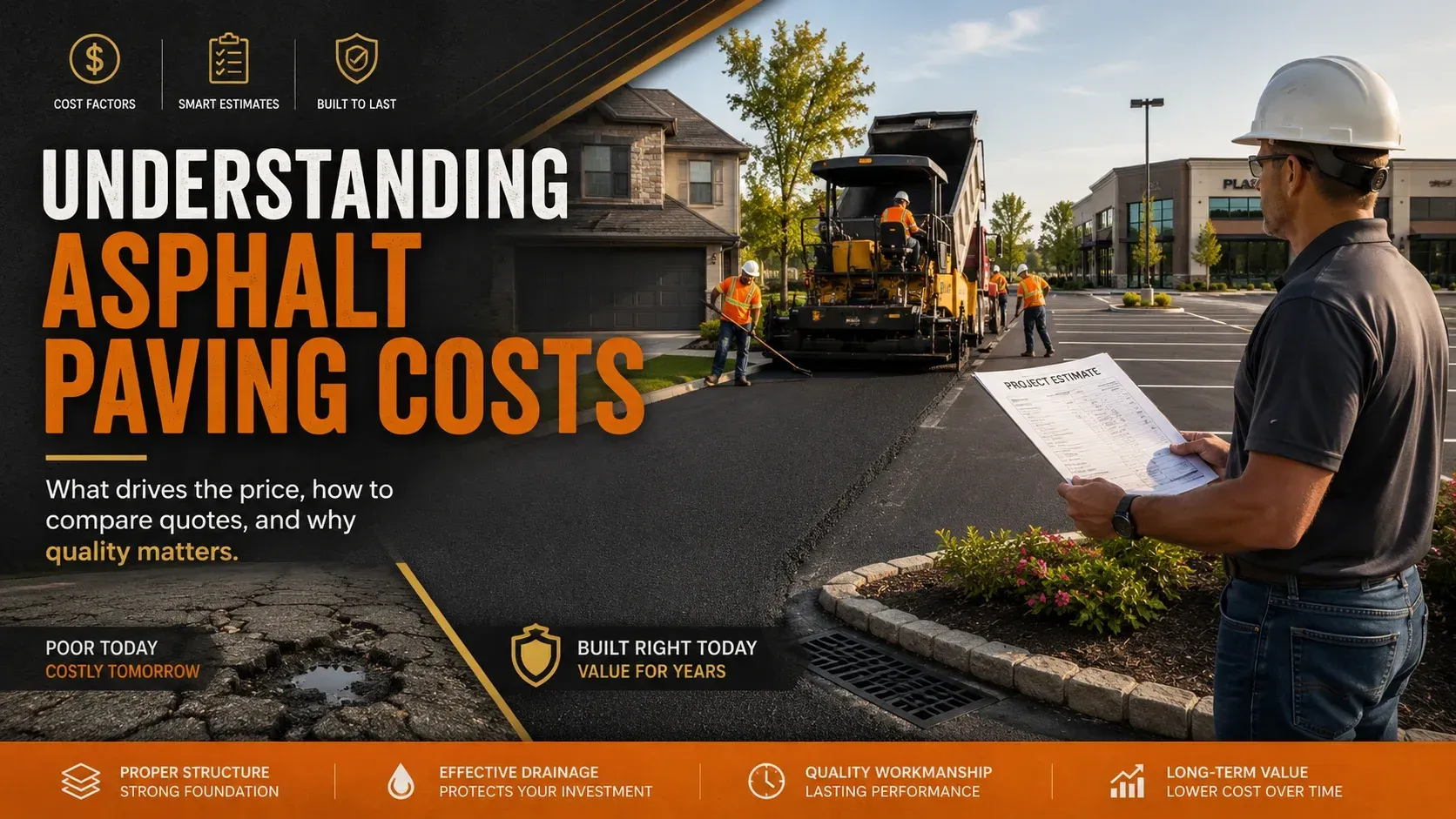
Page Index: Asphalt Paving Cost
Original Songs: Asphalt Paving Costs
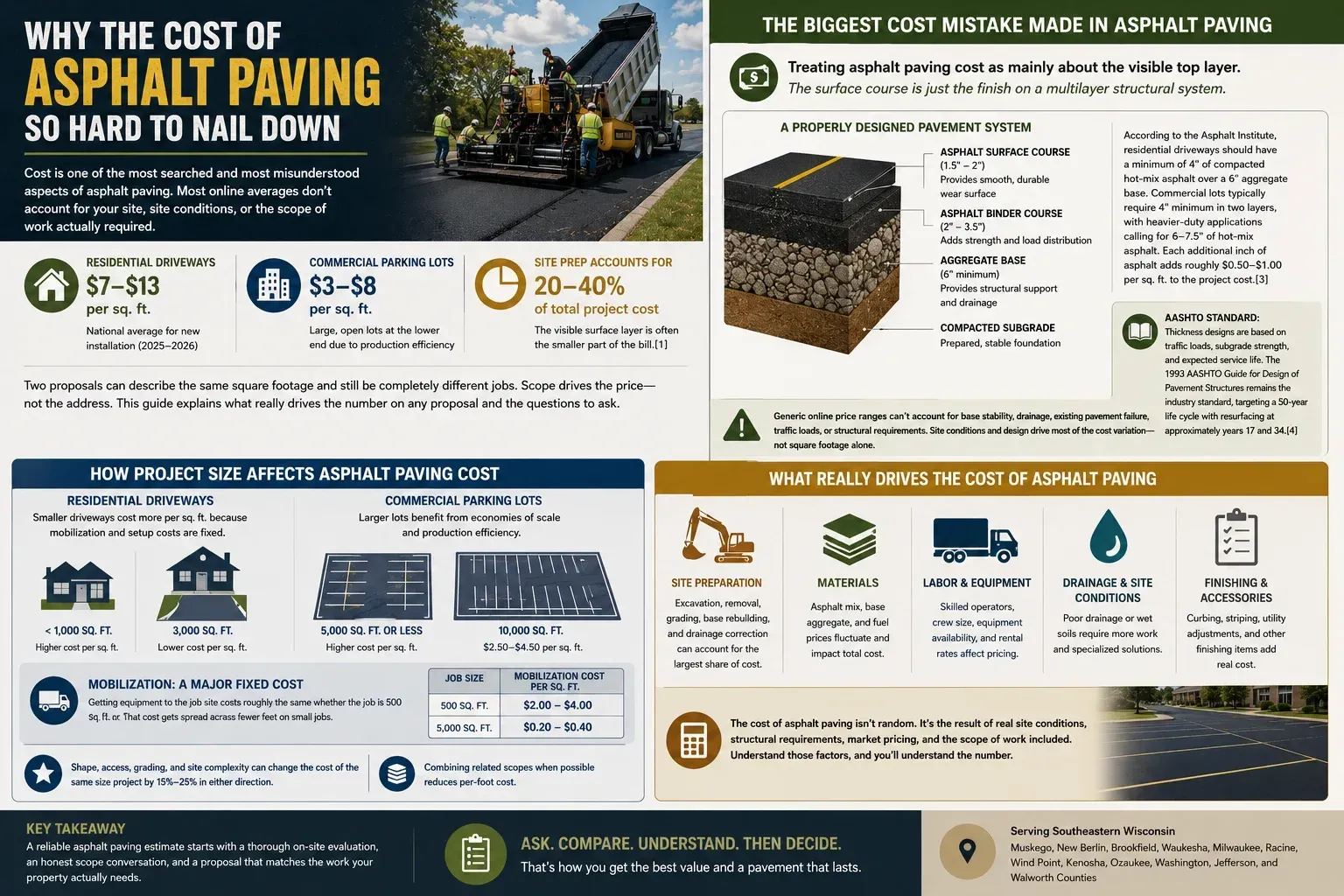
Why The Cost Asphalt Paving So Hard to Nail Down
The Biggest Cost Mistake Made in Asphalt Paving
How Project Size Affects Asphalt Paving Cost
How Site Access and Layout Affect Asphalt Paving Cost
Asphalt Paving Site Preparation Costs: Where the Real Money Goes
Asphalt Overlay vs. Full Replacement Cost: How to Choose
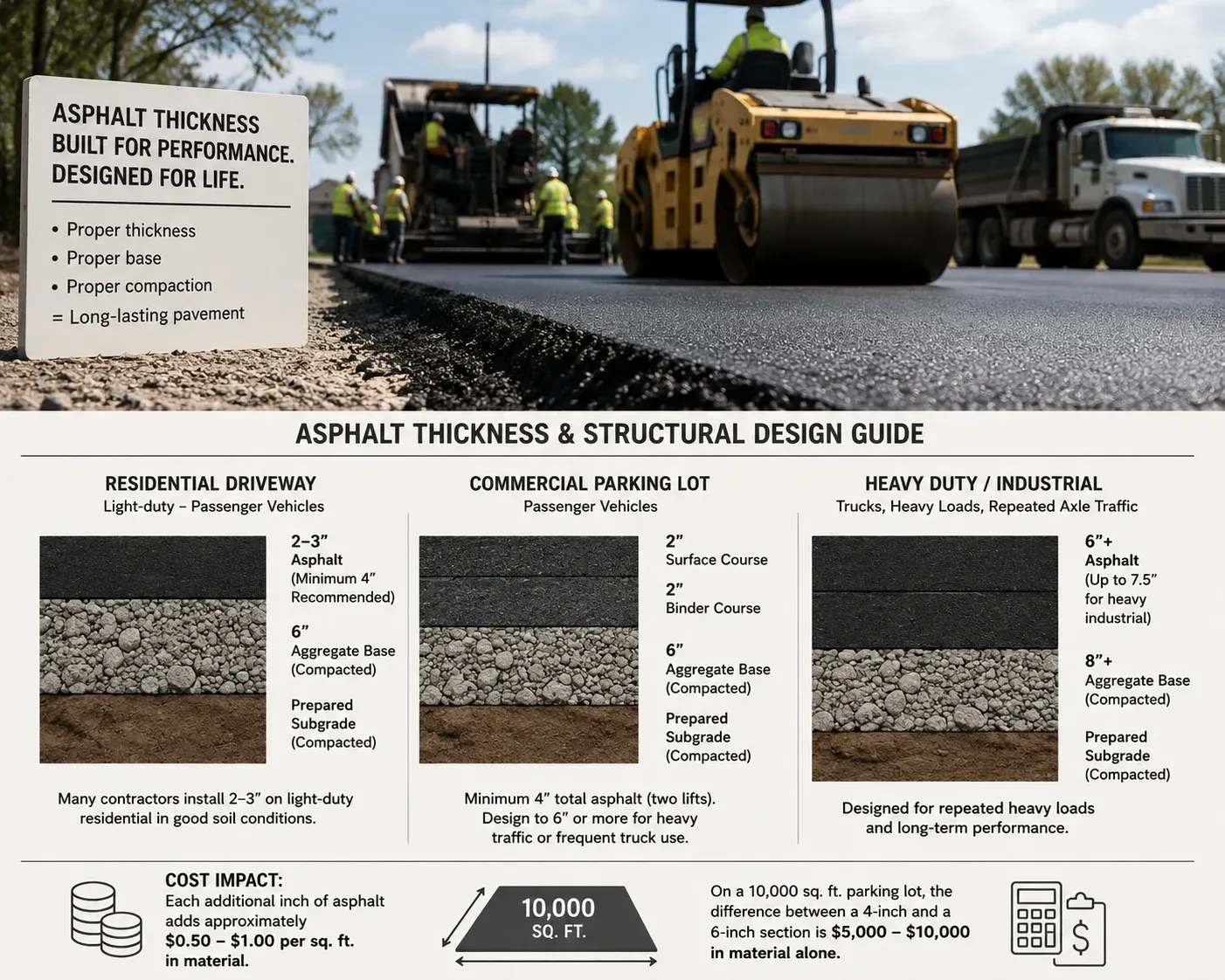
Asphalt Thickness and Structural Design: How It Affects Cost
Material Pricing, Oil Markets, and Why Asphalt Costs Shift
Recycled Asphalt and RAP: What It Is and When It Makes Sense
Drainage: The Cost Factor That Protects Everything Else
Asphalt Paving Details: Edges, Transitions, and Striping Costs
Residential vs. Commercial Paving: Where the Numbers Differ
Asphalt vs. Concrete: An Honest Cost Comparison
Asphalt vs. Pavers and Brick: The Premium Surface Option
Seasonal Timing and Its Effect on Asphalt Paving Cost
How Long Does Asphalt Paving Take: Timelines from Start to Traffic
How to Read an Asphalt Paving Quote
Why Two Asphalt Quotes Can Be So Different
Why the Cheapest Asphalt Paving Quote is Not Always the Best Value
What Asphalt Paving Actually Costs in Southeastern Wisconsin
Maintenance Costs: What to Budget After Paving
What to Ask Before Signing Any Asphalt Paving Contract
How to Choose an Asphalt Paving Contractor: What to Look For and What to Avoid
What a Thorough Asphalt Paving Estimate Actually Looks Like
Asphalt Paving Cost FAQ
The following questions are among the most commonly asked by property owners evaluating asphalt paving projects. The answers draw on current market data, industry standards, and practical experience.
If you have any questions you'd like to be added to our Q&A, please contact us.
Current market data shows residential driveway installation running $7 to $13 per square foot nationally for a new installation, with the Milwaukee area typically falling in the $4 to $7 per square foot range for standard 3- to 4-inch work including demolition of an existing surface. Commercial parking lots run $3 to $8 per square foot, with larger open lots often toward the lower end. These are ranges — not quotes. Your project cost depends on your specific site conditions, scope, access, and local market.
The biggest cost drivers are site preparation requirements, base condition, drainage correction needs, project size and shape, site access and layout complexity, asphalt thickness and structural design, distance from the asphalt plant, fuel and material prices at the time of the project, and finishing details including transitions, striping, and utility adjustments. Site preparation alone accounts for 20 to 40 percent of total project cost on many jobs.
Preparation is where the structural work happens. Excavation and grading runs $1 to $3 per square foot for routine work and $5 to $10 per square foot for complex sites with significant grade correction or soft soil undercutting. Old pavement removal adds $1 to $3 per square foot. Installing a compacted aggregate base adds another $1 to $3 per square foot. Poor soil conditions requiring special preparation can increase total project cost by 15 to 25 percent. Skipping or shortcutting preparation is one of the most consistent predictors of premature pavement failure.
An overlay places new asphalt over an existing surface and costs approximately $1.50 to $4.50 per square foot. Full removal and replacement costs $4 to $8 per square foot or more depending on excavation depth and base work required. Overlays typically cost 40 to 60 percent less upfront and add 8 to 15 years of service life — but only when the existing base is structurally sound. An overlay on a failing base will reflective-crack through the new surface within a few years. Full replacement with proper base correction is the only durable solution when the structure has failed.
For a residential driveway carrying standard passenger vehicles, the Asphalt Institute minimum is 4 inches of hot-mix asphalt on a 6-inch compacted aggregate base. In practice, many contractors install 2 to 3 inches for light-duty work, which can be adequate in stable soil conditions — but thinner sections leave less margin if soils shift or heavy vehicles occasionally use the surface. Each inch of asphalt adds roughly $0.50 to $1.00 per square foot. Going thicker costs more upfront and almost always saves money long-term by extending the pavement's service life.
Commercial parking lots typically require a minimum of 4 inches of asphalt installed in two layers — a binder course and a surface course. Lots receiving delivery trucks, garbage trucks, or heavy repeated vehicle loads should be designed to 6 inches or more. Heavy industrial applications may require 7.5 inches of full-depth hot-mix asphalt. These thicknesses are based on AASHTO pavement design standards targeting a service life of 20 to 50 years depending on the resurfacing schedule.
The most common reason is scope difference, not quality difference. One contractor may include full removal, grading correction, stronger base prep, thicker asphalt, and drainage work. The other may propose an overlay with minimal prep and a thinner section. Both reference the same address and square footage. The meaningful comparison is scope-to-scope — what is being removed, what base design is specified, what asphalt thickness is included, and how drainage is being handled.
No. A lower quote that excludes necessary preparation, drainage correction, or structural design will produce pavement that fails early. Asphalt installed over failing base or without proper drainage correction commonly fails well within the first decade rather than the expected 15 to 25 years. Replacing a failed pavement costs significantly more than doing the job correctly the first time. The better value is the proposal that most accurately reflects the actual site conditions and scope of work required.
A properly installed, well-maintained asphalt driveway typically lasts 15 to 30 years. New construction installed on a sound base averages 20 to 25 years, with some surfaces lasting 30 or more with consistent maintenance. An overlay on an existing surface typically extends service life 8 to 15 years. Without maintenance, asphalt can lose approximately 10 percent of its structural integrity per 10 years, and after 20 years without care, cumulative integrity loss can approach 45 percent.
Yes, significantly. Catch basin installation runs $1,000 to $4,000 per unit. Catch basin repair or adjustment can cost $2,500 to $5,000 per structure. Linear drainage systems cost $10 to $25 per linear foot installed. These costs are not optional on sites that need them — water is the leading driver of pavement failure, and drainage correction during construction always costs less than fixing drainage problems through existing pavement later.
Larger projects typically cost more in total but less per square foot, because fixed costs like equipment mobilization and material delivery are spread across more area. A small residential driveway under 1,000 sq ft is expensive per square foot for this reason. A commercial parking lot of 10,000 sq ft runs $25,000 to $45,000 — approximately $2.50 to $4.50 per square foot — benefiting from production efficiency. Small lots under 5,000 square feet often carry higher per-foot rates.
Yes. Tight sites, narrow entrances, low-hanging trees, parked vehicles, proximity to buildings, grade changes, and phased access all slow paving operations and increase labor cost. Any area that equipment cannot reach efficiently must be hand-finished, which is more labor-intensive and more expensive per square foot. Complex site access can move a job's cost 15 to 25 percent in either direction compared to an open, easily accessible surface of the same size.
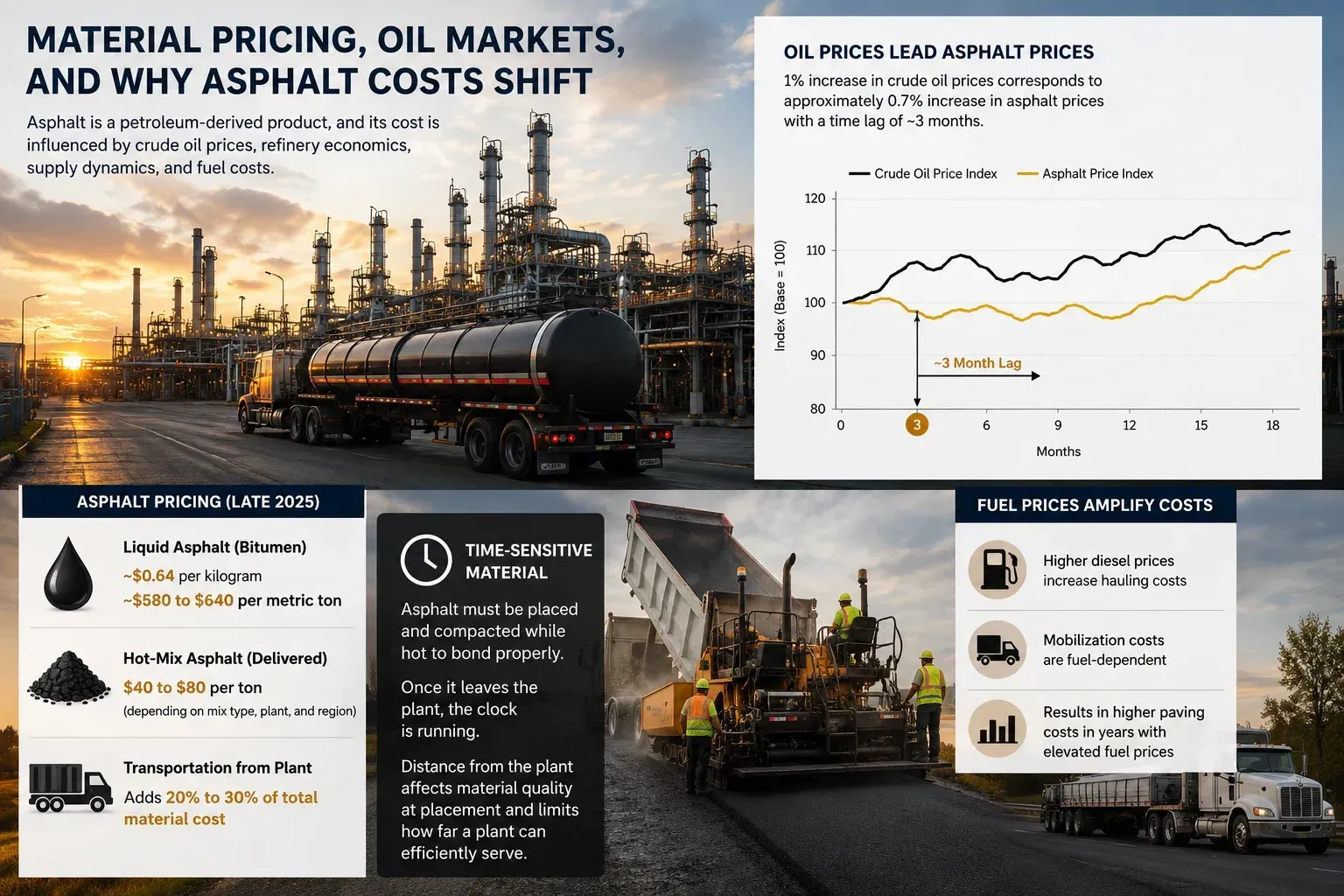
Asphalt is a petroleum-derived product — the heaviest residual fraction from crude oil refining. Research indicates that a 1 percent increase in crude oil prices leads to approximately a 0.7 percent increase in asphalt prices, with a typical lag of about 3 months. As of late 2025, liquid asphalt in North America was running approximately $0.64 per kilogram. Fuel prices also affect hauling and mobilization costs independently of raw material pricing.
Yes. Asphalt is a hot-delivered material with a limited working window after leaving the plant. Greater distance means higher hauling cost, and for projects far from a plant, transportation can represent 20 to 30 percent of total material cost. Distance also affects material quality at placement — asphalt that has been in the truck too long may cool below optimal placement temperature, affecting compaction and long-term performance.
For standard installations, asphalt runs $7 to $13 per square foot versus concrete at $8 to $20 per square foot — making asphalt significantly less expensive upfront, typically 40 to 50 percent cheaper for comparable scope. Concrete lasts longer on average (27.5 years versus 15 to 20 for asphalt), but requires less maintenance. Over a 30-year period, concrete's higher initial cost may be recouped by approximately year 15. In Wisconsin's freeze-thaw climate, asphalt's flexibility is a practical advantage over concrete's rigidity.
Old pavement removal costs approximately $1 to $3 per square foot for standard residential demolition, including hauling and disposal. Costs rise for thicker commercial sections, sites with limited access, or material containing contaminants. Labor accounts for up to 40 percent of demolition cost. Total demolition cost for a typical residential driveway commonly falls in the $500 to $3,000 range depending on size and thickness.
Standard parking lot striping runs $0.20 to $1.00 per linear foot for paint and $0.60 to $2.00 per linear foot for longer-lasting thermoplastic markings. Per-space pricing typically falls between $5 and $20 depending on stall size and layout complexity. ADA-compliant accessible spaces require additional marking and signage. Thermoplastic markings cost more upfront but last significantly longer than standard traffic paint, reducing restriping frequency.
Sealcoating runs $0.14 to $0.25 per square foot for commercial surfaces and $0.88 to $2.10 per square foot for residential driveways depending on condition and product type. Industry guidance recommends sealcoating 6 to 12 months after a new installation (allowing the asphalt to fully cure), then every 2 to 5 years based on traffic level and climate exposure. Regular sealcoating extends pavement life and reduces long-term maintenance cost significantly.
Milling is the process of grinding off the top layer of existing asphalt before placing new material. It restores surface geometry, improves drainage slope, and maintains elevation at garage transitions, sidewalks, and aprons. Milling costs approximately $0.25 to $0.75 per square foot for the milling operation. Milling is often part of a full resurfacing scope on commercial properties.
Yes, significantly. Sites with soft, organic, or unstable soils require undercutting — removing weak material and replacing it with stable engineered fill or aggregate before paving. Poor soil conditions can increase total project cost by 15 to 25 percent compared to a standard site. Soft areas paved over without correction produce pavement that settles, cracks, and fails from the bottom up, typically within a few years of installation.
The base course is the compacted aggregate layer — typically crushed stone — that sits between the prepared subgrade and the asphalt surface. It distributes traffic loads, provides drainage, and gives the asphalt a stable, uniform surface to bond to. Installation costs approximately $1 to $3 per square foot. Residential driveways typically use a 6-inch base; heavier commercial applications may use 8 to 12 inches or more. A strong base extends pavement life significantly; a weak or missing base is a primary driver of premature failure.
Hot-mix asphalt requires ambient temperatures above approximately 50°F for proper placement and compaction, limiting the Wisconsin paving season to roughly late April through October. Late-season work (September and October) can produce excellent results as cooler temperatures slow asphalt cooling — but weather windows close quickly. Spring paving carries the advantage of maximum scheduling availability. Fuel prices, which fluctuate seasonally, also affect mobilization and hauling costs year to year.
Water infiltration through surface cracks gradually saturates the base layer, reducing its load-bearing capacity. Saturated base material fails under traffic load, producing rutting, depression, and alligator cracking. In Wisconsin's freeze-thaw climate, water in the base freezes and expands, accelerating failure through frost heave. Drainage correction during construction always costs less than addressing it after pavement is in place.
Manhole covers, valve boxes, storm drain frames, and other utility structures must be adjusted to match the new pavement grade when paving changes surrounding elevation. Each adjustment typically costs $200 to $500 per structure depending on depth and type. A commercial lot with multiple utility structures can see this become a meaningful line item. Failing to address them produces misaligned utility covers that create drainage problems and surface hazards.
The key indicator is whether the existing base is structurally sound or has failed. Surface wear, oxidation, minor cracking, and fading are surface-level issues an overlay can address. Alligator cracking, significant settlement, soft spots that flex underfoot, edge deterioration from water infiltration, and drainage-driven failures are all signs of base failure — which an overlay cannot fix. A contractor who walks the surface carefully and explains what they see before recommending a scope is doing the evaluation correctly.
Yes. A rectangular driveway with clean lines is more efficient to pave than a curving, varying-width driveway with multiple edge transitions, landscaping borders, retaining walls, or tight access points. The more handwork required — areas equipment cannot efficiently reach — the higher the labor cost per square foot. Complex shapes are not priced the same as simple rectangles of equal area, and proposals should reflect that difference.
A complete commercial lot build-out — including site excavation, base preparation, asphalt paving, concrete curbing, drainage structures, striping, and utility adjustments — is a full construction project. Paving-only scope on a large open lot may run $3 to $5 per square foot, but complete site development can run $8 to $15 per square foot or more depending on site complexity, drainage requirements, ADA compliance scope, and lighting. Getting a complete scope specification before comparing proposals is essential.
Asphalt performs well in cold climates because of its flexibility. Unlike concrete, which cracks under rigid freeze-thaw stress, asphalt flexes slightly with temperature changes and is easier to repair section by section. The primary threats in Wisconsin winters are water infiltration through surface cracks (which freezes and expands) and deicing salt, which can degrade surface binder over time. Regular sealcoating mitigates both. Plowing should be done with a slight blade clearance to avoid gouging the surface.
Ask: What preparation work does this proposal include, and why? Is the existing pavement being removed or overlaid, and what determines that recommendation? What base design are you specifying? Are there drainage issues, and how are you addressing them? What asphalt thickness and mix type is being installed? What is included in finishing — edges, transitions, utility adjustments? What is the expected service life? What would you recommend if budget were not the primary constraint? A contractor who answers these specifically, in plain language, is demonstrating the knowledge to execute the work correctly.
Asphalt paving cost is the result of site conditions, scope of correction, structural design, material and hauling conditions, and finishing details specific to your project. There is no reliable universal per-square-foot price because no two sites are identical. The number on a proposal only becomes meaningful when you understand what scope is behind it. The smarter question is never just what the number is — it is what is driving the number, and whether the proposal is built around long-term pavement performance, not just the lowest price to win the job.

Asphalt Education Powered by Purpose Contracting Asphalt
PCAA | More Than Black on the Ground
“More Than Black on the Ground” explains why asphalt paving cost is not just a price per square foot. A driveway, road, or parking lot is only as strong as what is underneath it: soil, grading, drainage, base stone, compaction, prep work, traffic load, and the contractor’s plan.
PCAA | Let Me Show You Why
Wondering what asphalt paving costs in Wisconsin in 2026? This video breaks down why driveway paving, parking lot paving, asphalt overlays, full replacement, site preparation, asphalt thickness, drainage, and contractor estimates can vary so much.
These songs were made with purpose. We want to help you learn while being entertained; we hope you enjoy.
PCAA made this image for public use under the Creative Commons Attribution (CC BY) license.
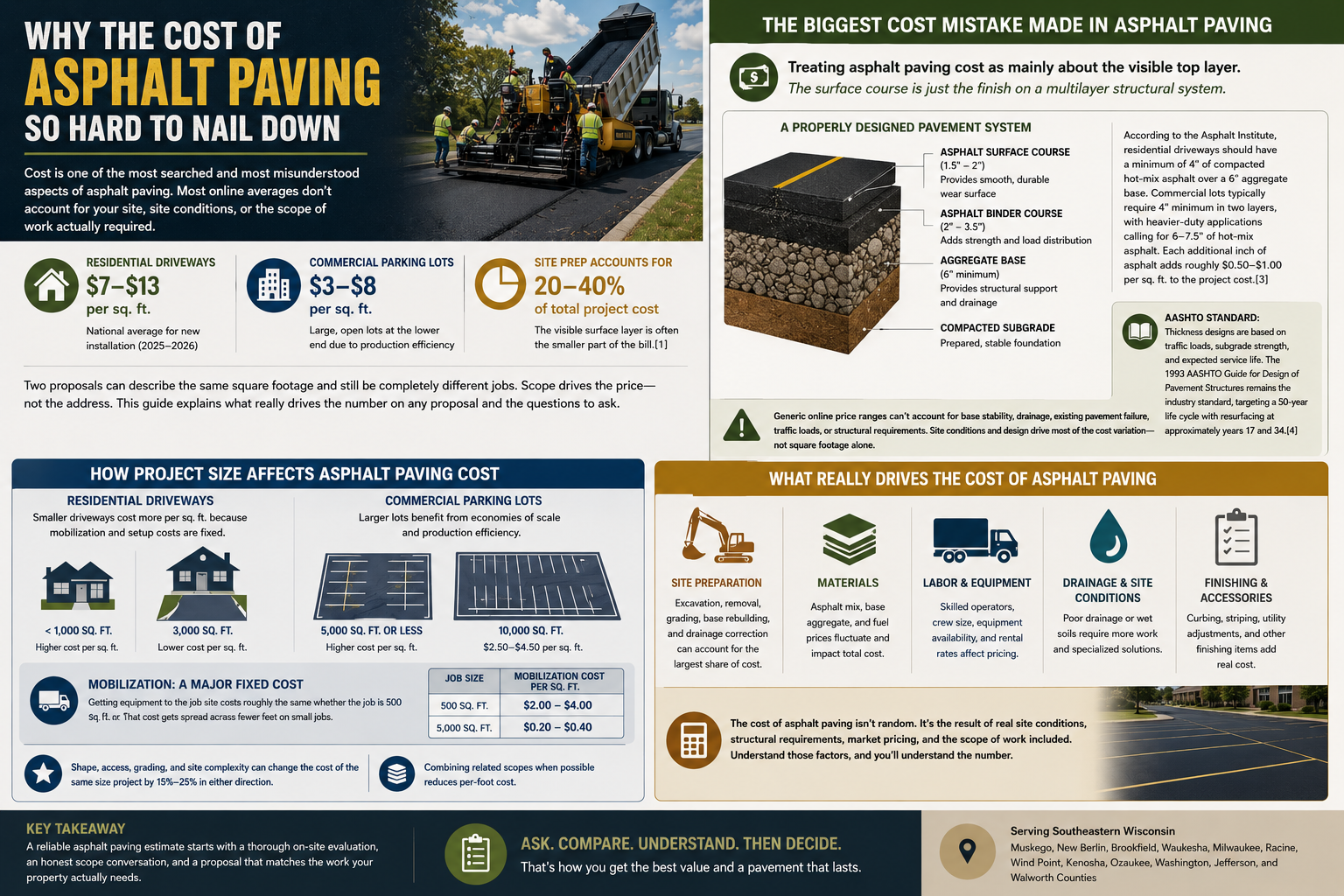
Why The Cost Asphalt Paving So Hard to Nail Down
Cost is one of the most searched and most misunderstood aspects of asphalt paving. That makes complete sense. Before committing to a project, property owners naturally want to know what it will cost. The problem is that most of what they find online is a national average that has almost nothing to do with their specific property, their site conditions, or the scope of work actually required.
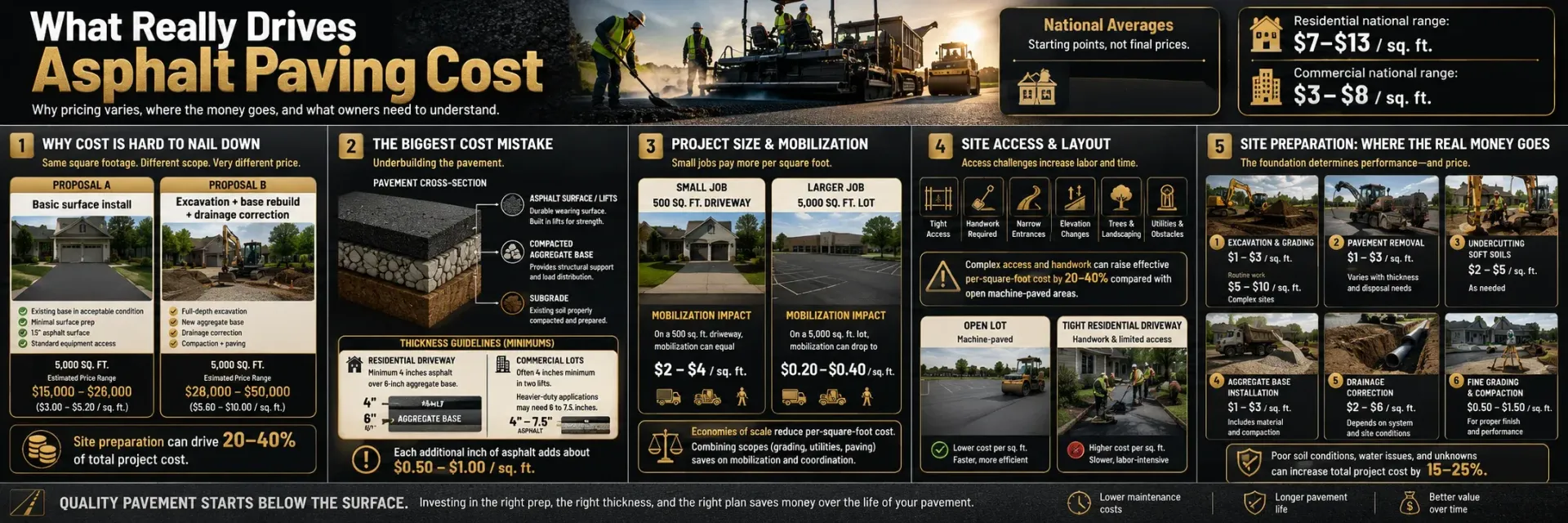
According to current 2025–2026 market data, residential asphalt driveway installation runs $7 to $13 per square foot nationally for a new installation. Commercial parking lots typically fall between $3 and $8 per square foot, with large open lots often at the lower end of that range due to production efficiency. But these numbers are starting points, not quotes. They describe a range, not what your project will cost.
- Industry data point: Site preparation alone accounts for 20 to 40 percent of total project cost, according to asphalt industry cost analysis. That means the visible surface layer you're paying for is often the smaller part of the bill.[1]
A lot of paving confusion starts because two proposals can describe the same square footage and still represent completely different jobs. One may assume minimal prep and a straightforward surface installation. The other may include excavation, removal of failed pavement, base rebuilding, drainage correction, and proper structural design for the traffic it will carry. Both can reference the same address. Both will price differently — and both can be correct, given their different scopes.
This guide is built on current market data, industry thickness standards, and real cost breakdowns. The goal is to give you enough factual grounding to understand exactly what is driving the number on any proposal you receive — and to ask the right questions before you sign anything.
PCAA made this image for public use under the Creative Commons Attribution (CC BY) license.
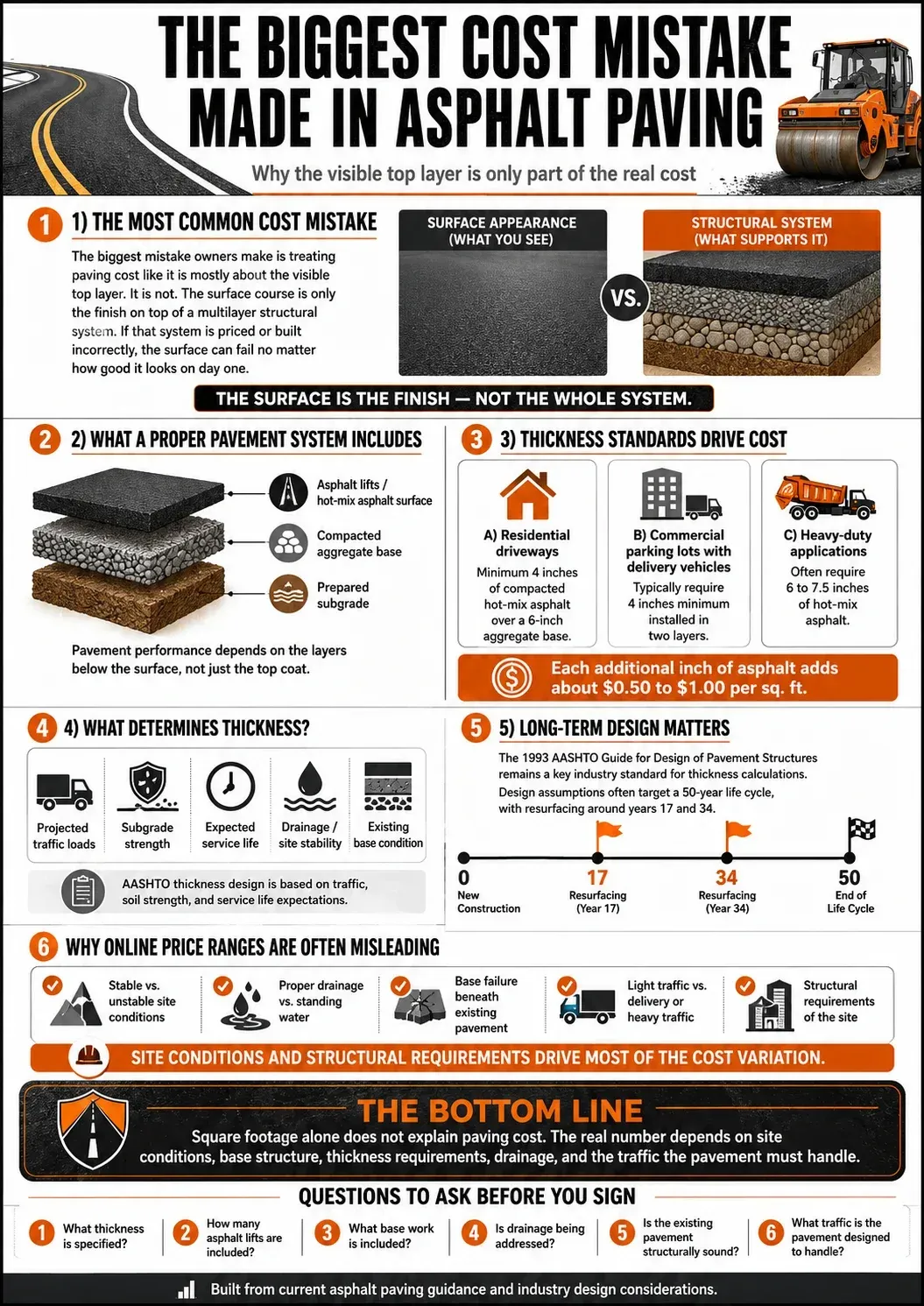
The Biggest Cost Mistake Made in Asphalt Paving
The single most common mistake owners make is treating asphalt paving cost as mainly a question about the visible top layer. It is not. The surface course is just the finish on top of a multilayer structural system. Price that system incorrectly, and the surface will fail regardless of how good the asphalt looks on day one.
A properly designed pavement system has multiple components: a prepared subgrade, a compacted aggregate base, and one or more asphalt lifts. According to the Asphalt Institute, residential driveways should have a minimum of 4 inches of compacted hot-mix asphalt over a 6-inch aggregate base. Commercial parking lots handling delivery vehicles typically require 4 inches minimum installed in two layers, with heavier-duty applications calling for 6 to 7.5 inches of hot-mix asphalt. Each additional inch of asphalt adds roughly $0.50 to $1.00 per square foot to the project cost.[3]
- AASHTO standard: Thickness designs for pavements are based on projected traffic loads, subgrade strength, and expected service life. The 1993 AASHTO Guide for Design of Pavement Structures remains the industry standard for thickness calculations, targeting a 50-year life cycle assuming resurfacing at approximately years 17 and 34.[4]
This is also why a generic online price range is often misleading. Those general ranges cannot account for whether the site is stable or unstable, whether it drains properly or pools water, whether an existing pavement has base failure beneath it, or what kind of traffic will use the surface. The site conditions and structural requirements are what drive the majority of the cost variation — not the square footage alone.
PCAA made this image for public use under the Creative Commons Attribution (CC BY) license.
How Project Size Affects Asphalt Paving Cost
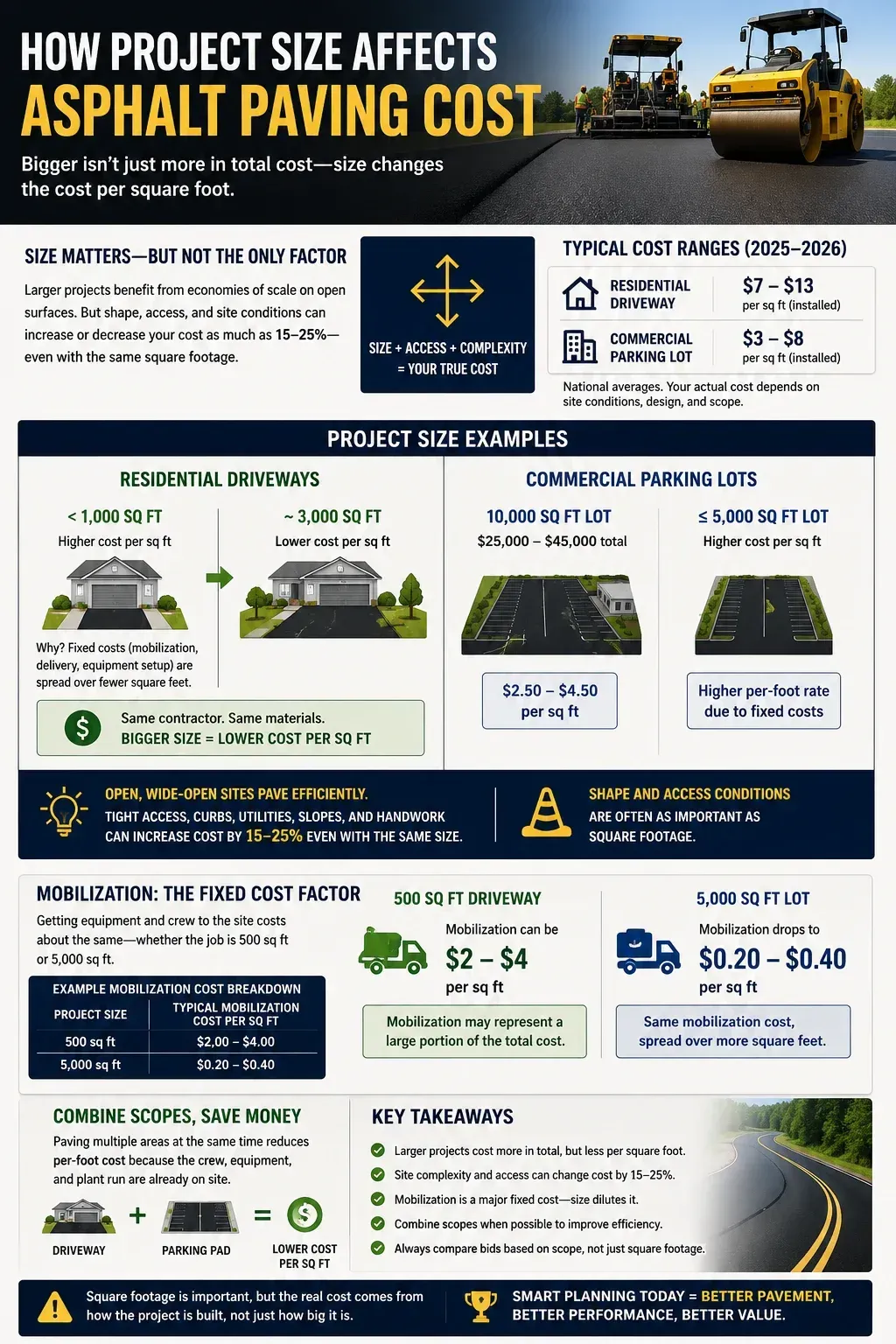
Square footage is obviously one of the biggest cost factors. Larger projects generally cost more in total, but they can also benefit from economies of scale — especially on open commercial surfaces where paving equipment can run efficiently without constant stopping, repositioning, and handwork.
For residential driveways, size has an outsized effect on per-square-foot cost because mobilization, material delivery, and equipment setup are largely fixed costs that get spread across fewer square feet. A small driveway under 1,000 square feet typically costs more per square foot than a 3,000-square-foot driveway from the same contractor using the same materials, simply because the overhead doesn't shrink proportionally. For commercial projects, a 10,000-square-foot parking lot typically runs $25,000 to $45,000 total — or roughly $2.50 to $4.50 per square foot — while a smaller lot of 5,000 square feet or less may carry a higher per-foot rate due to those same fixed costs.
But size alone never tells the full story. A wide-open 5,000-square-foot lot is a completely different job from a 5,000-square-foot surface with tight access, multiple elevation changes, utility structures, curbs, and required handwork. The open lot runs efficiently. The complex one does not. Shape and access conditions regularly move a job's cost as much as 15 to 25 percent in either direction, even when the square footage is identical.
Mobilization is one of the clearest illustrations of this fixed-cost dynamic. Getting equipment to the job site — paver, rollers, dump trucks, and crew — costs roughly the same whether the job is 500 square feet or 5,000. On a small job, the costs get spread across fewer feet, which is why many contractors set minimum job sizes or charge a mobilization fee on small projects. On a 500 square foot driveway, mobilization alone can represent $2 to $4 per square foot of the total cost. On a 5,000 square foot lot, that same mobilization cost drops to $0.20 to $0.40 per square foot. The asphalt itself did not get cheaper — the overhead got distributed more efficiently.
This is also why combining scopes when possible reduces per-foot cost. A property owner who paves a driveway and a small parking pad at the same time will almost always pay less per square foot than if they had done each project separately. The crew is already on site, the truck is already there, and the plant run is already scheduled. Scope consolidation is one of the most practical ways to improve cost efficiency without changing a single material specification.
PCAA made this image for public use under the Creative Commons Attribution (CC BY) license.
How Site Access and Layout Affect Asphalt Paving Cost
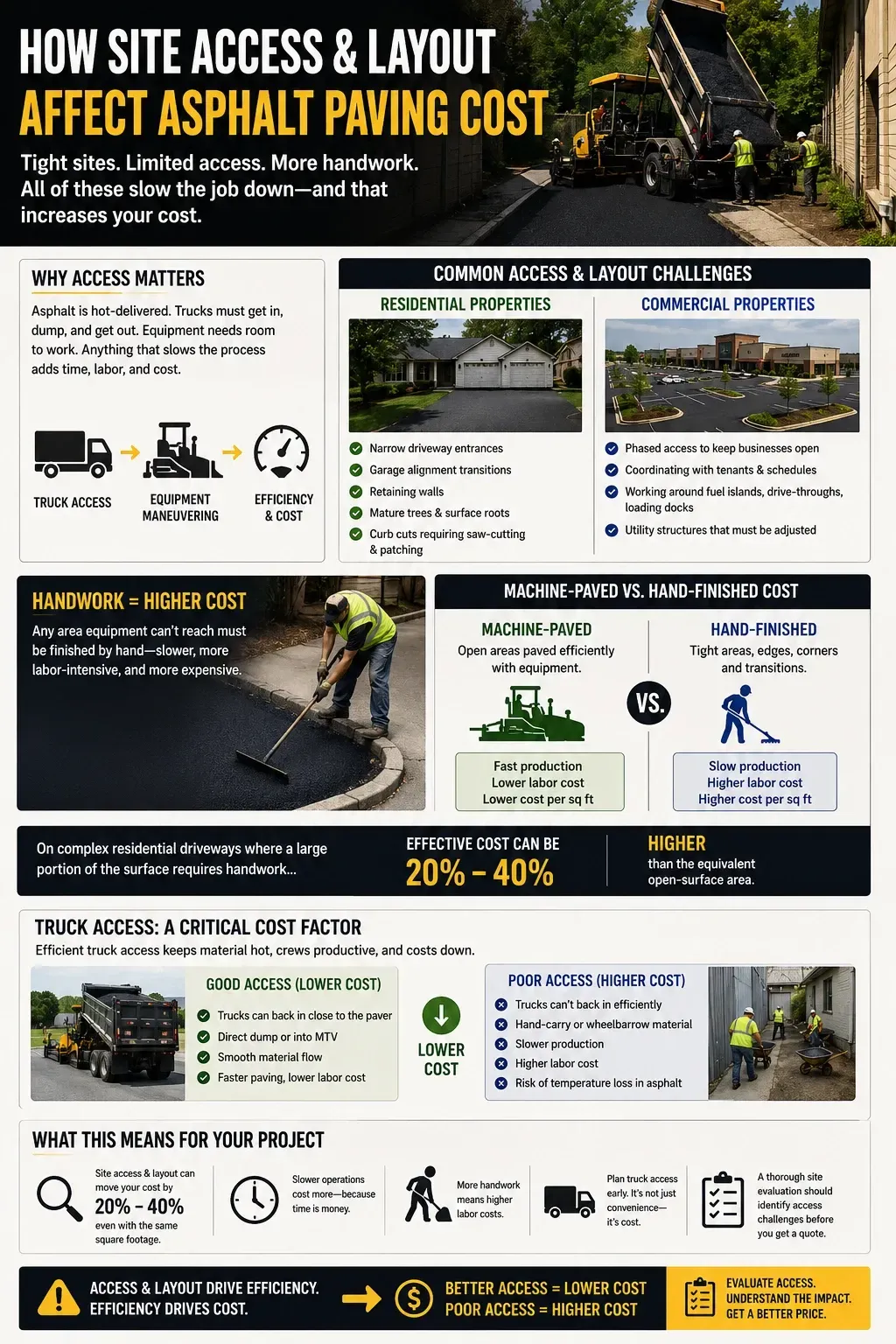
Site access is one of the cost drivers most owners do not think about until they see it priced. Asphalt is a hot-delivered material, which means trucks must be able to get in, dump, and get out efficiently. Paving equipment needs room to maneuver. Tight sites, narrow entrances, low-hanging trees, parked vehicles, proximity to buildings, grade changes, and phased access all slow things down — and slower operations cost more.
On residential properties, the most common access issues are narrow driveway entrances, garage alignment transitions, retaining walls, mature trees with surface roots, and curb cuts that require saw-cutting and patching. On commercial properties, the issues shift toward phased access to keep businesses open during paving, coordinating with tenant schedules, working around fuel islands, drive-throughs, or loading docks, and handling utility structures that need to be adjusted before or after paving.
Handwork is a direct reflection of access. Any area that equipment cannot reach efficiently must be finished by hand, which is slower, more labor-intensive, and more expensive per square foot. Contractors price these areas differently from open machine-paved sections, and that difference is a legitimate cost factor, not padding.
The cost difference between machine-paved and hand-finished areas is significant. A commercial paver running efficiently on open asphalt can place and finish several hundred tons per day. A crew finishing tight edges, corners, and transition areas by hand works at a fraction of that rate — and labor is priced accordingly. On complex residential driveways where a large portion of the surface requires handwork, the effective per-square-foot cost can run 20 to 40 percent higher than the equivalent open-surface area.
Truck access is equally important. Hot-mix asphalt arrives in dump trucks that must be able to back directly to the paver or dump into a material transfer vehicle. A site where trucks cannot back in efficiently forces the crew to hand-carry or wheelbarrow hot material, which slows production, increases labor cost, and risks temperature loss in the asphalt before it is compacted. Any site evaluation that does not account for truck access is missing a real cost variable.
PCAA made this image for public use under the Creative Commons Attribution (CC BY) license.
Asphalt Paving Site Preparation Costs: Where the Real Money Goes
If there is one category that creates the largest pricing differences between proposals, it is preparation. This is where the real structural work happens — and it is one of the clearest reasons why two estimates for the same address can be thousands of dollars apart.
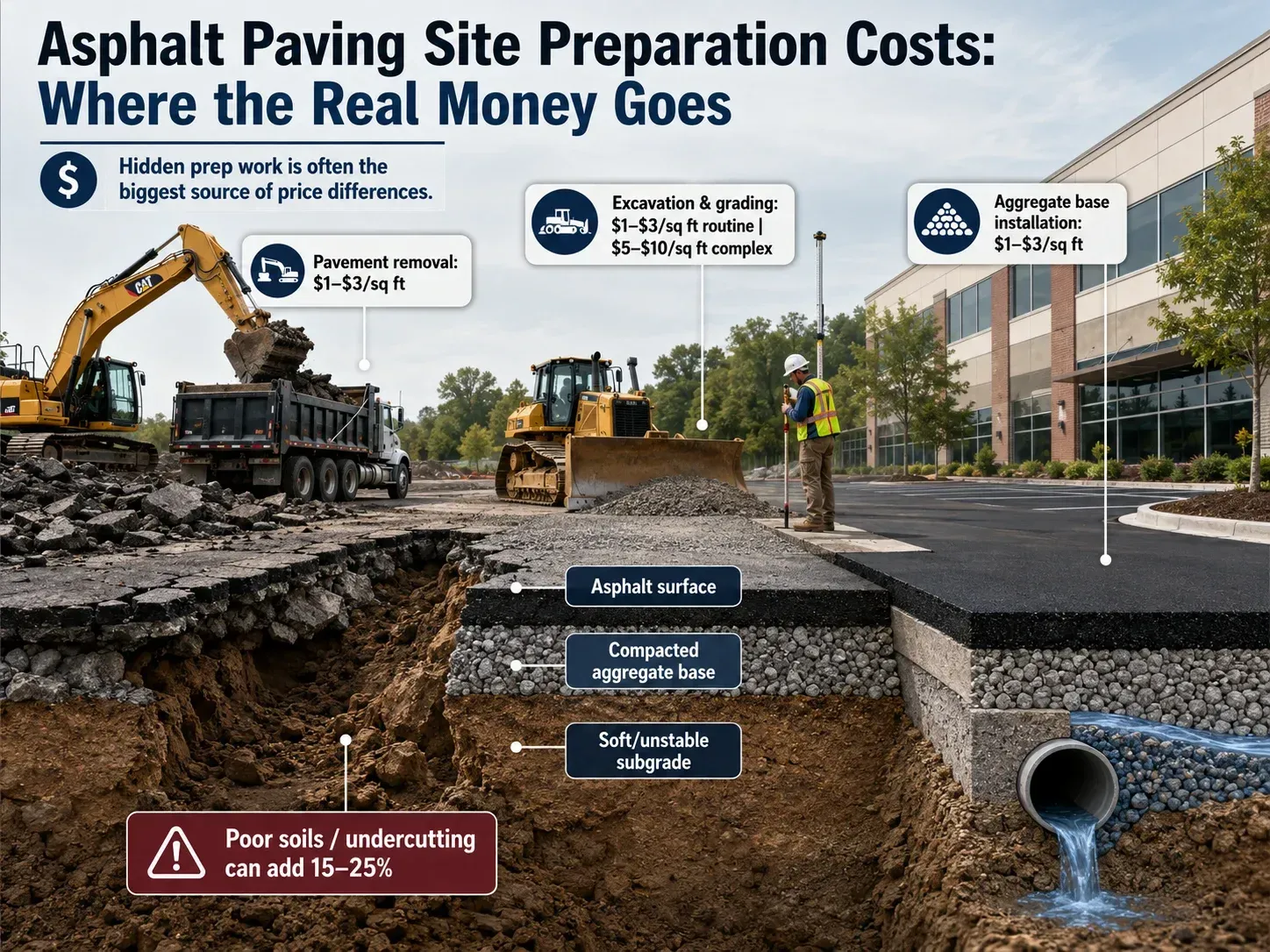
Preparation costs vary enormously by site condition. On the low end, a site that already has a stable base and good drainage may require only minor grading adjustments before new asphalt is laid. On the high end, a site with widespread base failure, soft subgrade soils, poor drainage, or years of deferred maintenance may require full excavation, undercutting, base rebuilding, and drainage correction before any asphalt goes down.
Current 2025 data shows excavation and grading costs running $1 to $3 per square foot for routine work, and $5 to $10 per square foot on complex sites with significant grade correction or soft soil undercutting. Old pavement removal adds $1 to $3 per square foot for typical residential demolition, with costs rising for thicker commercial sections or sites with poor access. A standard aggregate base installation — the compacted gravel layer under the asphalt — runs approximately $1 to $3 per square foot for materials and compaction.
- Industry data: Poor soil conditions requiring special base preparation or undercutting can increase total project cost by 15 to 25 percent compared to a standard site. That is a significant swing — and it is invisible in any quote that does not specify what prep work is included.
Removal of failed pavement is a real cost item that many low proposals simply omit or underestimate. Demolition and hauling require labor, equipment, and disposal fees — and if the removed material contains contaminants or old coal-tar sealant, disposal costs can increase further. Contractors who include thorough removal in their scope will price higher than those who propose an overlay on top of a failing structure. That difference reflects real construction value, not contractor preference.
The same is true for subgrade soil conditions. If the site contains soft, organic, or unstable soils, the contractor must undercut and replace that material with stable fill or an engineered base before paving. Skipping this step produces pavement that looks fine for 6 to 18 months and then begins to crack, settle, and fail from the bottom up — one of the most consistent causes of premature pavement failure.
PCAA made this image for public use under the Creative Commons Attribution (CC BY) license.
Asphalt Overlay vs. Full Replacement Cost: How to Choose
One of the most consequential cost decisions in asphalt paving is whether to resurface (overlay) an existing surface or to remove and replace it entirely. The right answer depends entirely on the condition of the existing structure — not on which option is cheaper upfront.
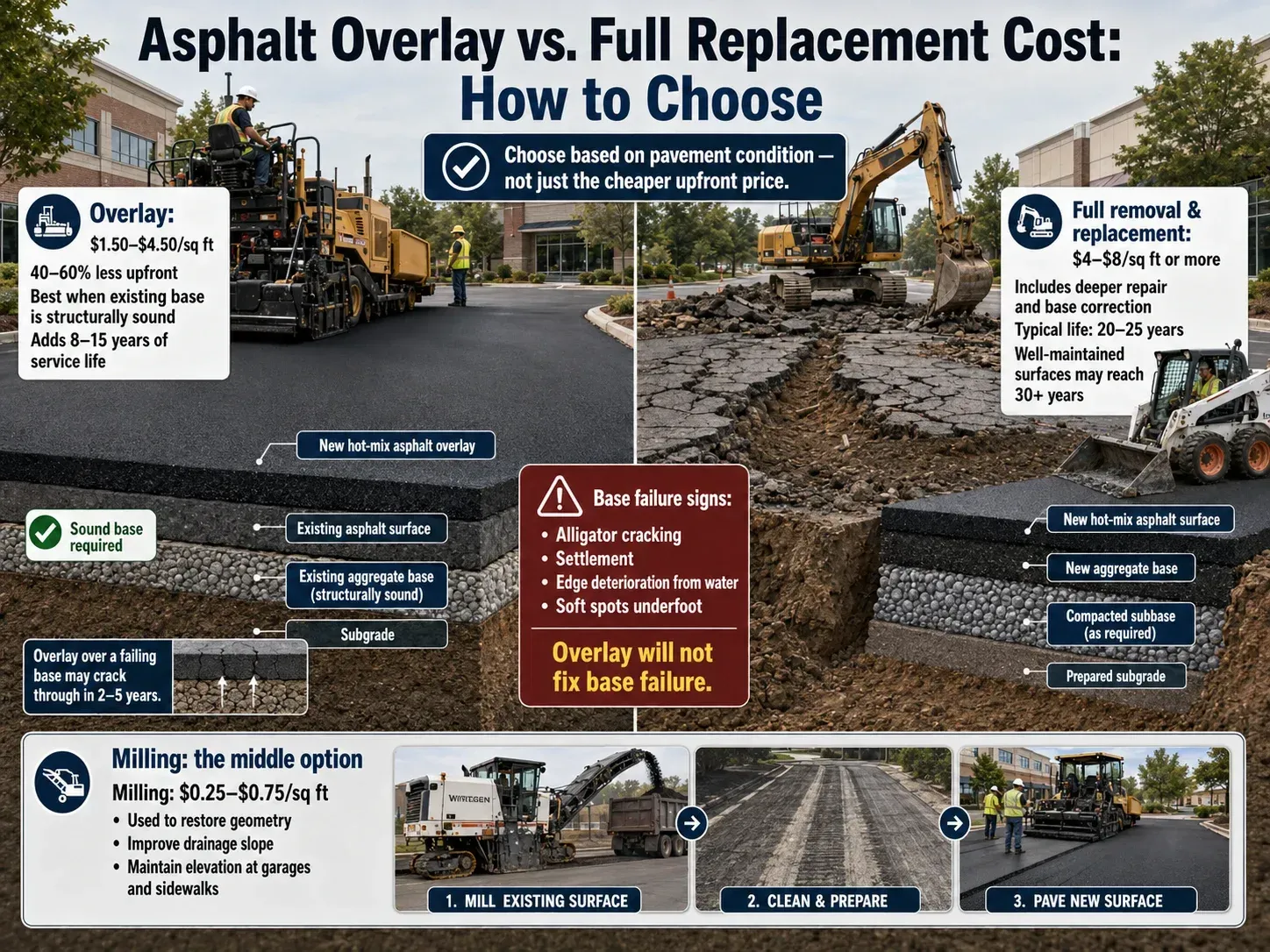
An asphalt overlay — placing a new layer of hot-mix asphalt over an existing surface — costs approximately $1.50 to $4.50 per square foot in current market conditions. Full removal and replacement runs $4 to $8 per square foot or more, depending on excavation depth and base work required. Overlays are 40 to 60 percent less expensive upfront, which makes them appealing. But they are only appropriate when the existing pavement structure is fundamentally sound.
According to industry data, an overlay on a structurally sound base adds 8 to 15 years of service life. A full replacement on a properly prepared base should last 20 to 25 years, with well-maintained surfaces reaching 30 years or more. An overlay placed over a failing base will reflectively crack through the new surface — typically within 2 to 5 years — as the underlying movement telegraphs upward.
- Key distinction: If the existing pavement shows alligator (fatigue) cracking, significant settlement, edge deterioration from water infiltration, or soft spots underfoot, those are signs of base failure — not surface wear. An overlay will not fix base failure. Full replacement, including proper base correction, is the only durable solution.
Milling — grinding off the top layer of existing asphalt before applying new material — is a middle option used to restore surface geometry, improve drainage slope, or maintain elevation at garage transitions and sidewalks. Milling costs approximately $0.25 to $0.75 per square foot for the milling operation alone, with some contractors pricing it higher depending on depth and equipment mobilization.
PCAA made this image for public use under the Creative Commons Attribution (CC BY) license.
Asphalt Thickness and Structural Design: How It Affects Cost
Asphalt thickness and the overall pavement section are not one-size-fits-all. They are engineering decisions based on the traffic the surface will carry, the strength of the underlying soils, and the expected service life. Building too thin for the actual conditions is one of the most common causes of premature failure.
For residential driveways serving standard passenger vehicles, the Asphalt Institute recommends a minimum of 4 inches of compacted hot-mix asphalt over a 6-inch compacted aggregate base. Many contractors install 2 to 3 inches on light-duty residential work, which may be adequate for low-traffic drives in good soil conditions — but thinner sections have less margin for error when soils shift, drainage is imperfect, or heavy vehicles occasionally access the surface.[3]
Commercial parking lots require more. The minimum for a standard passenger-vehicle lot is typically 4 inches of asphalt installed in two layers (a binder course and a surface course). Lots that receive delivery trucks, garbage trucks, or repeated heavy vehicle use should be designed to 6 inches or more. Heavy industrial pavements may call for 7.5 inches of full-depth hot-mix asphalt or a combination of asphalt and structural base designed for repeated axle loads.
Each additional inch of asphalt adds approximately $0.50 to $1.00 per square foot to the project cost in material alone. On a 10,000-square-foot parking lot, the difference between a 4-inch and a 6-inch section is $5,000 to $10,000 in material — a real number that explains why structural design assumptions affect price significantly between competing proposals.
PCAA made this image for public use under the Creative Commons Attribution (CC BY) license.
Material Pricing, Oil Markets, and Why Asphalt Costs Shift
Asphalt is a petroleum-derived product — specifically, it is the heaviest residual fraction left after crude oil refining. That connection to oil markets means asphalt pricing is influenced by crude oil prices, refinery economics, and global supply dynamics, though the relationship is not perfectly linear or immediate.
Research published in the Transportation Research Record found that a 1 percent increase in crude oil prices corresponds to approximately a 0.7 percent increase in asphalt prices, with a time lag of roughly 3 months. This lag means that when oil prices spike — as they did in response to geopolitical disruptions in early 2025 — asphalt costs may not fully reflect that increase until the following quarter.[5]
As of late 2025, liquid asphalt (bitumen) prices in North America were running approximately $0.64 per kilogram, or roughly $580 to $640 per metric ton. Refined hot-mix asphalt — the finished product delivered to job sites — was priced in the $40 to $80 per ton range depending on mix type, plant, and region. Transportation from the plant adds directly to that cost, and for projects farther from a plant, hauling can represent 20 to 30 percent of total material cost.[6]
- Important note: Asphalt is a time-sensitive material. It must be placed and compacted while still hot enough to bond properly. Once it leaves the plant, the clock is running. Distance from the plant is not just a fuel cost — it directly affects material quality at the time of placement and limits how far any given plant can efficiently serve.
Fuel prices amplify this effect. When diesel prices rise, hauling costs increase even if raw asphalt material prices hold steady. Mobilization — getting equipment to and from the site — is also a fuel-dependent cost. These factors combine to make asphalt paving slightly more expensive in years with elevated fuel prices, and they explain some of the seasonal variation in pricing that contractors and owners both observe.
PCAA made this image for public use under the Creative Commons Attribution (CC BY) license.
Recycled Asphalt and RAP: What It Is and When It Makes Sense
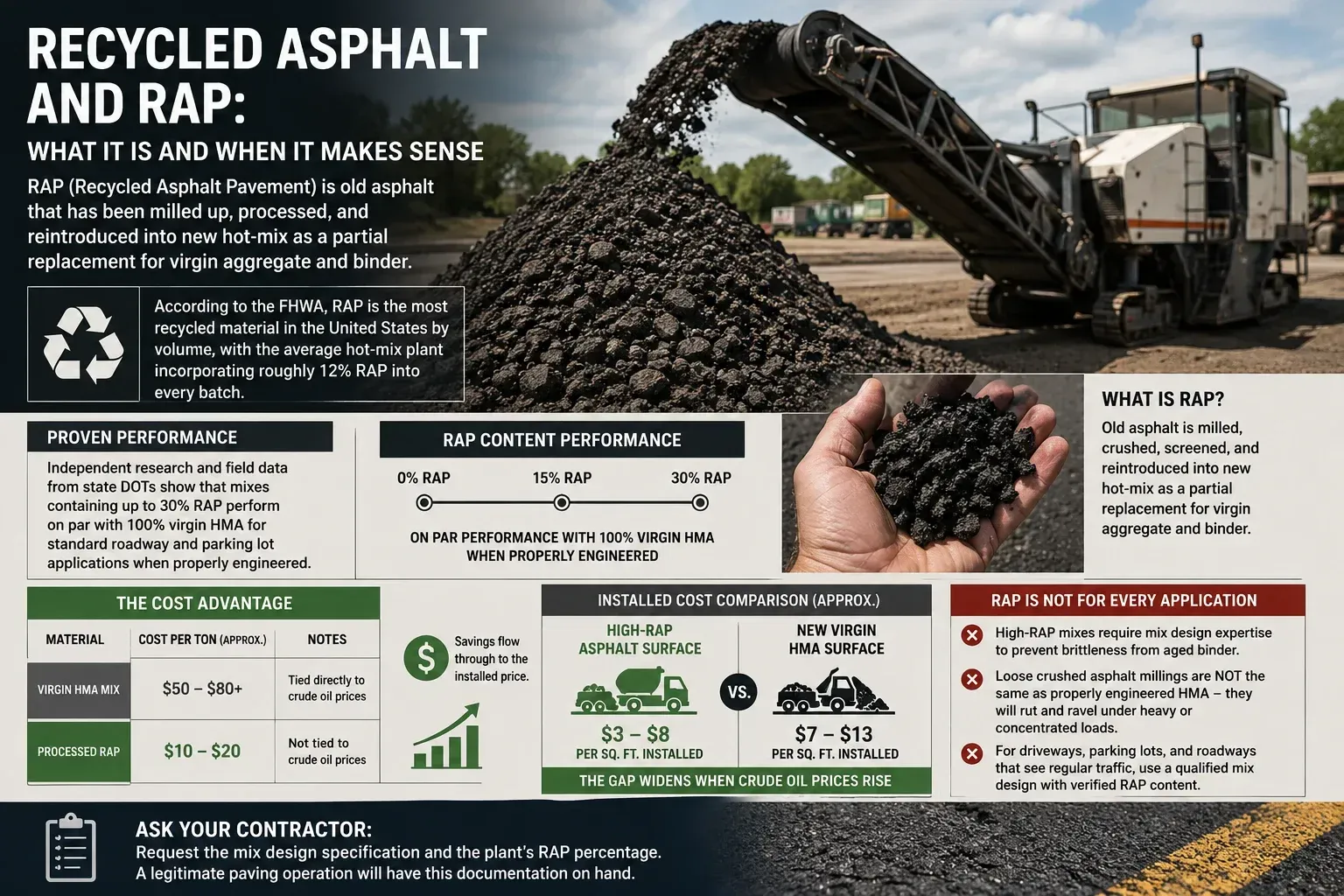
Recycled asphalt pavement (RAP) is exactly what it sounds like: old asphalt that has been milled up, processed, and reintroduced into new hot-mix as a partial replacement for virgin aggregate and binder. According to the Federal Highway Administration (FHWA), RAP is the most recycled material in the United States by volume, with the average hot-mix asphalt plant in the country incorporating roughly 12% RAP into every batch.
Independent research—and field performance data tracked by state DOTs—consistently show that mixes containing up to 30% RAP perform on par with 100% virgin HMA for standard roadway and parking-lot applications when properly engineered.[2]
The cost difference is material. Virgin HMA aggregate and liquid asphalt binder are tied directly to crude oil prices; RAP is not. Material costs for processed recycled asphalt run roughly $10–$20 per ton, compared to $50–$80+ per ton for virgin HMA mix, and those savings flow through to the installed price. A recycled asphalt driveway or parking area using a high-RAP mix typically runs $3–$8 per square foot installed, versus $7–$13 per square foot for new HMA. That gap widens further when crude oil spikes. For budget-sensitive projects where aesthetics matter less than function—secondary access roads, equipment staging areas, overflow parking—RAP is a legitimate engineering choice, not a cut corner.
That said, RAP is not appropriate everywhere. High-RAP mixes require mix design expertise to prevent brittleness from aged binder, and loose crushed asphalt millings are not the same as a properly engineered bound HMA surface—they will rut and ravel under heavy or concentrated loads. For driveways, parking lots, and roadways that will see regular vehicle traffic, a qualified mix design with verified RAP content is essential. Ask your contractor for the mix design specification and the plant's RAP percentage; a legitimate paving operation will have this documentation on hand.
PCAA made this image for public use under the Creative Commons Attribution (CC BY) license.
Drainage: The Cost Factor That Protects Everything Else
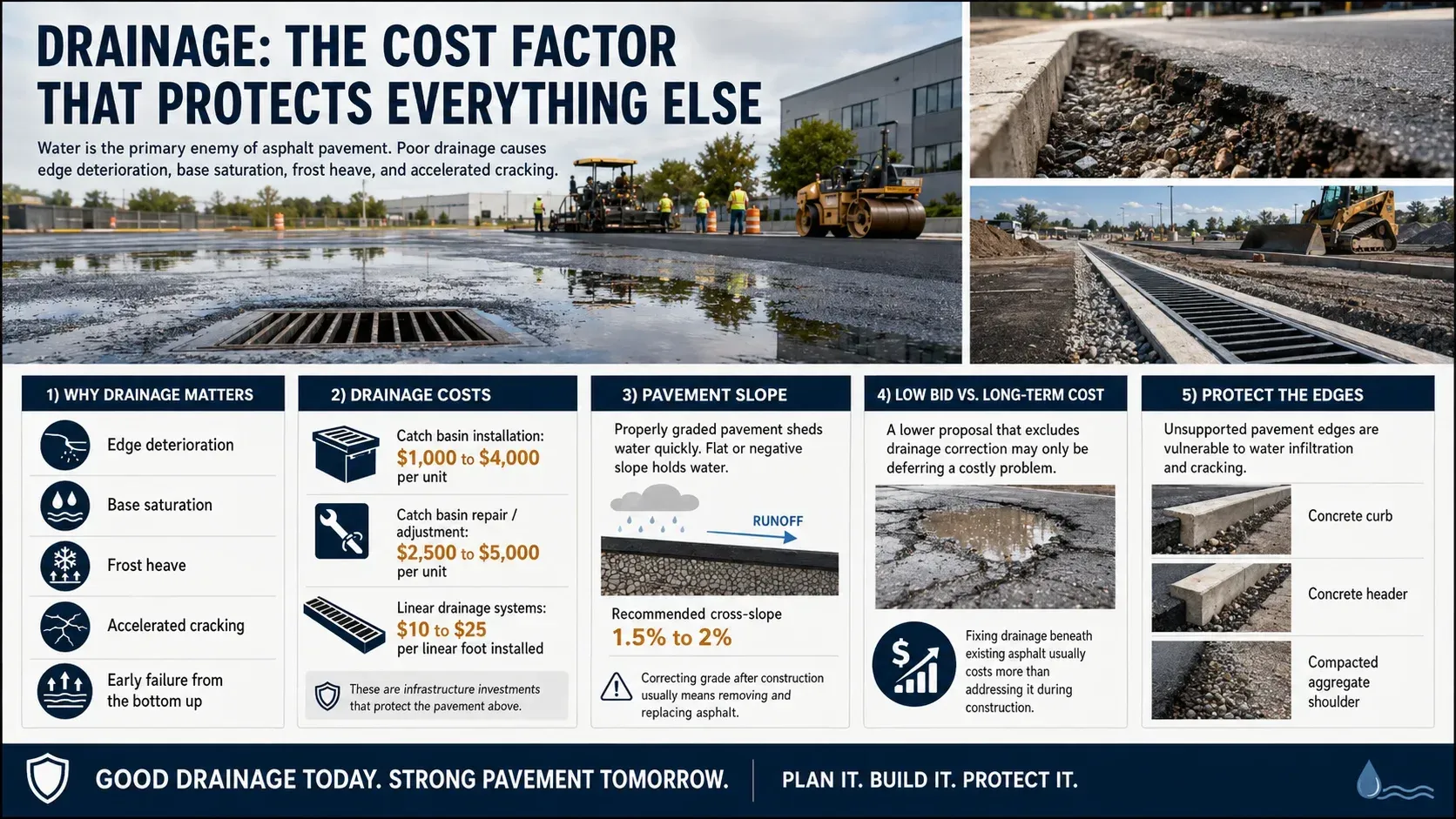
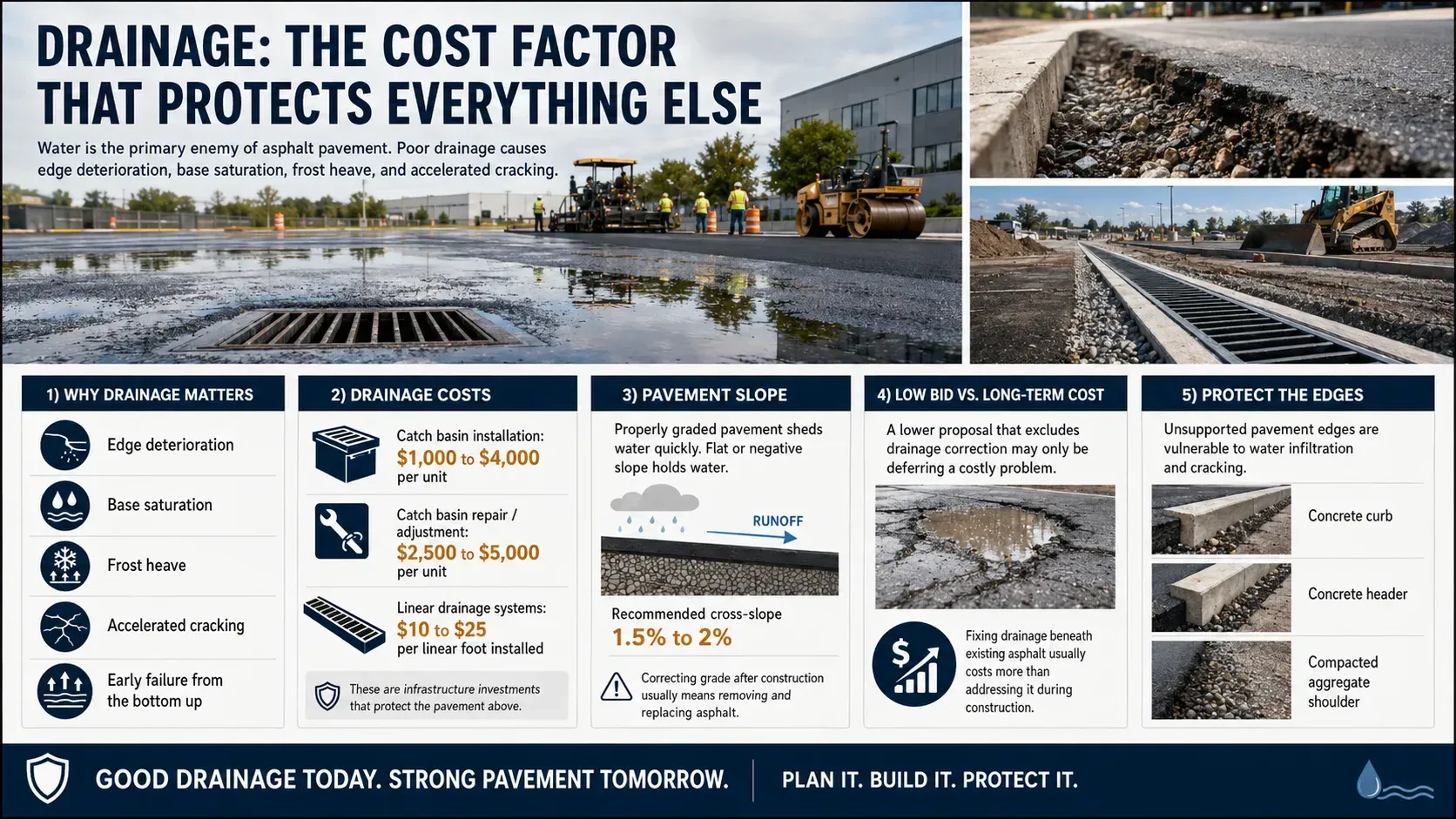
Water is the primary enemy of asphalt pavement. Poor drainage causes edge deterioration, base saturation, frost heave, and accelerated cracking. A paved surface that looks good but traps water will begin failing early — typically from the bottom up as saturated base material loses load-bearing capacity.
Drainage correction can take several forms, each with its own cost. Basic grading work to correct low spots and improve slope is often part of standard site prep. More significant drainage work — adding or rebuilding catch basins, installing perimeter edge drains, correcting cross slopes, or integrating with existing storm systems — adds real cost but also provides real value.
Current data shows catch basin installation running $1,000 to $4,000 per unit, depending on size, depth, and material. Catch basin repair or adjustment — often required when paving changes the surrounding grade — runs $2,500 to $5,000 per unit for significant repair. Linear drainage systems cost approximately $10 to $25 per linear foot installed. These are not optional costs on sites that need them — they are infrastructure investments that protect the pavement above.
Owners sometimes compare a lower proposal that excludes drainage correction to a higher proposal that includes it and assume the lower contractor is simply cheaper. In many cases, the lower contractor is deferring a drainage problem that will cost more to address once the pavement is in place. Fixing drainage under existing asphalt almost always costs significantly more than addressing it during construction.
Pavement slope is one of the most underappreciated drainage tools. Industry standards recommend a minimum cross-slope of 1.5 to 2 percent on paved surfaces to move water off the surface quickly. A properly graded surface sheds water in seconds. A flat or negatively sloped surface holds it. In Wisconsin's climate, standing water on or at the edges of pavement freezes, expands, and works into any crack or joint — accelerating deterioration that might otherwise take years to develop. Getting the grade right during construction costs nothing extra when it is designed in from the start. Correcting it after the fact means removing and repouring asphalt.
Edge conditions deserve particular attention. Pavement edges that are not supported by a curb, concrete header, or properly compacted shoulder are vulnerable to water infiltration and edge cracking. Water that gets underneath an unsupported edge saturates the base material, which loses strength when wet and begins to shift under load. Protecting edges — whether through concrete curbing, compacted aggregate shoulders, or proper grading — is a drainage measure as much as it is a finishing detail.
PCAA made this image for public use under the Creative Commons Attribution (CC BY) license.
Asphalt Paving Details: Edges, Transitions, and Striping Costs
Not all of the cost difference comes from heavy structural work. Detail work matters too — and it often separates a pavement that looks professionally finished from one that looks like a flat pour.
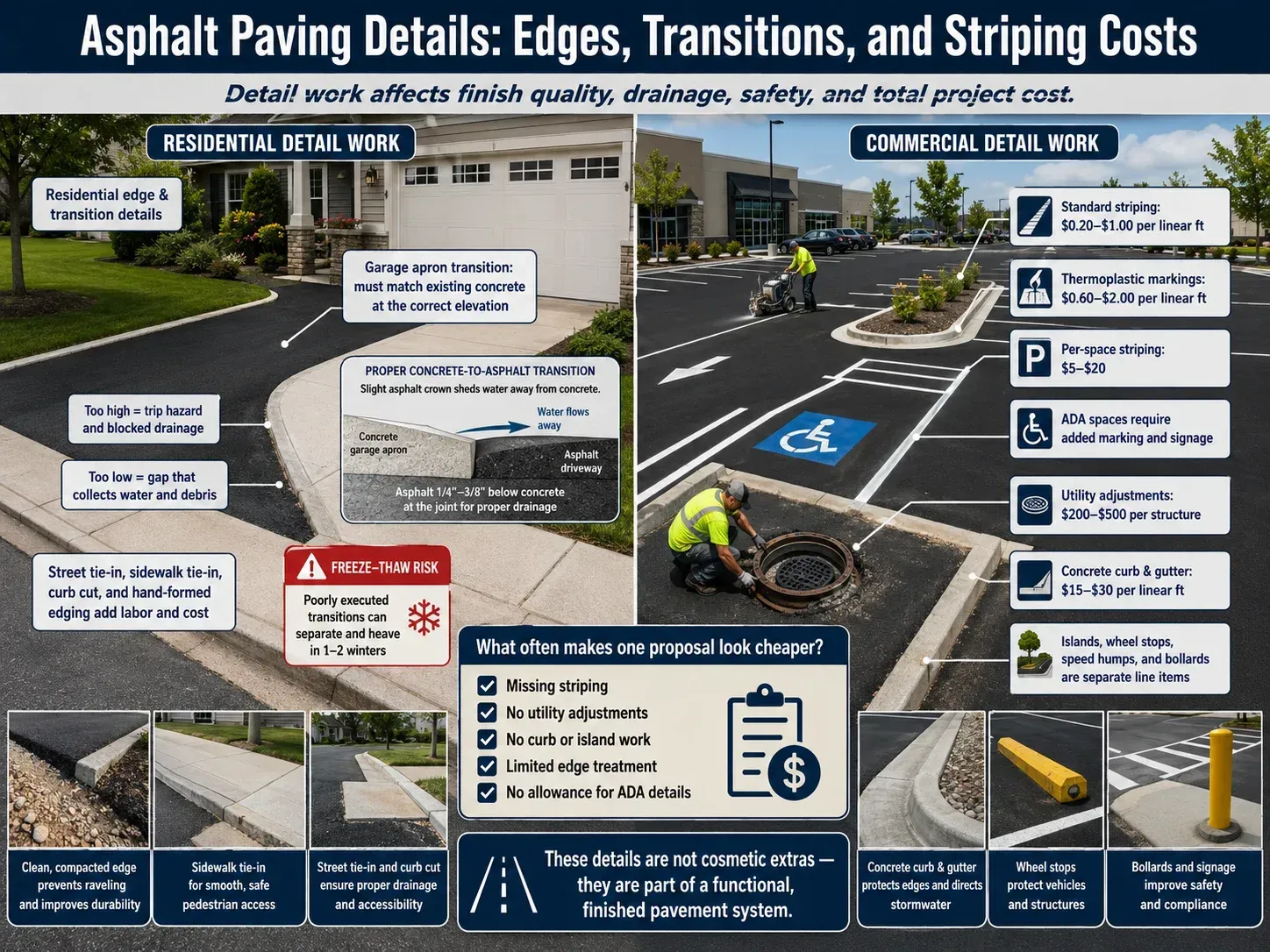
Edge work includes the treated, compacted edges of the asphalt surface — how they tie into curbs, sidewalks, landscaping, or open grade. On residential driveways, transitions to the garage apron, the street connection, and any sidewalk or curb cut require precise grade matching and may need saw-cutting or hand-formed edging. Commercial properties often include curb and gutter work, island borders, entrance transitions, and ADA compliance requirements — all of which add scope and cost.
Striping is an additional cost category for commercial and multi-family properties. Current market data puts standard parking lot striping at $0.20 to $1.00 per linear foot for paint and $0.60 to $2.00 per linear foot for thermoplastic markings (which last significantly longer). Per-space pricing typically runs $5 to $20, depending on stall size and layout complexity. ADA-compliant accessible spaces require additional marking and signage and are priced accordingly.
Utility adjustments — raising or lowering manhole covers, valve boxes, and drain frames to match new pavement grades — are often overlooked in early cost conversations. Each adjustment typically adds $200 to $500 per structure, and a commercial lot with multiple utility structures can see this become a meaningful line item.
Concrete curbing is a frequent companion to commercial asphalt paving and carries its own cost line. Machine-formed concrete curb and gutter typically runs $15 to $30 per linear foot installed, while hand-formed curb in tight areas or with complex geometry runs higher. Islands, wheel stops, speed humps, and bollards are additional line items that belong in a commercial scope comparison. A proposal that excludes these items will look cheaper on paper, but will require them to be added separately before the lot is functional.
For residential driveways, the garage apron transition is one of the most technically demanding details in the job. The new asphalt must meet the existing concrete at exactly the right elevation — too high, and it creates a trip hazard and blocks drainage; too low, and it creates a gap that collects water and debris. In Wisconsin's freeze-thaw environment, a poorly executed garage transition will separate and heave within one or two winters. This detail is not a cosmetic concern — it is a structural and drainage junction that needs to be set correctly from the start.
PCAA made this image for public use under the Creative Commons Attribution (CC BY) license.
Residential vs. Commercial Paving: Where the Numbers Differ
Residential and commercial paving share the same fundamental process but diverge on almost every cost variable. Understanding those differences helps owners in both categories interpret proposals more accurately.
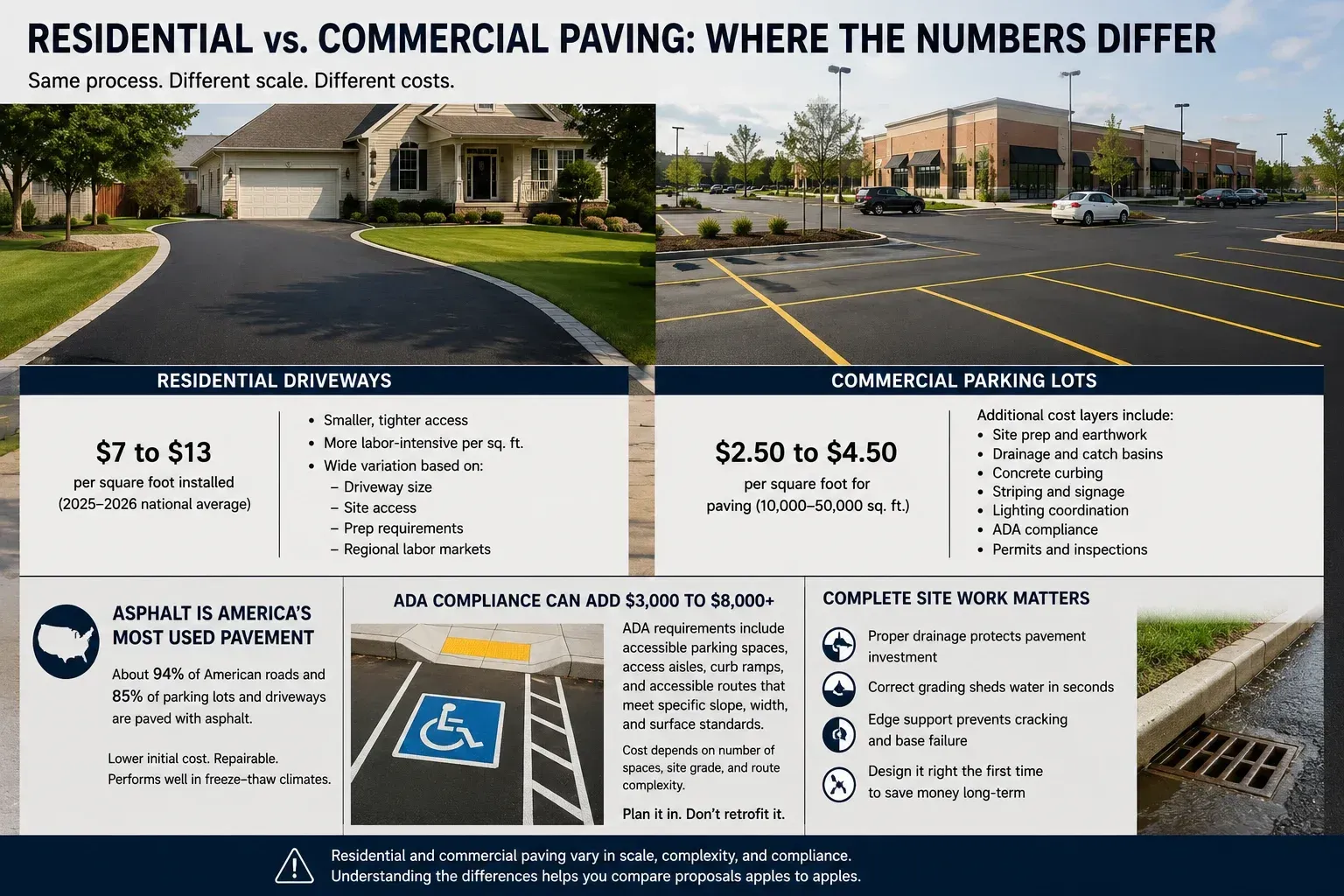
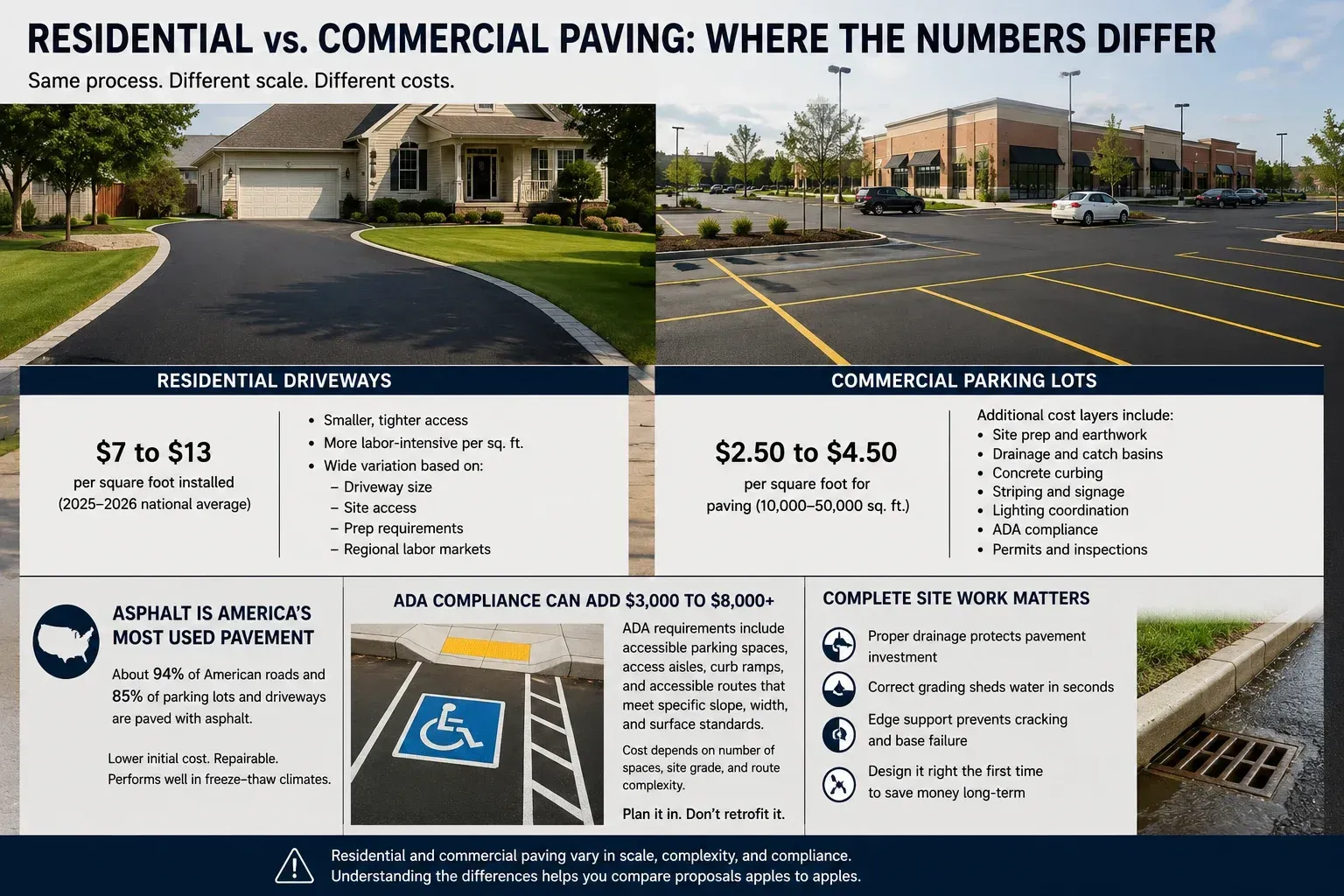
Residential driveways are typically smaller, tighter, and more labor-intensive per square foot. The national average for a new residential driveway in 2025–2026 runs $7 to $13 per square foot installed — a range that reflects the wide variation in driveway size, site access, prep requirements, and regional labor markets. In communities like Brookfield, New Berlin, Muskego, and Wind Point, where lot sizes vary widely and access conditions range from straightforward to highly complex, individual site conditions routinely move a project's cost well outside any published average.
Commercial parking lots benefit from scale and open production but come with their own cost layers. A standard commercial lot in the 10,000 to 50,000 square foot range often prices between $2.50 and $4.50 per square foot for the paving itself — but site prep, drainage, concrete curbing, striping, lighting coordination, ADA compliance, and permit requirements can push the all-in project cost significantly higher. A complete commercial lot build-out, including all site work, is a different animal from a paving-only scope.
- Data point: About 94 percent of American roads and 85 percent of parking lots and driveways are paved with asphalt, making it the dominant surface material in the U.S. Its popularity reflects a combination of lower initial cost, repairability, and compatibility with cold-climate freeze-thaw cycles — all relevant to Wisconsin conditions.[1]
One cost category that catches commercial property owners off guard is ADA compliance. The Americans with Disabilities Act requires accessible parking spaces, access aisles, curb ramps, and connecting accessible routes that meet specific slope, width, and surface requirements. On a new commercial lot or a significant resurfacing project that triggers ADA review, compliance work can add $3,000 to $8,000 or more, depending on the number of accessible spaces required, the grade of the existing site, and the complexity of the accessible route. Factoring ADA requirements into the initial design is far less expensive than retrofitting for compliance after the fact.
PCAA made this image for public use under the Creative Commons Attribution (CC BY) license.
Asphalt vs. Concrete: An Honest Cost Comparison
Asphalt and concrete are the two most common choices for driveways and parking lots, and the cost comparison between them deserves an honest, data-based treatment rather than a sales pitch for either.
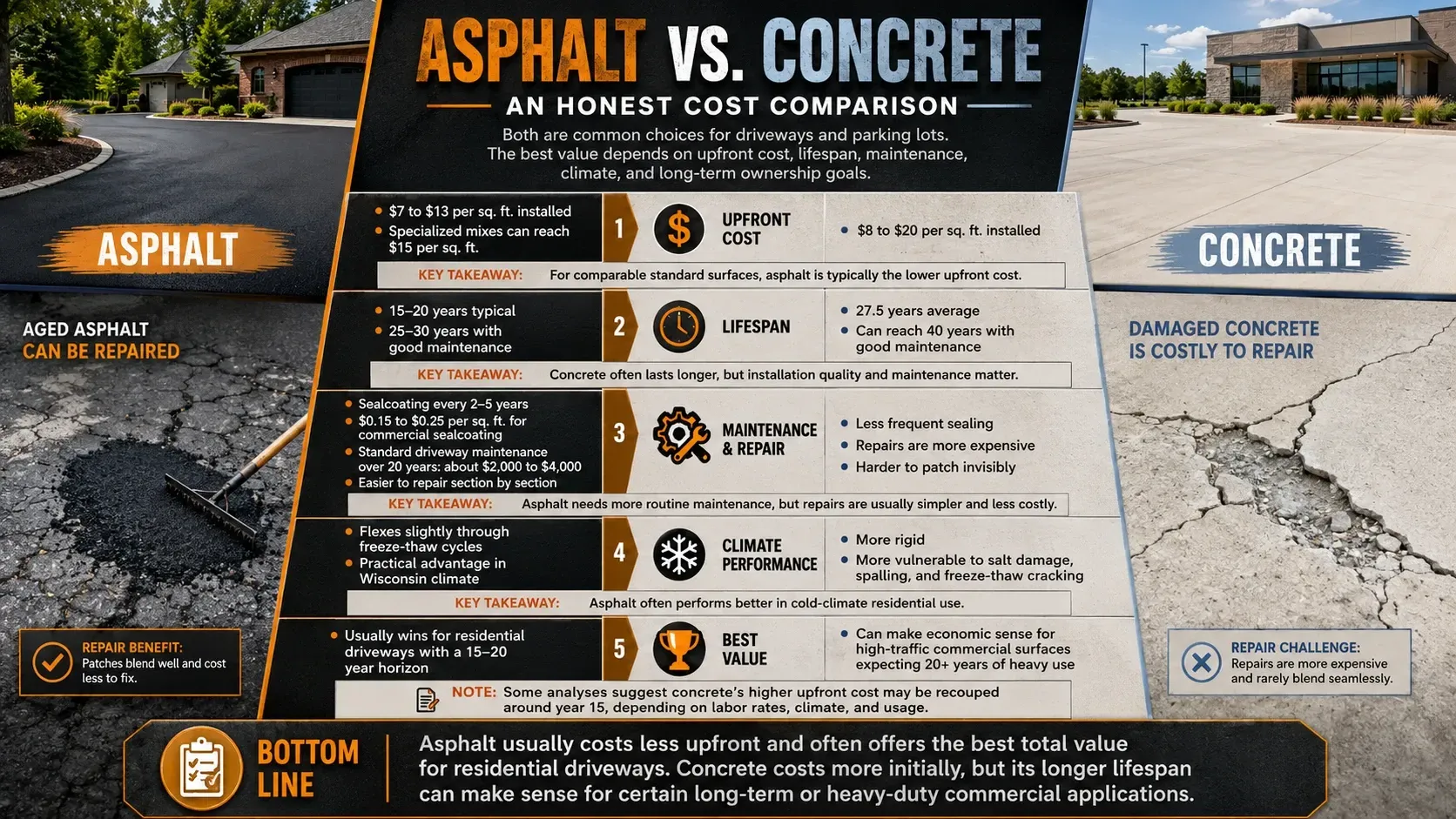
On initial installation cost, asphalt is clearly less expensive. For standard residential driveways and parking lots, current data puts asphalt at $7 to $13 per square foot installed, with specialized mixes such as permeable or polymer-modified asphalt reaching $15 per square foot. Concrete runs $8 to $20 per square foot. For comparable standard surfaces, asphalt is roughly half the upfront cost of concrete. That difference is real and significant for owners managing project budgets.
On lifespan, the picture is more nuanced. A properly installed asphalt surface averages 15 to 20 years before major repair or replacement, with well-maintained surfaces reaching 25 to 30 years. Concrete averages 27.5 years with the potential to reach 40 years with good maintenance. That difference is meaningful over the long term.[1][10]
On the total cost of ownership, the comparison depends heavily on maintenance. Asphalt requires sealcoating every 2 to 5 years at $0.15 to $0.25 per square foot for commercial surfaces, plus periodic crack filling and spot repair. Over a 20-year lifespan, total maintenance costs typically run $2,000 to $4,000 for a standard driveway. Concrete requires less frequent sealing but is more expensive to repair when it does crack or settle, and is significantly more difficult to patch invisibly. Some analyses conclude that concrete's higher upfront cost is recouped by approximately year 15 — though this depends on local labor rates, climate, and usage.[1]
In Wisconsin's freeze-thaw climate, asphalt has a practical advantage: it flexes slightly through temperature cycles rather than cracking rigidly the way concrete does. Concrete is more vulnerable to deicing salt damage and can spall under repeated freeze-thaw exposure. Asphalt is easier to repair section by section. For high-traffic commercial surfaces expecting 20-plus years of heavy use, concrete can make economic sense over the full ownership period. For residential driveways with a 15 to 20-year horizon, asphalt almost always wins on total cost
PCAA made this image for public use under the Creative Commons Attribution (CC BY) license.
Asphalt vs. Pavers and Brick: The Premium Surface Option
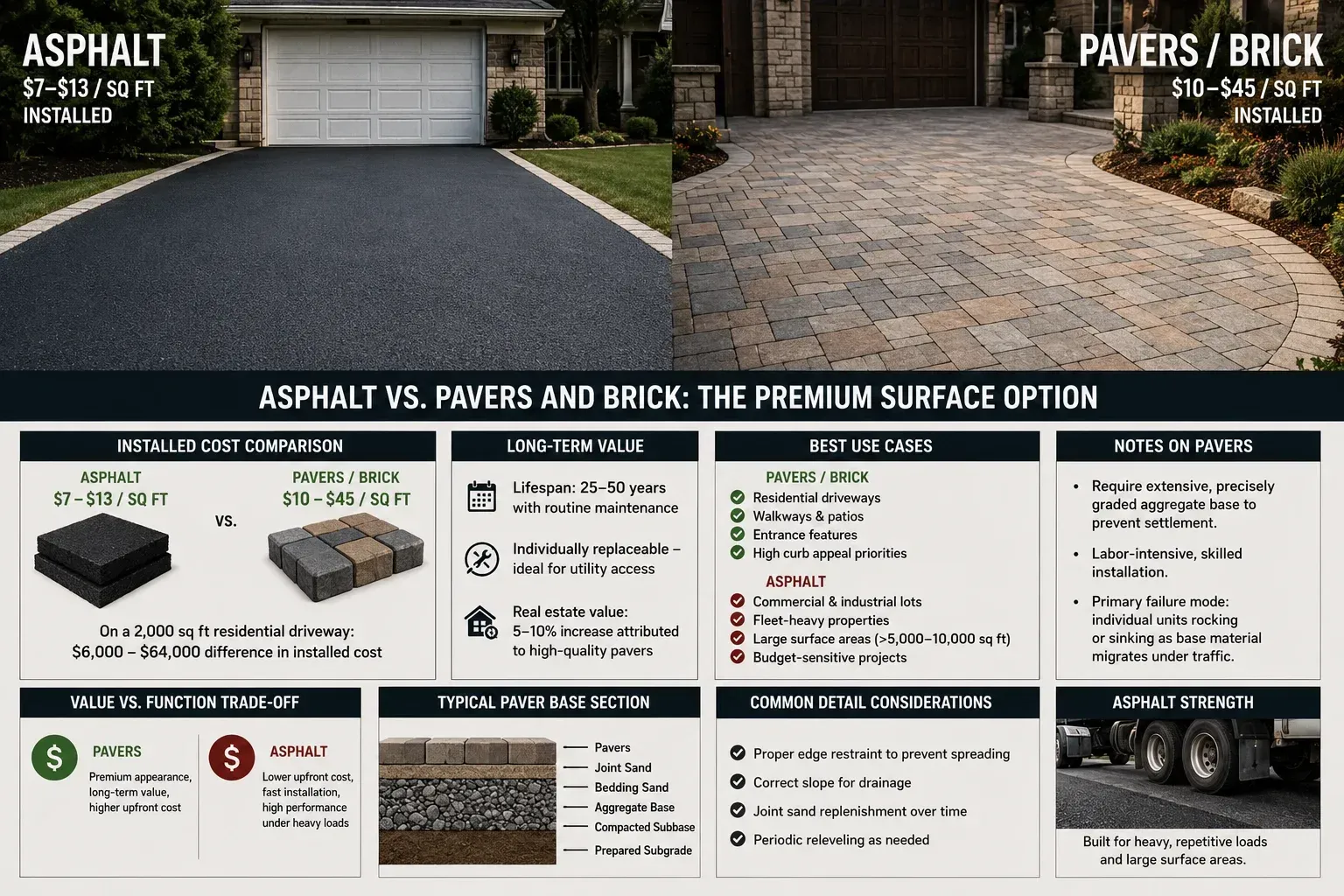
Concrete unit pavers—clay brick, concrete block, natural stone—represent the premium tier of paved surfaces and carry installed costs to match. Professionally installed pavers run $10–$45 per square foot, depending on material, pattern complexity, and site preparation required. Natural stone (bluestone, travertine, granite) reaches the high end of that range; standard concrete pavers start around $10–$15 installed. By comparison, asphalt runs $7–$13 per square foot for residential, 40 to 60 percent less upfront on equivalent square footage. On a 2,000-square-foot residential driveway, that difference translates to $6,000–$64,000 in installed cost depending on material choice.
The long-term calculus is more nuanced. Properly installed unit pavers have documented lifespans of 25–50 years with routine joint sand replenishment and periodic releveling. They are also individually replaceable: when a utility trench cuts through a paver surface, the affected units come up and go back down cleanly with no visible patch line. Real estate economists have attributed 5–10 percent property value increases to high-quality paver installations in residential settings—a premium with no reliable equivalent for asphalt or standard concrete. For homeowners in markets where curb appeal drives valuations and planning a sale within a decade, the math can favor pavers. For commercial operators, fleet-heavy properties, or anyone maximizing paved area on a budget, it rarely does.
Pavers are also structurally impractical for most commercial paving applications. Large surface areas require extensive, precisely graded aggregate base work to prevent differential settlement—the primary failure mode of unit paver installations is individual units rocking or sinking as base material migrates under traffic. Installation labor is intensive and highly skilled, which is why contractor availability for large-scale paver work is limited in most Midwest markets. For any surface exceeding 5,000–10,000 square feet, asphalt remains the dominant choice for cost, installation speed, and structural performance under heavy repetitive loads. Pavers belong in the decision matrix for residential driveways, walkways, patios, and entrance features where aesthetics and long-term curb appeal justify the premium.
PCAA made this image for public use under the Creative Commons Attribution (CC BY) license.
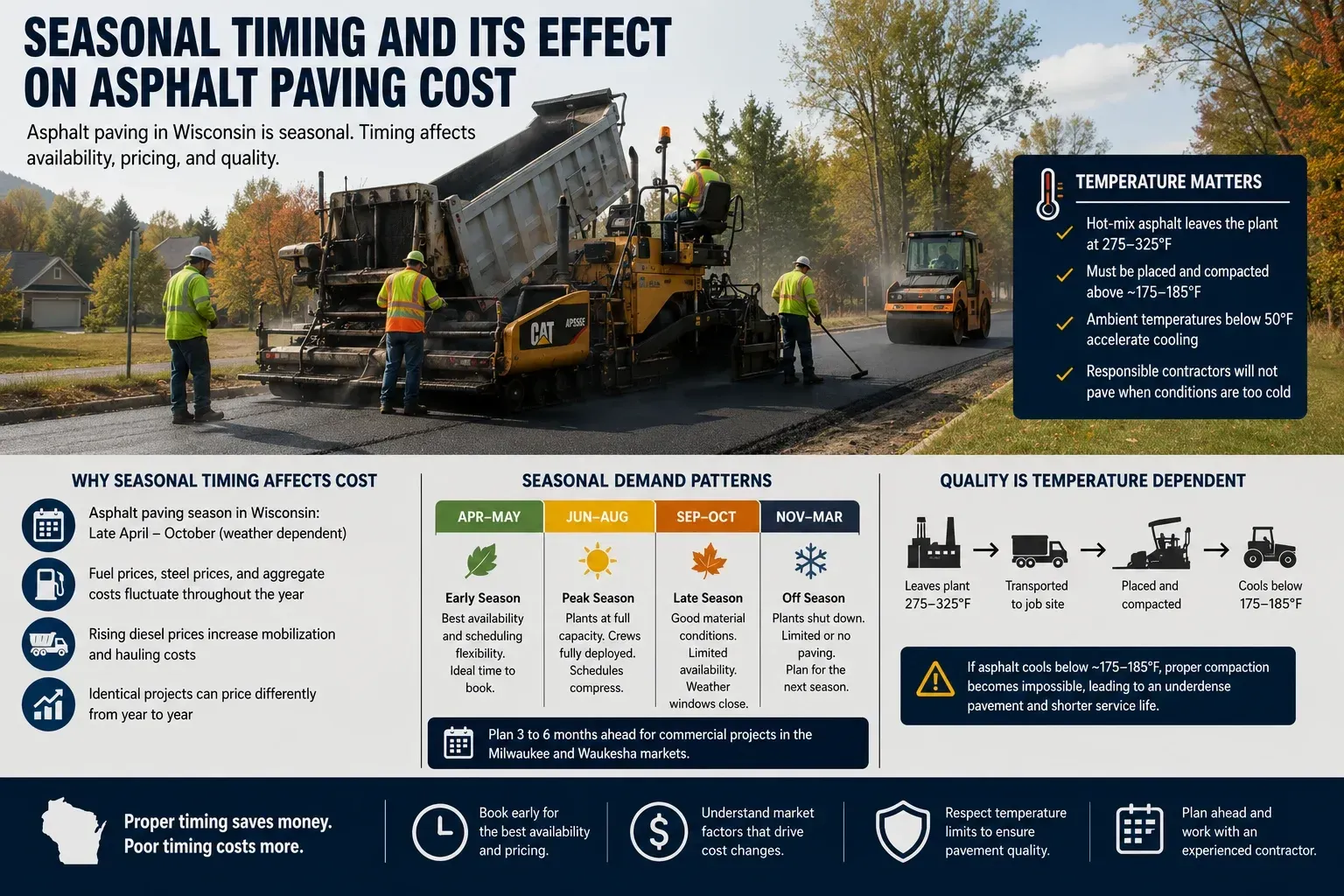
Seasonal Timing and Its Effect on Asphalt Paving Cost
Asphalt paving is a seasonal business in Wisconsin and throughout the Midwest. Hot-mix asphalt requires ambient temperatures above approximately 50°F during placement and compaction, which limits the practical paving season to roughly late April through October, depending on the year. Plant shutdowns, reduced availability, and end-of-season demand spikes all affect scheduling and, in some cases, pricing.
Booking early in the season — spring through early summer — typically gives owners the widest contractor availability and the most scheduling flexibility. Late-season work (September and October) can be excellent from a material standpoint, as cooler ambient temperatures actually slow the cooling of hot-mix asphalt slightly, giving crews more working time — but contractor schedules are often compressed, and weather windows can close quickly.
Fuel prices, steel prices (relevant to equipment and curbing), and aggregate costs all fluctuate through the year and across years. When diesel prices rise, mobilization and hauling costs increase even if asphalt material prices hold steady. This is one reason identical projects can price differently from year to year, and why a quote from two years ago is not a reliable benchmark for what a project costs today.
Temperature is not just a scheduling factor — it is a material quality factor. Hot-mix asphalt leaves the plant at approximately 275 to 325 degrees Fahrenheit and must be placed and compacted before it drops below roughly 175 to 185 degrees, depending on the mix design. Once it cools below that threshold, proper compaction becomes impossible, and the pavement will be underdense, which shortens its service life. In Wisconsin, ambient temperatures below 50°F accelerate cooling significantly — which is why responsible contractors will not pave when ground or air temperatures are too low, even if the project calendar is tight.[3]
Demand patterns in the region follow a predictable curve. Work booked in early spring — April through May — typically has the widest contractor availability and the longest lead time to accommodate large commercial projects. June through August is peak season: plants are running at full capacity, crews are fully deployed, and scheduling windows compress. September and October offer a secondary window with quality conditions but limited availability. Property owners who wait until late summer to schedule spring projects routinely find themselves pushed into the following season. Planning by three to six months is not excessive for commercial projects in the Milwaukee and Waukesha markets.
PCAA made this image for public use under the Creative Commons Attribution (CC BY) license.
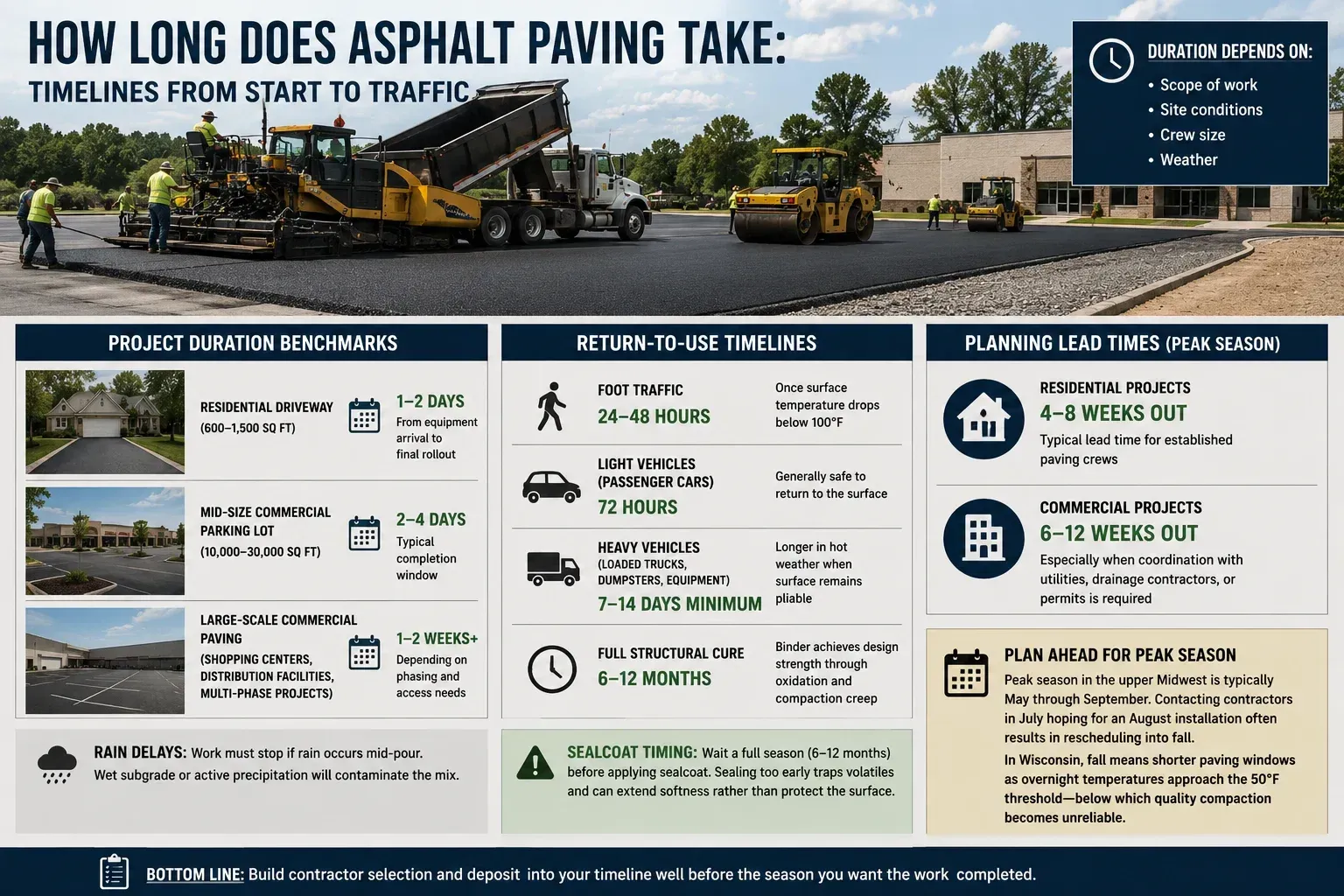
How Long Does Asphalt Paving Take: Timelines from Start to Traffic
Project duration depends on scope, site conditions, and crew size—but the industry benchmarks are well-established. A standard residential driveway (600–1,500 square feet) with minimal site prep runs one to two days from equipment arrival to final rollout. A mid-size commercial parking lot (10,000–30,000 square feet) is typically a two-to-four-day job. Large-scale commercial paving—shopping centers, distribution facilities, multi-phase parking structures—can run one to two weeks or longer, depending on phasing requirements that keep portions of the lot accessible during construction. Rain delays mid-pour require halting work entirely, as wet subgrade or active precipitation will contaminate the mix.
Return-to-use timelines are where owners most often get into trouble. New asphalt can bear foot traffic in 24–48 hours once surface temperatures drop below 100°F—typically the following morning in summer conditions. Light passenger vehicles can generally return in 72 hours. Heavy vehicles—loaded delivery trucks, dumpsters, construction equipment—should stay off new pavement for 7–14 days minimum, and longer in hot weather when the surface remains pliable. Full structural cure, during which the asphalt binder achieves its design strength through oxidation and compaction creep, takes 6–12 months. This is why reputable contractors recommend waiting a full season before applying sealcoat: sealing too early traps volatiles in the binder and can extend softness rather than protect the surface.
Planning lead times matter as much as construction duration. During peak season in the upper Midwest—typically May through September—established paving crews book 4–8 weeks out for residential work and 6–12 weeks out for commercial projects requiring coordination with utilities, drainage contractors, or municipal permits. Owners who contact contractors in July hoping for an August installation frequently find themselves rescheduled into fall shoulder season—which, in Wisconsin, means working against shortening paving windows as overnight temperatures approach the 50°F threshold below which quality compaction becomes unreliable. Build contractor selection and deposit into your project timeline well before the season you want the work completed.
PCAA made this image for public use under the Creative Commons Attribution (CC BY) license.
How to Read an Asphalt Paving Quote
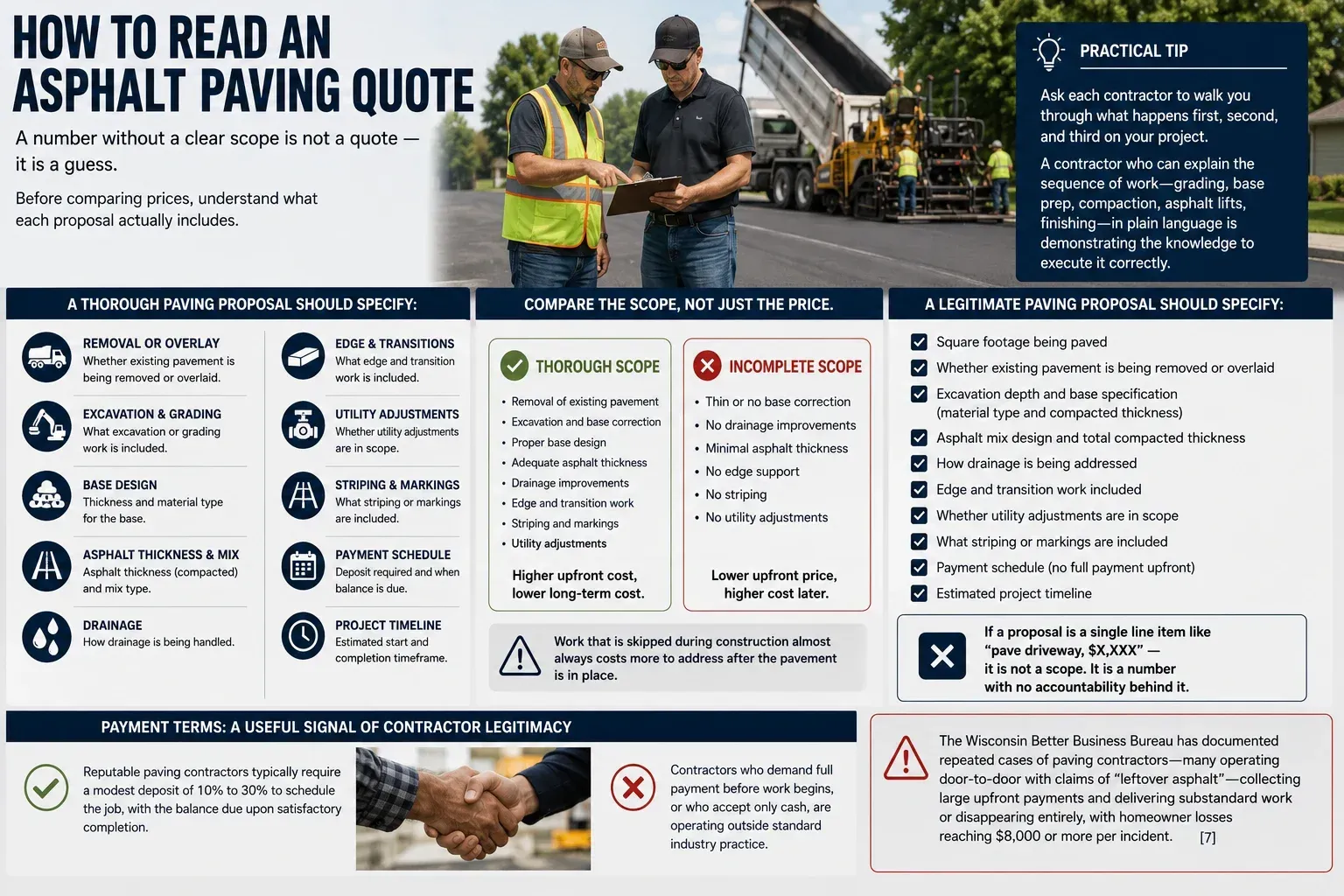
An asphalt paving proposal is only as useful as the scope it describes. A number without a clear scope is not a quote — it is a guess. Before comparing prices, owners should understand what each proposal actually includes.
A thorough paving proposal should specify: whether existing pavement is being removed or overlaid, what excavation or grading work is included, what base design is being used (thickness and material type), what asphalt thickness and mix type is being installed, how drainage is being handled, what edge and transition work is included, and whether striping, utility adjustments, or other finishing items are part of the scope.
When two proposals differ significantly in price, the first question should be: what does each scope include? Not: which contractor is cheaper? A lower proposal that excludes base correction, drainage work, or proper removal is not a better deal — it is a deferred cost. In paving, work that is skipped during construction almost always costs more to address after the pavement is in place.
- Practical tip: Ask each contractor to walk you through what happens first, second, and third on your project. A contractor who can explain the sequence of work — grading, base prep, compaction, asphalt lifts, finishing — in plain language is demonstrating the knowledge to execute it correctly.
A legitimate paving proposal should specify, at minimum: the square footage being paved, whether existing pavement is being removed or overlaid, the excavation depth and base specification (material type and compacted thickness), the asphalt mix design and total compacted thickness, how drainage is being addressed, what edge and transition work is included, whether utility adjustments are in scope, what striping or markings are included, the payment schedule (legitimate contractors do not require full payment upfront), and an estimated project timeline. Any proposal that is a single line item — "pave driveway, $X,XXX" — is not a scope. It is a number with no accountability behind it.
Payment terms are a useful signal of contractor legitimacy. Reputable paving contractors typically require a modest deposit of 10 to 30 percent to schedule the job, with the balance due upon satisfactory completion. Contractors who demand full payment before work begins, or who accept only cash, are operating outside standard industry practice. The Wisconsin Better Business Bureau has documented repeated cases of paving contractors — many operating door-to-door with claims of "leftover asphalt" — collecting large upfront payments and delivering substandard work or disappearing entirely, with homeowner losses reaching $8,000 or more per incident.[7]
PCAA made this image for public use under the Creative Commons Attribution (CC BY) license.
Why Two Asphalt Quotes Can Be So Different
This is the question many property owners most want answered. Two contractors look at the same driveway or parking lot and come back with numbers that are thousands of dollars apart. Why?
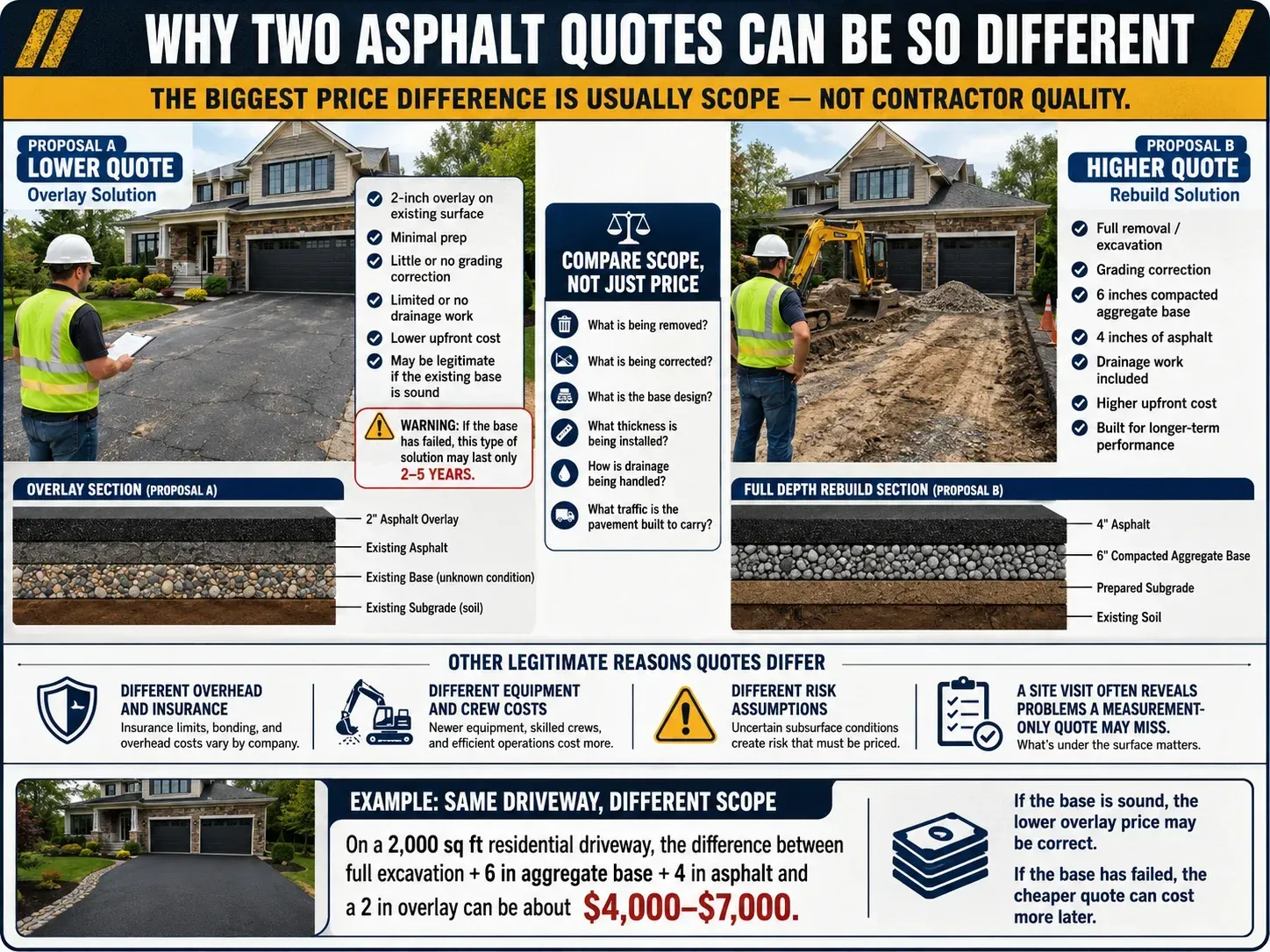
The most common reason is scope difference, not contractor quality. One contractor may include full removal, grading correction, stronger base prep, thicker asphalt, and drainage work. The other may propose an overlay on the existing surface, minimal prep, and a thinner section. Both proposals reference the same address and the same square footage. They describe fundamentally different projects.
There can also be legitimate differences in overhead, equipment, insurance, and how each contractor prices risk. A contractor who has done enough work to know that a particular site has drainage problems may price conservatively to account for additional work they expect to find. A contractor who is pricing the job off a driveway measurement without a site visit may underestimate what the project requires.
The most useful comparison is not price-to-price. It is scope-to-scope. For each proposal, understand what is being removed, what is being corrected, what the base design is, what traffic assumptions are being made, how drainage is being handled, and what the finished surface is actually built to do. That comparison will tell you far more than comparing dollar amounts.
To make the scope difference concrete: on a 2,000 square foot residential driveway, the difference between a proposal that includes full excavation, 6 inches of compacted aggregate base, and 4 inches of asphalt versus one that proposes a 2-inch overlay on the existing surface is approximately $4,000 to $7,000 in total project cost. Both proposals reference the same driveway. If the existing base is sound, the overlay may be the correct recommendation, and the lower price is legitimate. If the base has failed, the overlay will last 2 to 5 years, and the property owner will spend more on the eventual full replacement than if they had done it right initially. The number alone cannot tell you which situation applies to your property.
PCAA made this image for public use under the Creative Commons Attribution (CC BY) license.
Why is the Cheapest Asphalt Paving Quote is Not Always the Best Value
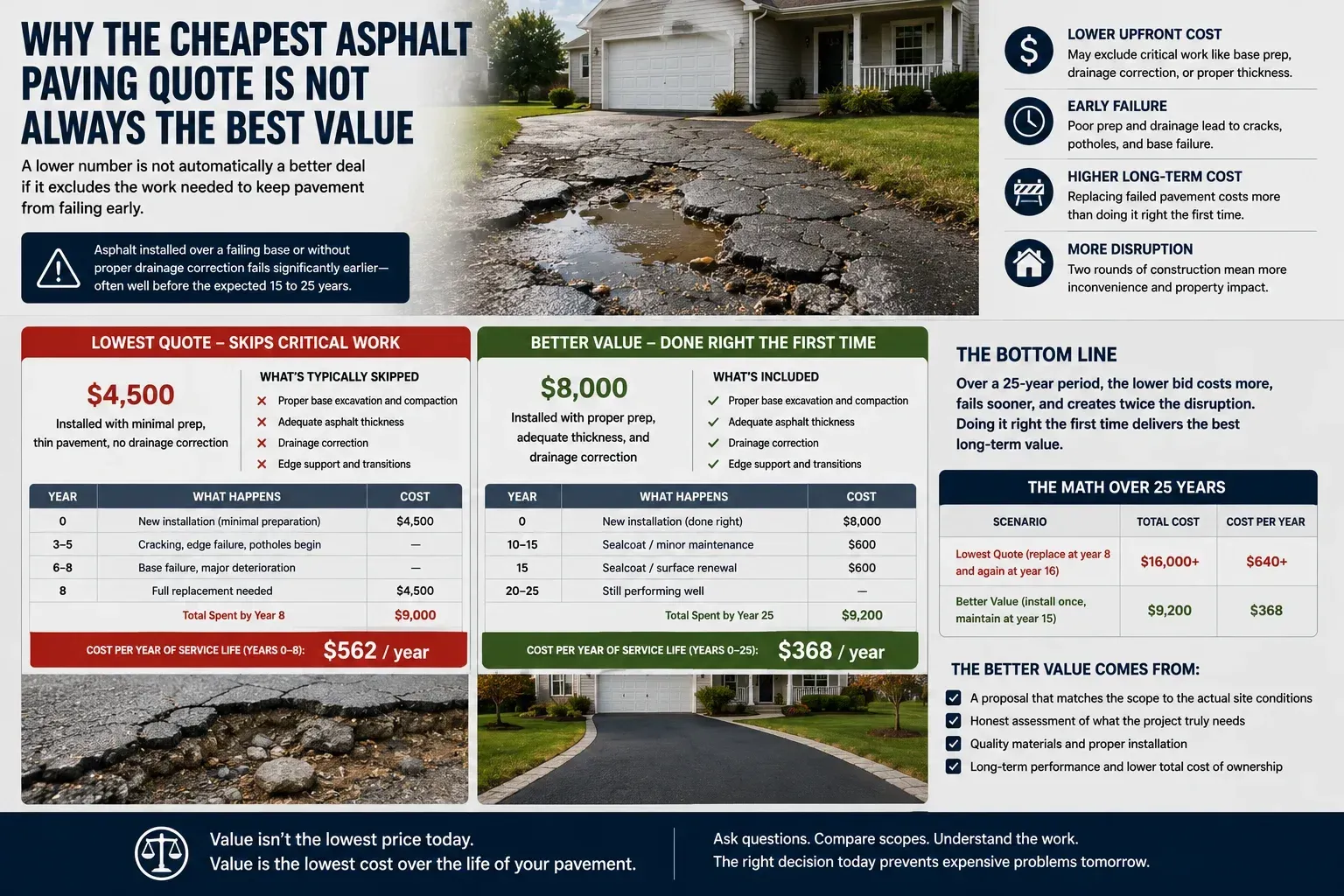
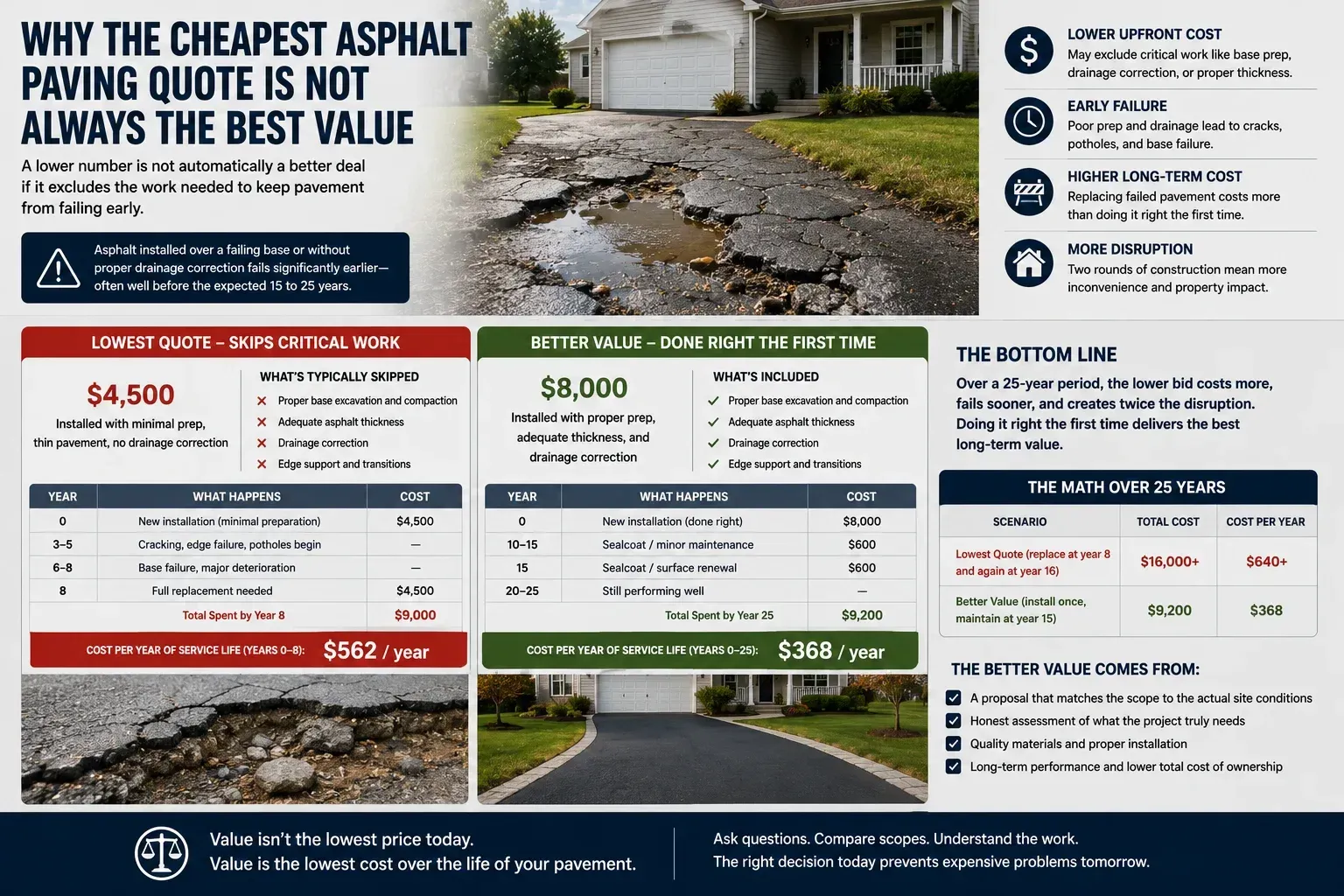
A lower number is not automatically a better deal if it excludes the work needed to keep the pavement from failing early. This is one of the clearest and most consistent lessons in asphalt paving. According to lifespan data, asphalt installed over a failing base or without proper drainage correction fails significantly earlier — in many documented cases, well before the expected 15 to 25 years.
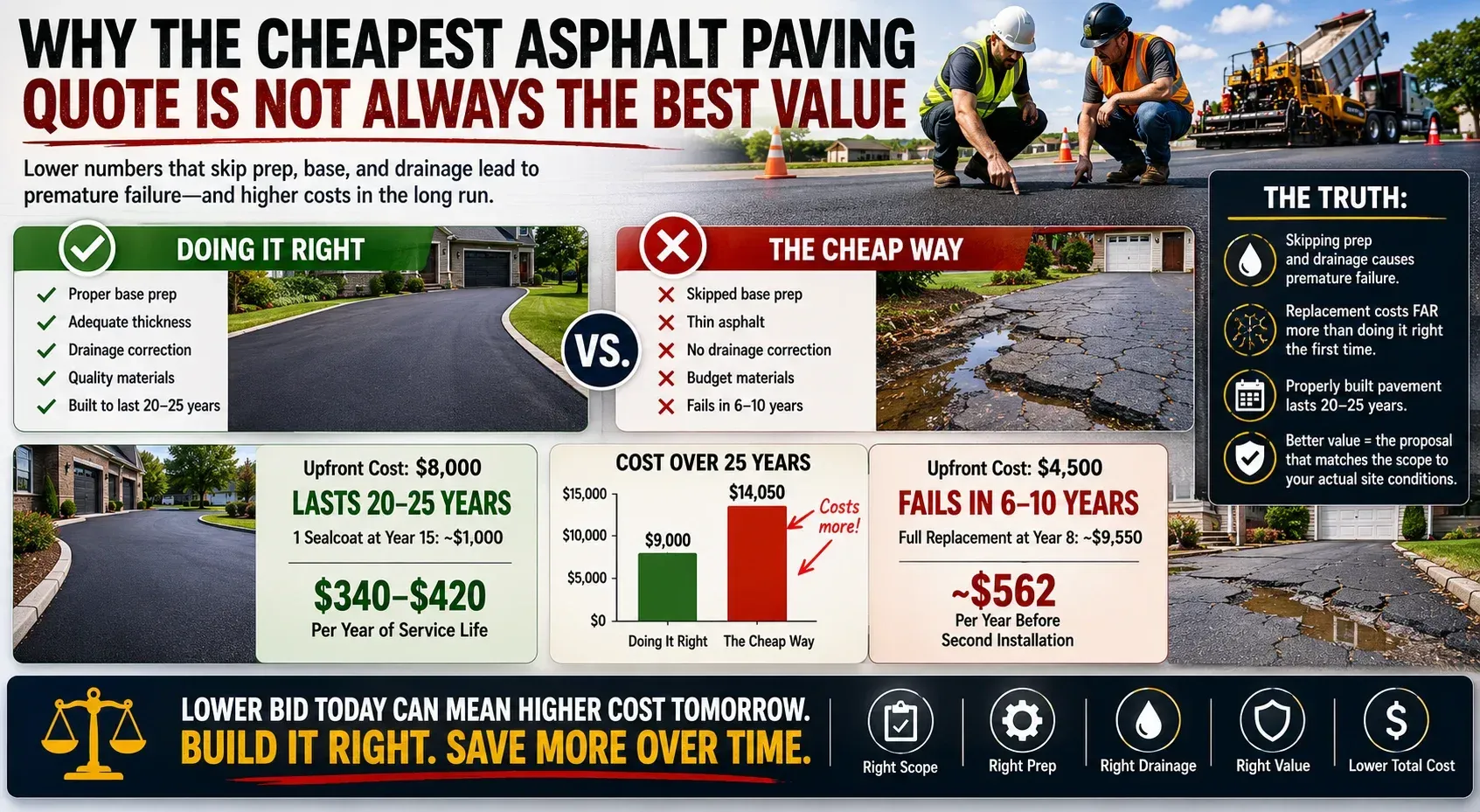
Replacing a failed driveway costs more than doing it right the first time. It also involves repeated disruption, hauling, and disposal costs. A pavement that lasts 25 years with one resurfacing at year 15 costs far less in total ownership than a pavement that requires full replacement at year 8 because the prep work was skipped. The math is straightforward once the numbers are compared honestly.
This does not mean the highest quote is always right, either. It means owners should understand what is included and what is assumed. The better value often comes from the proposal that most honestly matches the scope of work to the actual site conditions — not the one with the most impressive marketing or the lowest opening number.
The math is straightforward when laid out over time. A driveway installed correctly for $8,000 — with proper base prep, adequate thickness, and drainage correction — that lasts 20 to 25 years with one sealcoat cycle costs approximately $340 to $420 per year of service life. A driveway installed for $4,500 with skipped prep that requires full replacement at year 8 costs approximately $562 per year before the second installation begins. Over a 25-year ownership period, the owner who chose the lower bid has paid more in total and endured two rounds of construction disruption. This is not speculation — it is the predictable consequence of installing a structural pavement product without the structural foundation it requires.
PCAA made this image for public use under the Creative Commons Attribution (CC BY) license.
PCAA made this image for public use under the Creative Commons Attribution (CC BY) license.
What Asphalt Paving Actually Costs in Southeastern Wisconsin
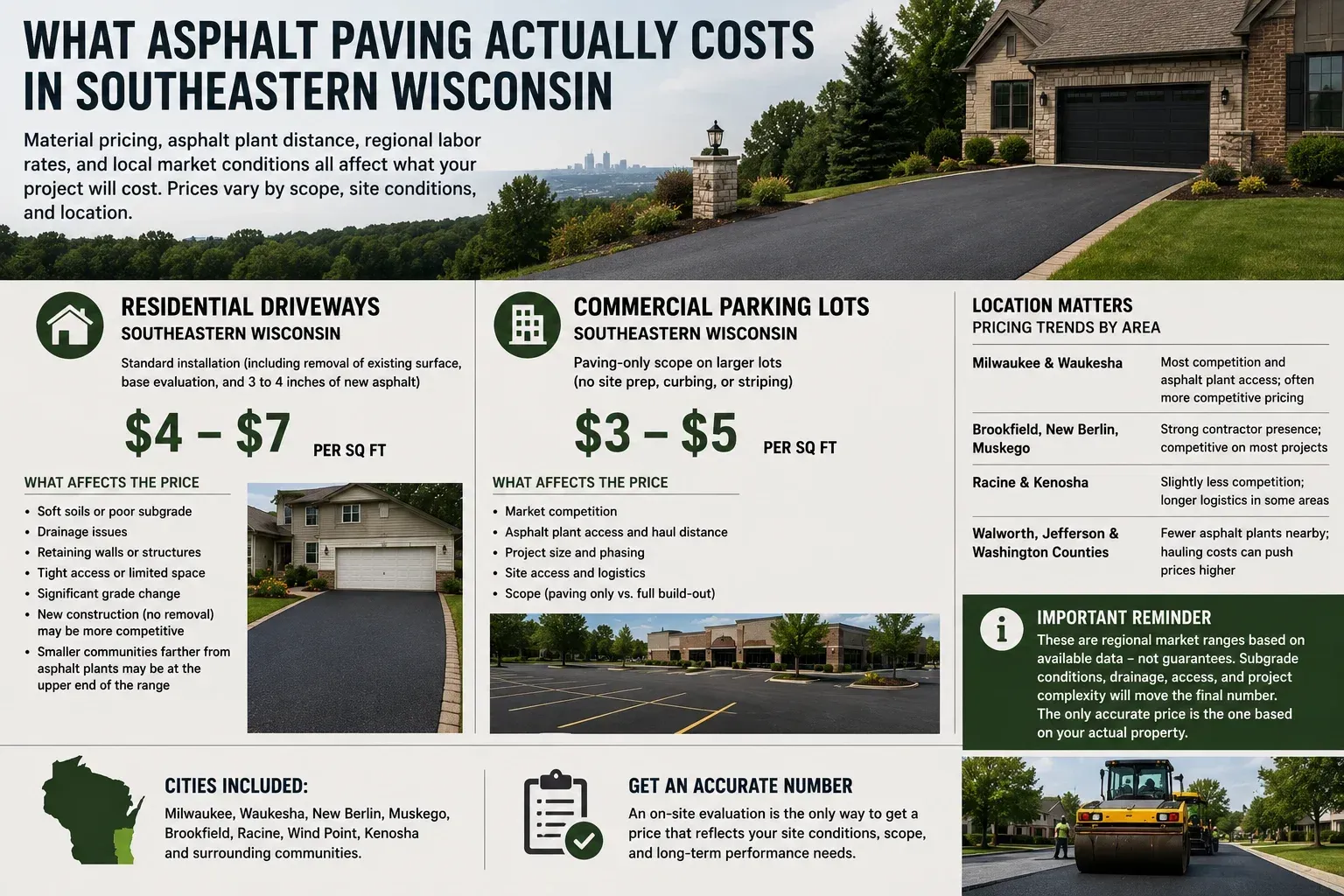
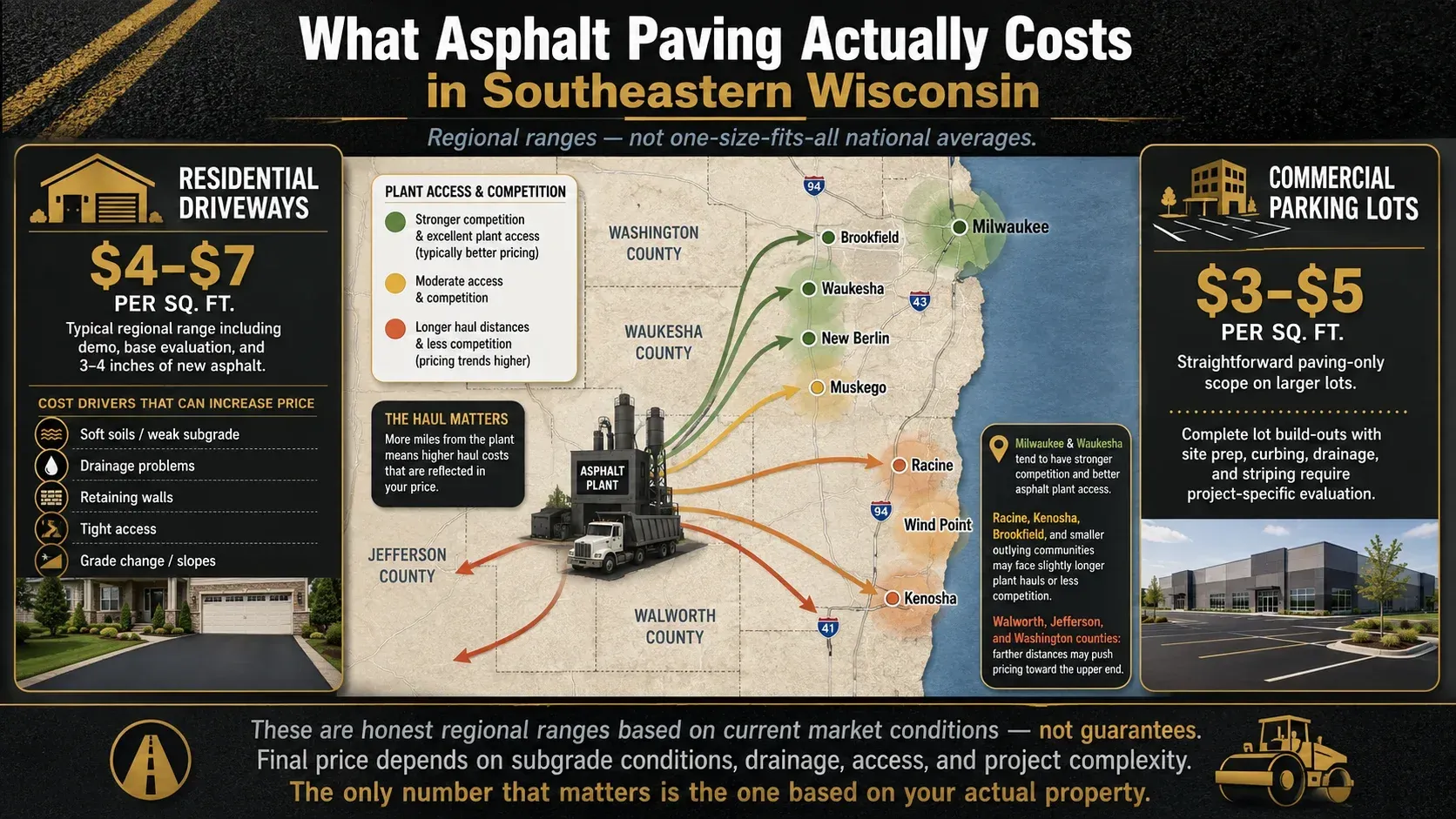
Generic national price guides list averages that rarely reflect what a real paving project costs in southeastern Wisconsin. Material pricing, asphalt plant distance, regional labor rates, and local market conditions all affect where any given project lands within a national range. What a driveway costs in Waukesha is not necessarily what it costs in Racine or Brookfield, and what a commercial lot costs in Milwaukee is not the same as one in a smaller community with fewer competing contractors and longer plant hauls.
For residential driveways across the region — including Milwaukee, Waukesha, New Berlin, Muskego, Brookfield, Racine, Wind Point, and Kenosha — current market data puts standard asphalt driveway installation (including demolition of an existing surface, base evaluation, and 3 to 4 inches of new asphalt) in a range of roughly $4 to $7 per square foot. Sites with soft soils, drainage problems, retaining walls, tight access, or significant grade change will run higher. New construction driveways without existing pavement to remove may be more competitive depending on site conditions. Smaller communities farther from major asphalt plants — including parts of Walworth, Jefferson, and Washington counties — may see pricing at the upper end of that range due to increased hauling cost.
For commercial parking lots in southeastern Wisconsin, per-square-foot pricing on a straightforward paving-only scope typically falls in the $3 to $5 range for larger lots. Milwaukee and Waukesha have the highest concentration of commercial paving contractors and the most asphalt plant access in the region, which can create competitive pricing on larger jobs. Smaller markets — Racine, Kenosha, Brookfield, and outlying areas — may have slightly less competition and longer plant logistics. Complete commercial lot build-outs, including site prep, concrete curbing, drainage structures, and striping, are full construction projects and should be evaluated as such, regardless of location.
These are honest regional ranges based on available market data. They are not guarantees, and no number in this guide substitutes for an on-site evaluation. Subgrade conditions, drainage, access, and project complexity will all move the final number. The only figure that matters for your specific project is the one based on your actual property.
PCAA made this image for public use under the Creative Commons Attribution (CC BY) license.
Maintenance Costs: What to Budget After Paving
A new asphalt surface is the beginning of a maintenance relationship, not the end of a spending decision. Budgeting for maintenance is part of understanding the true cost of asphalt paving.
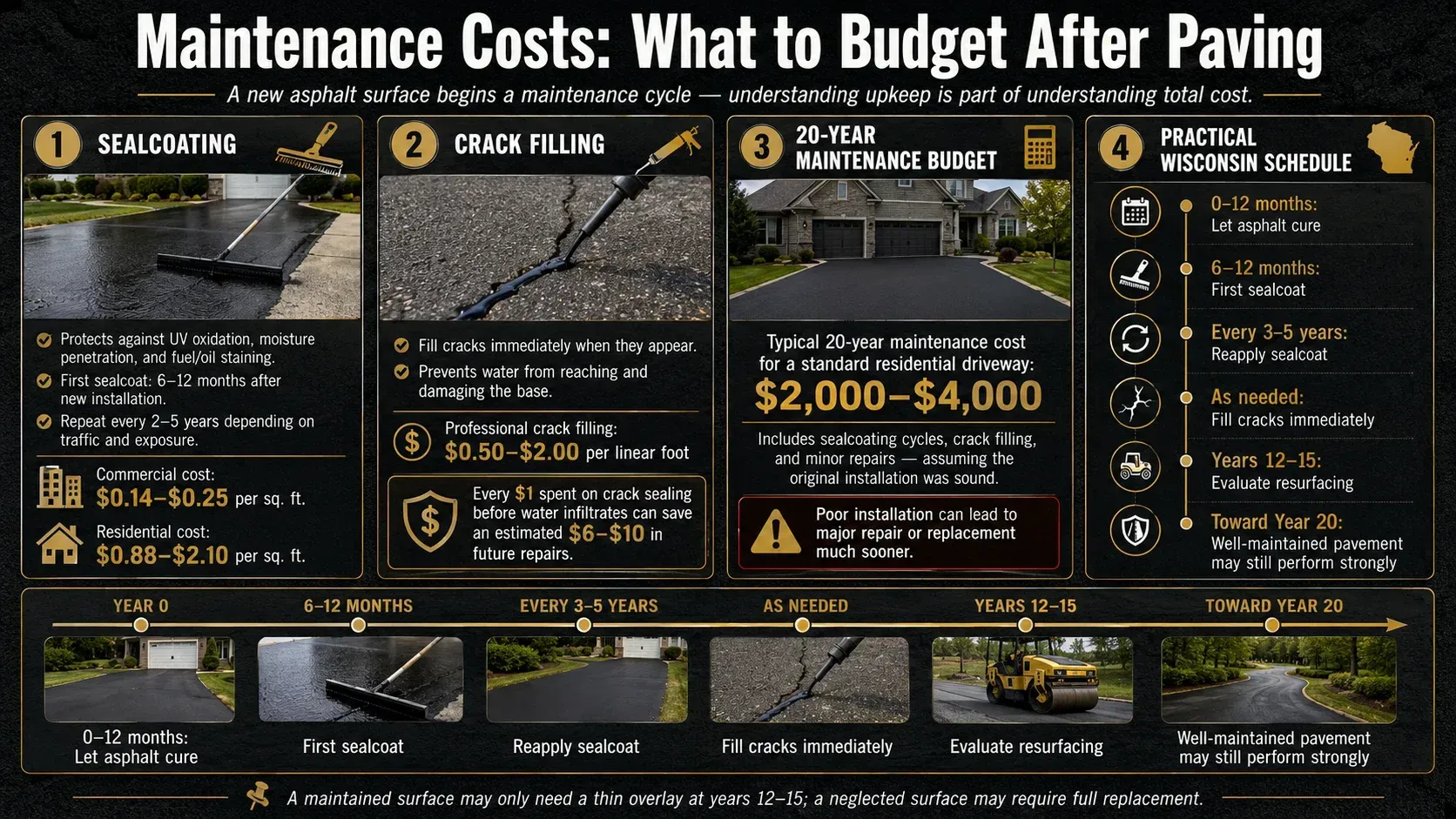
Sealcoating is the most common and cost-effective maintenance step. It protects the surface from UV oxidation, moisture penetration, and fuel or oil staining. Industry guidance recommends sealcoating 6 to 12 months after a new installation (once the asphalt has fully cured) and every 2 to 5 years after that, depending on traffic and exposure. Current market data puts sealcoating cost at $0.14 to $0.25 per square foot for commercial surfaces and $0.88 to $2.10 per square foot for residential driveways, depending on condition and product.
Crack filling should be addressed as soon as cracks appear, before water infiltrates and begins degrading the base. The cost of crack filling is minor compared to the cost of letting water reach the base layer and accelerating failure. Patching and localized repair pricing vary significantly by the depth and extent of the damaged area.
Total maintenance cost over a 20-year asphalt lifespan typically runs $2,000 to $4,000 for a standard residential driveway, including sealcoating cycles, crack filling, and minor repairs — assuming the original installation was sound. A poorly installed pavement may require major repair or replacement well before that 20-year mark, dramatically increasing total ownership cost.
A practical maintenance schedule for a new asphalt driveway in Wisconsin looks like this: wait 6 to 12 months after installation before applying the first sealcoat, allowing the asphalt binder to fully cure and offgas. Apply sealcoat every 3 to 5 years thereafter. Fill cracks immediately when they appear — crack filler costs $0.50 to $2.00 per linear foot applied professionally and is the single most cost-effective maintenance investment available, because every dollar spent on crack sealing before water infiltrates saves an estimated $6 to $10 in future repair costs. At approximately years 12 to 15, evaluate whether resurfacing is appropriate. A well-maintained surface at that age may need only a thin overlay; a neglected one may require full replacement.
PCAA made this image for public use under the Creative Commons Attribution (CC BY) license.
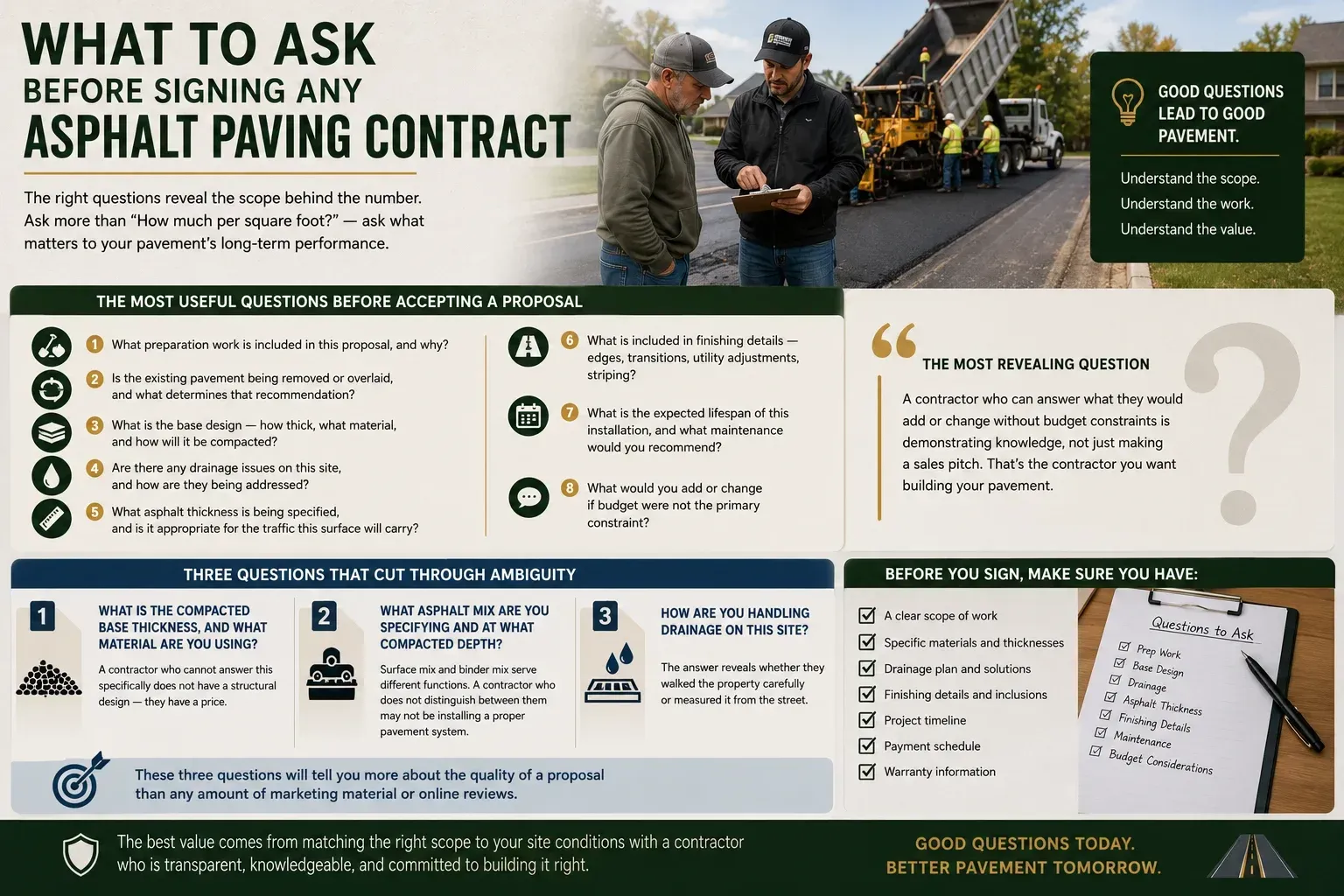
What to Ask Before Signing Any Asphalt Paving Contract
Instead of leading with "How much per square foot?" — the question that generates the least useful answer — property owners consistently get better results when they ask questions that reveal the scope behind the number.
The most useful questions before accepting a paving proposal include: What preparation work is included in this proposal, and why? Is the existing pavement being removed or overlaid, and what determines that recommendation? What is the base design — how thick, what material, and how will it be compacted? Are there any drainage issues on this site, and how are they being addressed? What asphalt thickness is being specified, and is it appropriate for the traffic this surface will carry? What is included in finishing details — edges, transitions, utility adjustments, striping? What is the expected lifespan of this installation, and what maintenance would you recommend? And — critically — what would you add or change if budget were not the primary constraint?
That last question is often the most revealing. A contractor who can answer it specifically and honestly — not as a sales pitch but as a technical recommendation — is demonstrating the knowledge and integrity to build a pavement that performs.
Three questions cut through most contractor ambiguity faster than any others. First: what is the compacted base thickness, and what material are you using? A contractor who cannot answer this specifically does not have a structural design — they have a price. Second: What asphalt mix are you specifying and at what compacted depth? Surface mix and binder mix serve different functions; a contractor who does not distinguish between them may not be installing a proper pavement system. Third: How are you handling drainage on this site? The answer reveals whether they walked the property carefully or measured it from the street. These three questions will tell you more about the quality of a proposal than any amount of marketing material or online reviews.
PCAA made this image for public use under the Creative Commons Attribution (CC BY) license.
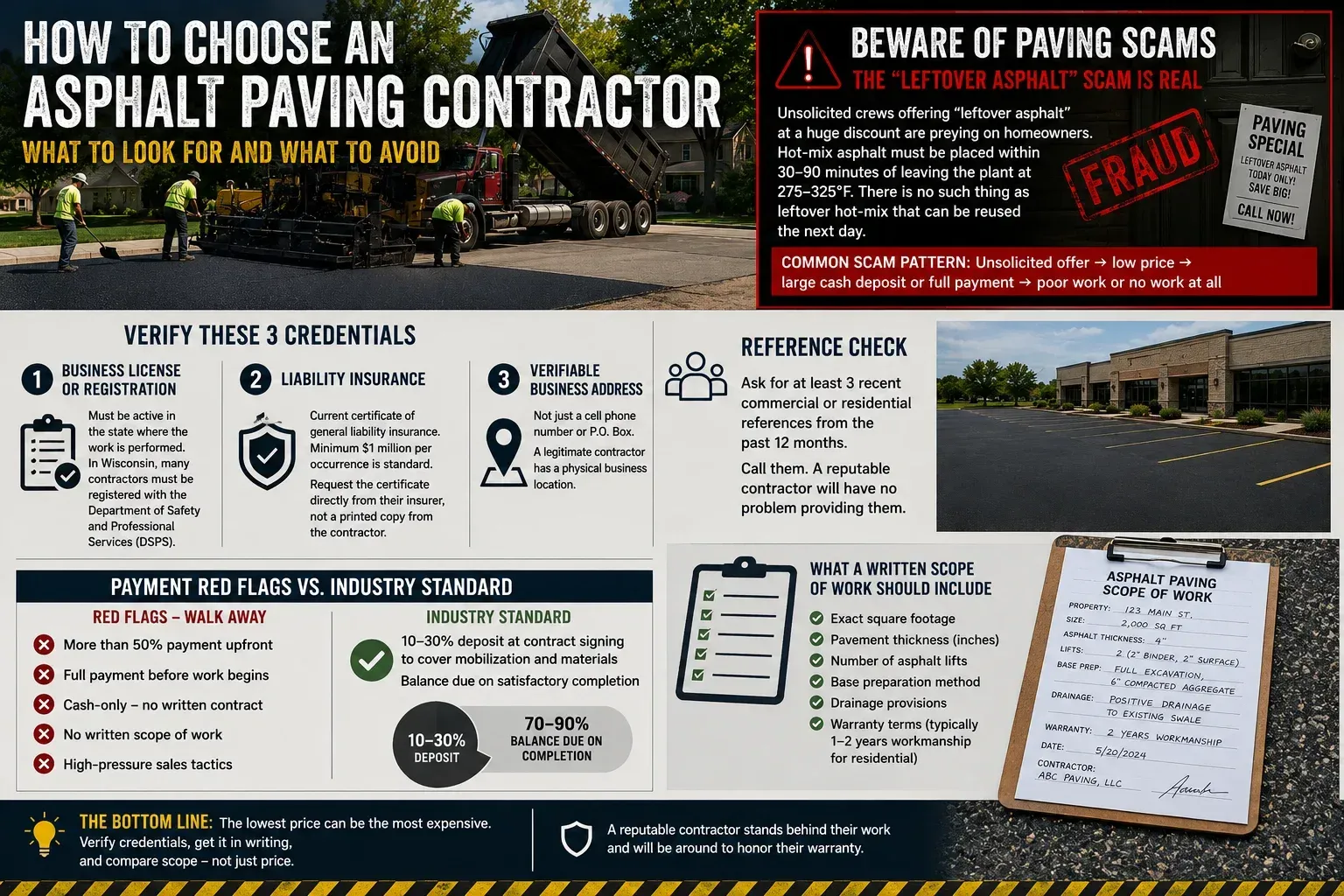
How to Choose an Asphalt Paving Contractor: What to Look For and What to Avoid
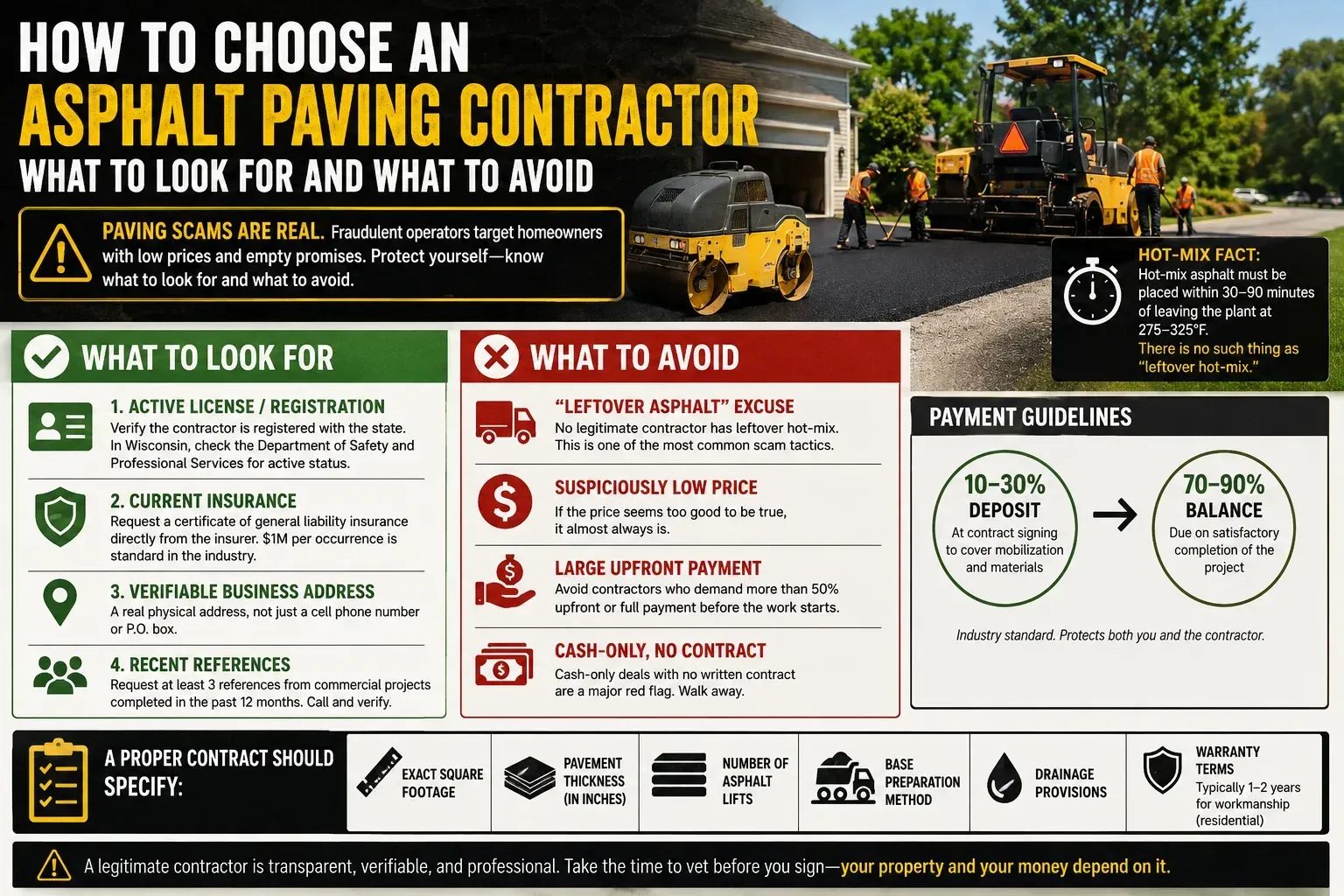
Asphalt paving attracts a higher-than-average share of fraudulent operators because the barrier to entry appears low—a truck, a load of mix, and a willingness to knock on doors. The Wisconsin Better Business Bureau, CBS58 Milwaukee, and FOX6 News have all documented paving scams in the state, with individual homeowner losses as high as $8,000. The most common pattern: a crew shows up unsolicited, claims to have ‘leftover asphalt’ from a nearby job, offers a suspiciously low price for same-day work, collects a large cash deposit or full payment upfront, and delivers either substandard work or no work at all. The ‘leftover hot-mix’ claim is a reliable fraud signal: hot-mix asphalt must be placed within 30–90 minutes of leaving the plant at temperatures of 275–325°F. There is no such thing as leftover hot-mix that can be reused the next day or transported door-to-door.[7] [8] [9]
Vetting a legitimate contractor requires three verifiable credentials: an active business license or contractor registration in the state where work is being performed, a current certificate of general liability insurance (minimum $1 million per occurrence is standard in the industry), and a verifiable business address—not just a cell phone number. In Wisconsin, contractors performing work above certain dollar thresholds must be registered with the Department of Safety and Professional Services; a legitimate contractor will provide their registration number without hesitation. Request the insurance certificate directly from the contractor's insurer, not a printed copy delivered to your door. References from completed commercial projects in the past 12 months are also a standard ask; a contractor who cannot provide three verifiable recent references is either new to the market or operating without a stable customer base.
Payment structure is one of the clearest indicators of legitimacy. Established paving contractors typically require a deposit of 10–30% at contract signing to cover mobilization and material costs, with the balance due on satisfactory completion. Any contractor demanding more than 50% upfront—or full payment before work begins—is operating outside industry norms. Cash-only payment requirements with no written contract are a hard stop: walk away. A written scope of work should specify exact square footage, pavement thickness in inches, number of asphalt lifts, base preparation method, drainage provisions, and any warranty terms—typically one to two years for workmanship on residential projects. If a contractor cannot or will not put these specifics in writing before work begins, that is the contract you will have to live with after the equipment leaves your property.
PCAA made this image for public use under the Creative Commons Attribution (CC BY) license.
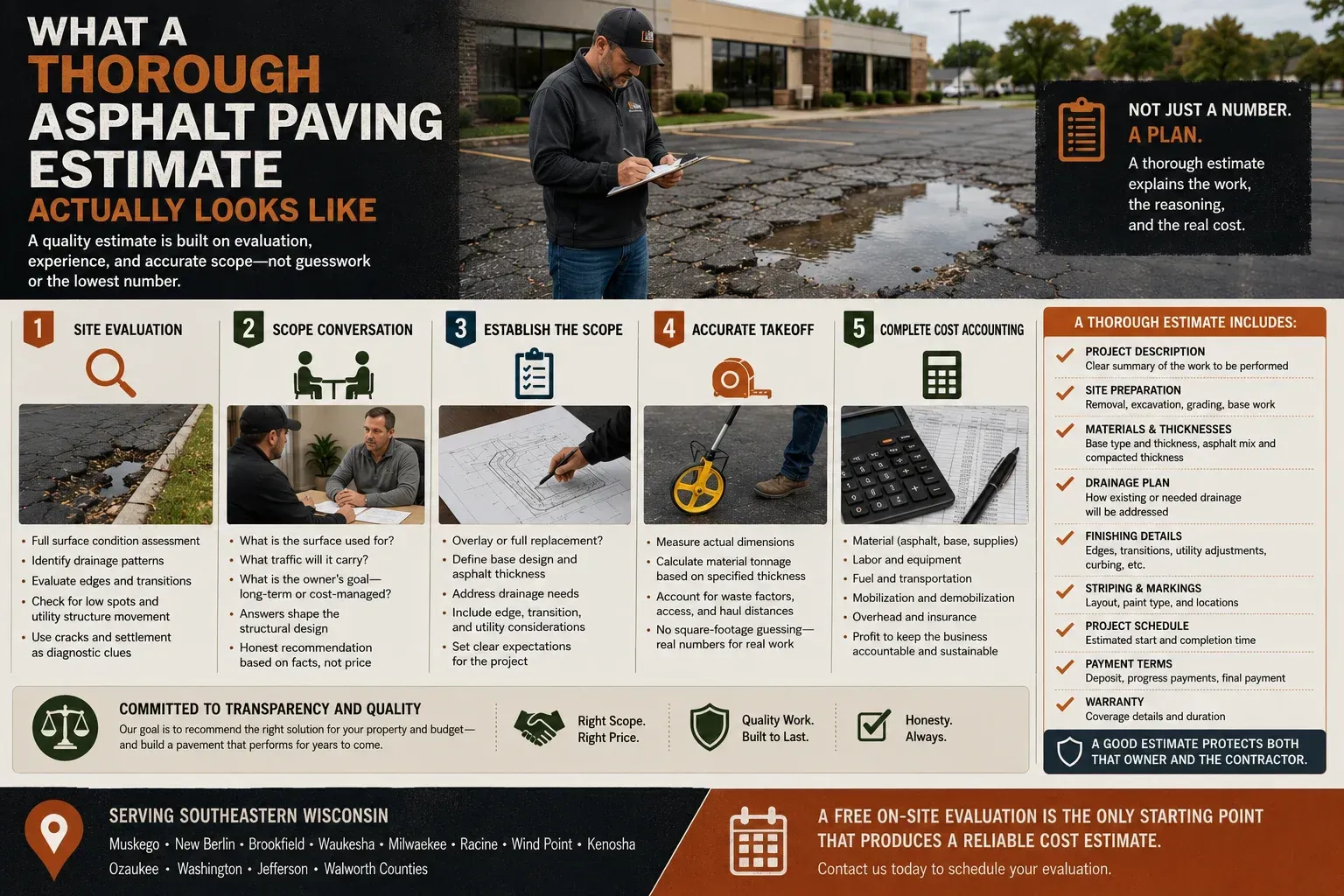
What a Thorough Asphalt Paving Estimate Actually Looks Like
A qualified paving contractor arrives at a property, thinking about the site — not the sale. The first job is to understand what the pavement system is actually doing, where it is succeeding, and where it is failing. That evaluation starts before a tape measure comes out.
A proper site walk covers the full surface condition: where water drains and where it does not, how edges and transitions are holding up, whether low spots or utility structures have shifted, and what the existing surface is telling you about what happened in the base below it. Cracks, settlement patterns, and drainage failures are diagnostic information — not just cosmetic problems.
Before any measurement is taken, the scope conversation matters. What is the surface being used for? What traffic will it carry? What is the owner's goal — a long-term replacement or a cost-managed overlay? The answers shape the structural design. An honest estimate follows the site conditions and the owner's actual goals, not a price point designed to win a bid. If the existing base is sound and an overlay is the right call, that is what should be recommended. If full replacement is the only durable path, the evidence for that recommendation should be explained clearly — not assumed.
Once the scope is established, a thorough estimate accounts for every real cost: material tonnage based on actual thickness specifications, base requirements, labor, equipment, fuel, mobilization, and appropriate overhead. The number on a quality proposal reflects the project as it actually exists — not a square-footage guess optimized to be the lowest number in the inbox.
For property owners in southeastern Wisconsin — including Muskego, New Berlin, Brookfield, Waukesha, Milwaukee, Racine, Wind Point, Kenosha, Ozaukee, Washington, Jefferson, and Walworth counties — the same principles apply regardless of which contractor performs the work. A free on-site evaluation based on actual site conditions is the only starting point that produces a reliable cost estimate.
- If you want to understand what your project will actually cost, the most useful first step is a free on-site evaluation. No generic numbers. No pressure. Just an honest look at your property and a clear proposal built on what it actually needs
PCAA made this image for public use under the Creative Commons Attribution (CC BY) license.
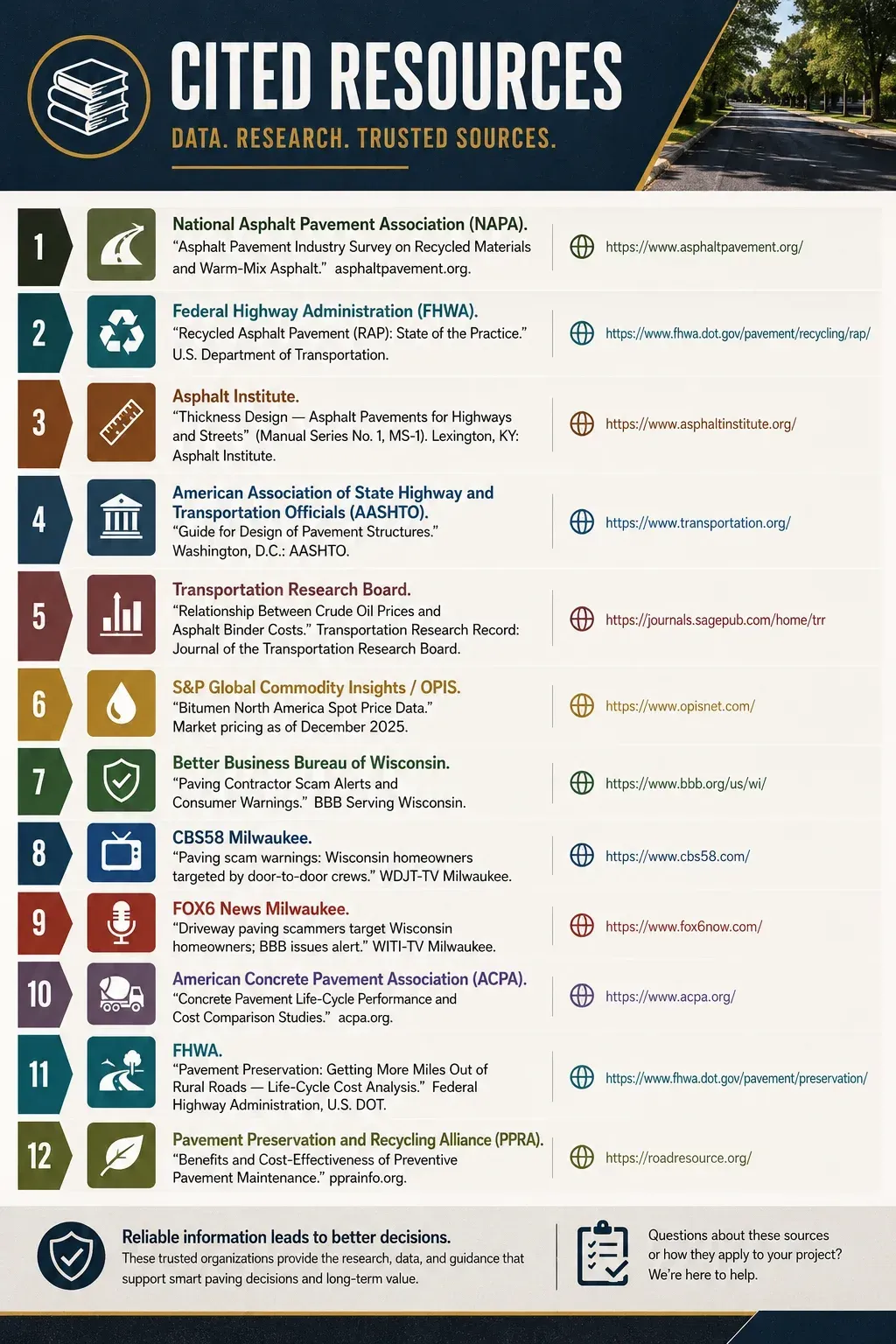
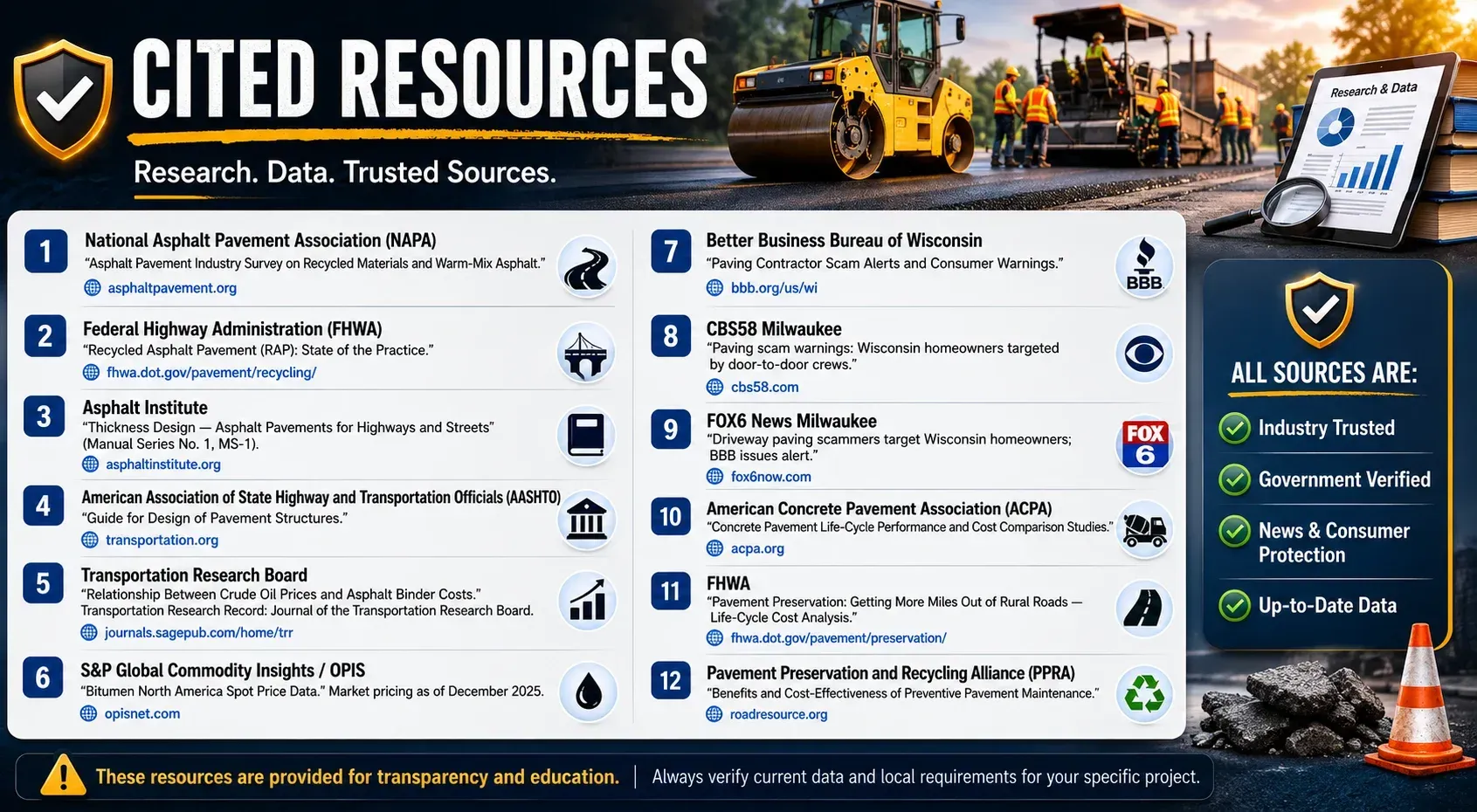
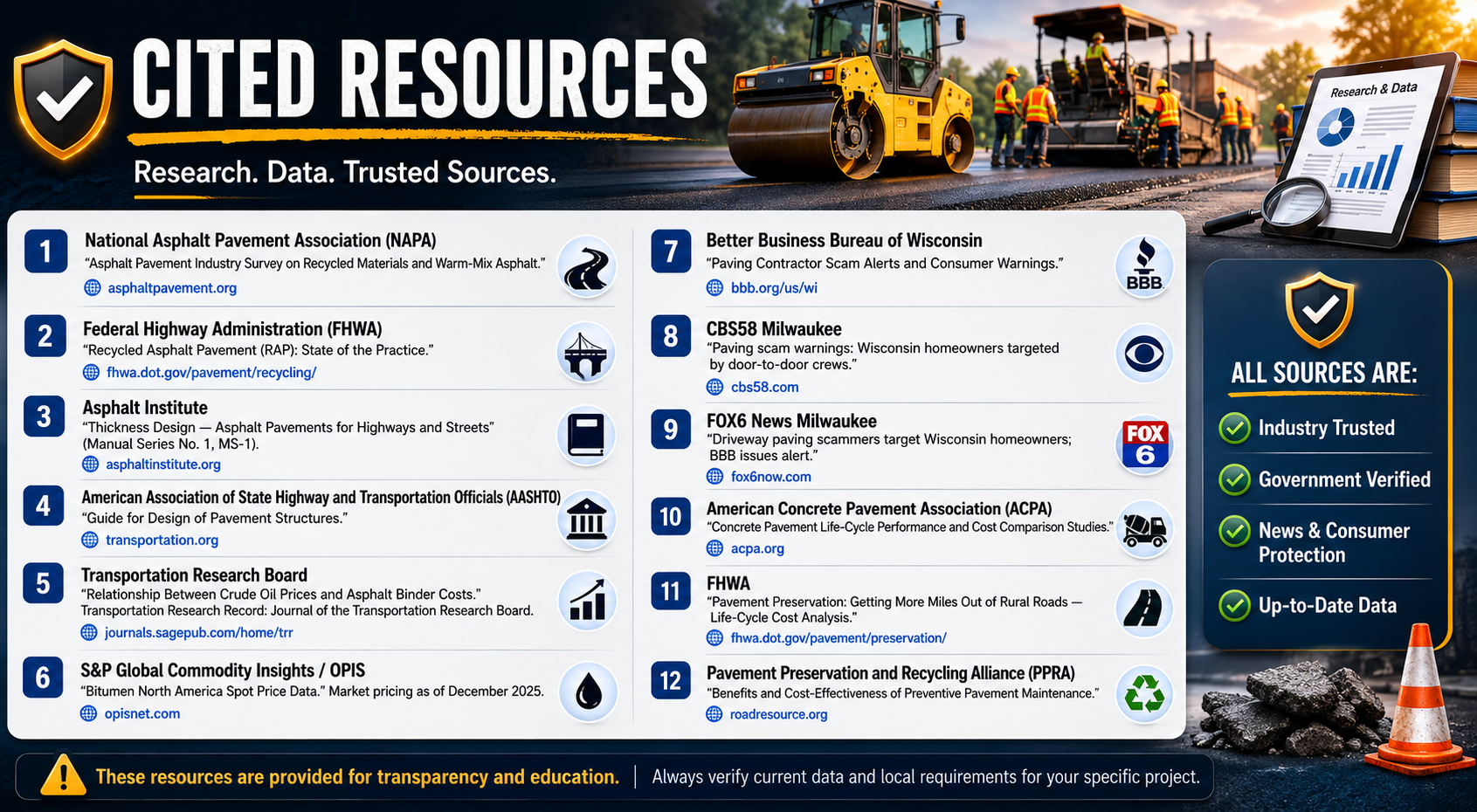
Cited Resources
[1] National Asphalt Pavement Association (NAPA). "Asphalt Pavement Industry Survey on Recycled Materials and Warm-Mix Asphalt." asphaltpavement.org. https://www.asphaltpavement.org/
[2] Federal Highway Administration (FHWA). "Recycled Asphalt Pavement (RAP): State of the Practice." U.S. Department of Transportation. https://www.fhwa.dot.gov/pavement/recycling/rap/
[3] Asphalt Institute. "Thickness Design — Asphalt Pavements for Highways and Streets" (Manual Series No. 1, MS-1). Lexington, KY: Asphalt Institute. https://www.asphaltinstitute.org/
[4] American Association of State Highway and Transportation Officials (AASHTO). "Guide for Design of Pavement Structures." Washington, D.C.: AASHTO. https://www.transportation.org/
[5] Transportation Research Board. "Relationship Between Crude Oil Prices and Asphalt Binder Costs." Transportation Research Record: Journal of the Transportation Research Board. https://journals.sagepub.com/home/trr
[6] S&P Global Commodity Insights / OPIS. "Bitumen North America Spot Price Data." Market pricing as of December 2025. https://www.opisnet.com/
[7] Better Business Bureau of Wisconsin. "Paving Contractor Scam Alerts and Consumer Warnings." BBB Serving Wisconsin. https://www.bbb.org/us/wi/
[8] CBS58 Milwaukee. "Paving scam warnings: Wisconsin homeowners targeted by door-to-door crews." WDJT-TV Milwaukee. https://www.cbs58.com/
[9] FOX6 News Milwaukee. "Driveway paving scammers target Wisconsin homeowners; BBB issues alert." WITI-TV Milwaukee. https://www.fox6now.com/
[10] American Concrete Pavement Association (ACPA). "Concrete Pavement Life-Cycle Performance and Cost Comparison Studies." acpa.org. https://www.acpa.org/
[11] FHWA. "Pavement Preservation: Getting More Miles Out of Rural Roads — Life-Cycle Cost Analysis." Federal Highway Administration, U.S. DOT. https://www.fhwa.dot.gov/pavement/preservation/
[12] Pavement Preservation and Recycling Alliance (PPRA). "Benefits and Cost-Effectiveness of Preventive Pavement Maintenance." pprainfo.org.
https://roadresource.org/