


Asphalt Paving Scams & How To Protect Yourself
The World's Most Comprehensive
Antifraud Guide for Asphalt Paving in 2026



Page Index: Asphalt Paving Scams & How To Protect Yourself
- Asphalt Paving Scams and How to Protect Yourself FAQ
- An Estimator's Note
- Section 1: How Asphalt Paving Scams Work in Southeastern Wisconsin
- The Leftover-Asphalt Pitch: Why this Story Keeps Working
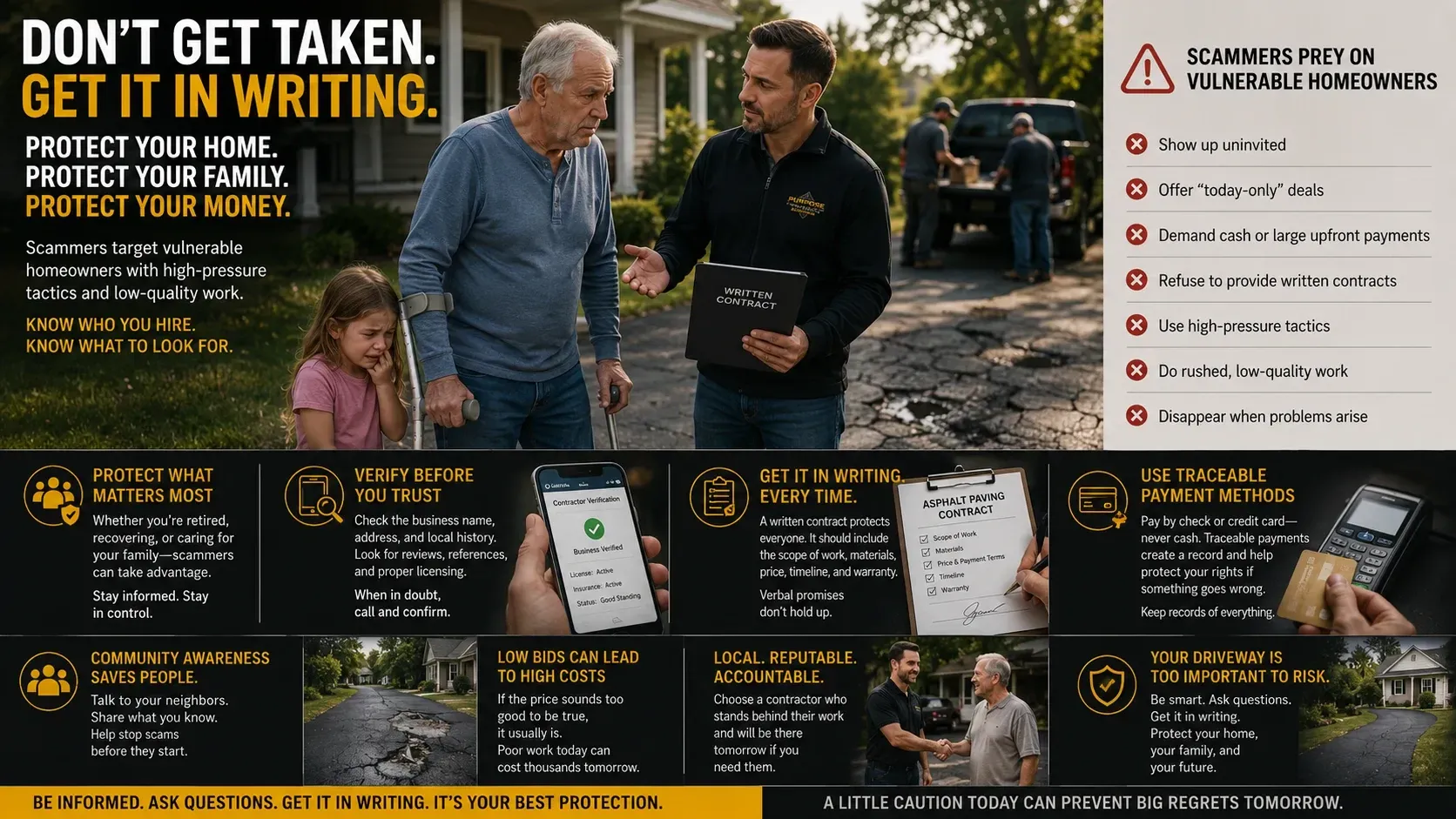
- Why Bad Asphalt Paving Doesn't Show Up Right Away
- Cash Up Front, then Disappear: The Payment Red Flag
- Why do These Crews Move so Fast Across County Lines
- The Pattern: Warning Signs that Show Up Together
- What a Real Local Contractor Sounds Like
- Who Scammers Target and How to Protect Them
- Commercial Properties: Bigger Lots, Bigger Losses
- Section 2: How to Verify an Asphalt Paving Contractor Before You Sign or Pay
- First Contact: Control the Conversation
- Identify the Business and Verify it Independently
- Insurance, Permits, and Credentials
- Get Multiple Estimates On the Same Scope
- Written Contracts and Detailed Scope
- Payment Structure, Lien Waivers, and Cancellation Rights
- Documentation, Safety, and Unauthorized Work
- Final Inspection and Lien Waivers Before Final Payment
- Spotting Impersonation and Online-Only Fronts
- Create a 'Second Set of Eyes' Rule Before Signing
- The Simple Rule: Don't Buy Asphalt from a Stranger in a Hurry
- Section 3: Building a Fraud-Resistant Asphalt Market in Southeastern Wisconsin
- Property Owners: Treat Asphalt Paving as a Planned Improvement
- Families and Neighborhoods: Prevention Before the Knock
- Municipalities, Police, and Local Media
- How Honest Contractors Fight Back
- Property Managers, Senior Communities, and HOAs
- How to Report a Suspicious Crew
- Churches, Nonprofits, and Small Businesses
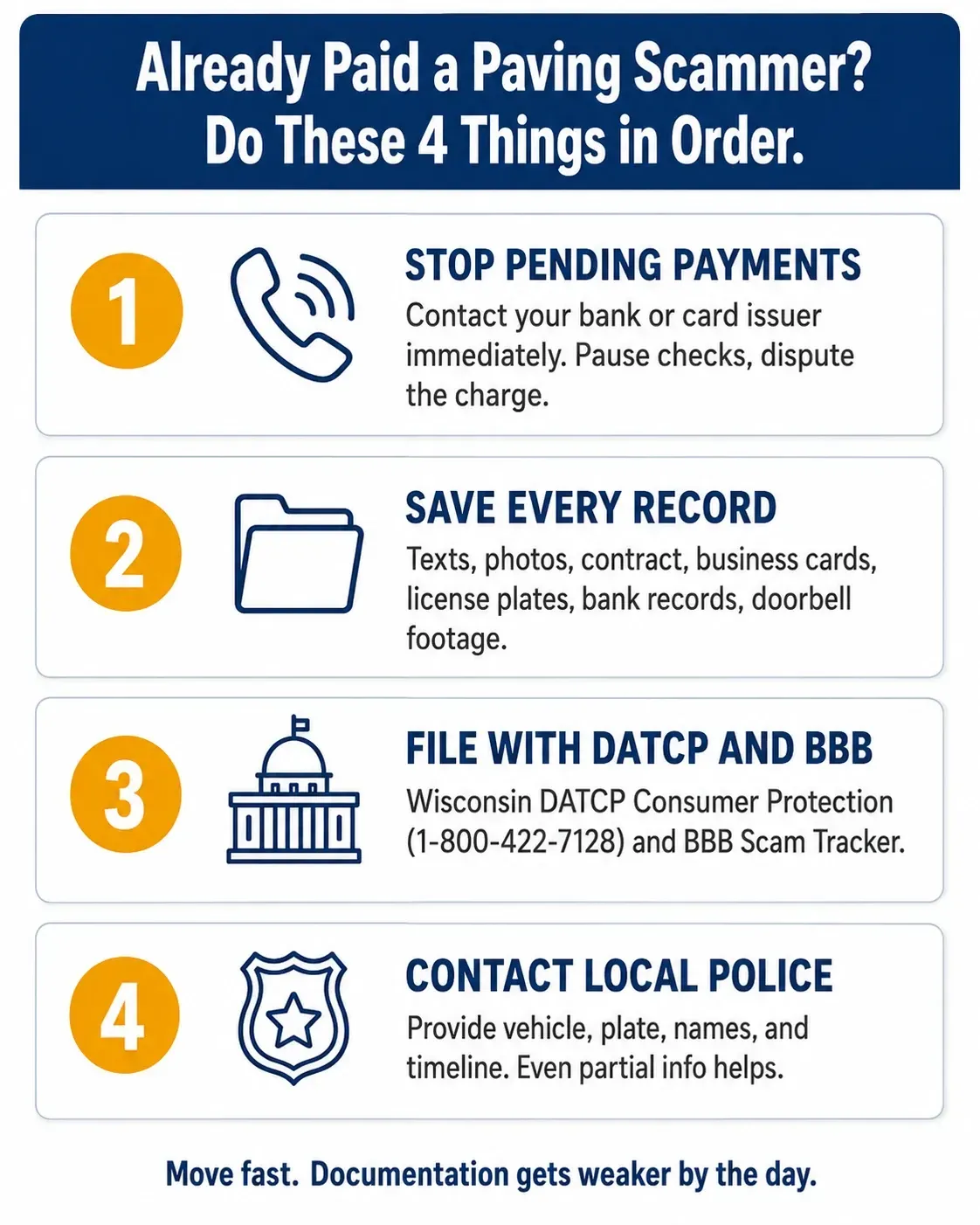
- If You've Already Paid: Documenting and Reporting
- Wisconsin Winters: Why Bad Work Fails Fast Here
- Which Agency Handles What: DATCP, BBB, Police, and Card Issuers
- Drainage and the Questions that Protect Your Driveway
- Cited Resources
Purpose and Public Notice: This report is written for customers and community members who want to understand how asphalt paving fraud happens, how to compare contractors safely, and how to respond when a suspicious crew appears. It is educational information, not legal advice. For legal questions or active disputes, contact the appropriate agency, attorney, local law enforcement, or consumer protection office.
Asphalt Paving Scams & How To Protect Yourself FAQ
The following questions are among the most commonly asked by property owners about asphalt scams. The answers draw on current market data, industry standards, and practical experience.
If you have any questions you'd like to be added to our FAQ, don't hesitate to get in touch with us.
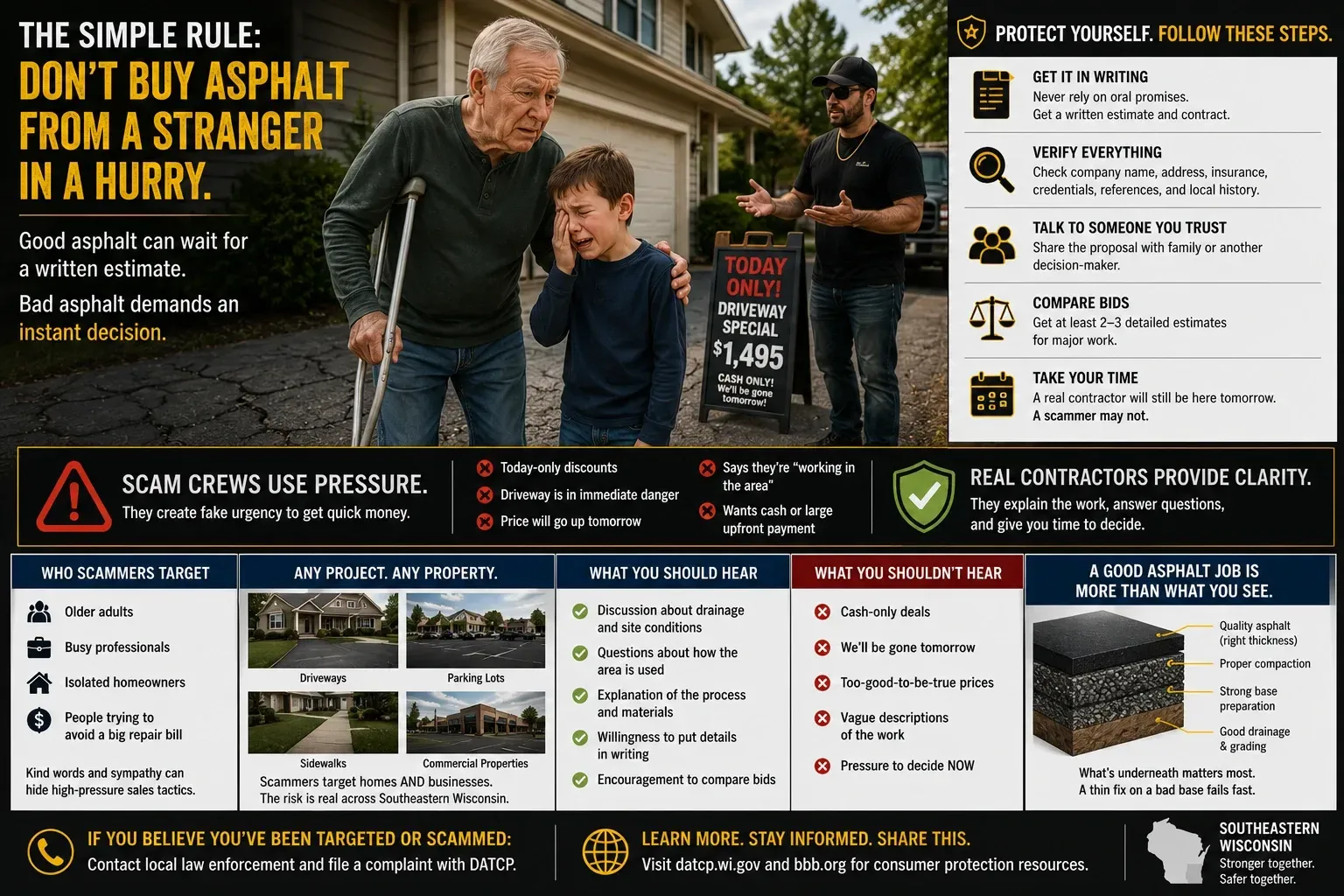
A crew knocks on your door and claims they have leftover hot asphalt from a nearby job. They say it has to be used before it cools. They quote a discounted, cash-only price and pressure the homeowner to decide on the spot. DATCP's September 2023 alert described exactly this pitch in southeastern Wisconsin, including Waukesha County. The story sounds efficient, discourages questions, and is the most common opener used in Wisconsin asphalt fraud.
Sources: [DATCP-2023] [BBB-2025]
→ See Section 1: The leftover-asphalt pitch: why this story keeps working
A surface can look dark and fresh on day one, even if the base is weak, the layer too thin, the compaction poor, or the material wrong. CBS 58's 2023 report noted that homeowners often don't realize subpar materials were used until weather, traffic, plowing, or ordinary use exposes the defects. By then the crew is unreachable. Verification has to happen before the work, not after the surface looks new.
Sources: [CBS58-2023] [DATCP-2023]
→ See Section 1: Why bad asphalt paving doesn't show up right away
Once cash changes hands, a homeowner has almost no leverage. DATCP warns never to pay the full price up front. BBB and TMJ4 report that scam crews routinely demand a large percentage before any meaningful work is done. CBS 58 and TMJ4 both recommend paying by credit card when possible, because card payments create documentation and a dispute path that cash never does.
Sources: [BBB-2025] [DATCP-2023] [TMJ4-2026] [CBS58-2026]
→ See Section 1: Cash up front, then disappear
Southeastern Wisconsin counties sit close together. A crew can move through Waukesha, Milwaukee, Racine, and Kenosha faster than scattered reports can be connected. DATCP specifically warned in 2023 that transient workers can move quickly from town to town, making them difficult to track. Mobility is why reporting matters even when no money was lost — license plates and descriptions help link patterns across communities.
Sources: [DATCP-2023]
→ See Section 1: Why these crews move so fast across county lines
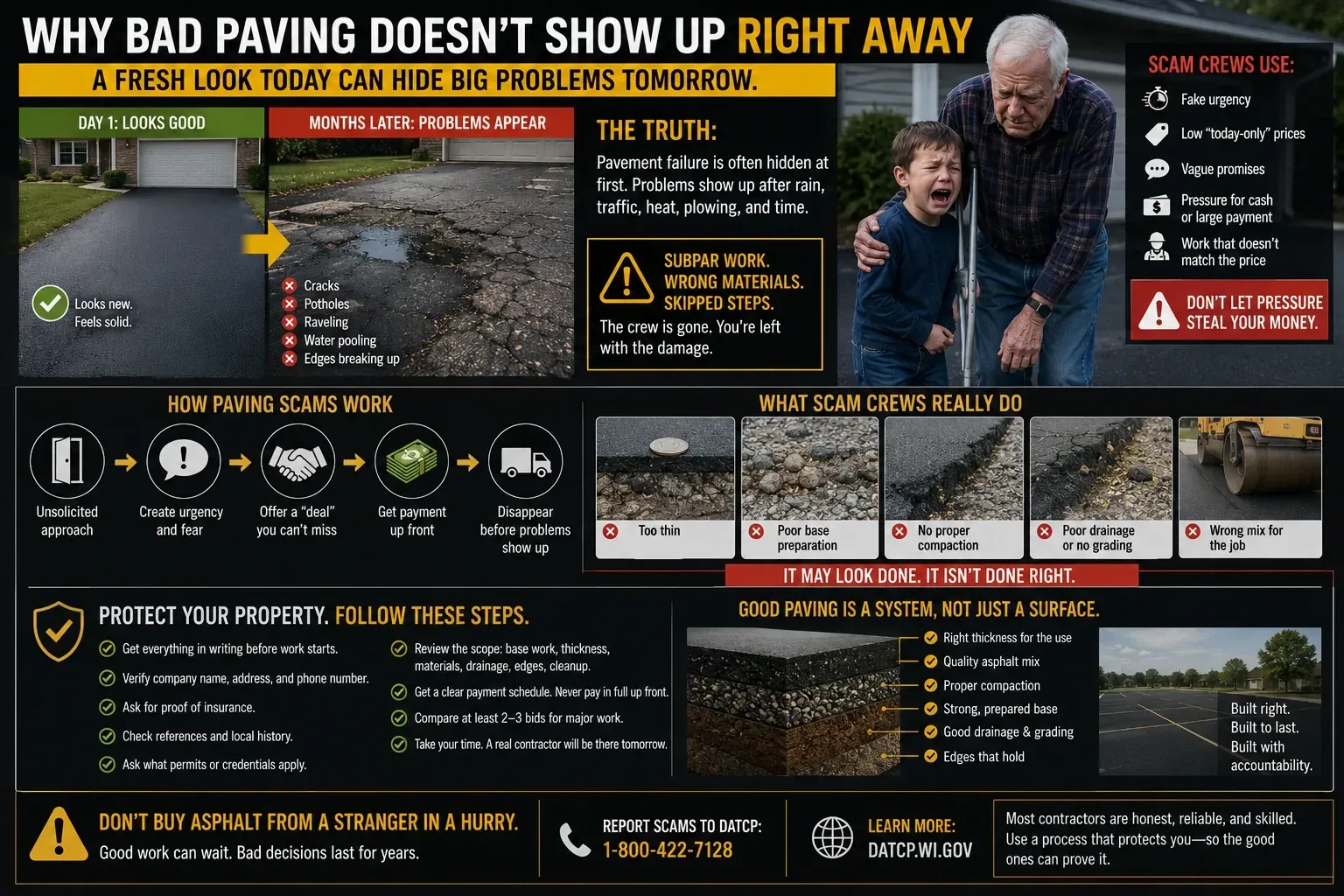
The reliable warning isn't one behavior — it's the combination. Unsolicited approach. Urgent deadline. Leftover-materials story. Big discount. No written scope. Vague business identity. Out-of-state info. Big upfront payment demand. Pressure against comparing bids. Unclear warranty. One fact alone may not prove fraud. Together they form a pattern documented by DATCP, BBB, and local police.
Sources: [BBB-2025] [DATCP-2023]
→ See Section 1: The pattern: warning signs that show up together
A legitimate contractor talks about the property, not just the price. They ask about the existing base, drainage, traffic load, freeze-thaw damage, low spots, and edge condition. They explain whether the right answer is overlay, patching, sealcoating, or full remove-and-replace. A scammer focuses on price and urgency; a professional focuses on cause and scope.
Sources: [DATCP-HI]
→ See Section 1: What a real local contractor sounds like
Scammers target older homeowners, people who seem isolated, busy property managers, and customers trying to dodge a bigger repair bill. The Minnesota Attorney General's 2025 Community Blacktop case and the North Carolina conviction of Lige "Larry" Boswell both named elder targeting explicitly. Pressure may look like friendliness, sympathy, or a same-day favor, not bullying.
Sources: [TMJ4-2026] [BBB-2025]
→ See Section 1: Who scammers target — and how to protect them
Families should agree in advance: no paving, roofing, tree, or repair contract gets approved at the door without a phone call to a trusted person first. That's about creating backup, not removing independence. Franklin Police, via TMJ4, made the same point in 2026: victims aren't alone and shouldn't decide alone. Talking before asphalt paving season is far cheaper than recovering money afterward.
Sources: [TMJ4-2026] [BBB-2025]
→ See Section 1 and Section 2, Step 22
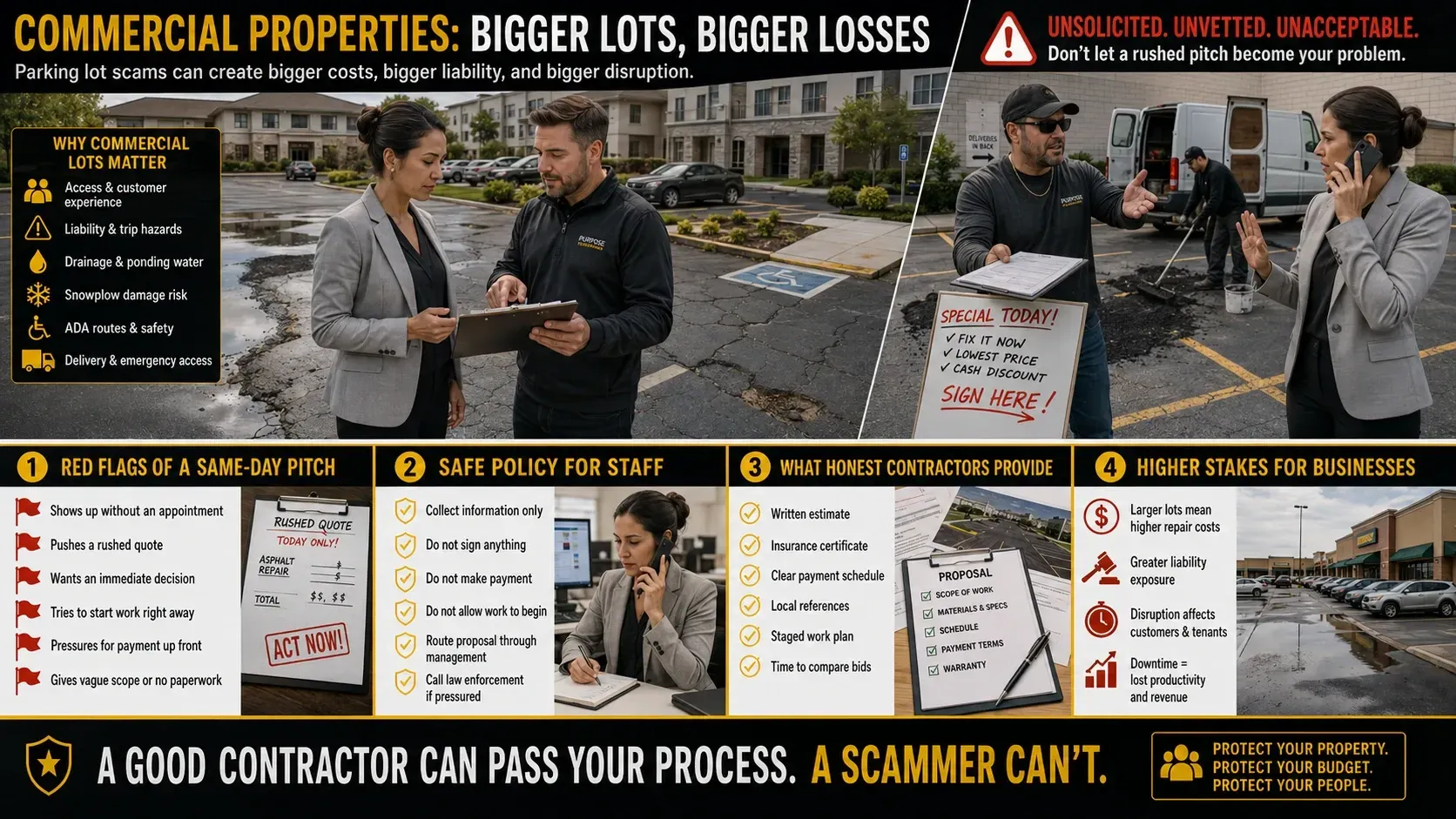
A bad parking-lot job creates trip hazards, ponding water, ADA-route problems, plow damage, and early failure. Apartment complexes, senior living, churches, retail, and warehouses pay the highest price — losses scale with lot size. DATCP warns that commercial asphalt paving requires planning, staging, traffic control, and documentation, none of which a same-day pitch provides. Property managers should refuse any walk-up offer.
Sources: [DATCP-2023] [DATCP-HI]
→ See Section 1: Commercial properties: bigger lots, bigger losses
Sealcoating is a surface maintenance service that protects and refreshes asphalt under the right conditions. It does not rebuild a failed base, restore structural thickness, or make alligator cracking disappear. Asphalt paving involves asphalt placement, compaction, and often base preparation or removal. When a door-to-door crew uses vague phrases like "blacktop it" or "lay some material over it," slow the conversation down.
Sources: [DATCP-HI] [BBB-2025]
→ See Section 1: What a real local contractor sounds like
No. DATCP provides consumer-protection guidance, takes complaints, and enforces certain rules, but it does not issue blanket approvals of individual contractors. A contractor claiming to be "DATCP approved" is using language DATCP itself does not use. Look instead for registered business information, applicable DSPS credentials, insurance, written contract, references, BBB history, and local presence.
Sources: [DATCP-HI] [DSPS-DC]
→ See Section 1: Who scammers target — and how to protect them
Don't buy asphalt from a stranger in a hurry. That doesn't mean every surprise offer is criminal — it means slow the transaction down until it becomes verifiable: legal company name, physical address, written estimate, proof of insurance, references, applicable credentials, payment schedule, and warranty. A real contractor will still exist tomorrow. A scammer often won't.
Sources: [BBB-2025] [DATCP-2023]
→ See Section 1: The simple rule
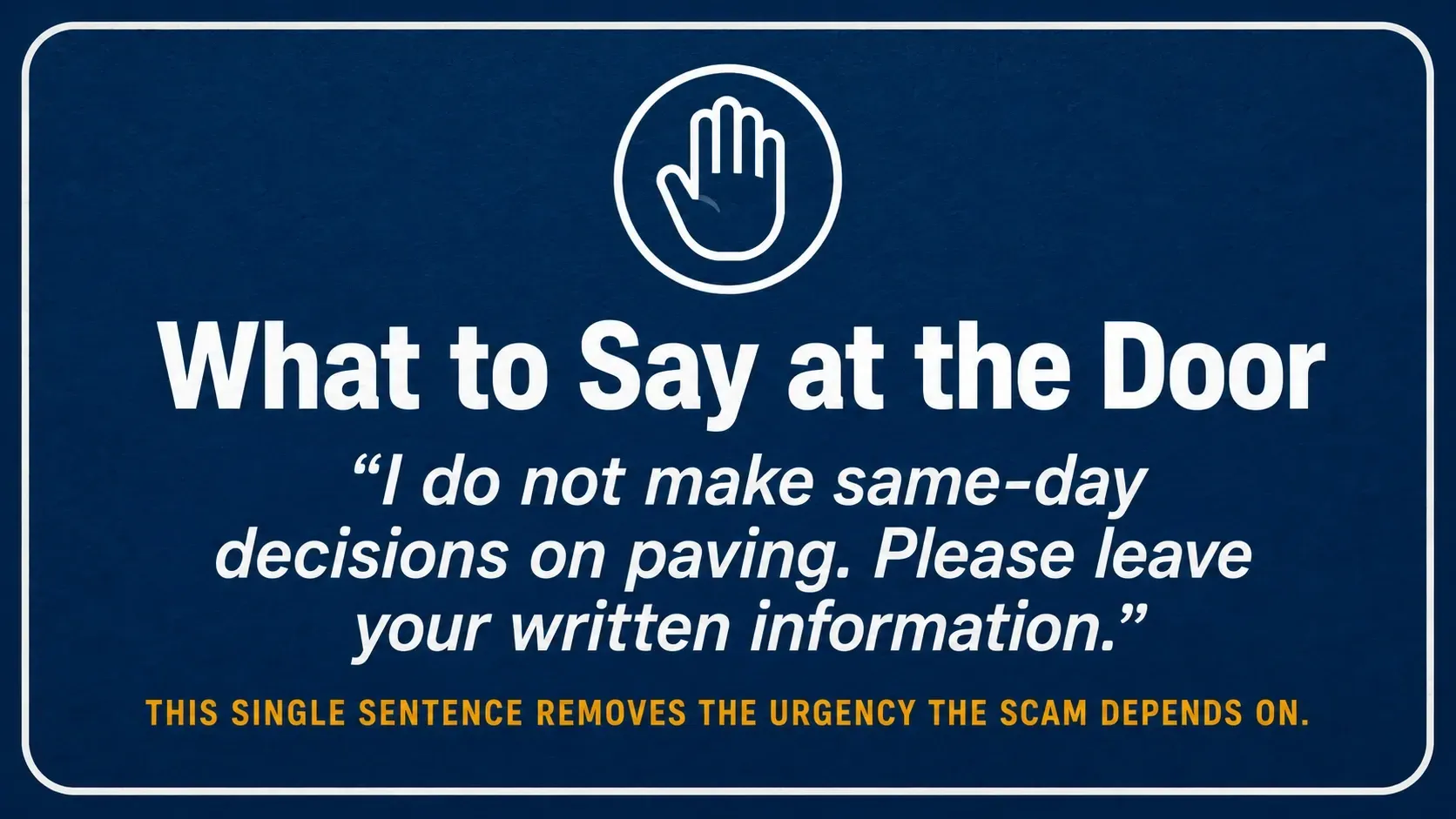
Use one repeatable line: "Please leave your written information. I do not make same-day decisions on asphalt paving." That single sentence removes the urgency the scam depends on. DATCP advises consumers to refuse high-pressure tactics from transient workers and never feel obligated to decide on the spot. If the crew becomes argumentative after a calm refusal, the risk isn't only the driveway — it's the seller.
Sources: [DATCP-HI]
→ See Section 2, Step 1
Get the legal company name, trade name, address, phone, email, website, salesperson's name, and crew names. DATCP says contracts must include a physical business and salesperson address — not just a P.O. box. Then verify independently: search the business, check BBB complaint history, contact DATCP's Bureau of Consumer Protection at 1-800-422-7128, and confirm phone numbers and websites match across sources.
Sources: [DATCP-HI] [CBS58-2026]
→ See Section 2, Steps 2–3
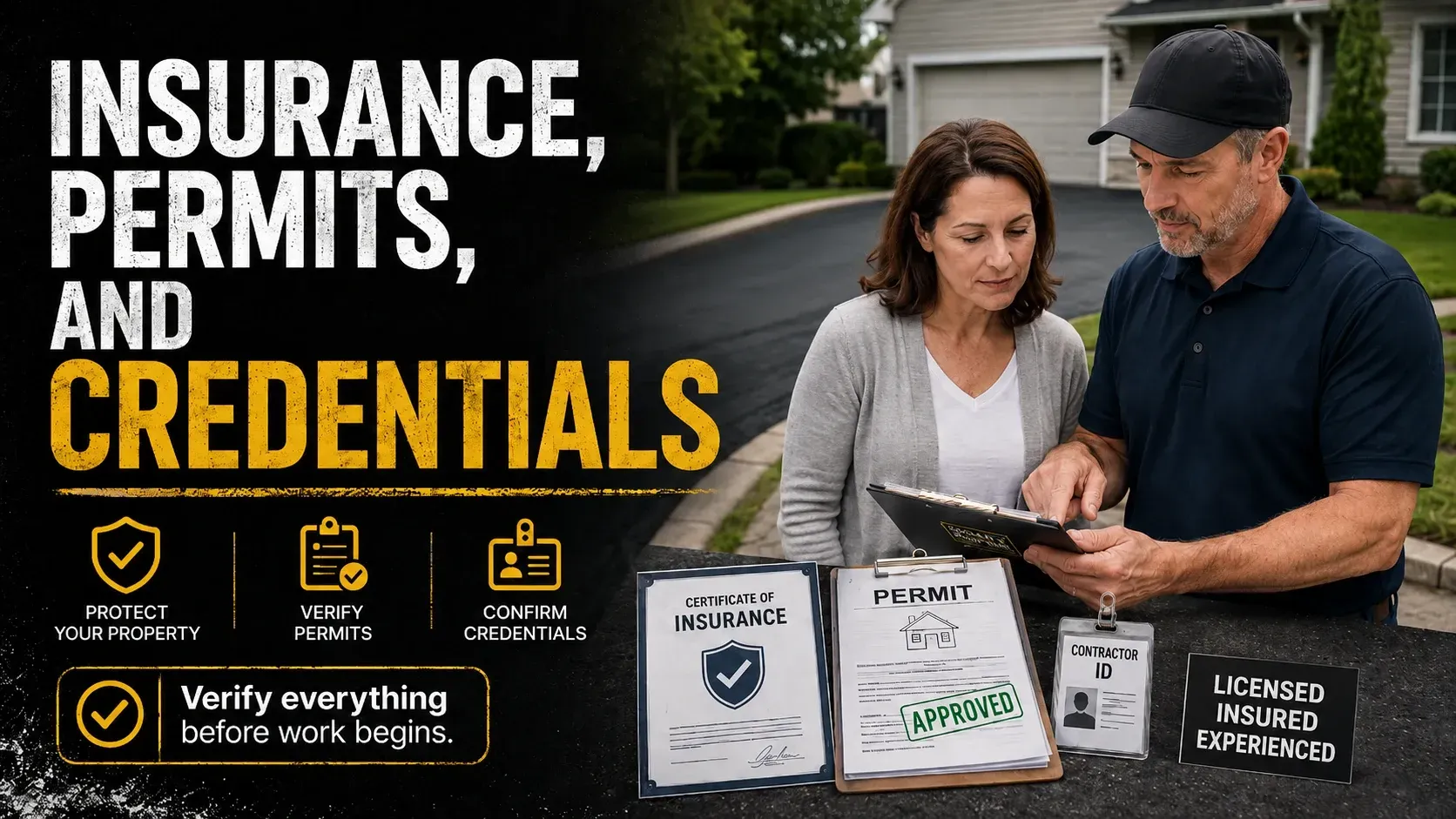
Ask for a certificate of insurance listing your name and address as the certificate holder. DATCP says any consumer can request this. The certificate shows an active policy and notifies the homeowner if coverage expires. "We're insured" is not the same as proof. A professional operation is used to this request. A suspicious crew often stalls or becomes defensive.
Sources: [DATCP-HI]
→ See Section 2, Step 4
Wisconsin rules are not identical for every situation. DATCP explains that if a contractor performs certain general construction work on one- or two-family homes and pulls building permits, the contractor must have Dwelling Contractor Certification and Dwelling Contractor Qualifier Certification from DSPS. Ask the contractor which permits or credentials apply to your specific job and verify any claim with the issuing agency.
Sources: [DATCP-HI] [DSPS-DC] [DSPS-DCQ]
→ See Section 2, Step 5
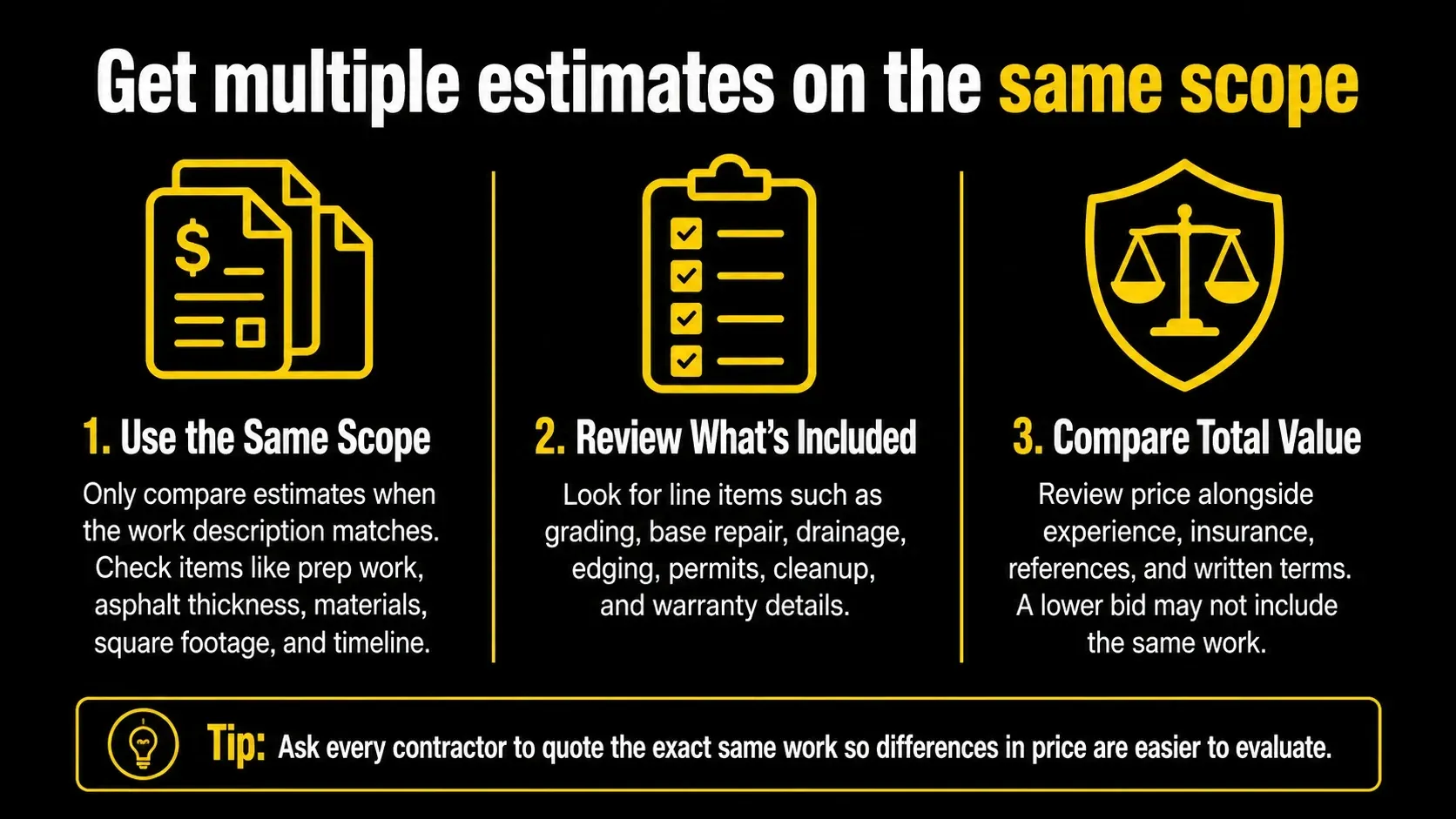
At least two, ideally three, on the same scope. DATCP recommends multiple bids and making sure every contractor is bidding on the same work. One bid may be sealcoating, another a two-inch overlay, another full removal and replacement — those numbers aren't comparable. Ask each bidder to identify square footage, preparation, thickness, material, compaction, edges, drainage, transitions, cleanup, schedule, warranty, and exclusions.
Sources: [DATCP-HI] [CBS58-2023]
→ See Section 2, Step 6
DATCP says a contract should include the job description, materials, total price, start and completion dates, warranty terms, and both the company and salesperson addresses. If any payment is required before work is done, a written contract is required by Wisconsin law. Avoid vague phrases like "pave the driveway" — specify area, removal depth, base prep, asphalt type, compacted thickness, transitions, drainage, edging, cleanup, and warranty.
Sources: [DATCP-HI] [CBS58-2026]
→ See Section 2, Steps 7–8
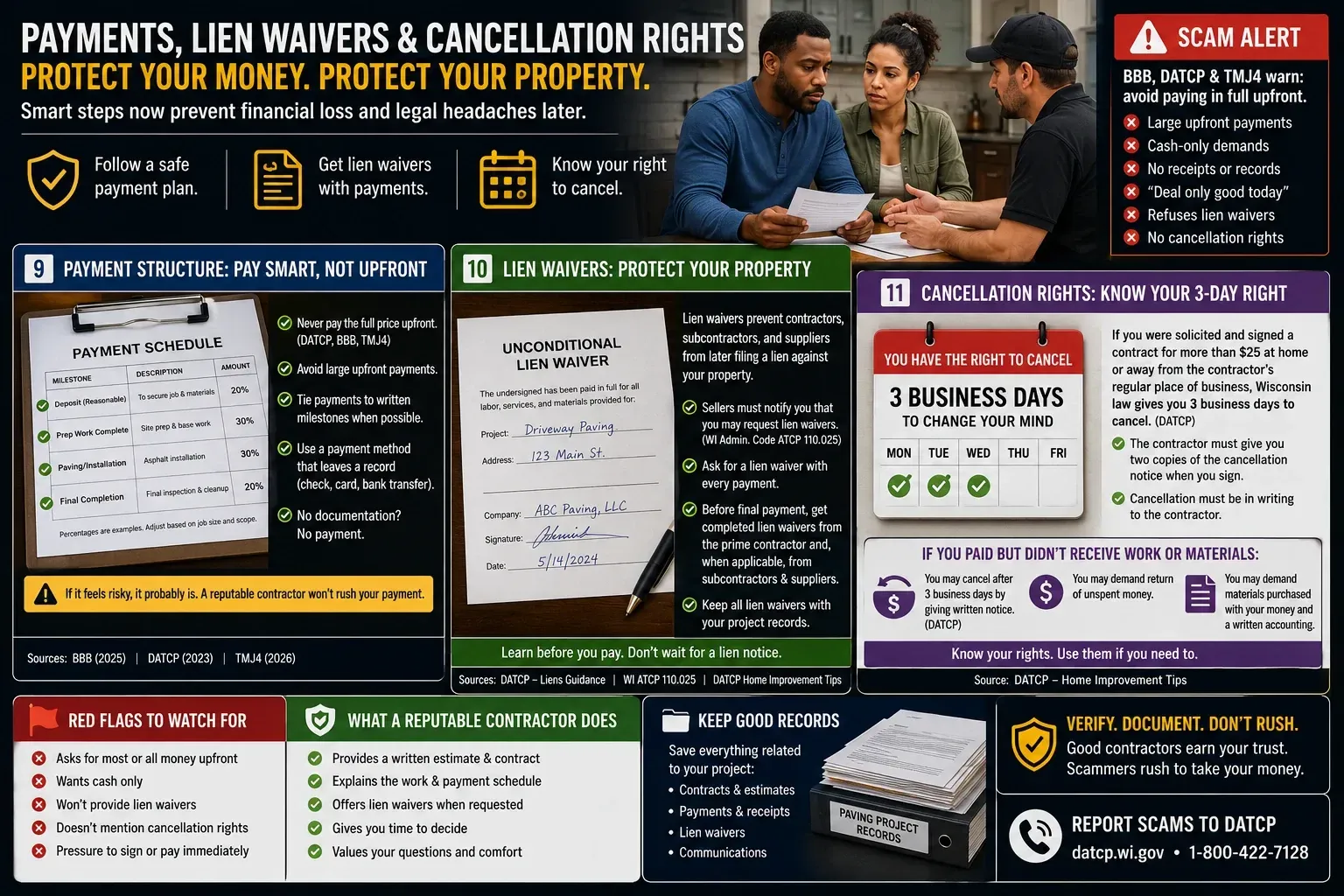
Never pay the full price up front — DATCP, BBB, and TMJ4 all repeat this. Tie payments to written milestones. Use a credit card when possible because cards create a record and may give consumers help from the card company. Cash and checks are especially risky with a stranger at the door, because once they change hands the customer has little practical leverage.
Sources: [BBB-2025] [DATCP-2023] [TMJ4-2026]
→ See Section 2, Step 9
A lien waiver stops a subcontractor or supplier from collecting from a homeowner who already paid the prime contractor. Wisconsin Administrative Code ATCP 110.025 requires sellers to give notice that consumers may request written lien waivers at or before payment. DATCP says always to request them. Ask for completed waivers before final payment — and during installment payments on larger jobs.
Sources: [WI-ATCP-110.025] [DATCP-LIENS] [DATCP-HI]
→ See Section 2, Step 10
Yes, under specific conditions. For door-to-door home solicitation contracts over $25, Wisconsin gives consumers three business days to cancel, and the contractor must provide two cancellation copies at signing. The right is set out in Wisconsin's Direct Marketing rule (ATCP 127). A contractor who refuses to discuss cancellation rights is not making the situation safer.
Sources: [DATCP-HI]
→ See Section 2, Step 11
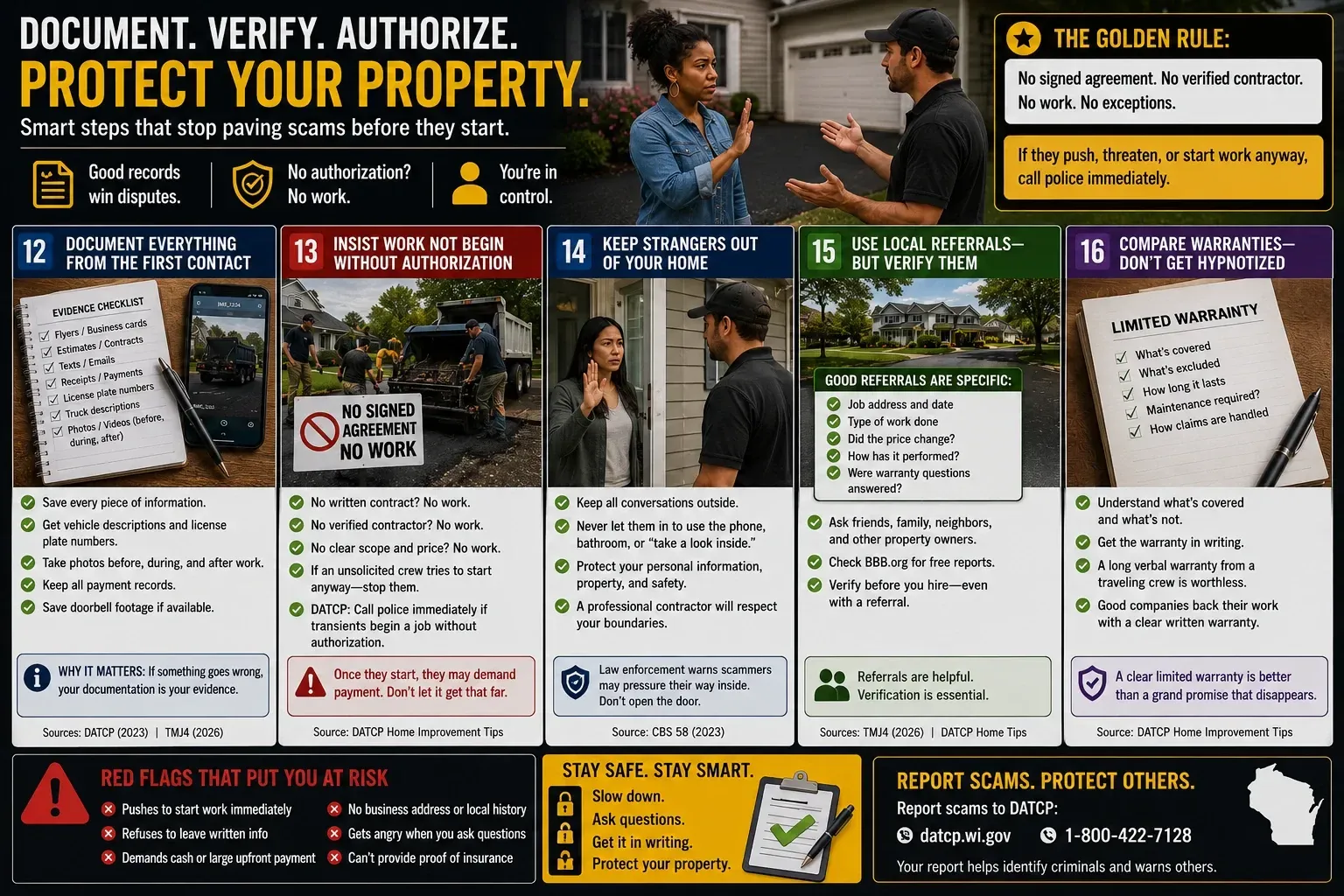
Save everything: flyers, business cards, estimates, texts, contracts, receipts, license plates, truck descriptions, doorbell footage, payment records, and photos of the driveway before, during, and after work. DATCP and Franklin Police both stress that this evidence helps identify scammers and warn others. Documentation turns an upsetting story into useful evidence.
Sources: [DATCP-2023] [TMJ4-2026]
→ See Section 2, Step 12
Call local law enforcement immediately. DATCP's home improvement guidance is explicit on this point. You are not obligated to pay for unsolicited work, and "they already started" is not a valid reason to hand over money under pressure. Keep the conversation outside, do not let strangers into the home, and document everything you can safely capture.
Sources: [DATCP-HI] [CBS58-2023]
→ See Section 2, Steps 13–14
A clear written warranty states what's covered, what's excluded, how long it lasts, what maintenance is required, and how to file a claim. DATCP advises that contracts include a warranty statement for materials, labor, or services. A long verbal warranty from a traveling crew has no enforceable value once the crew leaves Wisconsin. A clear limited written warranty from a verifiable local company is real protection.
Sources: [DATCP-HI]
→ See Section 2, Step 16
Different property types have different needs. A residential driveway, condo drive lane, church lot, school lot, warehouse dock, and senior living facility each face their own traffic, plowing, ADA, and drainage challenges. Heavy vehicles, fire access, and turning movements can change what the pavement actually needs. A contractor giving the same quick answer for every property may not be evaluating the job.
Sources: [DATCP-HI]
→ See Section 2, Step 17
Honest contractors may disagree with one another, but they should be able to explain their reasoning. Ask why they recommend overlay instead of removal. Ask what happens to cracks. Ask whether drainage needs correction. Ask what thickness they propose. A trustworthy contractor understands that questions are part of a serious job. A scammer treats questions as danger.
Sources: [DATCP-HI]
→ See Section 2, Step 18
A professional crew can work efficiently, but efficiency happens after planning. Be cautious of any offer that compresses estimate, contract, payment, mobilization, work, and final payment into the same surprise visit. Proper asphalt paving is scheduled around weather, plant availability, crew availability, and existing conditions. If a contractor says the job must happen immediately or not at all, ask who benefits from that timeline.
Sources: [BBB-2025] [DATCP-2023]
→ See Section 2, Step 19
Real asphalt operations plan material carefully because waste is expensive. There may be legitimate situations where a contractor has extra material, but that does not erase the need for a written scope, verified identity, insurance, payment terms, and proper construction. The question is never whether asphalt exists in a truck. It is whether the right contractor is using the right material on the right property under a written agreement.
Sources: [DATCP-2023] [BBB-2025]
→ See Section 2, Step 20
It depends on the work and the municipality. Local building inspection, engineering, or public works departments can explain whether a permit, right-of-way requirement, apron rule, or local license applies — especially when work touches a sidewalk, curb, driveway apron, culvert, or stormwater path. A contractor who says permits are never needed may be wrong. A contractor who shifts all permit responsibility to the homeowner may be hiding theirs.
Sources: [DATCP-HI]
→ See Section 2, Step 21
Agree in advance: no major home-improvement decision happens at the door without a call to a trusted person. Share warnings in church bulletins, senior community newsletters, subdivision pages, and local Facebook groups. Train front-desk staff at facilities not to sign or approve unsolicited work. Franklin Police's 2026 warning emphasized victims should report without shame.
Sources: [TMJ4-2026]
→ See Section 2, Step 22
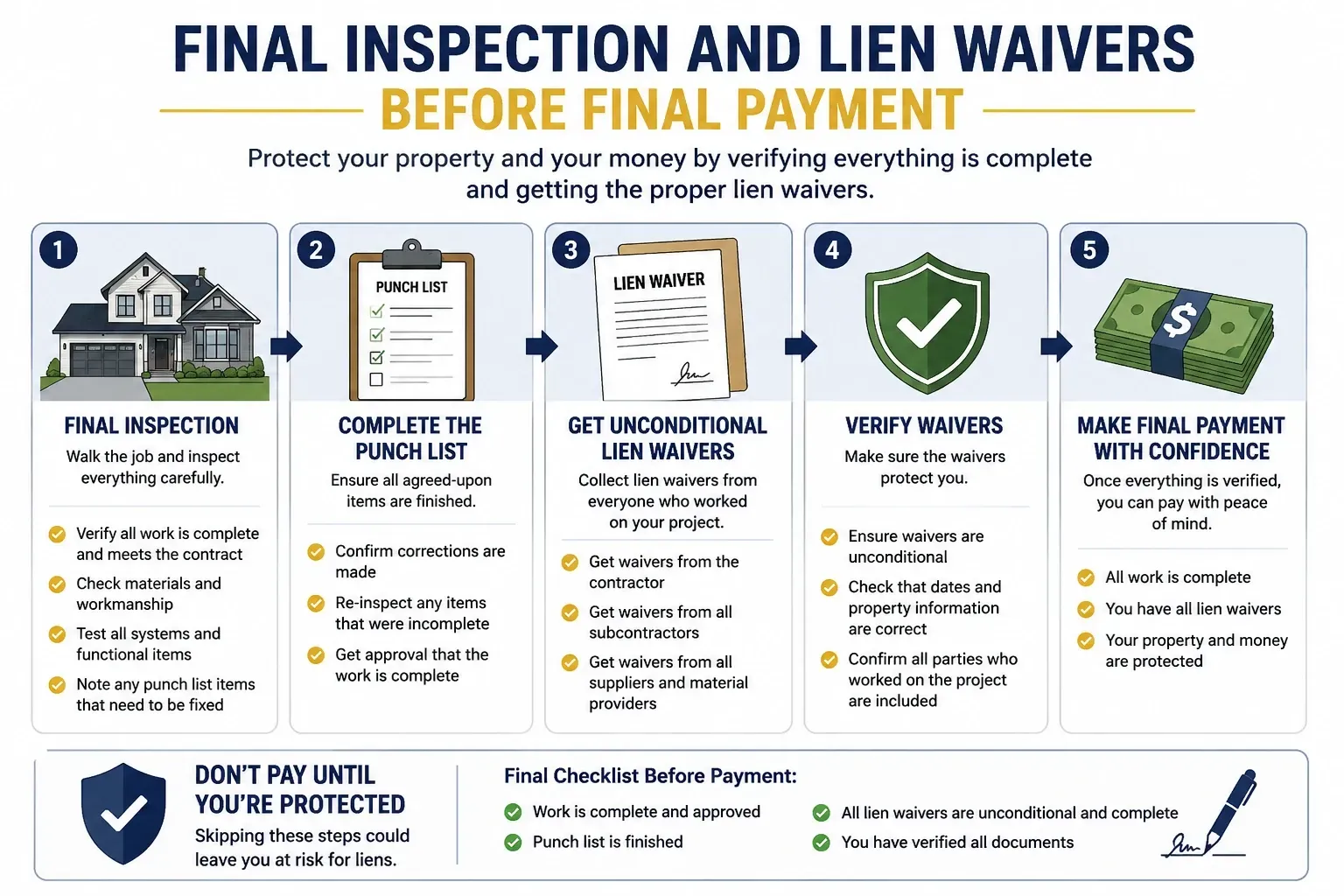
Walk the project with the contractor. Compare the finished work to the written scope. Photograph it. Collect any applicable lien waivers, get a receipt, and save the warranty. DATCP specifically warns not to sign a completion certificate or make final payment until you're satisfied and all work matches the contract. Final payment is your leverage — once it's gone, so is most of your ability to require corrections.
Sources: [DATCP-HI] [DATCP-LIENS]
→ See Section 2, Steps 23–24
Some scammers claim a tie to a real local contractor, a known business owner's relative, a municipal project, or a nearby job. A polished website, copied logo, or fake review can look legitimate online. Always call the real business directly using a phone number found independently — not the one on the flyer — and confirm whether the person is theirs. BBB warns sham contact information often becomes obvious only after payment.
Sources: [BBB-2025]
→ See Section 2, Step 27
A legitimate contractor may offer real scheduling efficiencies or seasonal promotions. But a major property improvement shouldn't hang on a pressured decision made today. Ask for the written estimate to remain valid for a reasonable period. If the contractor says the price disappears the moment they leave the driveway, let it disappear. A good price that cannot survive one night of thought is a pressure tactic.
Sources: [BBB-2025] [DATCP-2023]
→ See Section 2, Step 30
Scammers isolate the decision-maker — they want one person, one moment, one payment. A household or business rule that no asphalt paving contract is signed without a second person reviewing it breaks that isolation. For homeowners, that's a spouse, adult child, or trusted neighbor. For businesses, it's the owner, property manager, or board. If the offer is real, the contractor can wait one phone call.
Sources: [BBB-2025]
→ See Section 2, Step 31
Treat asphalt work as a planned improvement, not a spontaneous purchase. Keep a record of current pavement condition, set a budget range, request multiple estimates, check references, ask for proof of insurance, and review written terms before signing. When the customer already has a process, a door-to-door scam loses most of its power — the answer becomes "leave your written information, it'll be reviewed like any other proposal."
Sources: [DATCP-HI]
→ See Section 3: Property owners
Neighbors can share factual warnings — time, location, vehicle, business name, phone — on community pages without spreading rumors. Avoid accusations that can't be supported, but do share public agency warnings and local news stories from DATCP, BBB, CBS 58, TMJ4, and police departments. The goal is to make sure the next homeowner recognizes the pitch before opening a checkbook.
Sources: [DATCP-2023] [CBS58-2026] [TMJ4-2026]
→ See Section 3: Families and neighborhoods
Adopt a written internal rule: no asphalt paving, sealcoating, striping, patching, or exterior repair work is approved through a walk-up offer. Front-desk and maintenance staff should request written information only, refuse immediate payment, and route every proposal through the authorized manager or board. HOAs should require at least two or three comparable bids, insurance certificates, references, and board approval before any payment.
Sources: [DATCP-2023] [DATCP-HI] [CBS58-2023]
→ See Section 3: Property managers, senior communities, and HOAs
Churches and nonprofits often have large lots, tight budgets, and volunteer boards. A traveling crew may pitch a discount that sounds like good stewardship. Small businesses face similar pressure when an owner is short on time and money. The protection is the same: written proposals, board or owner review, certificates of insurance, references, lien-waiver planning for larger projects, and no payment to an unverified crew.
Sources: [DATCP-HI] [BBB-2025] [DATCP-2023]
→ See Section 3: Churches, nonprofits, and small businesses
Capture date, time, location, vehicle description, license plate, names used, business name, phone number, and any flyer or card. Then report to local police and to DATCP at 1-800-422-7128. Doorbell camera clips help; photos are fine if it's safe to take them. The point isn't confrontation — it's giving investigators data to connect a pattern across communities.
Sources: [DATCP-2023]
→ See Section 3: How to report a suspicious crew
Gather every record immediately: contract, estimate, texts, calls, check images, bank statements, card transactions, receipts, photos, license plate, and names. If you paid by credit card, contact the card company quickly — CBS 58 and TMJ4 both report BBB advice favoring cards because they create documentation and a dispute path. File complaints with DATCP and BBB, and contact local law enforcement.
Sources: [CBS58-2026] [TMJ4-2026] [DATCP-HI]
→ See Section 3: If you've already paid
Freeze-thaw cycles, snowplows, and road salt expose weak work fast. Water that enters cracks or weak edges freezes, expands, and accelerates damage. Plows catch raised edges, thin overlays, and loose patches. A scammer's quick surface treatment may look fine in July and fail by March — by which point the crew is unreachable. Evaluate proposals on preparation, thickness, and drainage, not on how black the surface looks on day one.
Sources: [CBS58-2023] [DATCP-HI]
→ See Section 3: Wisconsin winters
For immediate safety, threats, trespassing, or unauthorized work in progress, call local law enforcement. For consumer-protection complaints, contact DATCP's Bureau of Consumer Protection at 1-800-422-7128 or datcp.wi.gov. For complaint history and Scam Tracker reports, file with BBB. If a credit card was used, contact the card issuer. Don't assume one report reaches the others.
Sources: [DATCP-2023] [BBB-2025]
→ See Section 3: Which agency handles what
Yes. A crew turned away at one home will try the next. If nobody reports the attempt, agencies may not see the pattern until after someone pays. DATCP's 2023 alert specifically asked consumers — including those who only encountered the pitch — to contact the Consumer Protection Hotline at 1-800-422-7128 and share vehicle and crew details. Reporting an attempted scam is early warning for the next house on the route.
Sources: [DATCP-2023]
→ See Section 3: Why every Wisconsin report matters
Every estimate should specify square footage, existing conditions, removal depth, base preparation, asphalt type, compacted thickness, transitions, drainage notes, edging, cleanup, schedule, warranty, and exclusions. Drainage, cleanup, edge restraint, and disposal of removed material are where fraud commonly hides. "I assumed it was included" is not an enforceable position. A clear scope makes comparison possible.
Sources: [DATCP-HI]
→ See Section 3: Drainage and the questions that protect your driveway
In southeastern Wisconsin, expect $3–$7 per square foot for a 2-inch asphalt overlay. Full remove-and-replace with proper base preparation runs $7–$12 per square foot. Final price depends on driveway size, existing base condition, drainage corrections, edge treatments, and disposal of old asphalt. A bid significantly below this range — half the price of competing estimates — is usually a different scope of work, not a better deal.
Sources: [CBS58-2023]
→ Pricing varies by site, year, and contractor. Get multiple written bids on the same scope. (See Section 2, Step 6.)
Both work in Wisconsin if installed correctly. Asphalt costs roughly half as much per square foot, is easier to repair, handles freeze-thaw and salt well when properly maintained, and can be paved in a single day. Concrete lasts longer (25–40 years vs 15–25 for asphalt), stays cleaner, and requires less maintenance, but costs more upfront and is harder to repair when it cracks. For most Wisconsin homeowners on a budget, asphalt is the practical choice when sealcoated regularly.
→ Both options have legitimate uses. The scam pattern in this report applies to both materials.
A properly built asphalt driveway in Wisconsin typically lasts 15 to 25 years. Lifespan depends on base preparation, asphalt thickness, drainage, compaction, and maintenance. Driveways that get sealcoated every 2 to 3 years, have proper edge support, and shed water rather than holding it can reach the upper end of that range. Driveways with poor base, thin layer, or trapped water often fail in 5 to 10 years — sometimes the first Wisconsin winter.
Sources: [CBS58-2023] [DATCP-HI]
→ See Section 3: Wisconsin winters — why bad work fails fast here
For a new asphalt driveway, wait 6 to 12 months for the surface to fully cure before the first sealcoat. After that, sealcoat every 2 to 3 years in Wisconsin's freeze-thaw climate. Sealcoating protects asphalt from UV damage, water penetration, and the chemicals in road salt and gasoline. It does NOT repair structural damage — sealcoating cracks does not fix them. If a contractor sells you sealcoating as a "fix" for a failing driveway, that is a scam pitch.
Sources: [DATCP-HI] [BBB-2025]
→ See Section 1: What's the difference between asphalt paving and sealcoating?
Late May through early October is the typical Wisconsin asphalt paving window. Asphalt requires ambient temperatures consistently above 50°F for proper compaction and bonding. Paving in cold weather or on wet ground can cause the mat to cool too fast, fail to compact properly, and develop early cracking. Reputable Wisconsin contractors will refuse to pave when conditions aren't right. A contractor willing to pave in November or after a hard rain is rushing the job.
Sources: [DATCP-HI]
→ See Section 2, Step 29: Weather and scheduling
For small surface patches and crack filling, yes. Cold-patch asphalt repair products from a home center can fix minor potholes and cracks if the underlying base is intact. For structural damage, alligator cracking covering large areas, edge failures, or repairs near drainage problems, professional work is the safer option. DIY patches over a failing base will fail again within a season. If multiple cracks reappear after patching, the underlying problem is the base, not the surface.
Sources: [DATCP-HI]
→ See Section 1: What a real asphalt paving contractor sounds like
Generally no. Standard homeowner's insurance covers sudden, accidental damage from covered perils (fire, hail, vandalism). A bad paving job is a contract dispute, not a covered peril, so it typically falls outside coverage. Some policies include a contractor-fraud rider that may apply to outright criminal fraud. If you paid with a credit card, the card issuer's dispute process is often a faster recovery path than insurance. Check your policy and contact your agent.
Sources: [FTC-2024] [BBB-2025]
→ See Section 3: If you've already paid — documenting and reporting
There's no strict deadline for filing a consumer complaint with DATCP or the BBB — earlier is better. Evidence and contractor whereabouts deteriorate over time. For a civil lawsuit, Wisconsin's general statute of limitations for breach of contract is 6 years (Wis. Stat. § 893.43). Construction-defect actions may have additional procedural requirements under Wisconsin's Right to Cure law (Wis. Stat. § 895.07). Consult a Wisconsin attorney for case-specific guidance.
Sources: [DATCP-HI]
→ Report sooner rather than later. See Section 3: Where do you report asphalt paving fraud in Wisconsin?
Yes, generally. Wisconsin law allows homeowners to sue contractors for breach of contract, fraud, or defective work. However, Wisconsin's Right to Cure law (Wis. Stat. § 895.07) typically requires the homeowner to provide written notice of construction defects and give the contractor an opportunity to respond before filing suit. This is procedural and not optional. Consult a Wisconsin construction-law attorney before filing — process and evidence requirements matter.
Sources: [DATCP-HI]
→ Document everything in writing first. See Section 2, Step 25: Right to Cure
Wisconsin does not require a separate state license for asphalt paving contractors as such. The state credential most relevant to home improvement is the DSPS Dwelling Contractor Certification and Dwelling Contractor Qualifier Certification — required for contractors who pull building permits on one- and two-family homes. "Licensed" and "registered" get used loosely in advertising. Ask any contractor to specify exactly what credential they hold and verify it with DSPS or your municipality.
Sources: [DSPS-DC] [DSPS-DCQ] [DATCP-HI]
→ See Section 2, Step 5: Insurance, permits, and credentials
It depends on the scope and your municipality. Many residential driveway resurfacing jobs in Wisconsin don't require building permits, but work that touches the public right-of-way(apron, sidewalk, curb), affects drainage, or exceeds local thresholds typically does. Some municipalities require driveway permits regardless of scope. Always check with your local building inspection or public works department before authorizing work. A contractor who refuses to discuss permits may be hiding something.
Sources: [DATCP-HI]
→ See Section 2, Step 21: Use municipal resources when appropriate
Yes. Under Wisconsin's construction lien statute (Wis. Stat. Chapter 779), contractors, subcontractors, and material suppliers who improve real property can file a lien against the homeowner's property if they aren't paid. Lien waivers protect homeowners — Wis. Adm. Code ATCP 110.025 requires sellers to give notice that consumers may request written lien waivers at or before payment. Always request waivers from the prime contractor, subcontractors, and suppliers tied to each payment.
Sources: [WI-ATCP-110.025] [DATCP-LIENS] [DATCP-HI]
→ See Section 2, Step 10: Lien waivers
PCAA made this image for public use under the Creative Commons Attribution (CC BY) license.
An Estimator's Note
As the owner of an asphalt paving company, I have seen how confusing the estimate process can be for homeowners. Based on what I have seen, I believe the way a homeowner gets an estimate matters just as much as the estimate itself. A good estimate process does more than give you a price. It helps protect you from confusion, pressure, poor communication, and possible fraud.
Not every asphalt contractor who approaches a homeowner is a scammer. Some legitimate paving companies do go door-to-door. Some drive by, see a nice long driveway with the homeowner outside getting his mail, and stop to talk. A contractor driving by and offering an estimate is not automatically fraud. The real issue is whether you take time to verify who you're dealing with.
The first and most important thing I can tell any homeowner is this: do your research. Research who you are calling before you agree to anything. Look up the business, check reviews, confirm they carry insurance, ask for a written estimate, and make sure the scope of work is clearly explained.
Research three to four companies you have a good feeling about. Schedule an appointment. Feel them out. How's their knowledge? How do they interact? How do they talk? Did the estimator leave you feeling comfortable or not? That's the first vision you get. If they seem educated, that's usually a good sign.
Second, make sure you are getting a fair quote. The lowest price is not always the best deal, especially with asphalt work. Many paving scams succeed because the offer sounds too good to pass up, and the homeowner feels pressured to make a quick decision. That is when people get caught.
A fair quote from a properly insured, reputable asphalt contractor is almost always safer than a rock-bottom price from someone you have not checked out. People do get scammed. Sometimes they are chasing the lowest possible price, and sometimes the wrong company catches them at the wrong moment. Either way, slowing down and doing the research first can save you from a much bigger problem later.
Every company you call is going to handle the estimate process a little differently. Some contractors will come out quickly. Some may not come out at all. Some will look at the project and give you a number on the spot. Others will meet with you, talk through the work, and then never follow up with a written proposal.
That is why it is important to pay attention to how each company approaches the estimate. Every contractor has a different way of looking at a project. They may measure differently, explain things differently, and focus on different parts of the job. Some use satellite measurements. Some use measuring wheels. Some use newer estimating software, while others still rely on old-school notes, sketches, and pen-and-paper drawings. None of those methods is automatically good or bad by itself. What matters is how clear, accurate, and complete the final estimate is.
Beyond the measuring, every estimator is going to see the project a little differently. One contractor may tell you the driveway needs to be raised or lowered in certain areas. Another may recommend drain tile to help with water issues. One company may suggest removing the entire base and installing all new stone, while another may only recommend a new base in the areas that clearly need it.
That does not always mean one contractor is right and the others are wrong. Experience, equipment, approach, and opinion all play a role. Some estimators may catch things others miss. Some may have more field experience. Some may be more conservative, while others may focus only on the obvious repairs. The important thing is to listen to what each one is saying, compare their recommendations, and use that information to better understand what your project actually needs.
Here’s what I recommend: take every estimate you received, sit them down in front of you, and go through them carefully. Start by looking for the common items. What did every contractor quote the same way? Did they all mention the same base work, asphalt thickness, grading, drainage, removal, or prep work?
Then look at the differences. What did one estimator catch that the others missed? What did one company include that another left out? Where do the proposals disagree? Those differences matter because one contractor may be seeing something important that the others skipped.
Once you compare everything, put the common suggestions, missing items, extra recommendations, and the things you actually want done onto one sheet. Now you have a clear scope of work built from three or four different estimators’ opinions.
Send that same sheet back to each contractor and tell them, “I want you to quote this exact scope of work. How will this change the price?” Now you are not comparing three or four completely different proposals. You are comparing the same job, the same details, and the same expectations. That is when you can truly compare prices apples to apples.
This is the power of doing your research. Do not rush it. Most homeowners only install one asphalt driveway or parking lot in their lifetime, so it is worth taking the time to understand what you are actually paying for.
That is how every homeowner should compare asphalt estimates. It protects the homeowner, keeps the process fair, and makes it much easier to see which contractor is actually paying attention. When every company is asked to quote the same scope of work, you can clearly see who understands the project, who is being thorough, and who may have missed important details.
It also shows you how each contractor handles communication. Some companies may not respond at all. Some may raise the price because the updated scope includes more work than their original estimate. Others may explain the changes clearly and help you understand why the price did or did not change. That response tells you a lot.
At that point, you are not just choosing based on price. You are choosing based on professionalism, honesty, communication, and the quality of the estimate. A contractor who takes the time to review the full scope and gives you a clear answer is usually showing you how they will handle the job itself.
This is another reason research matters so much. The estimate process is not about finding the cheapest job. It is about finding the contractor who understands the work, communicates clearly, and is willing to stand behind the details before the job ever begins.
Google reviews, review sites, and company websites can all help you form an opinion, but none of them should make the decision for you by themselves. Reviews can be useful, but they are not perfect. Some are honest, some are exaggerated, some are fake, and some have nothing to do with the type of work you are actually trying to hire for. A website can tell you how a company presents itself, explains its services, and communicates with customers, but even that is only one piece of the picture.
The real value comes from slowing down and comparing the estimates properly. When you take several proposals, study what each contractor included, identify what they all agree on, and notice what one contractor caught that another missed, you start to understand the project better yourself. Then, when you ask each company to quote the same scope of work, you are no longer guessing. You are comparing the contractors on the same job, with the same expectations, and the same details in front of them.
That is how a homeowner gets a fair estimate. Not by rushing, not by trusting one review, not by picking the first person who sounds confident, and not by assuming every proposal means the same thing. A fair estimate comes from research, comparison, communication, and a clear scope of work.
Most homeowners only install one asphalt driveway or parking lot in their lifetime. Taking the time to understand the estimate before signing anything is not overthinking it. It is protecting your property, your money, and the final result. That is how the process should be done.
— Chris Morawski, owner & estimator, Purpose Contracting Asphalt · Muskego, Wisconsin
PCAA made this image for public use under the Creative Commons Attribution (CC BY) license.
How Asphalt Paving Scams Work in Southeastern Wisconsin
Fraud in asphalt paving usually does not begin with a bad driveway. It begins with a moment of pressure. A homeowner is outside, a property manager is walking a lot, or a business owner is trying to get through a normal day when an unknown crew appears with a friendly offer that sounds practical. They may say they are working nearby. They may say they have leftover asphalt. They may say the price is only good today because the material will cool, spoil, or be wasted. The customer hears a discount; the scammer hears a chance to turn confusion into cash. In southeastern Wisconsin, that pattern has been serious enough for state agencies, the Better Business Bureau, police departments, and local newsrooms to warn the public repeatedly. [DATCP‑2023] [BBB‑2025]
A good asphalt project is not a mysterious transaction. It is a planned construction job involving evaluation, drainage, base preparation, compaction, material selection, timing, temperature, equipment, cleanup, and payment terms. A fraud pitch tries to erase all of that. Instead of measuring the driveway, discussing the existing base, or explaining the thickness of the proposed asphalt, the traveling crew focuses on urgency. The job is framed as a lucky break, not a construction decision. That is the first warning sign: legitimate asphalt paving companies do not need a customer to decide within minutes at the front door. They can explain the work, write the scope down, and allow the customer to compare bids without resistance. [DATCP‑HI]

PCAA made this image for public use under the Creative Commons Attribution (CC BY) license.
The Leftover-Asphalt Pitch: Why this Story Keeps Working
DATCP, Wisconsin's Department of Agriculture, Trade and Consumer Protection, issued a consumer alert in September 2023 after receiving numerous reports of possible door-to-door asphalt scams in southeastern Wisconsin, including reports around Waukesha County. DATCP described transient home improvement workers who claimed their truck had broken down and that they had leftover asphalt that needed to be used before it went to waste. That story sounds clever because it borrows a real construction detail: asphalt is time-sensitive once produced and hauled. The dishonest part is turning that detail into a high-pressure sales weapon. The property owner has no way to confirm where the material came from, whether it's suitable, or whether the crew is who they claim to be. [DATCP-2023]
The leftover materials pitch works because it feels specific. It's not simply, 'Do you want asphalt paving?' It's, 'We're already nearby. We noticed your driveway. We can save you money because we have material left from another job.' That story gives the appearance of efficiency. It also discourages questions. If the material is supposedly waiting in the truck, then the homeowner is nudged to decide immediately. If the crew is supposedly already working down the road, then the homeowner may think the crew must be legitimate. If the price is far below other estimates, the homeowner may believe they are catching a rare break. This is how fraud often succeeds: not by sounding obviously foolish, but by sounding just reasonable enough for a busy person to skip the steps that protect them. [BBB-2025]
CBS 58 reported a BBB warning in April 2026 about unsolicited contractors offering discounted driveway or sidewalk asphalt paving. The report explained that the scam often starts with a claim of leftover materials from a nearby job. After collecting a large upfront payment, the contractor may disappear or leave behind shoddy work. The BBB advice in that local report was simple and valuable: research contractors, get estimates in writing, stagger payments, and use credit cards rather than cash when possible. Those steps are not paperwork for paperwork's sake. They are friction. Scammers hate friction because friction slows down the sale long enough for the customer to think. [CBS58‑2026]
The same story reappears because it keeps working. In April 2026, TMJ4 reported that the BBB and the Franklin Police Department were warning residents about a springtime surge in asphalt paving scams Wisconsin homeowners face every year. Franklin police said they receive reports of this scam every spring. One reported case involved a victim who wrote a $1,500 check for work to be done later, but the contractor never returned. Another BBB-related report involved a crew that put down gravel and promised to come back, then disappeared. Those are not complicated crimes. They are direct, repeated abuse of trust that returns each asphalt paving season because nobody upstream has stopped the crew from coming back. [TMJ4‑2026]
The seasonal timing matters in southeastern Wisconsin. Asphalt work is weather-dependent, and the main asphalt paving season naturally heats up in spring and summer. Homeowners notice cracked driveways after freeze-thaw damage. Businesses want parking lots repaired before customer traffic increases. Property managers want trip hazards handled before complaints arrive. Scammers understand that rhythm. When people are already thinking about pavement, a knock at the door feels less random. That is why public warnings often appear in spring and summer: not because asphalt becomes suspicious, but because the demand for asphalt creates cover for crews that want to move fast and vanish faster. [TMJ4‑2026] [DATCP‑HI]
PCAA made this image for public use under the Creative Commons Attribution (CC BY) license.
Why Bad Asphalt Paving Doesn't Show Up Right Away
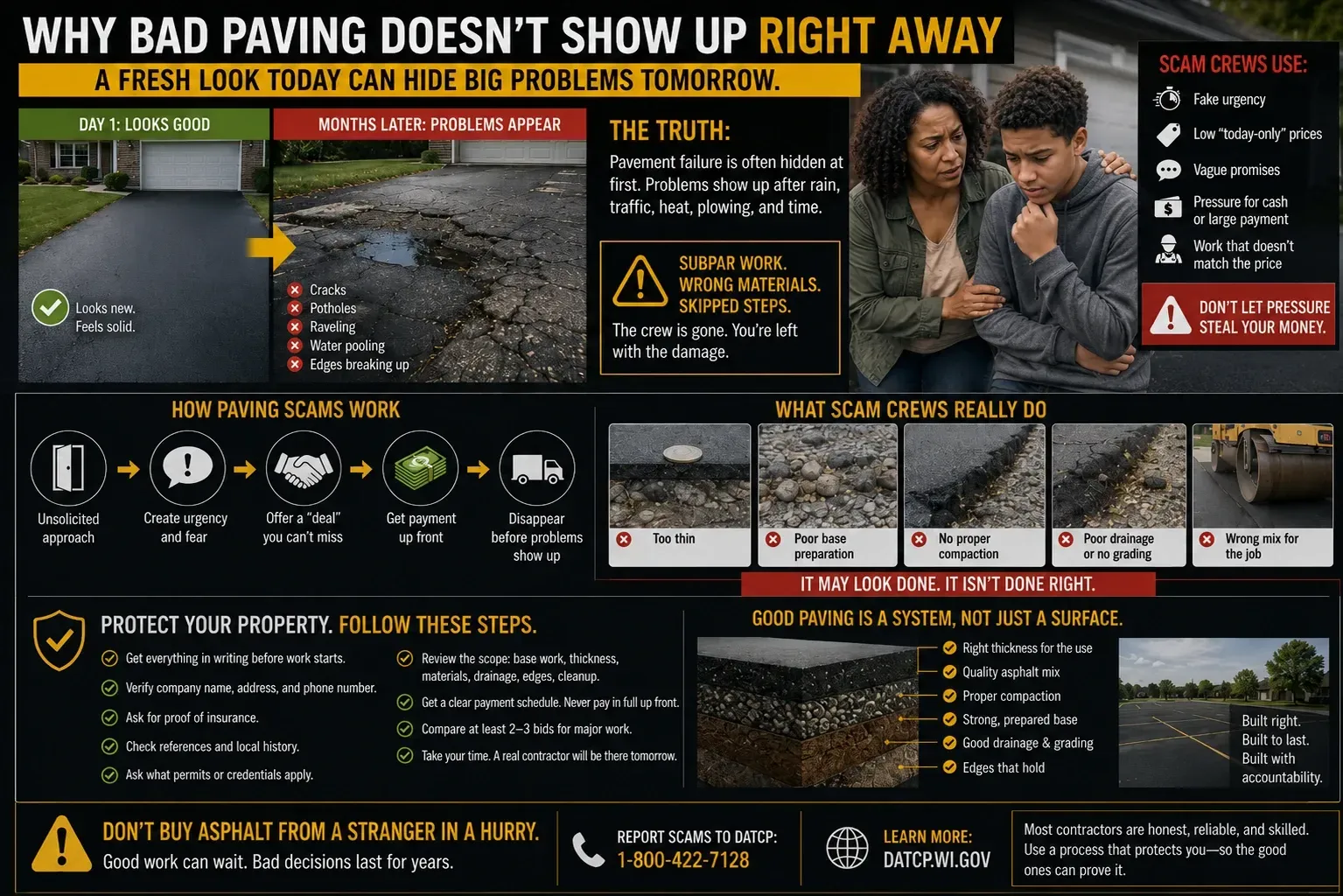
A major reason traveling asphalt scams are dangerous is that pavement failure is not always visible immediately. The surface can look dark and fresh on the first day even if the base is weak, the asphalt layer is too thin, the compaction is poor, or the material is wrong for the use. A customer may not realize the problem until rain, traffic, heat, plowing, or ordinary use exposes it. CBS 58's 2023 report noted that homeowners may not realize subpar materials were used until days later, after the surface reacts to weather or simply fails. By then, the crew may be unreachable, the phone number may be useless, and the business name may not match a real operation. [CBS58 2023]
This delayed discovery is one reason asphalt paving fraud is so frustrating. If a fake contractor steals money and does no work at all, the problem is obvious. If the crew spreads a thin layer, dumps gravel, sprays a coating, or covers defects instead of repairing them, the property owner may initially think the job is finished. The driveway looks different, and different can be mistaken for improved. But asphalt is a system. The base, drainage, edge support, thickness, mix, compaction, and traffic load all matter. A fraudulent crew can make a surface look temporarily acceptable while skipping the steps that make it last. That is not construction. It is a thin surface treatment designed to hide damage long enough for the crew to collect payment and leave. [DATCP 2023] [CBS58 2023]
DATCP has described cases where only a base coat was applied, even though the consumer or business was charged for the promised topcoat. The agency also warned that crews may set a price, begin work, then demand a much larger final payment before finishing. This matters because the customer's leverage changes once the crew has already disturbed the property. A half-done driveway leaves the homeowner under pressure to settle the dispute quickly just to finish the project. The customer may pay more just to get the mess completed or to get the strangers to leave. A legitimate contractor avoids that confusion with a written scope, agreed payment schedule, and clear change-order process before work starts. [DATCP 2023]
PCAA made this image for public use under the Creative Commons Attribution (CC BY) license.
Cash Up Front, then Disappear: The Payment Red Flag
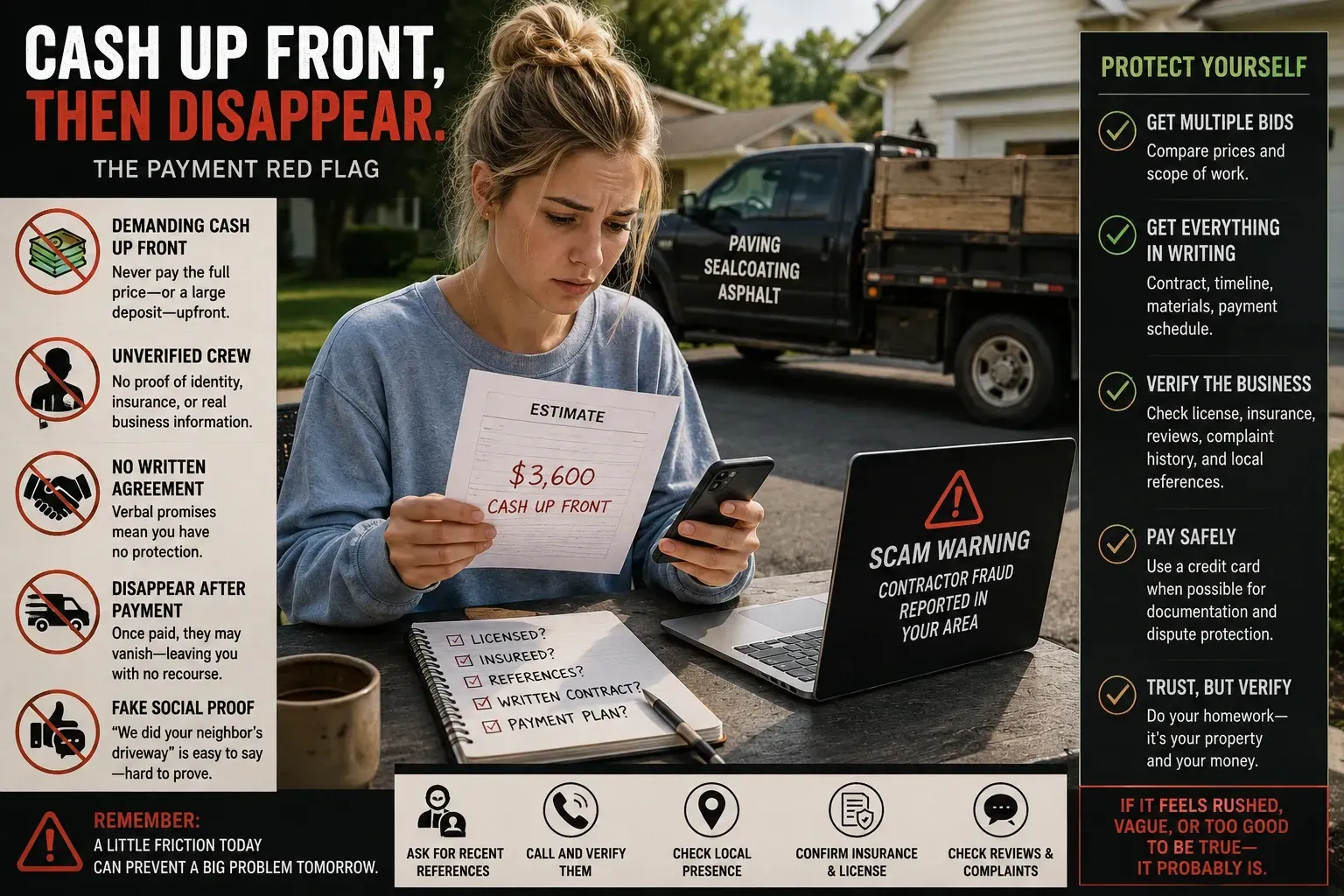
Another warning sign is the cash-first culture of the scam. BBB reports describe contractors asking for a large percentage of the fee upfront. DATCP warns consumers never to pay the full price of a project up front. TMJ4's 2026 reporting included the same message: compare prices, get multiple bids, get everything in writing, and avoid paying in full upfront. A down payment is not automatically wrong in construction, especially when materials, scheduling, and mobilization are involved. The problem is an unverified crew demanding major payment before the customer has a written agreement, verified identity, proof of insurance, or any realistic path to recovery if things go wrong. [BBB 2025] [TMJ4 2026] [DATCP 2023]
Cash and checks are especially risky when dealing with a stranger at the door. Once a check is cashed or cash changes hands, the customer may have little practical leverage. CBS 58's 2026 report noted BBB advice to pay by credit card rather than cash, when possible, because card payments may create better documentation and a possible dispute path. TMJ4's 2026 report echoed that credit card payments can create proof and may give the customer help from the card company. A legitimate contractor should not be afraid of traceable payment methods. Scammers prefer payment methods that let them disappear before the customer understands what happened. [CBS58 2026] [TMJ4 2026]
The scam also relies on social proof. A crew member may say they worked on a neighbor's driveway, a church down the street, a nearby business, or a municipal job. Sometimes the claim is vague enough that it sounds safe but cannot be checked. The safest response is to verify it in real time. A property owner can call the neighbor, ask for the exact job address, request the company name, ask for references from recent local work, and look for a real local presence. DATCP's home improvement guidance tells consumers to ask for recent customer names and call to ask whether the contractor showed up, cleaned up, followed through on warranties, and would be hired again. That step is simple, and it works because fraud cannot survive a verified reference call. [DATCP HI]
Local identity is important, but a logo on a truck is not enough. A business card can be printed. A temporary website can be thrown together. A phone number can be forwarded. A name can be borrowed or impersonated. A scam crew's online presence often tells the story if you look closely. Check four signals. Is the company's website registered recently — a WHOIS lookup takes seconds? Does the Google Business listing have reviews older than a few months? Was the Facebook page created in the same season it appeared at your door? Do the crew photos look like stock images rather than real local jobsites? A legitimate contractor's digital footprint builds over years — project photos with recognizable Wisconsin neighborhoods, customer reviews that mention specific streets, and a physical address that matches a real building. A scam operation's footprint appears overnight and disappears just as fast. [DATCP-HI] [CBS58-2026]
PCAA made this image for public use under the Creative Commons Attribution (CC BY) license.
Why do These Crews Move so Fast Across County Lines
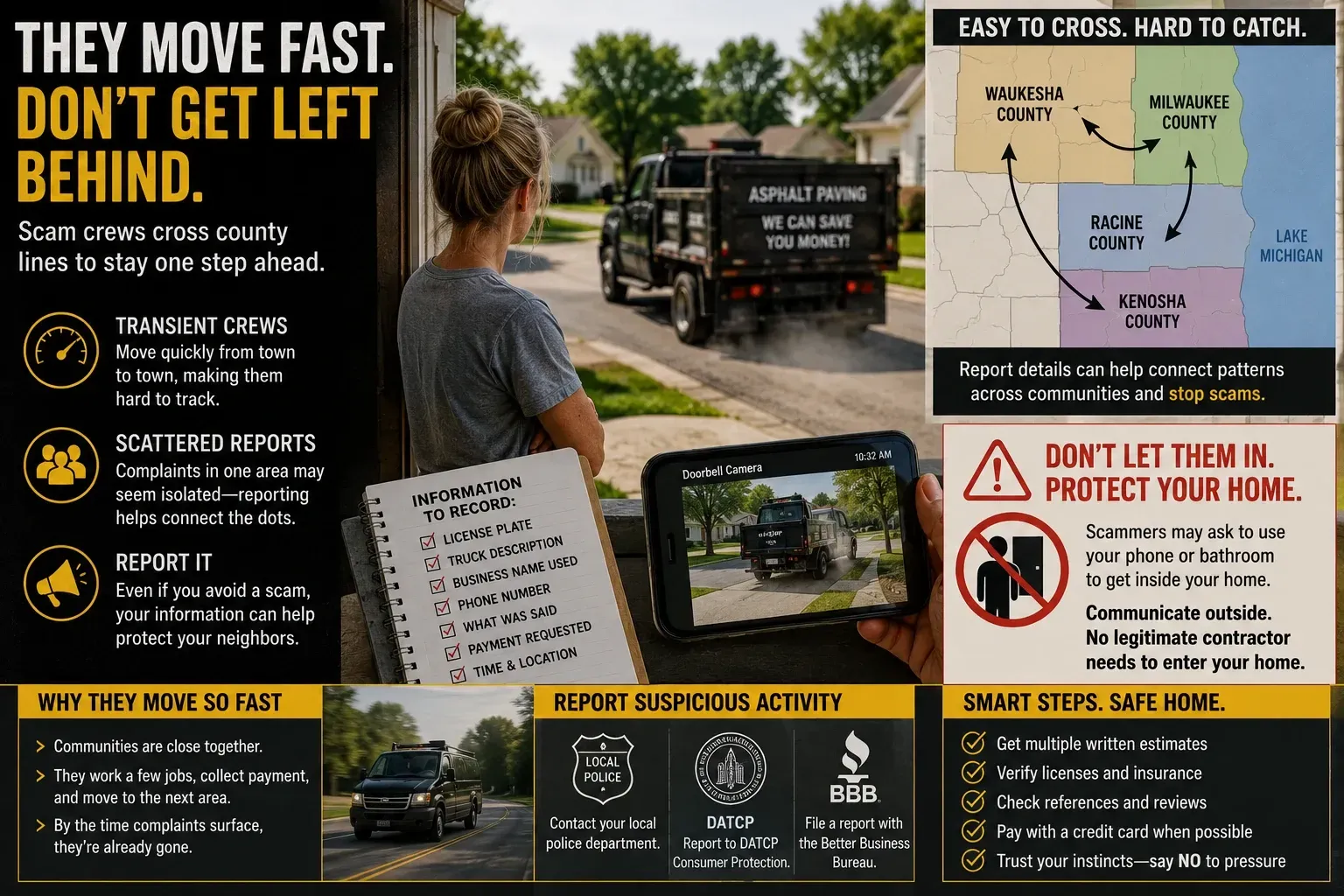
Southeastern Wisconsin has another complication: communities are close together. A crew can move from Waukesha County to Milwaukee County to Racine County to Kenosha County, or from a suburban neighborhood to a commercial corridor, quickly enough that scattered reports may look isolated at first. DATCP warned that transient workers can move quickly from town to town, making them difficult to track. That is why reporting matters even when a person avoids being scammed. A license plate, truck description, flyer, doorbell camera clip, name used, phone number, or payment request can help police and consumer protection agencies connect patterns across communities. [DATCP 2023]
CBS 58's 2023 report included a warning from law enforcement about unsolicited crews and pressure tactics. The report also described how some scammers may try to get inside a home by asking to make a phone call or use the bathroom. That detail is not about asphalt technique; it is about personal safety. A homeowner should never let an unknown contractor into the house because they appear at the door with a driveway offer. Real contractors can communicate outside, provide paperwork, schedule an appointment, and respect boundaries. A stranger who turns a driveway pitch into a reason to enter the home is creating a second risk beyond the pavement. [CBS58 2023]
PCAA made this image for public use under the Creative Commons Attribution (CC BY) license.
The Pattern: Warning Signs that Show Up Together
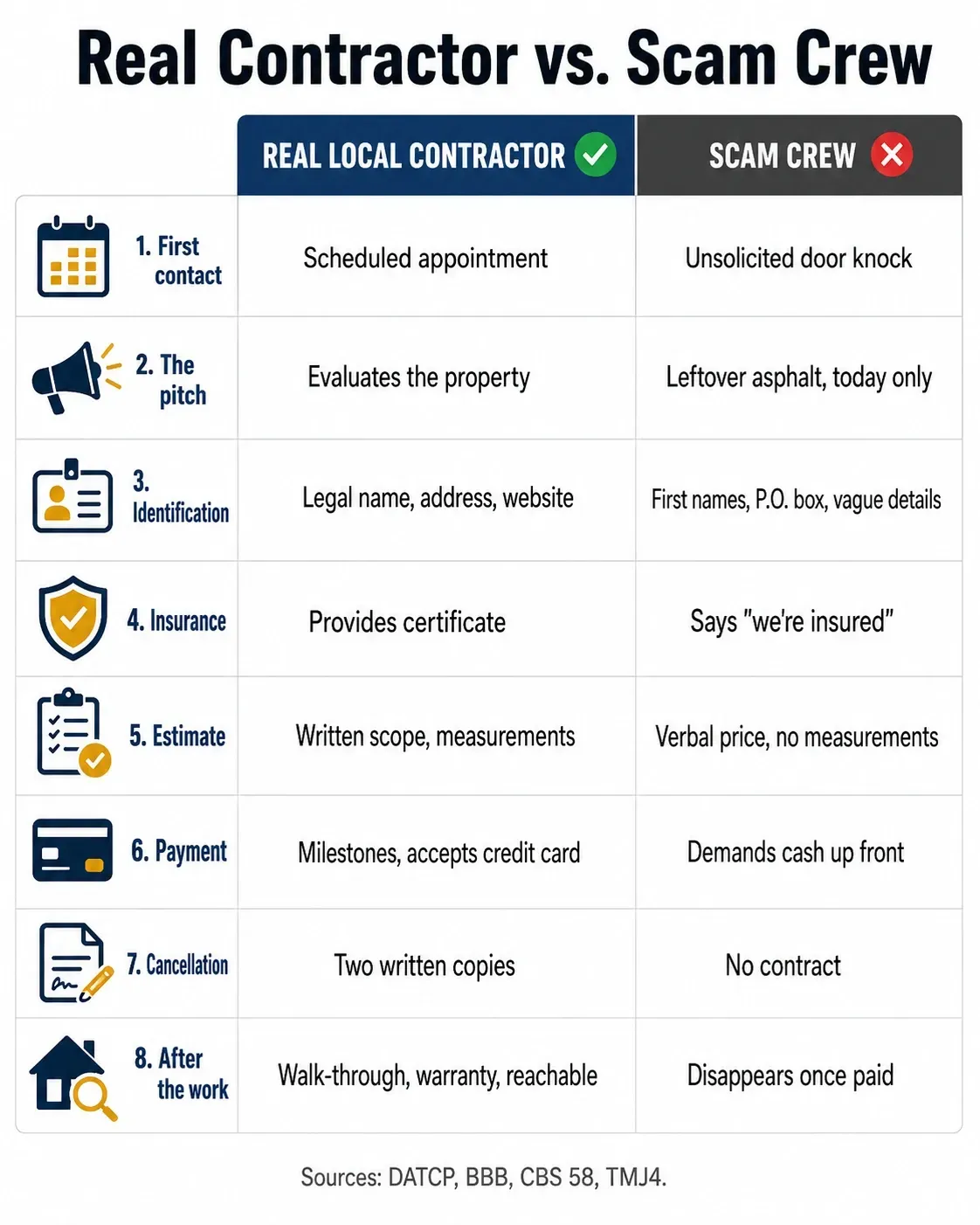
The most reliable fraud warning is not one single behavior. It is the combination: unsolicited approach, urgent deadline, leftover-materials story, big discount, no written scope, reluctance to identify the business, out-of-state or inconsistent information, large upfront payment, pressure against calling family or comparing bids, and unclear warranty. One of those facts alone may not prove fraud. Together, they form a pattern. A legitimate contractor can answer questions without making the customer feel foolish for asking. A fraudulent crew turns questions into conflict because the sale depends on speed, not trust. [BBB 2025] [DATCP 2023]
A local example from CBS 58 in 2023 shows why comparing bids matters. The report included Christopher Morawski of Purpose Contracting Asphalt explaining that when two or three estimates are relatively similar, and one is about half the price, that gap should raise a red flag. That is a practical point for homeowners and property managers. The cheapest bid is not always fraudulent, and the highest bid is not always best. A large price gap usually means one of the bidders is planning to skip something a homeowner cannot see after the asphalt cools. The U.S. The EPA Office of Inspector General has issued public fraud alerts about traveling pavement crews. The cost savings these crews advertise are typically achieved by using thinner mats, watered-down or recycled material, and skipping the base preparation that makes a driveway last more than a single season. The half-price job is not a discount; it is a different job entirely, sold under the same name. [CBS58-2023] [EPA-OIG]
The CBS 58 report also noted that Purpose Contracting Asphalt had been in business for 30 years and showed a legitimate asphalt project where a binder course was being laid after existing asphalt had been removed. That kind of local visibility is important. Fraud thrives when customers cannot tell the difference between a real contractor and a name on a flyer. A company that is willing to explain the work, show actual projects, and stand behind its presence in the community helps the public understand what legitimate work looks like. That does not mean every established business is automatically right for every job, but it does mean reputation can be checked in ways a traveling crew cannot match. [CBS58 2023
PCAA made this image for public use under the Creative Commons Attribution (CC BY) license.
What a Real Local Contractor Sounds Like
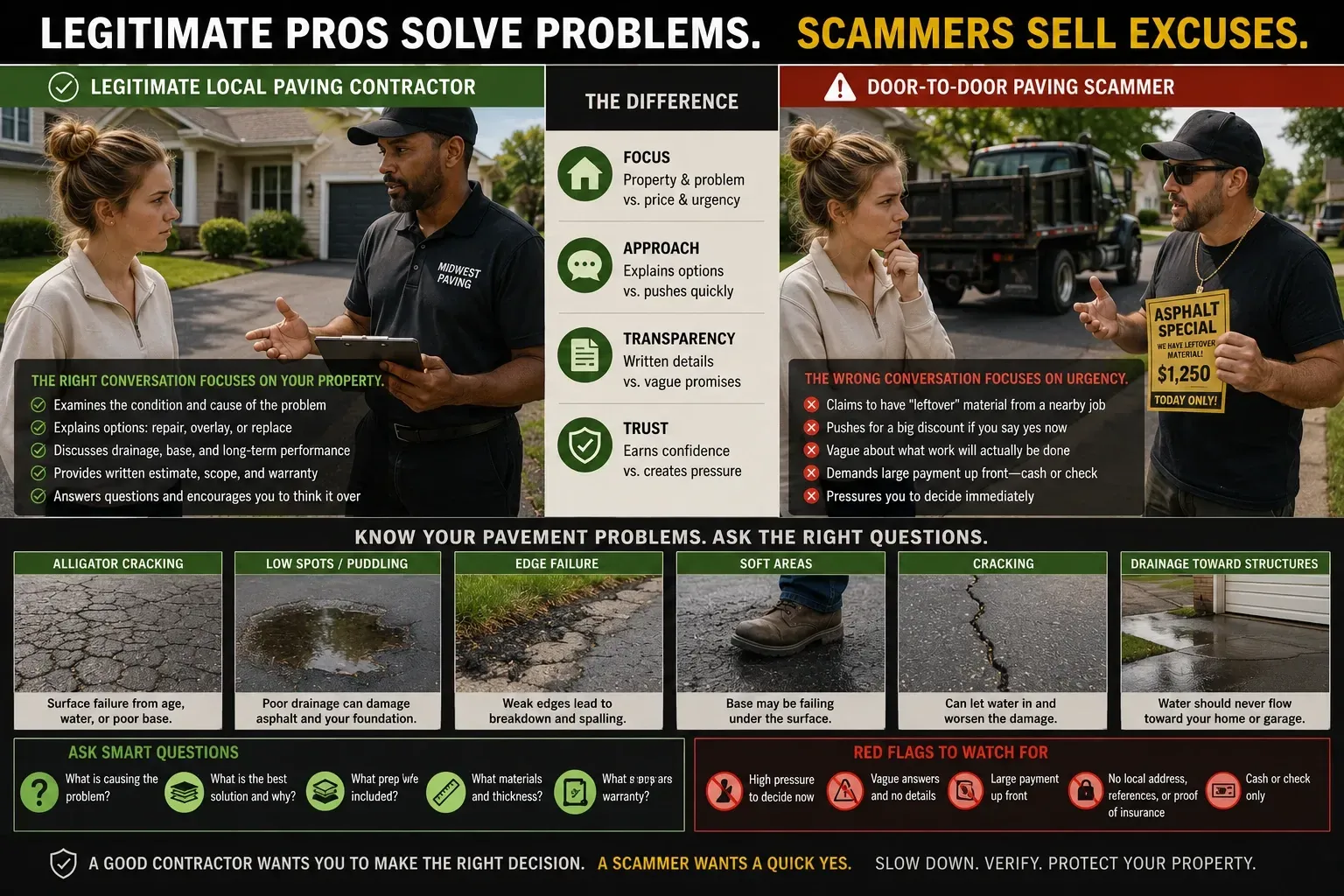
A legitimate local asphalt paving contractor should be able to talk about the property itself. Is the existing asphalt failing from age, water, poor base, tree roots, heavy traffic, or freeze-thaw damage? Does the driveway need to be removed and replaced, an overlay, patched, crack filling, sealcoated, drainage corrected, or graded? Are there low spots, soft areas, alligator cracking, edge failures, or drainage paths toward a garage, sidewalk, or neighboring property? A scammer usually wants the customer focused on price and urgency. A professional wants the customer to focus on the actual cause of the pavement problem. Those are very different conversations. [DATCP HI]
The difference between sealcoating and asphalt paving is another place fraud can hide. Sealcoating is a surface maintenance service intended to protect and refresh asphalt under the right conditions. It does not rebuild a failed base, restore structural thickness, or make alligator cracking disappear permanently. Asphalt Paving involves asphalt placement, compaction, and often base preparation or removal. When a door-to-door crew uses vague phrases like 'blacktop it,' 'fix it up,' or 'lay some material over it,' the customer should slow the conversation down. What exactly is being done? What material? How thick? What areas? What preparation? What warranty? Vague words are cheap. Asphalt is not. [DATCP HI] [BBB 2025]
PCAA made this image for public use under the Creative Commons Attribution (CC BY) license.
Who Scammers Target and How to Protect Them
Some property owners are targeted because they are older, busy, isolated, or trying to avoid a larger repair cost. Fraud does not always look like obvious bullying. It may look like friendliness, sympathy, and convenience. A crew may say they can help today because the driveway is unsafe, because water will damage the garage, because the price will rise tomorrow, or because the customer seems like a good person. Pressure can be delivered with a friendly tone. That is why families, neighbors, facility managers, senior communities, and local businesses should talk openly about asphalt scams before someone is standing at the door alone. [TMJ4 2026] [BBB 2025]
Franklin Police's public warning, amplified by TMJ4 in 2026, is a useful example of community prevention. The police department used its community resource dog, Clover, to draw attention to scam warnings because posts with Clover get more public engagement. That detail may sound lighthearted, but the purpose is serious: get warnings in front of people before a crew gets in front of their garage. Fraud prevention is partly communication. The best warning does nothing if nobody sees it, understands it, or remembers it when the knock comes. [TMJ4 2026]
The role of local media also matters. CBS 58, TMJ4, FOX6, and other Wisconsin outlets have helped translate agency warnings into stories that residents can recognize. A DATCP alert may explain the official risk, but a local report can show how it feels in a real neighborhood. A police quote can explain pressure tactics. A BBB representative can summarize common patterns. A legitimate contractor can explain what price differences mean. Those pieces together help the public build a practical gut check. Fraud relies on isolation; public reporting breaks that isolation. [CBS58 2026] [CBS58 2023] [TMJ4 2026]
A serious fraud-prevention message should also avoid turning every traveling worker into a villain. Some contractors travel for legitimate reasons, especially for specialized work, storms, major projects, or seasonal demand. The issue is not geography alone. The issue is an unverified contractor using pressure, vague identity, fake urgency, questionable payment demands, and poor documentation. A good out-of-area company can still provide written contracts, proof of insurance, references, permit information, and clear payment terms. A scammer cannot or will not. The public should focus on verifiable behavior, not just a license plate. [DATCP 2023] [DATCP HI]
The word 'licensed' also needs careful use in Wisconsin. Home improvement work can involve different legal requirements depending on the type of project, the property, the municipality, and whether permits are being pulled. DATCP says contractors doing certain general construction work on one- or two-family homes and obtaining building permits must have Dwelling Contractor Certification and Dwelling Contractor Qualifier Certification from DSPS. DSPS also explains that certain one- and two-family dwelling permits require a Dwelling Contractor or Restricted certification and a qualified person. The safe customer-facing advice is not to assume every asphalt job has the same credential requirement, but to ask what permits or credentials apply and verify what the contractor claims. [DATCP HI] [DSPS DC] [DSPS DCQ]
That distinction matters because misleading language can create its own trust problem. A contractor should not claim to be 'DATCP approved' unless a real approval program exists for that specific claim. DATCP provides consumer protection guidance, takes complaints, and enforces certain rules, but it does not issue blanket approvals of individual contractors. Customers should instead look for verifiable facts: registered business information, applicable DSPS credentials where required, insurance, written contract, references, BBB information, local history, and a real ability to explain the work. Honest trust is built with proof, not magic words. [DATCP HI] [DSPS DC]
Homeowners should also be cautious of a crew that refuses to leave written materials behind. A legitimate contractor should have no problem providing a written estimate that describes the work and gives the customer time to review it. DATCP's home improvement tips specifically advise against relying on oral agreements and say written contracts protect both the consumer and contractor. If any payment is required before work is done, DATCP says a written contract is required by law. That requirement alone defeats much of the door-to-door scam model. Scammers want a quick yes, quick money, and quick movement to the next town. [DATCP HI]
Written contracts also protect honest contractors. A customer can't fairly compare bids if one contractor prices a full remove-and-replace, another prices an overlay, and a third vaguely promises to 'redo the driveway.' They think they're comparing three prices for the same result. They're actually comparing three different projects. A written scope forces details into the open. It should identify the company, address, salesperson, job description, materials, quantities, price, start and completion dates, warranties, and payment terms. DATCP lists many of these contract components in its home improvement guidance. [DATCP-HI]
One of the most common customer mistakes is treating a driveway as a simple product instead of a construction system. Asphalt itself is only part of the job. The preparation underneath determines whether the surface has support. Water management determines whether the pavement will be undermined. Edges determine whether the driveway holds shape or breaks apart. Compaction determines density and durability. The type and thickness of asphalt should match the use. A fraud crew sells the black surface because that is what customers see. A reputable contractor explains the layers and conditions customers cannot see. [DATCP HI]
The cheap-price trap is especially strong when the existing driveway already looks bad. A homeowner facing a large repair estimate may want to believe a smaller number can solve the same problem. Sometimes a smaller scope is appropriate. Crack filling, patching, or sealcoating may make sense for maintenance if the pavement is structurally sound. But if the base is failing, the surface is badly alligatored, water is trapped, or the driveway needs removal, a bargain overlay may simply bury the problem until it returns worse. A suspiciously low price should not be accepted or rejected blindly. It should be investigated. [CBS58 2023] [DATCP HI]
PCAA made this image for public use under the Creative Commons Attribution (CC BY) license.
Commercial Properties: Bigger Lots, Bigger Losses
Commercial properties face the same risk with larger consequences. A parking lot at a senior living facility, apartment complex, church, warehouse, strip mall, clinic, or school is not just a surface. It affects access, liability, drainage, customer experience, snow removal, ADA routes, delivery traffic, and emergency response. A fraudulent or incompetent asphalt paving job can create trip hazards, ponding water, plow damage, and early failure. Property managers should resist any crew that appears without an appointment and try to sell a same-day fix. Real commercial asphalt paving requires planning, staging, traffic control, communication, and documentation. [DATCP 2023] [DATCP HI]
Southeastern Wisconsin businesses are also vulnerable to crews that solicit during work hours when decision-makers are busy. A manager may be handed a fast quote while dealing with staff, customers, deliveries, or maintenance issues. The safest policy is simple: no unsolicited asphalt paving decisions on the spot. The employee receiving the pitch should collect information, avoid signing anything, avoid payment, avoid letting work begin, and route the proposal through the normal approval process. If the crew pressures, refuses to leave, or begins work without authorization, DATCP advises contacting local law enforcement. [DATCP 2023] [DATCP HI]
The public should understand that fraud prevention is not about being suspicious of every contractor. Most contractors, as DATCP notes, are honest, reliable, and skilled. The goal is to create a process that honest contractors can pass easily and that dishonest crews cannot survive. A written estimate, local references, an insurance certificate, a clear payment schedule, applicable credential verification, a BBB review, and time to compare bids are not obstacles to good work. They are evidence that the customer and contractor are entering into a serious agreement. If a contractor treats those steps as insulting, the customer has learned something important before losing money. [DATCP HI]
Fraud also harms legitimate asphalt companies. When a scam crew leaves a failed driveway, the homeowner often distrusts the whole trade. Real contractors then have to explain why a proper job costs more. Why base work matters. Asphalt thickness can't be wished into existence. A thin coating won't perform like a professionally built surface. Local contractors who speak publicly about scams aren't just defending their reputations. They help residents tell the difference between real construction and a fraud that imitates it. [CBS58-2023]

PCAA made this image for public use under the Creative Commons Attribution (CC BY) license.
How to Verify an Asphalt Paving Contractor Before You Sign or Pay
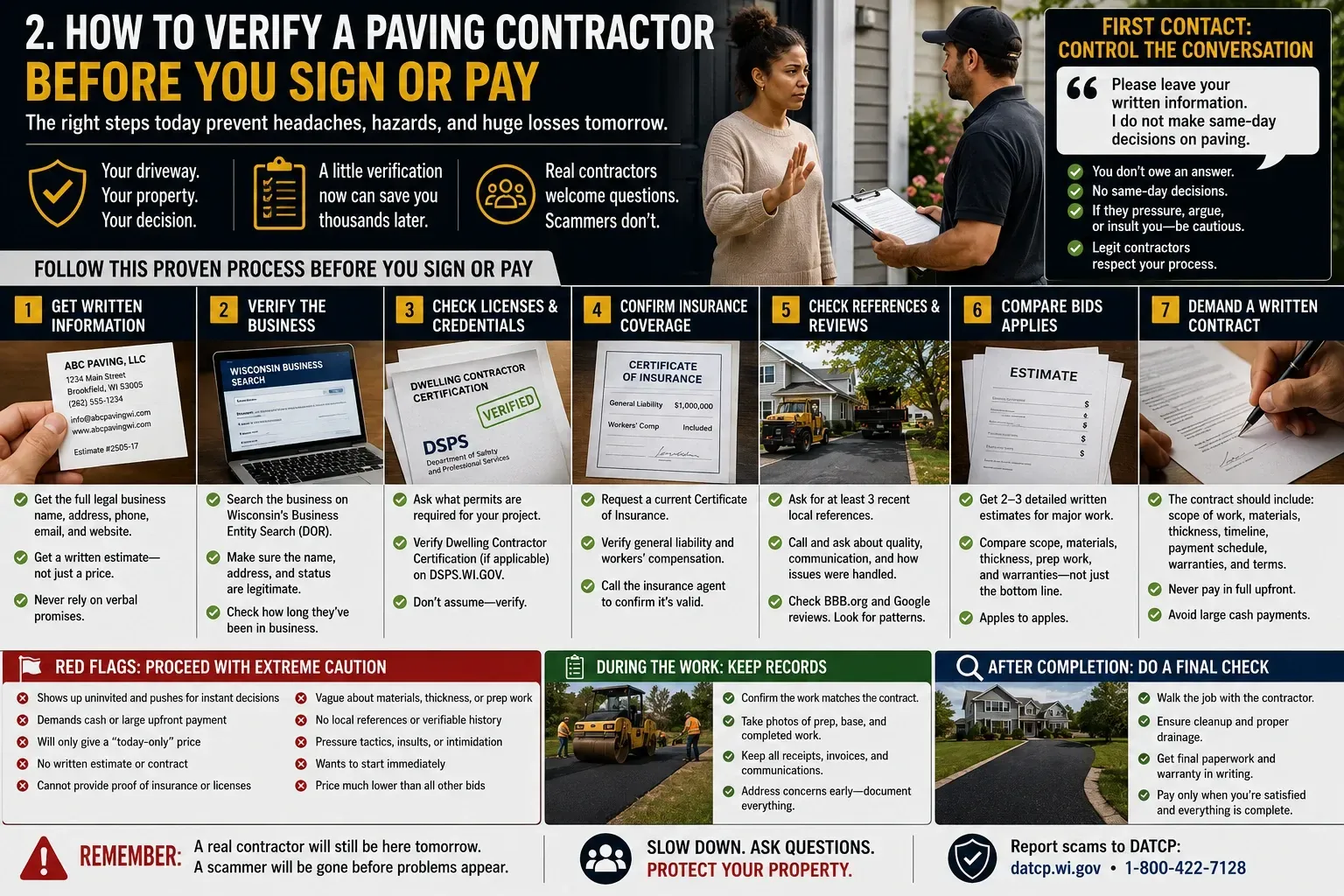
Preventing asphalt fraud begins before a contractor is hired. The safest customer is not the customer who knows every asphalt mix by memory. The safest customer is the customer who follows a repeatable process. That process should be simple enough for a homeowner, property manager, church trustee, senior community director, or small business owner to use it under real pressure. It starts with the first contact and continues through written estimates, verification, payment, documentation, work inspection, and final closeout. A scammer wants the process skipped. A reputable contractor can walk through it calmly. [DATCP HI]
PCAA made this image for public use under the Creative Commons Attribution (CC BY) license.
First Contact: Control the Conversation
Step one is to control the conversation. If a contractor appears without being invited, the customer does not owe an immediate answer. A safe response is: 'Please leave your written information. I do not make same-day decisions on asphalt paving.' That sentence is powerful because it removes urgency. If the crew becomes irritated, argumentative, pushy, or insulting, the customer has learned that the risk is not just the driveway. DATCP advises consumers not to give in to high-pressure tactics when transient workers come to the door. Pressure is not proof of skill. It is proof that the seller benefits from the customer acting before thinking. [DATCP HI]
PCAA made this image for public use under the Creative Commons Attribution (CC BY) license.
Identify the Business and Verify it Independently
Step two is to identify the business completely. Ask for the legal company name, trade name, physical business address, phone number, email address, website, salesperson's full name, and names of the people who would perform the work. DATCP says a written contract should include the name and address of the salesperson and the company name and address, not only a post office box. That matters because a vague identity makes complaints, warranty claims, payment disputes, and law enforcement reports harder. A contractor who wants thousands of dollars should be willing to identify the business clearly and verifiably. [DATCP HI]
Step three is to pause and verify the information independently. Do not use only the phone number the contractor gives you. Search for the business name. Check whether the address appears real. Look for consistent phone numbers and websites across sources. Review BBB information and complaints. Ask DATCP's Bureau of Consumer Protection or BBB whether complaints have been filed, as DATCP suggests. Look for local reviews, but do not stop at star ratings. Read patterns. Do people mention no-shows, unresolved warranty problems, pressure tactics, changed prices, or poor communication? One bad review may not prove much. Repeated patterns across multiple customers are a warning sign worth paying attention to. [DATCP HI] [CBS58 2026]
PCAA made this image for public use under the Creative Commons Attribution (CC BY) license.
Insurance, Permits, and Credentials
Step four is to ask for proof of insurance. DATCP says consumers may ask any contractor for a certificate of insurance with the homeowner's name and address listed as a certificate holder. That certificate shows an active policy and can notify the homeowner if coverage expires. For asphalt paving work, insurance matters because equipment, trucks, hot material, grading, edges, adjacent structures, utilities, and workers create real risks. A contractor saying 'we are insured' is not the same as providing proof. A professional operation should be used to this request. A suspicious crew often refuses, stalls, or becomes defensive when proof of insurance is asked for. [DATCP HI]
Step five is to ask what permits or credentials apply. Wisconsin rules are not identical for every asphalt paving situation, and customers should avoid simplistic claims. DATCP explains that if a contractor is doing certain general construction work on one- or two-family homes and obtaining building permits, the contractor must have Dwelling Contractor Certification and Dwelling Contractor Qualifier Certification from DSPS. DSPS states that certain one- and two-family dwelling permits require a Dwelling Contractor or Restricted certification and a qualifying person. The customer should ask the contractor to explain whether permits or credentials apply to the specific job and verify any claimed credentials through official sources. [DATCP HI] [DSPS DC] [DSPS DCQ]
This is where language matters. The public should not be told to look for a 'DATCP approved asphalt contractor' unless that phrase is accurate for the specific program being discussed. Better wording is to look for a contractor with verifiable local history, proper insurance, written contracts, applicable credentials, and a record that can be checked with BBB, DATCP, DSPS, municipal offices, and recent customers. Government agencies do not issue general endorsements of individual businesses. They provide rules, complaint channels, credentials, and consumer guidance that customers can use to make safer decisions. [DATCP HI] [DSPS DC]
PCAA made this image for public use under the Creative Commons Attribution (CC BY) license.
Get Multiple Estimates On the Same Scope
Step six is to get more than one estimate. DATCP recommends getting more than one estimate and making sure all contractors are bidding on the same work. For asphalt, this is critical. One contractor may price crack filling and sealcoating. Another may price a two-inch overlay after milling transitions. Another may include price removal, grading, base correction, and new asphalt. Those numbers are not comparable unless the scope is comparable. The customer should ask each contractor to identify square footage, preparation, thickness, material, compaction, edges, drainage treatment, transitions, cleanup, schedule, warranty, and exclusions. [DATCP HI]
A proper estimate should describe the problem before describing the price. Does the contractor identify why the existing pavement is failing? Does the contractor explain whether cracks are surface aging, reflection cracking, structural base failure, or drainage-related? Does the contractor distinguish between cosmetic maintenance and structural repair? Does the contractor mention grading, low spots, edge restraint, or water flow? A scammer may only say the driveway 'needs blacktop.' A good contractor should be able to explain the difference between making the surface black and making the pavement perform. Those are not the same thing. [DATCP HI]
PCAA made this image for public use under the Creative Commons Attribution (CC BY) license.
Written Contracts and Detailed Scope
Step seven is to require a written estimate before payment is discussed. CBS 58's 2026 BBB warning advised getting estimates in writing. DATCP says not to rely on oral agreements and explains that a contract should contain a full job description, detailed materials, total price, start and completion dates, and warranty information. If any payment is required before work is done, DATCP says a written contract is required by law. This is one of the most important consumer protections. A written estimate turns a sales pitch into a document that can be compared, questioned, corrected, and saved. [CBS58 2026] [DATCP HI]
The written scope should avoid vague phrases. 'Pave driveway' is not enough for a major job. Better language identifies the area, approximate square footage, existing conditions, removal depth if applicable, base preparation, aggregate base, asphalt type or course, compacted thickness, number of lifts if relevant, transitions, drainage notes, edging, cleanup, and warranty. Not every residential estimate will read like a highway specification, and not every small driveway needs a novel. But the scope should be clear enough that both sides know what is included. A scammer benefits from vagueness because vague promises are easy to deny. [DATCP HI]
Step eight is to compare the price against the scope, not against hope. CBS 58's 2023 report included a warning from Christopher Morawski of Purpose Contracting Asphalt that when two or three estimates are fairly close, and one is roughly half the price, the low bid is a major red flag. That does not automatically make the low bidder a scammer. It means the customer should ask what changed. Is the cheaper contractor doing less preparation? Using a thinner layer? Skipping base repair? Offering sealcoating when the other contractors quoted asphalt paving? Leaving out disposal? Offering no warranty? A low price may be a different job wearing the same name tag. [CBS58 2023]
PCAA made this image for public use under the Creative Commons Attribution (CC BY) license.
Payment Structure, Lien Waivers, and Cancellation Rights
Step nine is to understand the payment structure. BBB warns that scam contractors may ask for a large percentage up front. DATCP says never to pay the full price of a project up front. TMJ4's 2026 report also carried BBB advice to avoid paying in full up front. A reasonable payment schedule depends on job size, materials, scheduling, and contractor policy, but customers should avoid paying most or all of the contract before meaningful work is completed. Payments should be tied to written milestones where possible. The payment method should leave a record. If a contractor insists on cash and refuses documentation, the answer should be no. [BBB 2025] [DATCP 2023] [TMJ4 2026]
Step ten is to protect yourself with lien waivers when payments are made. Wisconsin lien rules matter even when the contractor is honest, because subcontractors and material suppliers may have rights if they are unpaid. DATCP explains that lien waivers protect consumers because they prevent contractors, subcontractors, and material suppliers from trying to collect from homeowners who have already paid. Wisconsin Administrative Code section ATCP 110.025 requires the seller to give notice that the consumer may request written lien waivers at or before payment. Customers should understand lien waivers before final payment, not after receiving a collection notice from a subcontractor or supplier the homeowner did not directly pay. [DATCP LIENS] [WI ATCP 110.025]
DATCP's home improvement tips say contractors must provide lien waivers if the consumer requests them, and consumers should always ask for a lien waiver when making a payment. The practical rule is straightforward: before making the final payment, ask for completed lien waivers from the prime contractor and, when applicable, subcontractors and suppliers tied to the payment. For larger commercial or residential asphalt paving work, this helps confirm that the money is reaching the people and suppliers connected to the job. A scam crew probably will not have a clean lien-waiver process because the entire operation is built on avoiding accountability. [DATCP HI] [DATCP LIENS]
Step eleven is to understand cancellation rights. DATCP states that if a consumer was solicited and signed a contract for more than $25 at home or away from the contractor's regular place of business, Wisconsin law allows three business days to cancel. The contractor must provide two copies of the cancellation notice at the time the contract is signed. This protection matters because many asphalt scams begin with door-to-door solicitation. Customers should read the contract before signing and make sure required cancellation notices are provided when applicable. A contractor who refuses to discuss cancellation rights is not making the situation safer. [DATCP HI]
DATCP explains a separate right for incomplete jobs. If a consumer pays but doesn't receive materials, services, or completion of work, they may cancel a home improvement contract after three business days by giving written notice. The consumer may then demand return of unspent money, delivery of materials purchased with their money, and a written accounting of payments. These are legal concepts, not magic refund buttons, and customers should seek proper advice for disputes. Still, knowing the rights exist helps customers avoid accepting a scammer's claim that nothing can be done. Documentation is what makes those rights easier to use. [DATCP-HI]
PCAA made this image for public use under the Creative Commons Attribution (CC BY) license.
Documentation, Safety, and Unauthorized Work
Step twelve is to document everything from the first contact. Save flyers, business cards, estimates, texts, emails, contracts, receipts, license plate numbers, truck descriptions, doorbell footage, payment records, and photos of the driveway before, during, and after work. If the job becomes a dispute or a fraud report, those details matter. DATCP advises getting vehicle descriptions and license plate numbers if transient crews appear. Franklin Police encouraged victims to report scams because reports help identify criminals and warn others. Documentation turns an upsetting story into useful evidence. [DATCP 2023] [TMJ4 2026]
Step thirteen is to insist that work not begin without authorization. DATCP's home improvement guidance tells consumers to call police immediately if transients begin a job without authorization. That advice may sound extreme until a customer imagines a crew unloading material onto a driveway and then demanding payment because work has already started. The safest policy is clear: no signed written agreement, no verified contractor, no work. If an unsolicited crew tries to start anyway, the issue is no longer a bargain opportunity. It is a property and safety problem. [DATCP HI]
Step fourteen is to avoid letting strangers into the home. CBS 58's 2023 report included a law enforcement warning that some scammers may pressure their way inside by asking to use the phone or bathroom. Homeowners should keep the conversation outside, avoid sharing personal details, and avoid leaving strangers unattended near garages, tools, vehicles, or entryways. A professional contractor can schedule a meeting and respect the property. A person who reacts badly to boundaries is signaling a risk the customer should take seriously. [CBS58 2023]
Step fifteen is to use local referrals carefully. Friends, family, neighbors, facility managers, and other property owners can provide helpful references. TMJ4's 2026 report included BBB advice to contact friends and family and check free BBB reports. But referrals should still be verified. A neighbor may have been happy on day one and unhappy after the first winter. A relative may remember a company name incorrectly. A scammer may claim to know someone who never heard of them. Good referrals are specific: job address, date, type of work, whether the price changed, how the surface performed, and whether warranty questions were answered. [TMJ4 2026] [DATCP HI]
Step sixteen is to compare warranties without being hypnotized by them. The warranty is only as strong as the company behind it and the exclusions inside it. A long verbal warranty from a traveling crew has no enforceable value once the crew leaves Wisconsin. Customers should ask what is covered, what is excluded, how long coverage lasts, whether maintenance is required, and how claims are handled. DATCP advises that contracts should include a statement explaining warranties on materials, labor, or services and that consumers should understand limitations. A clear limited warranty is better than a verbal promise from a crew that may not be reachable when the driveway cracks. [DATCP HI]
Step seventeen is to consider the property type. A residential driveway, condo association drive lane, church parking lot, private road, farm access, warehouse dock, apartment lot, school lot, municipal repair, and senior living facility all have different traffic patterns and risks. Heavy vehicles, garbage trucks, delivery trucks, fire access, snowplows, drainage, ADA access, and turning movements can change what the pavement needs. A contractor who gives the same quick answer for every property may not be evaluating the job. Fraud prevention includes making sure the proposed work fits the actual use. [DATCP HI]
Step eighteen is to watch how the contractor handles questions. Honest contractors may disagree with one another, but they should be able to explain their reasoning. Ask why they recommend overlay instead of removal. Ask what happens to cracks. Ask whether drainage needs correction. Ask what thickness they propose. Ask when the driveway can be used. Ask how edges will be handled. Ask what is not included. A trustworthy contractor should understand that questions are part of a serious job. A scammer treats questions as danger. [DATCP HI]
Step nineteen is to avoid confusing speed with professionalism. A professional crew can work efficiently, but efficiency happens after planning. A scam crew wants to make the sale, perform something fast enough to justify payment, and leave before defects become obvious. Customers should be cautious of any offer that compresses estimate, contract, payment, mobilization, work, and final payment into the same surprise visit. Proper asphalt paving may be scheduled around weather, plant availability, crew availability, existing conditions, and other projects. If the contractor says the job must happen immediately or not at all, the customer should wonder who benefits from that timeline. [BBB 2025] [DATCP 2023]
Step twenty is to recognize that leftover asphalt is not automatically a favor. Real asphalt operations try to plan material carefully because waste is expensive. There may be legitimate situations where a contractor has extra material, but that does not erase the need for a written scope, verified identity, insurance, payment terms, and proper construction. A homeowner should never accept an asphalt job just because material is supposedly available. The question is not whether asphalt exists in a truck. The question is whether the right contractor is using the right material in the right way for the right property under a written agreement. [DATCP 2023] [BBB 2025]
Step twenty-one is to use municipal resources when appropriate. Local building inspection departments, clerk offices, engineering departments, or public works departments may be able to explain whether a permit, right-of-way requirement, apron rule, drainage restriction, or local license applies. This is especially important when work touches a sidewalk, curb, driveway apron, culvert, public right-of-way, or stormwater path. A contractor who says permits are never needed may be wrong. A contractor who says the homeowner should pull every permit personally may be shifting responsibility. The customer should verify locally rather than relying only on the sales pitch. [DATCP HI]
Step twenty-two is to protect senior relatives and vulnerable neighbors before asphalt paving season. Families can agree that no major home improvement decision will be made at the door without calling a trusted person. Neighbors can share warnings in subdivision pages, church bulletins, senior community newsletters, and local Facebook groups. Businesses can train front-desk staff not to sign or approve unsolicited work. Franklin Police's 2026 warning emphasized that victims are not alone and should report what happened without shame. Scam prevention is stronger when the community removes embarrassment from the process. [TMJ4 2026]
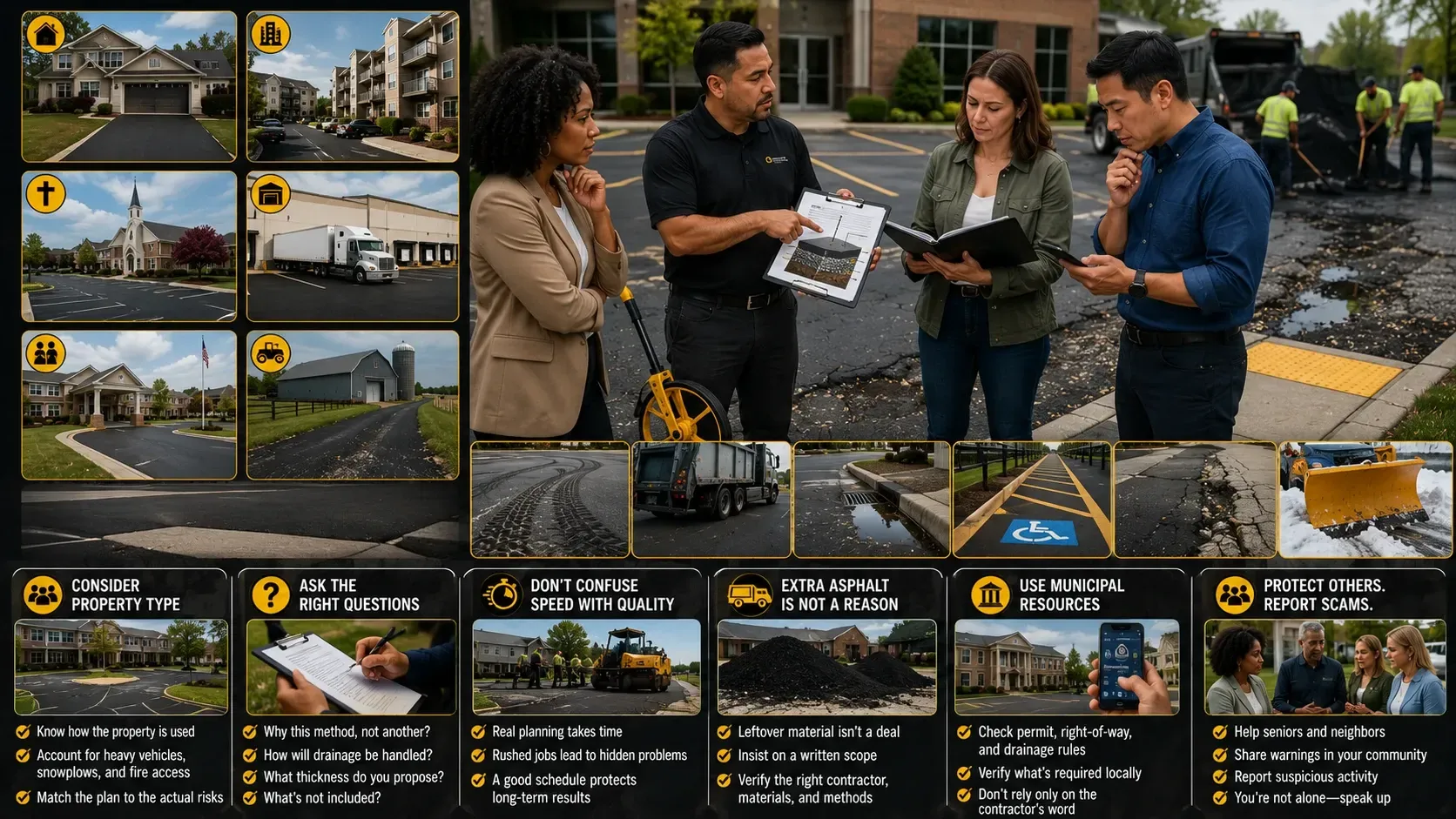
PCAA made this image for public use under the Creative Commons Attribution (CC BY) license.
Final Inspection and Lien Waivers Before Final Payment
Step twenty-three is to inspect before final payment. Customers should walk the project with the contractor, compare the finished work to the written scope, ask about care instructions, collect lien waivers if requested and applicable, obtain a receipt, save warranty information, and photograph the completed work. For larger projects, the customer may document transitions, edges, drainage points, approaches, patched areas, and any items that need correction. DATCP warns not to sign a completion certificate or make final payment until satisfied and all work is done as specified. Final payment is the customer's primary leverage to require corrections and cleanup, and it should not be released before the work matches the contract. [DATCP HI]
Step twenty-four is to know the difference between a complaint and a normal punch-list item. Even good contractors may need to address cleanup, edge details, minor touchups, communication issues, or weather-related scheduling changes. Fraud prevention does not mean assuming every problem is criminal. It means preserving a clear path to resolution. A written contract, payment record, photos, and contact information make ordinary corrections easier. A door-to-door cash job with no paperwork makes even simple problems nearly impossible to solve. Documentation protects the customer and the honest contractor at the same time. [DATCP HI]
Step twenty-five is to use the Right to Cure process correctly when construction defects are alleged. DATCP explains the requirement clearly. Under Wisconsin's Right to Cure law, contractors must provide consumers with a brochure at signing describing requirements for future construction defect claims. Consumers must give written notice before legal action so contractors or suppliers can respond. This is another reason written communication matters. A customer who is upset should still document the issue clearly, preserve evidence, and follow the required process. The goal is resolution. Written, dated communication is what preserves the customer's options under Wisconsin's Right to Cure process. [DATCP-HI]
Step twenty-six is to understand that BBB information is a tool, not a crystal ball. BBB reports, complaint history, ratings, and Scam Tracker information can help reveal patterns, but they are not the only verification step. A contractor may be new, may operate under multiple names, or may have a limited history. A scammer may impersonate another company. Customers should combine BBB checks with contract review, insurance proof, references, local presence, DSPS or municipal verification where applicable, and careful payment practices. Fraud prevention is layered. One layer can fail; several layers are harder to beat. [BBB 2025] [DATCP HI]
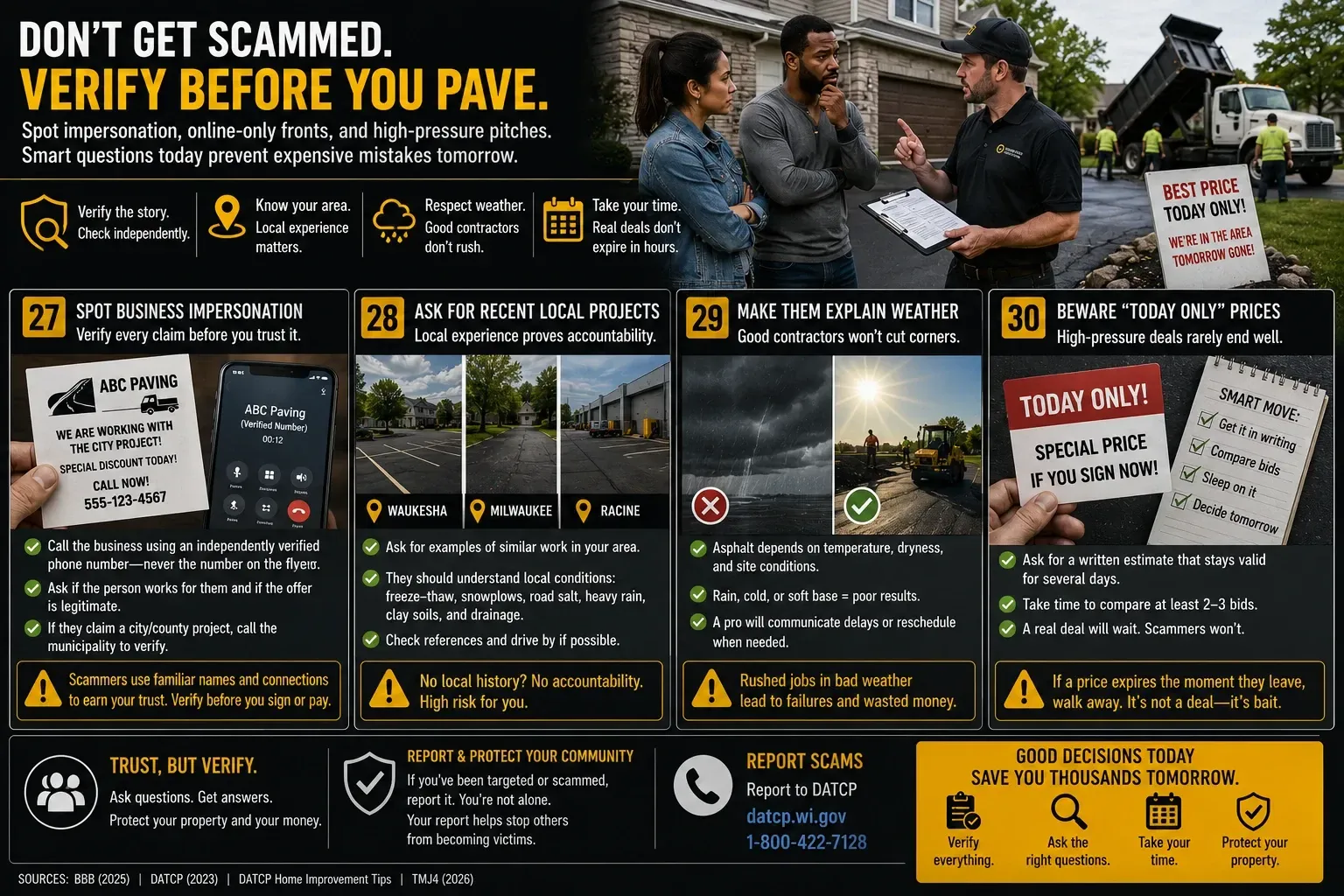
PCAA made this image for public use under the Creative Commons Attribution (CC BY) license.
Spotting Impersonation and Online-Only Fronts
Step twenty-seven is to pay attention to business impersonation. Some scammers claim association with a real contractor, a relative of a local business owner, a municipal project, or a nearby job. Customers should call the business directly using an independently verified phone number, not the number on the flyer. Ask whether the person is employed by them, whether they are working nearby, and whether the offer is legitimate. If the contractor claims to be connected to a city or county project, call the municipality. Impersonation works because people trust names they recognize. Verification turns recognition into evidence. [BBB 2025]
Step twenty-eight is to ask for recent local project examples, not just generic references. A contractor working in Milwaukee, Waukesha, Racine, Kenosha, Franklin, Muskego, New Berlin, Brookfield, Oak Creek, Waterford, Burlington, Sussex, Pewaukee, Oconomowoc, or nearby communities should be able to discuss relevant local conditions and show recent work when appropriate. Southeastern Wisconsin pavement faces freeze-thaw cycles, snowplows, road salt, heavy rain, clay soils in some areas, and drainage challenges. A real contractor should understand those conditions. A traveling crew with no local accountability may simply want the job, not the responsibility that follows. [DATCP 2023] [DATCP HI]
Step twenty-nine is to make the contractor explain what happens if the weather changes. Asphalt placement depends on weather, temperature, and site conditions. Rain, cold, soft base, and scheduling delays can affect work. A legitimate contractor should communicate if conditions are not suitable. A scammer may rush because they need payment before the customer sees failure. The customer should not pressure an honest contractor to pave in bad conditions just because the driveway looks inconvenient. Prevention works both ways: customers should choose contractors carefully and then allow proper work to be done properly. [DATCP HI]
Step thirty is to treat 'today only' pricing as a serious warning. A legitimate contractor may have scheduling efficiencies, route planning, or seasonal promotions. But a major property improvement should not depend on an immediate decision made under pressure. Customers should ask for the written estimate to remain valid for a reasonable period. If the contractor says the price disappears the moment they leave the driveway, the customer should let it disappear. A good price that cannot survive one night of thought is usually a pressure tactic rather than a real offer. [BBB 2025] [DATCP 2023]
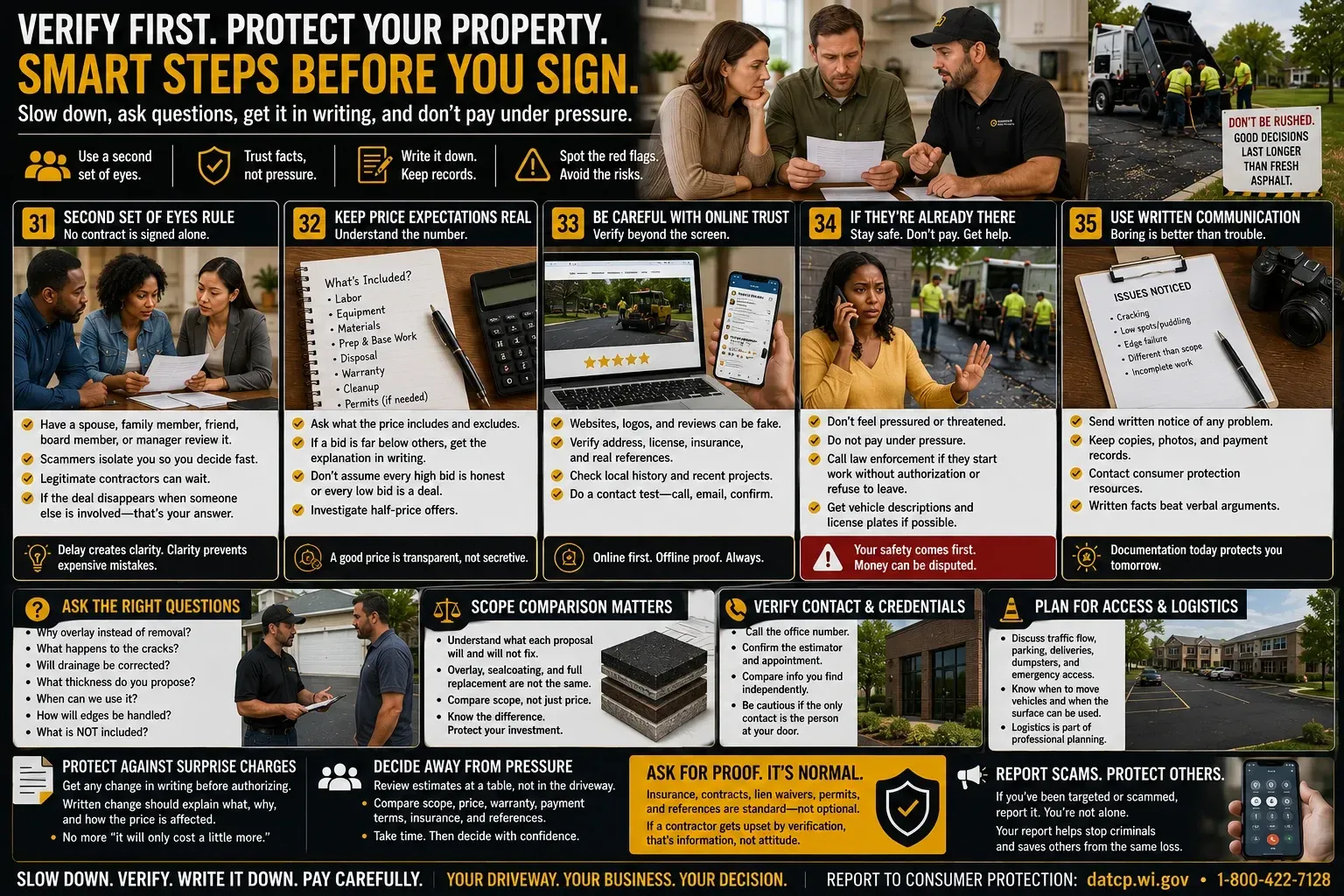
PCAA made this image for public use under the Creative Commons Attribution (CC BY) license.
Create a 'Second Set of Eyes' Rule Before Signing
Step thirty-one is to create a simple household or business rule: no contract is signed until it has been reviewed by at least one other person. For homeowners, this may be a spouse, adult child, neighbor, or trusted friend. For businesses, it may be the owner, property manager, maintenance supervisor, board, or accounting office. Scammers often isolate the decision-maker. They want one person, one moment, one payment. A review rule creates delay and accountability. If the offer is legitimate, the contractor can wait. If the offer collapses because another person is involved, the process just prevented a bad transaction. [BBB 2025]
Step thirty-two is to keep expectations realistic about price. Asphalt work costs money because labor, equipment, trucking, fuel, insurance, materials, prep, disposal, scheduling, and warranty responsibility all cost money. A customer should not assume every expensive estimate is honest or every affordable estimate is suspicious. Instead, ask what the price includes. The local CBS 58 warning about a half-price estimate matters because it encourages investigation, not panic. When a bid is far below others, the customer should require an explanation in writing. A contractor who cannot explain the number probably should not receive the job. [CBS58 2023]
Step thirty-three is to be careful with online-only trust. A website can look polished and still be temporary. A social media page can show photos borrowed from other jobs. A logo can be copied. A five-star review can be fake. Online research is valuable, but it should be connected to offline proof: local address, real references, current insurance, written contract, visible work history, applicable credentials, and consistent identity. Scammers use the internet too. Online polish is not a substitute for verifiable local presence. [BBB 2025]
Step thirty-four is to understand what to do if the crew is already on the property. Stay calm, avoid confrontation if you feel unsafe, do not pay under pressure, and contact local law enforcement if the crew refuses to leave, starts work without authorization, threatens, or intimidates. DATCP advises turning transient asphalt workers away and contacting local law enforcement, while sharing vehicle descriptions and license plates if possible. TMJ4's 2026 Franklin Police report emphasized that victims should report without shame. Safety comes first. Money can be disputed; personal safety cannot be patched later. [DATCP 2023] [TMJ4 2026]
Step thirty-five is to use written communication after any problem. If work is defective, incomplete, different from the scope, or abandoned, send a written notice describing the issue, keep copies, photograph conditions, preserve payment records, and contact consumer protection resources. DATCP's home improvement tips explain complaints, cancellation, Right to Cure, and potential remedies in broad terms. Customers should not rely on verbal arguments in the driveway. Written facts protect the customer's claim and create a record that the contractor cannot deny later. [DATCP HI]
The protection process can feel like too much when all someone wanted was a driveway. But a driveway or parking lot is expensive, permanent, and visible. It affects property value, safety, access, drainage, and maintenance. A few verification steps before hiring are far easier than trying to recover money from a contractor who was never real. Southeastern Wisconsin has enough documented warnings from DATCP, BBB, CBS 58, TMJ4, and local police to make the safest message clear. Slow down. Verify it. Write it down. Pay carefully. Report pressure tactics before the next person gets hit. [DATCP-2023] [CBS58-2026] [TMJ4-2026]
A safe verification process should also include a scope-comparison conversation with every bidder. Ask each contractor to explain what they believe caused the current pavement failure and what their proposal will and will not fix. If one contractor recommends full replacement and another recommends sealcoating, the customer should not treat those as competing versions of the same service. They may be completely different levels of repair. The safest decision comes from understanding the difference, not from choosing the lowest number on a page. [DATCP HI]
Customers should request that estimates use plain language whenever possible. If a contractor uses trade terms, ask for definitions. If a proposal mentions binder, surface, milling, tack, compacted depth, base correction, crack filling, or sealcoating, the customer should know what those terms mean for the finished property. This is not nitpicking. It is how a customer avoids paying for one service while imagining another. A reputable contractor should be able to translate the work into terms a property owner can understand without turning the conversation into a guessing game. [DATCP HI]
Verification should include a contact test. Call the office number. Send an email. Ask for confirmation of the estimator's name and appointment. Search the business independently and compare the information. If the only way to reach the contractor is through the person standing in front of you, the risk is higher. Legitimate local companies usually have stable communication channels. A scammer's contact information may work only long enough to collect payment. BBB warns that sham contact information may become obvious only after the transaction is complete, when the phone number, email, or website no longer responds. [BBB 2025]
For larger jobs, customers should ask how the contractor will handle traffic, access, and safety. A business may need customer parking, employee access, delivery routes, dumpster access, or emergency access. A homeowner may need to know when cars must be moved and when the surface can be used. These details belong to the planning conversation. A crew that cannot discuss logistics may not be planning a real project. Scammers want to reduce the job price and payment. Professional contractors know that access and timing are part of the work. [DATCP HI]
Customers should also protect themselves from oral changes. If the contractor says additional work is needed, ask for the change in writing before authorizing it. The written change should explain what changed, why it changed, and how the price is affected. DATCP's warnings about crews that begin work and then demand a much larger payment show why these matters. A clear change-order habit does not prevent every dispute, but it makes surprise charges much harder to justify. [DATCP 2023] [DATCP HI]
The verification process should end with a decision made away from pressure. Review the estimates at a table, not in the driveway while a stranger waits for a check. Compare scope, price, warranty, payment terms, insurance, local history, references, and communication. Discuss the decision with another person if possible. That simple pause changes the customer's position. The contractor is no longer controlling the pace. The customer is choosing based on information rather than pressure, which is the condition in which fraud fails. [BBB 2025]
A customer should never feel foolish for asking for proof. Proof is normal in construction. Insurance certificates, written contracts, payment records, lien waivers, permit information, and references are routine parts of serious property work. The person asking for them is not being difficult; they are acting like the project matters. A contractor who wants access to a driveway, lot, or business property should expect reasonable scrutiny. If a contractor treats verification as disrespect, the customer should treat that reaction as information. [DATCP HI] [DATCP LIENS]
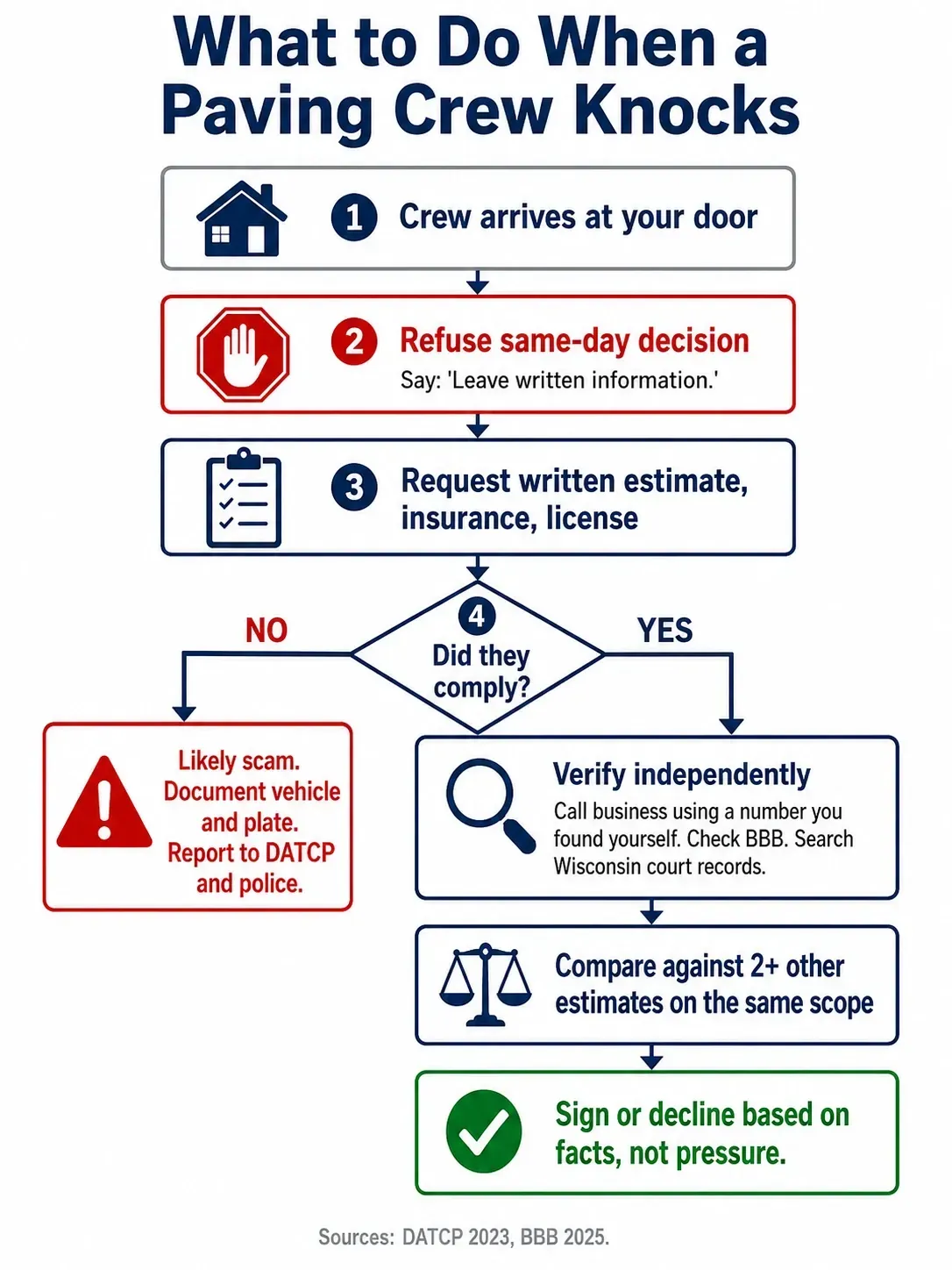
PCAA made this image for public use under the Creative Commons Attribution (CC BY) license.
The Simple Rule: Don't Buy Asphalt from a Stranger in a Hurry
The easiest public rule is this: do not buy asphalt from a stranger in a hurry. That does not mean every surprise offer is criminal, but it does mean the customer should slow the transaction down until it becomes verifiable. Ask for the company's legal name, physical address, proof of insurance, written estimate, references, applicable credentials, payment schedule, warranty, and time to review. Check the information independently. Talk to family or another property decision-maker. Compare at least two or three bids for major work. A real contractor will still exist tomorrow. A scammer may not. [BBB 2025] [DATCP 2023]
This pattern is predictable because it is built around human pressure. A customer wants to save money. The driveway looks bad. The crew looks available. The offer sounds temporary. The price sounds lucky. The customer does not want to miss the chance. That is exactly when prevention steps matter most. Fraud protection is not something to think about after the check clears. It is something to use before the first signature, before the first payment, and before a stranger unloads equipment onto your property. Southeastern Wisconsin has seen enough warnings to make one lesson clear: good asphalt can wait for a written estimate; bad asphalt demands an instant decision. [CBS58 2026] [TMJ4 2026]
In southeastern Wisconsin, the scam pitch often sounds believable because legitimate asphalt paving activity is visible everywhere during the season. Residents see municipal road projects, subdivision work, commercial lot repairs, driveway replacements, and sealcoating crews moving through neighborhoods. A dishonest crew can borrow that background activity to make a private offer sound connected to real work. The customer may see trucks, orange cones, or work clothes and assume the situation has already been vetted by someone else. That assumption is dangerous. A real nearby job does not automatically authorize a stranger to sell work on another property, and a claimed nearby job should always be verified before money changes hands. [DATCP 2023]
The scam also takes advantage of how difficult asphalt quality can be for a customer to judge on the spot. Most homeowners can see cracks, potholes, fading, sinking, or crumbling edges, but they may not know whether the right answer is maintenance, patching, overlay, or reconstruction. That knowledge gap is not a personal failure. It is why reputable contractors inspect, explain, and document recommendations. A scammer uses that uncertainty as leverage with a simple promise: fast work, low price, immediate improvement. Simplicity is the lure. Pavement problems are often caused by water, base failure, age, use, or poor prior work, and those causes need to be discussed before the surface is covered. [DATCP HI]
A public warning about asphalt fraud should therefore teach customers to listen to what is missing. Is the crew discussing drainage? Are they asking how heavy vehicles use the driveway or lot? Are they measuring the area? Are they explaining preparation? Are they willing to put thickness, materials, and limits in writing? Are they comfortable with the customers comparing bids? Missing details are not small details. They are the space where the scam lives. A crew that can talk only about a discount but not about the job is not offering a professional asphalt paving plan. It is offering a decision shortcut. [BBB 2025] [DATCP HI]
The phrase 'working in the area' should be treated as a claim to verify, not a reason to trust. A legitimate company can tell the customer where it is working, who authorized the job if the information can be shared, and how to schedule a real estimate. A scammer uses the phrase to create social proof without evidence. The customer does not need to argue. They can simply ask for written information and say the proposal will be reviewed later. If the offer depends on the customer not checking the story, that is itself a warning sign. [BBB 2025]
Southeastern Wisconsin homeowners should also remember that asphalt scams are not only about driveways. DATCP's 2023 alert referred to homes and businesses, and local reports have discussed sidewalks, parking lots, and general asphalt paving or sealing offers. That matters because a business owner, church office, senior community, landlord, or property manager may be approached differently than a homeowner. The crew may talk about customer safety, tenant complaints, parking-lot appearance, or a limited commercial discount. The tactic changes, but the structure stays the same: unsolicited approach, urgency, unclear identity, pressure to pay, and little written accountability. [DATCP 2023] [CBS58 2026]
Fraud prevention also requires customers to understand that a black surface is not proof of good work. Fresh asphalt or coating can create a dramatic visual change, especially on an old gray driveway. That visual improvement can make a customer feel relieved before the technical quality is known. Problems may show up later as raveling, cracking, potholes, soft spots, drainage failure, edge breakup, or rapid wear. CBS 58's 2023 report warned that subpar materials may not be obvious immediately. That delay is exactly why verification must happen before the job begins, not after the surface looks new. [CBS58 2023]
The public should be especially careful when a crew combines a friendly tone with a warning that the property is in immediate danger. There are real pavement hazards, and reputable contractors should be honest about them. But scammers may exaggerate risk to force action. They may say the driveway will collapse, water will destroy the garage, a sidewalk will cause a lawsuit, or the price will become impossible later. The customer should separate the condition of the pavement from the pressure of the pitch. A real concern can be inspected by more than one contractor. A fake emergency demands belief before verification. [DATCP 2023] [BBB 2025]
The bigger lesson here is that fraud is a process problem before it's a pavement problem. You lose protection when the process is rushed, undocumented, and paid upfront. You gain protection when it's written down, compared, verified, shared with someone else, and paid through records. That's why DATCP, BBB, CBS 58, TMJ4, police, and real contractors all keep returning to the same advice. The details vary. The core message doesn't: slow the transaction down until it becomes checkable. [DATCP-2023] [CBS58-2026] [TMJ4-2026]
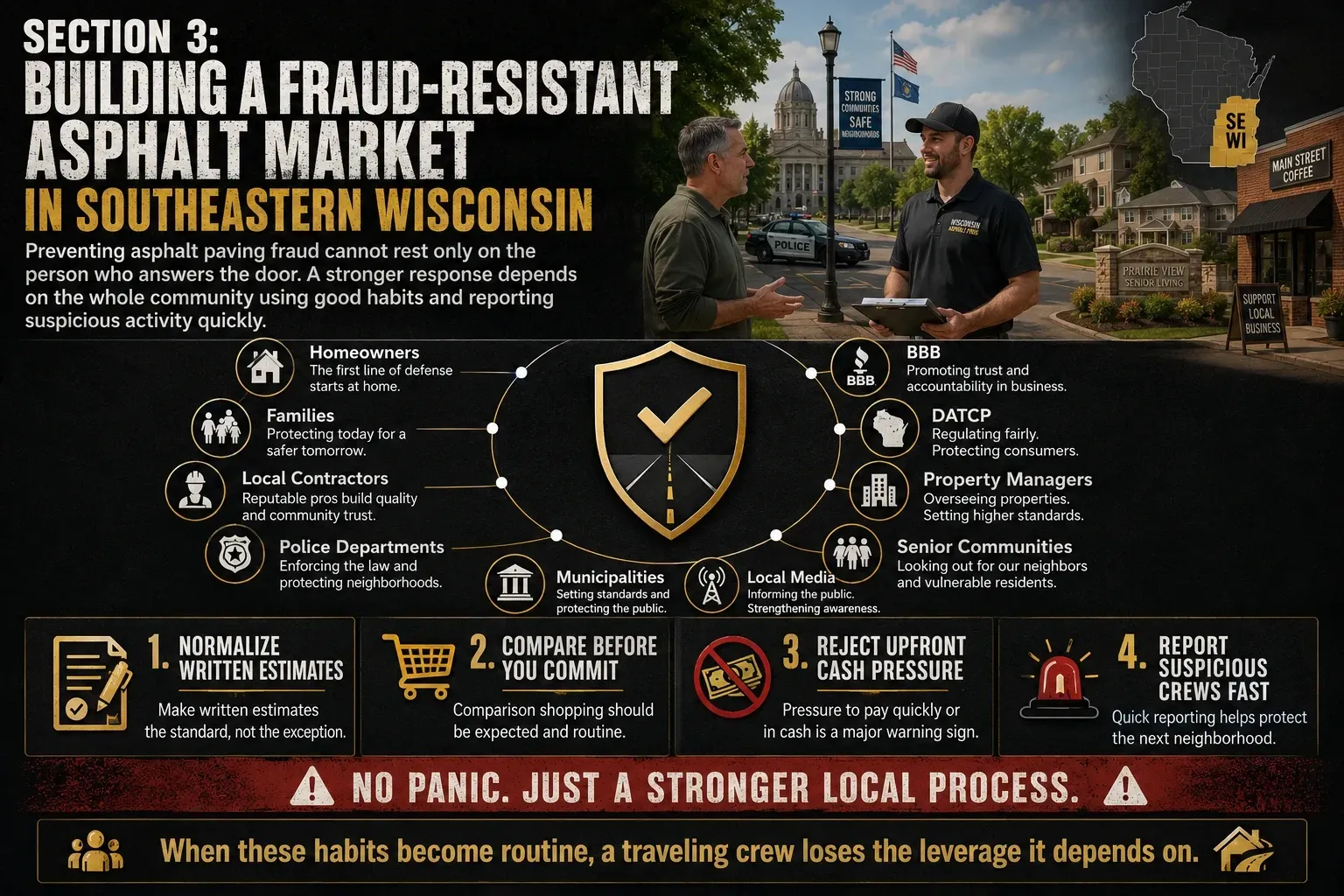
PCAA made this image for public use under the Creative Commons Attribution (CC BY) license.
Building a Fraud-Resistant Asphalt Market in Southeastern Wisconsin
Preventing asphalt paving fraud in southeastern Wisconsin cannot be left only to the person who happens to answer the door. The pattern is too mobile, too seasonal, and too dependent on pressure for that. A stronger response needs homeowners, families, local contractors, police departments, BBB, DATCP, property managers, senior communities, municipalities, and local media all doing their part. This does not require panic. It requires a local culture where written estimates are normal, comparison shopping is expected, upfront cash pressure is rejected, and suspicious crews are reported quickly. When those habits become routine, a traveling crew loses the leverage it depends on. [DATCP 2023] [TMJ4 2026]
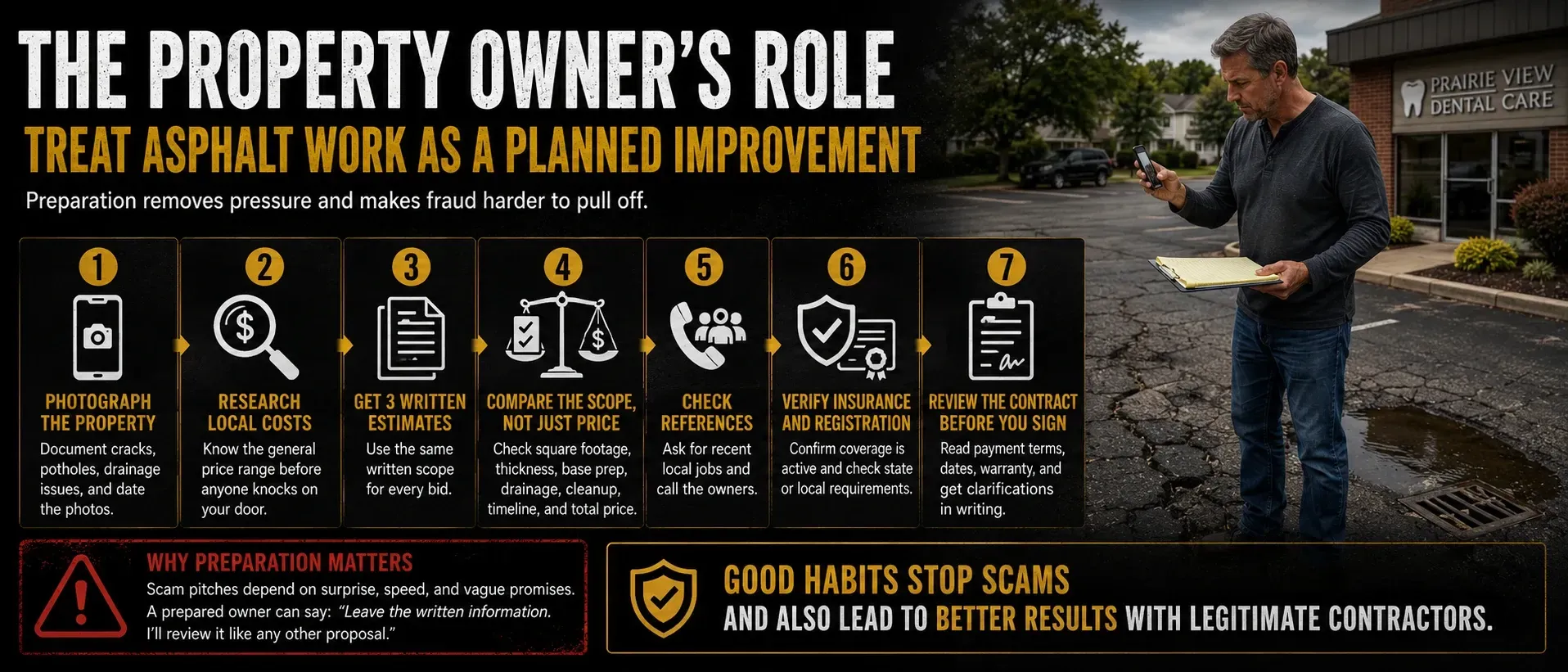
PCAA made this image for public use under the Creative Commons Attribution (CC BY) license.
Property Owners: Treat Asphalt Paving as a Planned Improvement
The first local responsibility belongs to property owners. A homeowner or business owner should treat asphalt work as a planned improvement, not a spontaneous purchase. That distinction matters more than it sounds. Scam pitches are engineered for the unprepared customer — the person who has not thought about their driveway recently, has no reference point for cost, and has no process ready when someone knocks. When a property owner has already done the groundwork, the pitch loses its leverage before the conversation even starts.
Preparation begins before any contractor makes contact. Walk the property and photograph what you see. Note cracks, potholes, drainage problems, and surface deterioration, and date the photos. This creates an honest baseline and prevents a contractor from exaggerating damage you cannot independently evaluate under pressure. A scammer's opening move is often to point out problems and manufacture urgency around them. Documented knowledge removes that opening.
Before anyone asks you to commit to a price, research what asphalt work costs in your area. Driveway paving prices vary by square footage, thickness, base preparation, and local material costs, but regional averages are publicly available and worth knowing in advance. When you already have a general sense of the range, a dramatically low bid raises a flag rather than excitement. It also means you are not making a financial decision on the spot with no frame of reference to work from.
No single estimate tells you much. Three estimates on the same written scope of work tell you a great deal. Require that every estimate be itemized and dated, and that the scope specify square footage, asphalt thickness, base preparation method, drainage considerations, cleanup responsibilities, timeline, and total price. When estimates are written and directly comparable, price differences become meaningful data. When they are verbal and vague, you have no reliable basis for comparison and no documentation if something goes wrong.
References deserve the same attention. Ask every contractor for contacts from jobs completed within the past twelve months, preferably in your county. Call those references and ask whether the work matched the written estimate, whether the crew arrived on schedule, whether unexpected charges appeared, and whether the property owner would hire the same contractor again. A legitimate contractor expects this question. A transient crew typically cannot provide verifiable local references because they do not stay in one area long enough to build them.
Insurance and licensing verification are not optional steps. Request a current certificate of general liability insurance and, where applicable, workers' compensation coverage, then verify the policy is active by contacting the insurer directly rather than relying on the document alone. A certificate can be outdated or fabricated. In Wisconsin, contractor registration status can be checked through the Department of Safety and Professional Services, and local permits may be required depending on the municipality. An uninsured crew working on your property creates liability exposure that does not disappear when the truck leaves.
Before signing anything, read the contract in full and confirm that the written terms match everything discussed verbally. Verify the payment schedule — a legitimate contractor will not require full payment before work begins. Note the start date, completion date, warranty terms, and what recourse exists if the work does not meet the agreed standard. If anything is vague, ask for clarification in writing before the contract is signed. If the contractor resists putting details in writing, that resistance is the answer you need.
When the customer already has a process, a door-to-door scam loses power. The pitch may still happen, but the answer becomes easy: leave written information, and it will be reviewed like any other proposal. No pressure, no same-day decision, no work begun before terms are agreed. This is not bureaucracy for its own sake. It is deliberate friction that slows the transaction down long enough for the customer to think clearly. Scam operations depend on speed. They need a decision before questions get asked, references get checked, or a second opinion gets sought. A prepared property owner removes that speed advantage entirely.
The same habits that stop a scam also produce better outcomes with legitimate contractors. Written estimates create accountability. Checked references and surface workmanship problems before money changes hands. Verified insurance protects against injury liability on your property. Reviewed contracts eliminate the ambiguity that leads to disputes over scope, price, or warranty after the job is complete. Preparation is not a defensive measure reserved for suspicious situations. It is simply how a significant property improvement should be handled every time. [DATCP HI]
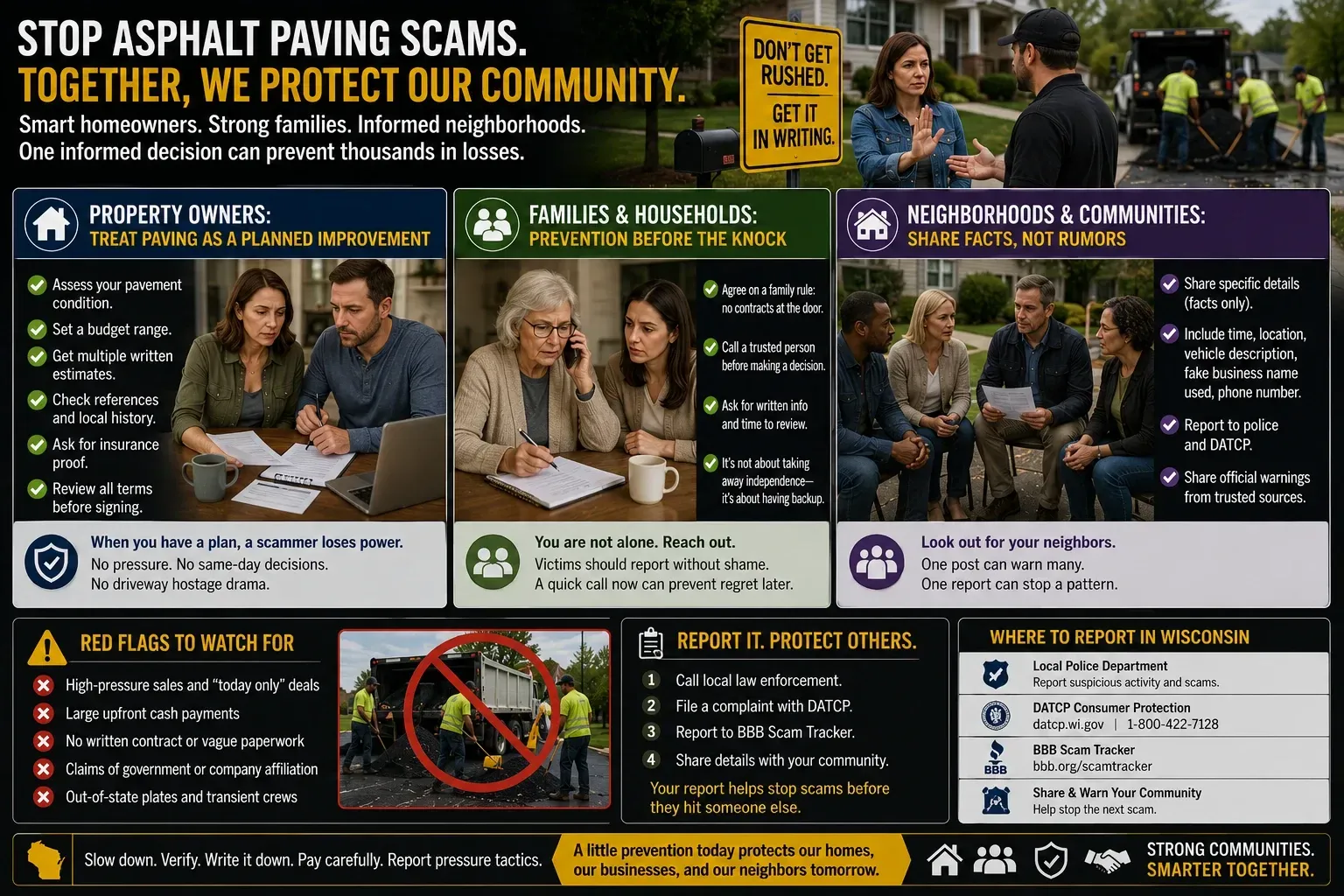
PCAA made this image for public use under the Creative Commons Attribution (CC BY) license.
Families and Neighborhoods: Prevention Before the Knock
Families can prevent fraud by creating a simple communication plan. Older parents, grandparents, widowed homeowners, and busy relatives should know that no asphalt paving, roofing, tree, chimney, gutter, driveway, or repair contract should be approved at the door without a call. This is not about taking away someone's independence. It is about creating backup in moments when a stranger is applying pressure. A brief family conversation held before anything happens is worth far more than a conversation held after money has already changed hands.
The plan does not need to be formal or complicated. It needs to exist. A family member designated as the first call when an unsolicited contractor appears gives the homeowner an immediate and socially acceptable reason to pause: "I need to check with my son before I agree to anything." That sentence alone ends most scam pitches because it introduces exactly the kind of delay that transient crews cannot afford. The pitch depends on a same-day decision. A phone call to a family member makes that impossible.
This matters most for residents who live alone, have recently lost a spouse, are managing health challenges, or are simply less familiar with current contractor scam patterns. These are not personal failings. There are circumstances that scammers identify and deliberately target. TMJ4's 2026 Franklin report made an important point through law enforcement: victims are not alone and should reach out. Families can make that easier by talking before anything happens, rather than waiting until after a problem surfaces. A proactive conversation removes the shame and isolation that scammers count on when targeting vulnerable residents.
It also helps to extend that conversation beyond immediate family. Property managers overseeing senior living communities, church administrators who work with older congregants, and neighborhood association leaders who communicate regularly with isolated residents all have an opportunity to reinforce the same message: no door-to-door contractor deserves a same-day decision, and a trusted contact is always a reasonable first step before any agreement is made.
Neighborhoods can strengthen that protection by sharing specific warnings without spreading rumors. If an unsolicited crew is going door to door, neighbors can post factual details: time, location, vehicle description, company name used, phone number on any flyer, and whether police or DATCP were contacted. The specificity matters. A post that says "suspicious paving truck in the area" is easy to dismiss. A post that says "dark gray dump truck, no company name on the door, knocked on three houses on Elm Street between 2 and 4 p.m. Tuesday, cash only, claimed leftover asphalt from a job nearby" gives neighbors something actionable to recognize and respond to.
Avoid accusations that cannot be supported. The goal is not to publicly identify individuals or assign guilt before any investigation has occurred. The goal is to share observable facts that help a neighbor recognize the same pitch before opening a checkbook. Public agency warnings and verified local news reports from DATCP, the BBB, CBS 58, TMJ4, and local police departments are all appropriate to share because they carry institutional verification that a personal post cannot. Sharing a DATCP consumer alert or a TMJ4 news segment alongside a personal observation adds credibility and removes the risk of the warning being dismissed as a neighbor's overreaction.
Neighborhood communication platforms, local Facebook groups, Nextdoor, and community association email lists all serve this function well when used with restraint and factual discipline. The information that travels fastest in a neighborhood is not always the most accurate. Slowing down to confirm details before posting, tagging the relevant agency warning when one exists, and encouraging neighbors to report directly to police and DATCP rather than simply commenting online all improve the quality of community-level protection. A scam crew that encounters an informed, communicating neighborhood loses the anonymity and speed that makes the model work. When residents compare notes quickly, the window for a transient crew to collect payment and disappear narrows significantly.
The goal is not to create alarm or to turn neighbors against legitimate contractors doing honest work in the area. The goal is to make sure that when the same pitch appears twice on the same block, the second homeowner already knows what it sounds like.

PCAA made this image for public use under the Creative Commons Attribution (CC BY) license.
Municipalities, Police, and Local Media
Municipalities can help by pushing clear seasonal reminders through websites, newsletters, social media, and community alerts. A short spring warning can explain the leftover asphalt pitch, remind residents not to pay in full upfront, encourage written estimates, and provide contact information for police, DATCP, BBB, and local building inspection offices. DATCP's 2023 warning specifically advised contacting local law enforcement and sharing vehicle and plate information if possible. Local governments are already trusted sources for road closures, trash pickup, and snow emergencies. They can also be trusted sources for preventing driveway scams. [DATCP 2023]
Police departments play a crucial role because these scams move fast. The Franklin Police Department's 2026 public warning, reported by TMJ4, showed how a local department can use creative communication to get attention before damage occurs. The department used Clover, its community resource dog, to increase engagement with public safety messaging. That may sound like a small detail, but attention is the bottleneck in public warnings. A warning nobody reads protects nobody. If a community resource dog helps residents notice a scam alert before asphalt paving season, that is effective public education. [TMJ4 2026]
Local media have already shown how valuable it can be. CBS 58's April 2026 report brought BBB's warning directly to Milwaukee-area homeowners. CBS 58's 2023 report connected police warnings, BBB expertise, and a legitimate local asphalt paving company in one story. TMJ4's 2026 report used a Franklin example to explain the springtime surge and what residents should do. These reports turn abstract fraud patterns into local memory. When a person later hears 'leftover asphalt from a nearby job,' they may remember the warning and step back. [CBS58 2026] [CBS58 2023] [TMJ4 2026]
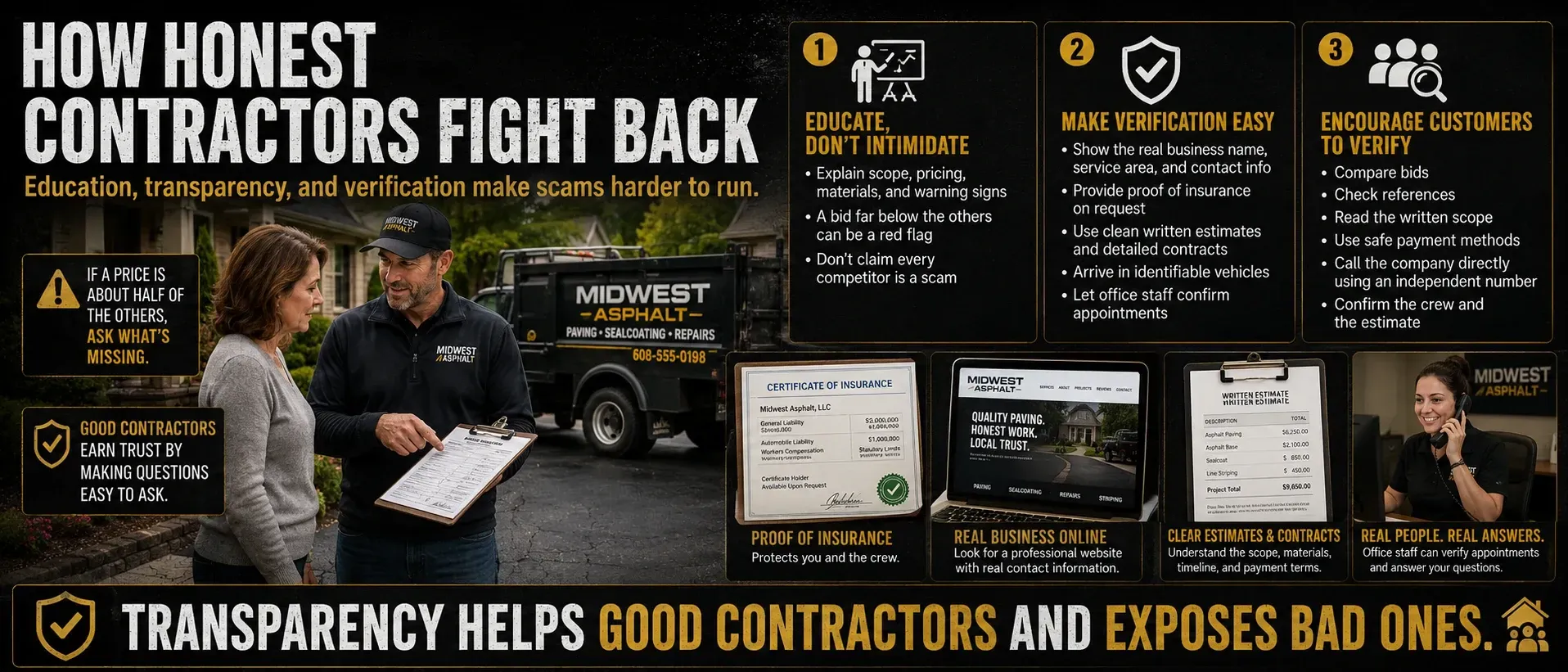
PCAA made this image for public use under the Creative Commons Attribution (CC BY) license.
How Honest Contractors Fight Back
Legitimate asphalt companies can stand up to fraud by educating the public, not just selling work. The CBS 58 2023 report included Purpose Contracting Asphalt as a local contractor, explaining why a price that is about half of other estimates can be a red flag. That type of participation matters because it gives homeowners a trade-level explanation of something they may otherwise feel only as suspicion. When local contractors explain scope, pricing, materials, and warning signs clearly, they make the market harder for scammers to manipulate. [CBS58 2023]
This kind of public education should be honest, not fear-based. A reputable contractor should not tell customers that every competitor is a scam. That is not education; that is marketing disguised as a warning. The better message is to compare bids, verify insurance, get everything in writing, understand the scope, check references, use safe payment methods, and ask questions. If the company is legitimate, those steps should help it earn trust. If the company is fraudulent, those steps should make the scam fall apart. [DATCP HI] [BBB 2025]
Contractors can also help by making their own documentation easy to verify. A public website should show the company's real name, service area, and contact information. Proof of insurance should be available on request. Add project examples, clear service descriptions, and educational content about when asphalt paving, overlay, patching, crack filling, or sealcoating makes sense. Contracts and estimates should be clean and specific. Crews should arrive in identifiable vehicles. Office staff should be able to confirm appointments. Customers should never have to wonder whether the person at the door is actually connected to the company whose name is being used. [BBB-2025]
This is especially important because scammers may impersonate real businesses or borrow the credibility of local names. A homeowner may hear a company name they recognize and let their guard down. The safest habit is to call the company directly using a phone number found independently, not the number handed over by the person at the door. Ask whether the crew is theirs, whether the offer is real, and whether a written estimate is on file. A real local company should appreciate that verification. It protects the customer and the company's reputation. [BBB 2025]
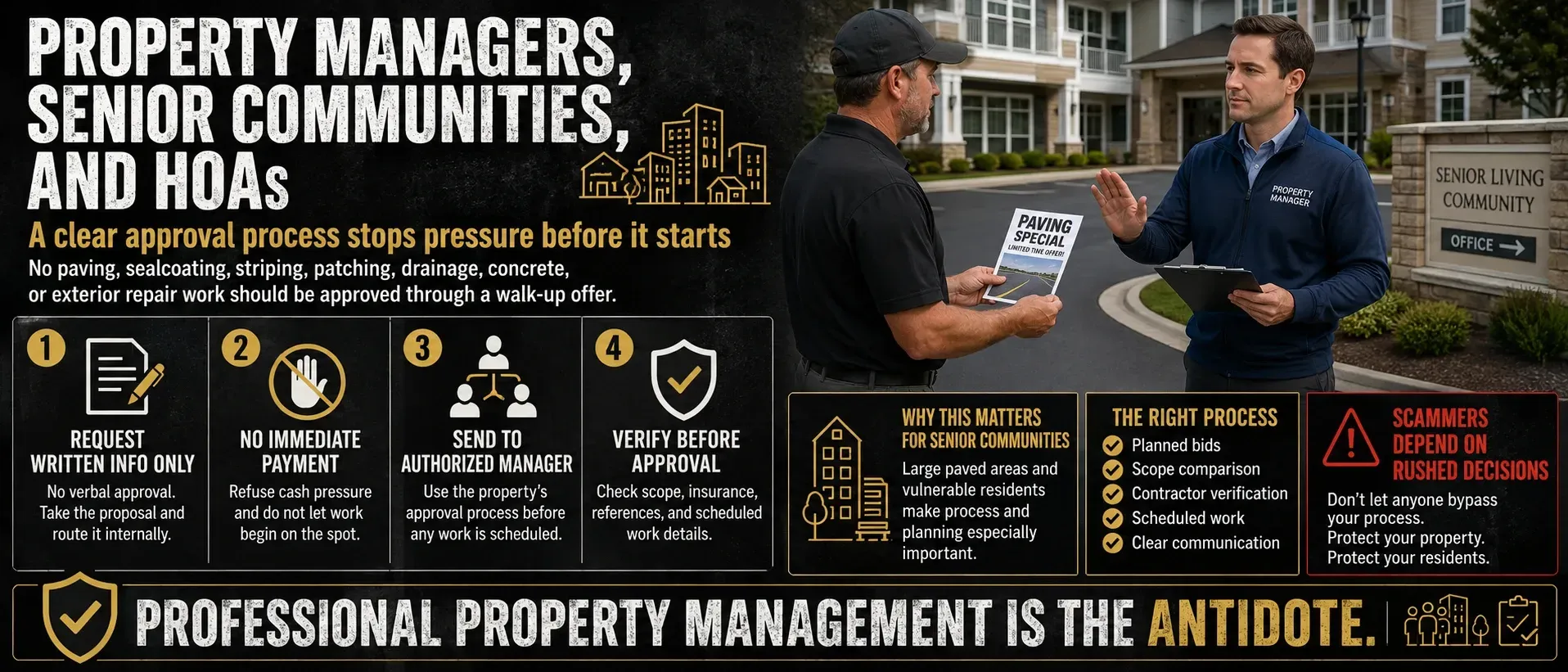
PCAA made this image for public use under the Creative Commons Attribution (CC BY) license.
Property Managers, Senior Communities, and HOAs
Property managers should create an internal no-solicitation procedure for asphalt paving work. Staff should know that no asphalt paving, sealcoating, striping, patching, drainage, concrete, or exterior repair work may be approved through a walk-up offer. The person receiving the pitch should request written information only, refuse immediate payment, avoid letting work begin, and send the proposal to the authorized manager. This protects apartment communities, senior living facilities, retail centers, industrial properties, churches, schools, and condominium associations. A property with a clear approval process is much harder to pressure. [DATCP 2023] [DATCP HI]
Senior communities deserve special attention. CBS 58's 2023 report showed a legitimate asphalt project at a senior home where management had done its homework by getting multiple offers. That example matters because senior housing communities often manage large, paved areas and serve residents who may be more vulnerable to door-to-door pressure. A responsible facility can model the right process: planned bids, scope comparison, contractor verification, scheduled work, and clear communication. Scammers depend on rushed decisions. Professional property management is the antidote. [CBS58 2023]
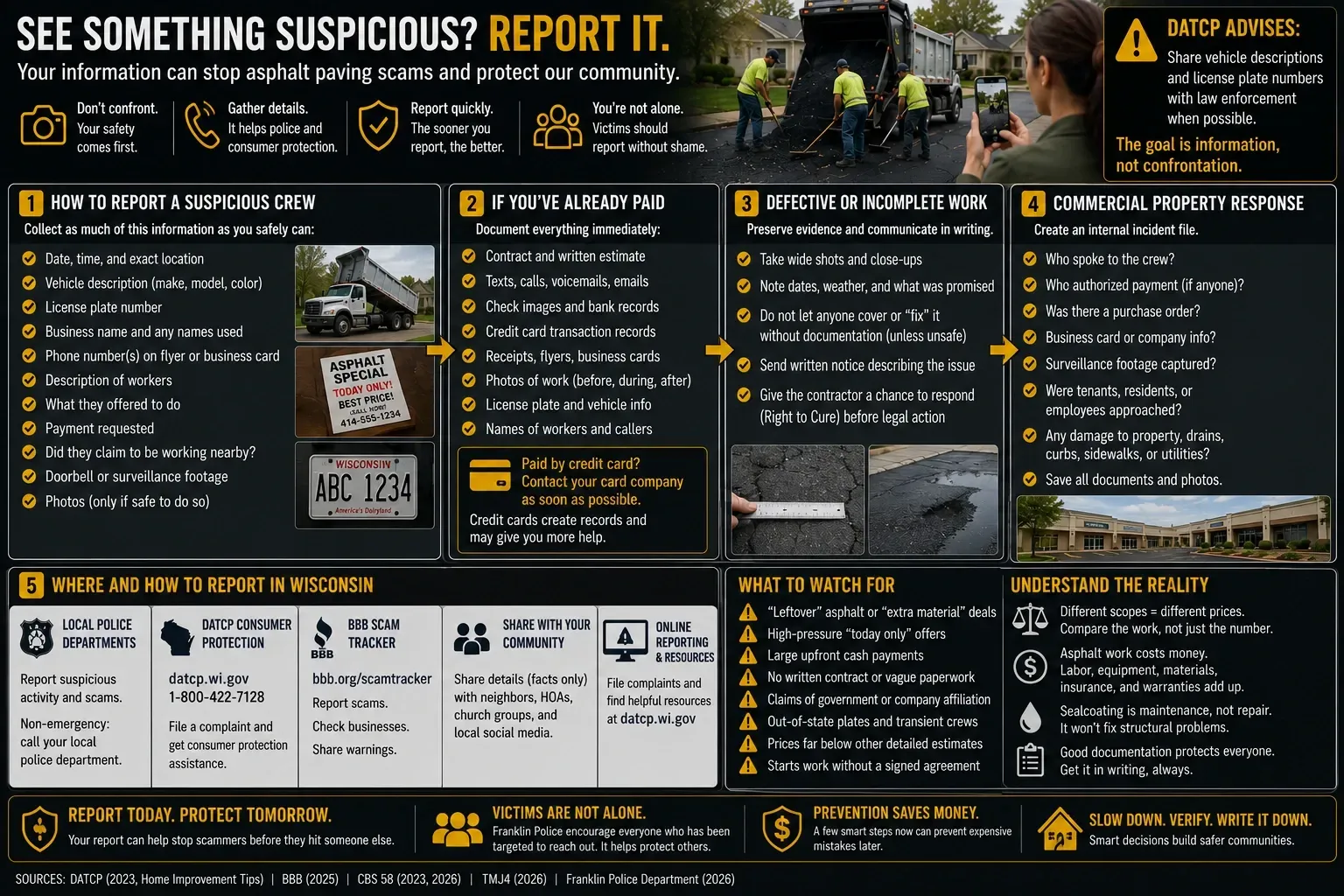
PCAA made this image for public use under the Creative Commons Attribution (CC BY) license.
How to Report a Suspicious Crew
When a suspicious crew appears, capture as many details as you can. Date, time, location, vehicle description, license plate, names used, business name, phone number, flyer or card. What they offered, what payment they requested, and whether they claimed to be working nearby. Doorbell camera footage may help. Photos should only be taken if safe. DATCP specifically advises sharing vehicle descriptions and plate numbers with law enforcement when possible. The goal is not confrontation. The goal is information. Let police and consumer protection agencies handle the investigation. The customer's job is to collect and report information accurately.
Write the details down immediately after the encounter, not hours later. Memory degrades quickly under stress, and the specific details that seem obvious in the moment — the color of the truck, the wording of the pitch, the name on the flyer — are exactly what investigators need and what fades first. A note on your phone, a voice memo recorded while walking back inside, or a quick email to yourself all work. The format does not matter. Getting the details down before they blur does.
If a flyer or business card was left behind, keep it. Do not discard it as junk mail. That document may contain a phone number, a business name, or a logo that connects this crew to reports from other neighborhoods or previous complaints already on file with DATCP or the BBB. Even a poorly printed flyer with a disconnected number is useful because it establishes a pattern. Investigators looking at multiple reports across multiple counties can connect crews through shared phone numbers, truck descriptions, or business name variations that no single complainant would recognize on their own.
Doorbell and security camera footage is increasingly valuable in these cases. If your system captured the crew's approach, the vehicle, the license plate, or the interaction at the door, preserve that footage before it overwrites. Most residential systems operate within days. Export or save the relevant clip as soon as possible and note the timestamp. If a neighbor's camera may have captured the vehicle on the street, let them know what you observed so they can check their own footage before it is also overwritten.
When you are ready to report, you have several channels available, and using more than one is appropriate. File a complaint with DATCP online at datcp.wi.gov or by phone. DATCP tracks consumer complaints statewide and uses them to identify patterns of transient contractor fraud across Wisconsin counties. File a separate report with your local police department even if no money was exchanged and no crime was committed. Franklin police told TMJ4 in 2026 that they receive reports of this scam every spring, and those reports matter even when no arrest follows immediately. A report on file establishes that the crew was present in your area on a specific date, which supports future investigations if the same crew reappears.
File a BBB Scam Tracker report at bbb.org/scamtracker. Scam Tracker reports are publicly visible, which means your report can warn the next homeowner who searches the company name or phone number before agreeing to anything. This is one of the most direct ways a single report generates community-wide protection. A property owner in Waukesha County who files a detailed Scam Tracker report may prevent the same pitch from succeeding in Racine County two days later.
If the crew used high-pressure tactics, demanded cash, began work without a signed contract, collected payment and did not return, or left behind visibly substandard work, those facts belong in every report you file. The more specific the complaint, the more useful it is. Vague reports are difficult to act on. Specific reports with dates, amounts, vehicle descriptions, and direct quotes from the pitch give investigators something to work with.
One practical note on confrontation: do not attempt to detain, follow, or physically block a suspicious crew. Do not argue about whether their materials are legitimate or their price is fair. The conversation at the door should end simply — no thank you, no contract will be signed today — and then the door should close. Everything after that is a matter for the agencies equipped to investigate it. Your safety and the accuracy of your report matter far more than winning an argument with a crew that is already prepared for pushback.
Reporting also matters when you successfully avoid the scam. DATCP's 2023 consumer alert noted that numerous reports had been received from residents who recognized the pitch and walked away. Those reports still contributed to the public warning that followed. You do not need to have lost money for your report to have value. Every documented encounter helps authorities understand where these crews are operating, how frequently they return, and what tactics they are currently using.
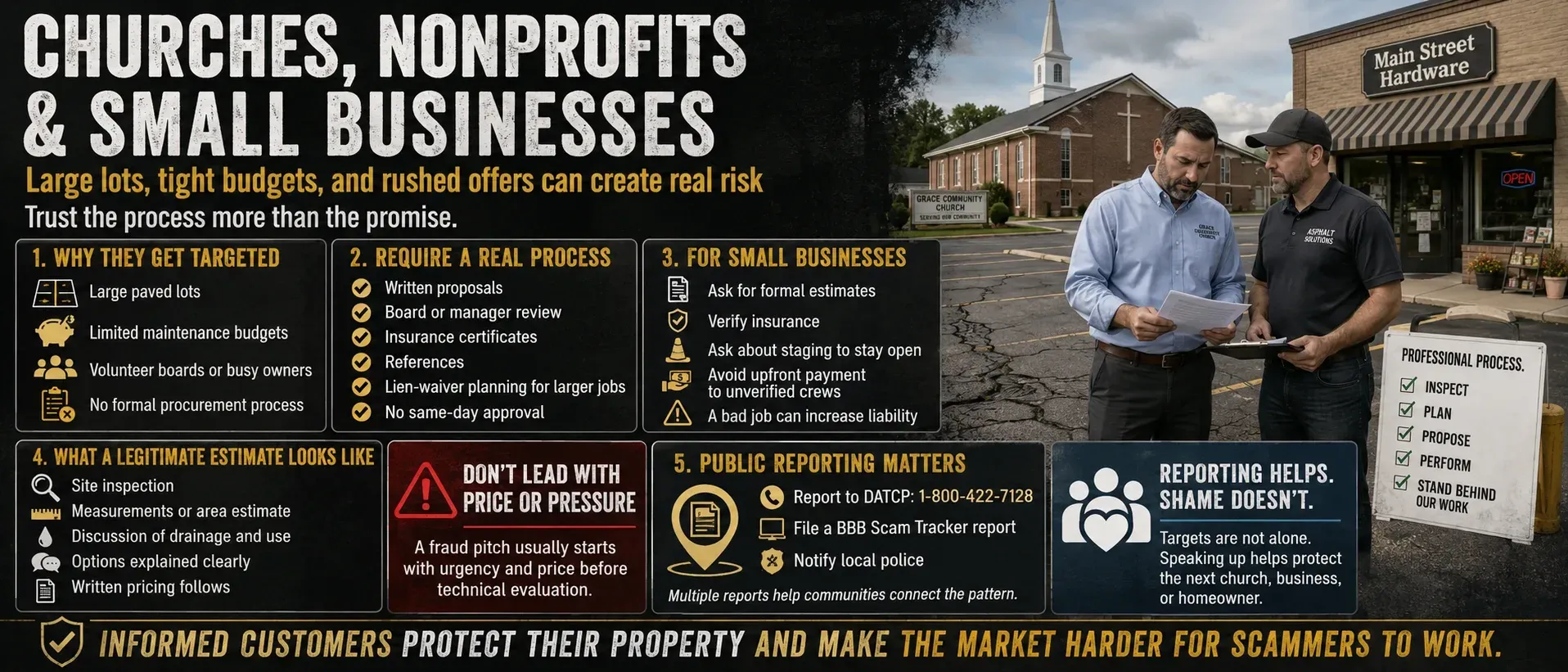
PCAA made this image for public use under the Creative Commons Attribution (CC BY) license.
Churches, Nonprofits, and Small Businesses
Churches and nonprofits can also be targets because they often have large lots, limited maintenance budgets, and volunteer boards. Montgomery County, Maryland police have publicly warned about traveling crews specifically targeting churches and senior housing facilities with discounted leftover-asphalt offers, recognizing that volunteer-led organizations may not have a formal procurement process to fall back on. The pitch sounds like stewardship: a cheap fix that saves the congregation money. The reality is often a thin coating over failing pavement that needs full replacement within a year. The organization should require written proposals, board review, insurance certificates, references, and lien-waiver planning for larger projects. Saving money is important, but a bad lot can cost far more in repairs, liability, and disruption. A church parking lot should not be repaired by a contractor whose only selling point is urgency. [MD NEWS] [DATCP HI] [BBB 2025]
Small businesses face similar pressure. A business owner may see cracked pavement as a customer-experience problem but delay repairs because money is tight. That makes a discounted same-day offer tempting. The owner should remember that pavement failure can affect customers, delivery drivers, employees, snow removal, and insurance claims. A bad job may create more liability than the original cracks. Businesses should request formal estimates, ask about staging to keep operations open, verify insurance, and avoid paying upfront to a crew with no verified local presence. [DATCP 2023] [DATCP HI]
Homeowners should also understand what a legitimate estimate appointment often looks like. The contractor inspects the site, measures or estimates the area, discusses the condition, asks about drainage and use, explains options, and follows up with written pricing. The contractor may not be able to solve every problem cheaply. That is not a scam; that is honest construction explaining real limits. A fraud pitch, by contrast, usually starts with the price and the pressure before the technical evaluation. Customers should trust the process more than the promise. [DATCP HI]
Public reporting matters more than most homeowners realize, because traveling crews depend on information not crossing jurisdictions. Consumer-protection prosecutors have repeatedly noted that these schemes succeed when complaints stay siloed. A complaint filed only with a city police department may never reach the state attorney general or the next county where the crew is heading. When homeowners report to DATCP at 1-800-422-7128, file with the BBB Scam Tracker, AND notify local police, the same incident enters three different databases that talk to one another and to neighboring states. Public education on a contractor's website can do the same work: a page explaining how to spot a pitch, how to compare estimates, and how to report becomes a service the community uses regardless of who they eventually hire. Legitimate companies do not benefit from customer confusion; they benefit from informed customers. [DATCP-HI] [CBS58-2026]
The report should also avoid shaming victims. Shame is useful to scammers because embarrassed victims stay quiet. Franklin Police explicitly encouraged people who were targeted to reach out, stressing that victims are not alone. That message matters. Many smart, capable people have fallen for home improvement scams because the tactics are designed to create urgency, trust, and fear. Reporting is not an admission of foolishness. It is how communities learn where the crew went, what name they used, and who may be next. [TMJ4 2026]
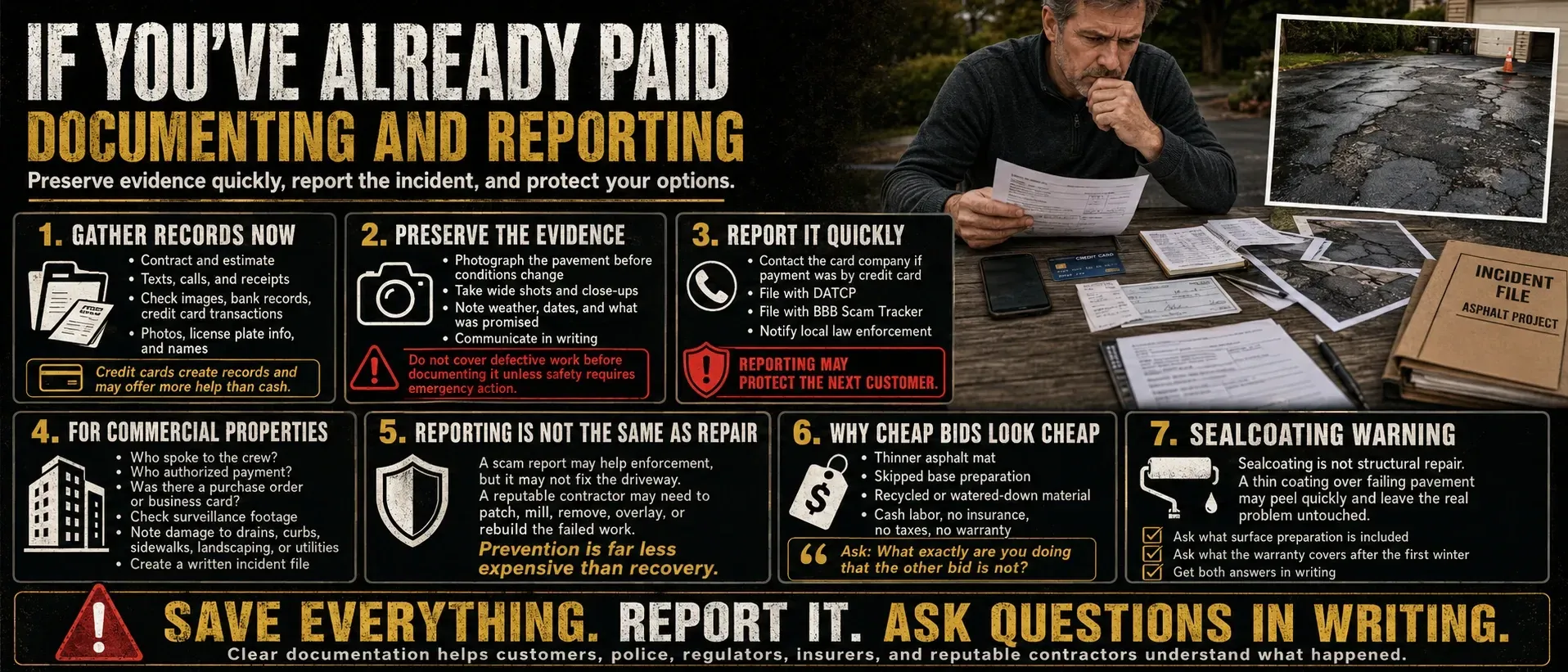
PCAA made this image for public use under the Creative Commons Attribution (CC BY) license.
If You've Already Paid: Documenting and Reporting
If money has already changed hands, the customer should gather records immediately: contract, estimate, texts, calls, check images, bank records, credit card transactions, receipts, photos, license plate information, and names. If payment was by credit card, contact the card company quickly. CBS 58 and TMJ4 both reported BBB advice favoring credit cards over cash when possible because they create records and may give consumers more help. Customers should also consider filing complaints with the BBB and DATCP and contacting local law enforcement. [CBS58 2026] [TMJ4 2026]
If defective work was performed, the customer should photograph the pavement before conditions change. Capture wide shots and close-ups. Note the weather, dates, and what was promised. Do not let another contractor immediately cover everything without documentation, unless safety requires emergency action. DATCP's Right to Cure discussion explains that consumers with poor quality work or materials must provide written notice before legal action, giving contractors and suppliers a chance to respond. A customer dealing with suspected fraud may need advice, but the basic rule remains: preserve evidence and communicate in writing. [DATCP HI]
For commercial properties, the post-incident response should also include internal documentation. Who spoke to the crew? Who authorized payment, if anyone? Was there a purchase order? Did staff receive a business card? Was any surveillance footage captured? Were tenants, residents, or employees approached? Was there damage to adjacent property, storm drains, landscaping, curbs, sidewalks, or utilities? Fraud can create operational consequences beyond the initial payment. A written incident file helps management, insurance, legal counsel, police, and future contractors understand what happened. [DATCP 2023]
Communities should also understand the difference between enforcement and repair. Reporting a scam may help protect others, but it may not immediately fix the driveway. A reputable local contractor may need to evaluate whether the bad work can be patched, milled, removed, overlaid, or rebuilt. Sometimes, the cheapest fraud repair is not cheap because the original damage has to be corrected first. Saving money on the initial scam can result in paying twice: once for the fraudulent work and again for the legitimate replacement. Prevention is far less expensive than recovery. [BBB 2025] [DATCP HI]
A fraud-resistant market also depends on honest pricing education. The U.S. The EPA Office of Inspector General has published fraud alerts on the math behind a cheap asphalt paving bid. The savings come from thinner mats than specified, recycled or watered-down material, skipped base preparation, and crews paid in cash — without the overhead of insurance, taxes, or warranty obligations. A driveway that needs full removal, base correction, grading, and new asphalt cannot fairly be compared to a surface-only treatment, but customers rarely see the difference until the first winter. The right question is not 'Why are you expensive?' The right question is: 'What exactly are you doing that the other bid is not? And what happens to my driveway in February if you leave it out?' [EPA-OIG] [CBS58-2023]
Local contractors can include comparison language in estimates to help customers. For example, an estimate can clarify whether it is for remove-and-replace, overlay, patching, sealcoating, or crack filling. It can state compacted thickness, preparation, exclusions, and warranty terms. This helps the customer compare bids honestly and reduces confusion. Scammers profit from vague categories. Professionals should want the customer to understand exactly what is being purchased. A clear estimate is not just a sales tool. It is fraud prevention with a company letterhead. [DATCP HI]
Sealcoating scams deserve their own warning. Iowa's Attorney General has prosecuted traveling crews that sold sealcoating as a structural repair. They applied a thin, water-based product over cracked, failing pavement and collected payment before the customer could see that the coating would peel within a season. The Iowa AG's office documented cases where the same crew operated under multiple company names across different counties to stay ahead of complaints. In Wisconsin, DATCP's home improvement guidance explicitly warns that coatings applied over moisture, weeds, or structural damage do not bond and do not protect. Customers should ask any sealcoating contractor: what surface preparation does the estimate include, and what does the warranty cover once the first Wisconsin winter tests it? If the contractor cannot answer those two questions in writing, that is the answer. [IA-AG] [DATCP-HI] [BBB-2025]
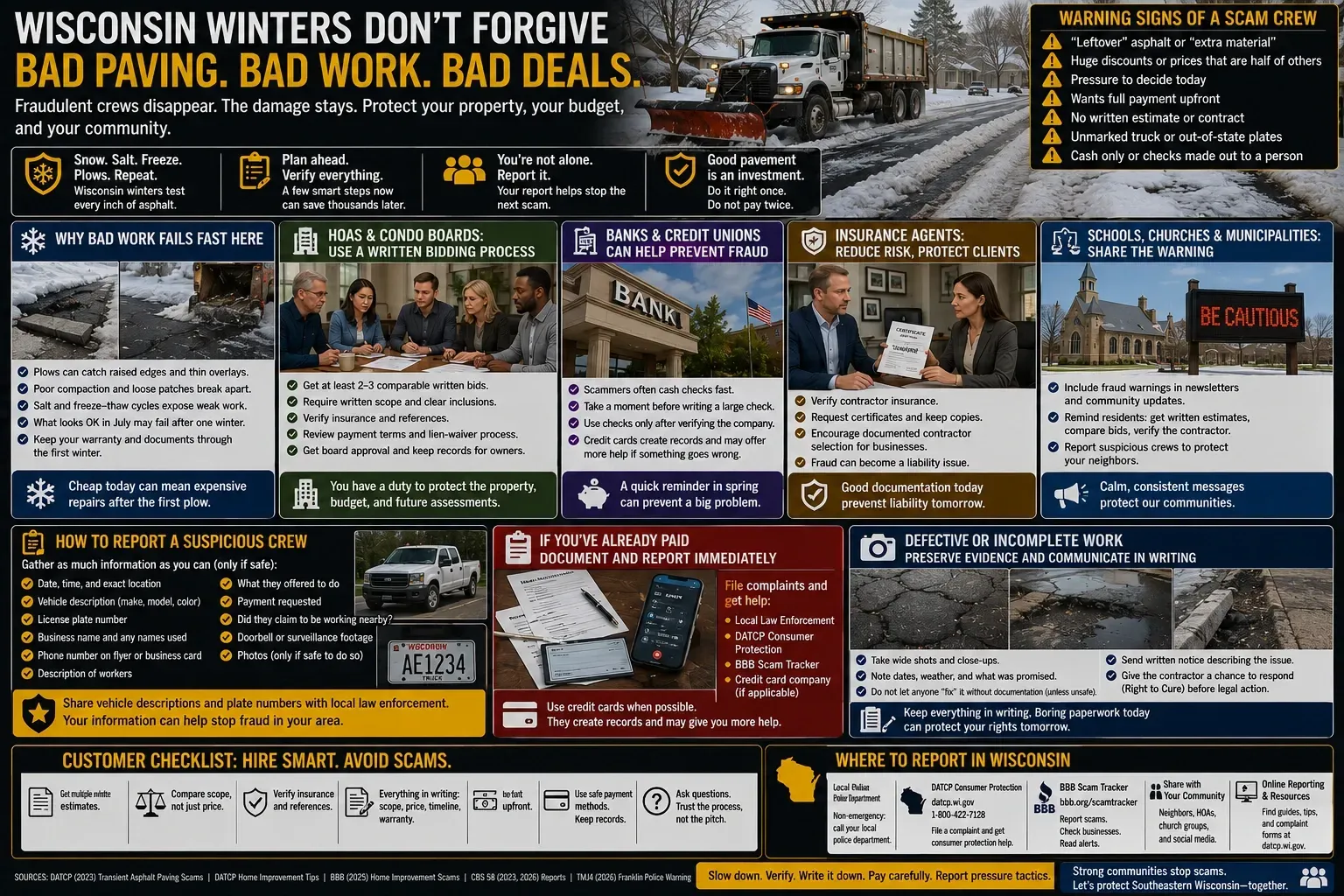
PCAA made this image for public use under the Creative Commons Attribution (CC BY) license.
Wisconsin Winters: Why Bad Work Fails Fast Here
Wisconsin winters are why bad asphalt paving fails fast here. Freeze-thaw cycles, road salt, snowplows, and standing water all test a driveway in ways a homeowner cannot see in July. A surface that looked acceptable when the crew left in summer can crack, ravel, or sink by the following spring. Customers who understand the local climate ask different questions, and contractors who understand the local climate write different estimates.
Snow removal is another southeastern Wisconsin factor. Plows can catch raised edges, thin overlays, loose patches, and poorly compacted material. Salt and freeze-thaw cycles can expose weak work. A driveway that looked acceptable in July may show problems after one winter. Customers should ask contractors how the proposed repair will handle normal local winter use. They should also keep documentation and warranty information through the first winter. Fraudulent crews may be long gone before the first plow arrives, leaving the customer to discover that 'cheap' was just another word for temporary. [CBS58 2023] [DATCP HI]
Homeowner associations and condo boards should adopt written bidding rules for pavement work. The rules might require at least two or three comparable bids, a written scope, a certificate of insurance, references, a review of payment terms, a lien-waiver process, and board approval. The board should keep records for owners. This helps prevent both fraud and internal confusion. When residents ask why the association did not hire the cheapest crew that appeared with leftover material, the answer is simple: because the association has a duty to protect the property, the budget, and everyone's future assessments. [DATCP HI]
Local banks and credit unions are underused fraud-prevention partners. The Federal Trade Commission's 2024 consumer fraud data confirms that wire transfers and checks — not just credit cards — are among the top payment methods exploited in home improvement scams, because they are difficult or impossible to reverse. AARP's Fraud Watch Network specifically trains financial institution staff to recognize and interrupt elder-targeted payment coercion, including the "my contractor needs cash today" scenario. DATCP's home improvement guidance warns that transient workers often know the quickest route to local banks to cash checks — sometimes within minutes of receiving them. A short fraud-prevention insert in spring statements or branch signage costs a bank nothing and may stop a $4,000 loss before it happens. [FTC 2024] [AARP FW] [DATCP HI]
Insurance agents can help, too. While insurance may not cover a voluntary bad hire in many situations, agents often have trusted local networks and understand property risk. They can remind clients to verify contractor insurance, request certificates, and avoid cash deals. For commercial clients, agents may encourage documented contractor selection processes. This is especially useful for businesses with parking lots, loading areas, and customer access routes. Asphalt fraud is not only a consumer issue. It can become a premises liability and property management issue. [DATCP HI]
Schools, churches, and municipal offices have stopped active scams simply by putting a fraud warning on a bulletin board before asphalt paving season. In Montgomery County, Maryland, the Office of Consumer Protection issued a public driveway-paving scam alert in April 2024, advising residents to verify contractors and avoid cash-up-front demands. The warning does not need to be dramatic or technical. It can say: be cautious of door-to-door asphalt paving offers, leftover-materials claims, large discounts, upfront cash requests, and pressure to decide today. That message, repeated calmly before each season starts, can protect someone who might otherwise face the decision alone and in a hurry. [MD-NEWS] [DATCP-2023] [TMJ4-2026]
A contractor's website can also include a customer checklist without making the page feel like a checklist. The content can explain how to compare estimates, how to read a scope, why insurance matters, why lien waivers matter, why full upfront payment is risky, and why local references matter. The source labels should be transparent so readers can verify the information themselves. This builds trust because the company is not asking readers to believe only its own claims. It is pointing readers to DATCP, BBB, local police reporting, and news coverage. Trust that can survive verification is the only kind worth having. [DATCP HI] [BBB 2025]
Reporting attempted scams — not just completed ones — is what builds a cross-state enforcement picture. The Washington Attorney General's office has noted that pattern documentation from attempted scam reports is often the evidence that justifies a multi-state investigation. DATCP's 2023 alert explicitly asked Wisconsin consumers who encountered a suspicious transient asphalt crew to contact DATCP Consumer Protection at 1-800-422-7128 or datcp.wi.gov — and emphasized that a report is useful even if no payment was made. A crew that gets turned away from one home may knock at the next. The report you file today may be the data point that stops them. [WA-AG] [DATCP-2023]
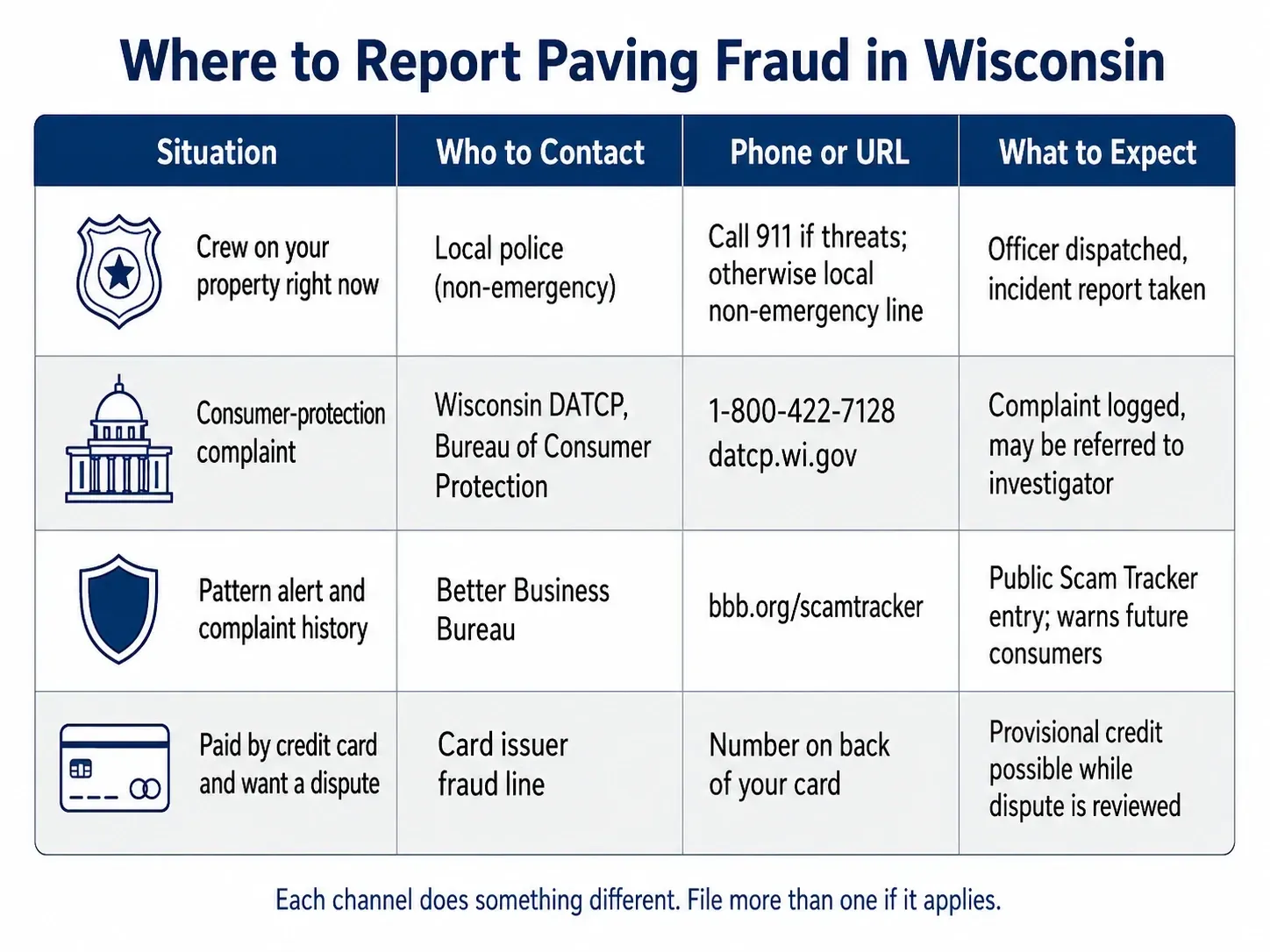
PCAA made this image for public use under the Creative Commons Attribution (CC BY) license.
Which Agency Handles What: DATCP, BBB, Police, and Card Issuers
Customers should understand where to report. For immediate safety, threats, trespassing, or crews beginning unauthorized work, call local law enforcement. For consumer complaints or suspected home improvement fraud, DATCP's Bureau of Consumer Protection is a statewide resource. BBB accepts complaints and Scam Tracker reports. Credit card companies may assist with payment disputes if a card was used. Municipal offices may need to know if work involves permits or right-of-way issues. Each channel does something different. The customer should not assume one report automatically reaches everyone. [DATCP 2023] [BBB 2025]
Local examples show that public response can work. DATCP's 2023 alert put Waukesha County and southeastern Wisconsin residents on notice. CBS 58's 2026 segment amplified BBB's warning to Milwaukee-area homeowners. TMJ4's Franklin story showed police and BBB working to warn residents before spring scams spread. CBS 58's 2023 story featured local law enforcement, BBB insight, and Purpose Contracting Asphalt speaking directly about price red flags. These are examples of institutions and legitimate local voices standing up to a scam pattern that depends on silence. [DATCP 2023] [CBS58 2026] [TMJ4 2026] [CBS58 2023]
The best public-facing conclusion is not "hire us or else." The better conclusion is: choose a contractor you can verify. Get the scope in writing. Compare estimates. Verify insurance. Ask about applicable credentials and permits. Check local history. Understand payment terms. Request lien waivers when appropriate. Never let urgency replace judgment. [DATCP HI]
A customer who follows this process may still have to make a difficult decision. Asphalt work can be expensive, and there may be more than one reasonable solution. One contractor may recommend full replacement; another may recommend phased repairs; another may recommend maintenance until a future replacement. The goal is not to eliminate judgment. The goal is to make judgment possible. Fraud steals that by forcing an immediate yes. A transparent process gives the customer room to choose based on facts, budget, and long-term needs. [DATCP HI]
For southeastern Wisconsin, the practical rule fits in one paragraph. Don't agree to asphalt paving, sealcoating, or driveway repair from an unsolicited crew without written details, verified identity, proof of insurance, time to compare bids, and a safe payment plan. Be extra cautious of leftover-materials claims, today-only discounts, high-pressure sales, large upfront payments, and contractors who avoid questions. If a crew refuses to leave, starts without authorization, threatens, or pressures a vulnerable person, contact local law enforcement. If money is lost or work is incomplete, document everything and report it to DATCP, BBB, and payment providers where applicable. [DATCP-2023] [BBB-2025] [TMJ4-2026]
Good pavement is built in layers, and so is fraud prevention. The first layer is public awareness. The second is written estimates. The third is contractor verification. The fourth is careful payment. The fifth is documentation. The sixth is reporting. When all layers are present, scams have a harder time taking root. When all layers are skipped, even a smart customer can be rushed into a bad decision. Southeastern Wisconsin does not need to fear every asphalt truck. It needs to recognize the difference between a planned local asphalt paving project and a traveling sales pitch that wants cash before questions. [DATCP HI] [CBS58 2026]
A driveway should never become a lesson in fraud prevention after the fact. It should be a planned improvement handled by a contractor who can be identified, checked, insured, compared, and reached after the work is done. The warnings from DATCP, BBB, CBS 58, TMJ4, Franklin Police, and local contractors all point in the same direction: slow the decision down. A legitimate asphalt company will still be there after the customer reads the estimate. A scam crew needs the customer to act before the facts catch up. That is the difference homeowners and businesses must remember before the next knock at the door. [DATCP 2023] [BBB 2025] [CBS58 2026] [TMJ4 2026]
A local property owner should also be careful with the phrase 'repair.' In normal conversation, repair can mean almost anything that makes a surface look better. In asphalt work, repair might mean crack filling, patching, milling, overlay, base correction, remove-and-replace, drainage work, or sealcoating. A customer should not accept the word alone. Ask the contractor to name the method, the limits of the method, and the expected life of the method. This protects the customer from paying asphalt paving money for a temporary surface change that was never capable of solving the underlying problem. [DATCP HI]
The same principle applies to businesses comparing bids for parking lots. One proposal may include traffic control, striping coordination, dumpster-pad work, drainage corrections, concrete curb work, or phased access. Another may only include a quick surface layer. The cheaper number may look attractive until the customer realizes important pieces are missing. Before choosing, ask every bidder to explain what is included, what is excluded, and what conditions could change the price. Fraud hides inside vague assumptions. Clarity pulls those assumptions into daylight, where customers can actually judge them. [DATCP HI]
A strong local prevention message should reach renters and tenants too. Tenants may not hire asphalt paving contractors, but they may see suspicious crews at apartment complexes, senior communities, mobile home communities, storage facilities, or small commercial properties. If a crew appears to be pressuring residents, blocking access, or claiming authority that seems questionable, tenants can notify property management or local police. They should not confront workers unless safety requires immediate action. Fraud prevention improves when more eyes recognize the pattern and pass information to the right people. [TMJ4 2026]
The reporting process should not wait for perfect proof. If a crew uses a suspicious pitch but leaves when refused, the resident may still report the attempt to local police non-emergency lines or community alert systems if appropriate. Agencies can decide how to use the information. A partial vehicle description or business name may connect with another report across town. DATCP noted that transient crews can move quickly from town to town, so small pieces of information may matter more than one resident realizes. [DATCP 2023]
Customers should be cautious when a contractor discourages outside advice. A fraudster may say family members will only confuse the issue, competitors will lie, or the price will vanish if the customer calls someone. That is not professionalism. It is isolation. A legitimate contractor may explain why their recommendation differs from another estimate, but they should not need to keep the customer away from other opinions. A serious property improvement can survive a second phone call. A scam often cannot survive a second opinion. [BBB 2025]
The best public message also respects good contractors. Honest asphalt businesses have to manage weather, equipment, material supply, labor, traffic, and customer expectations. They may require deposits, schedule changes, or contract terms for legitimate reasons. Fraud prevention should not train customers to distrust every professional practice. It should train customers to ask whether the practice is documented, reasonable, and connected to a verifiable business. The difference between a professional payment term and a scam demand is usually transparency, proportion, and accountability. [DATCP HI] [BBB 2025]
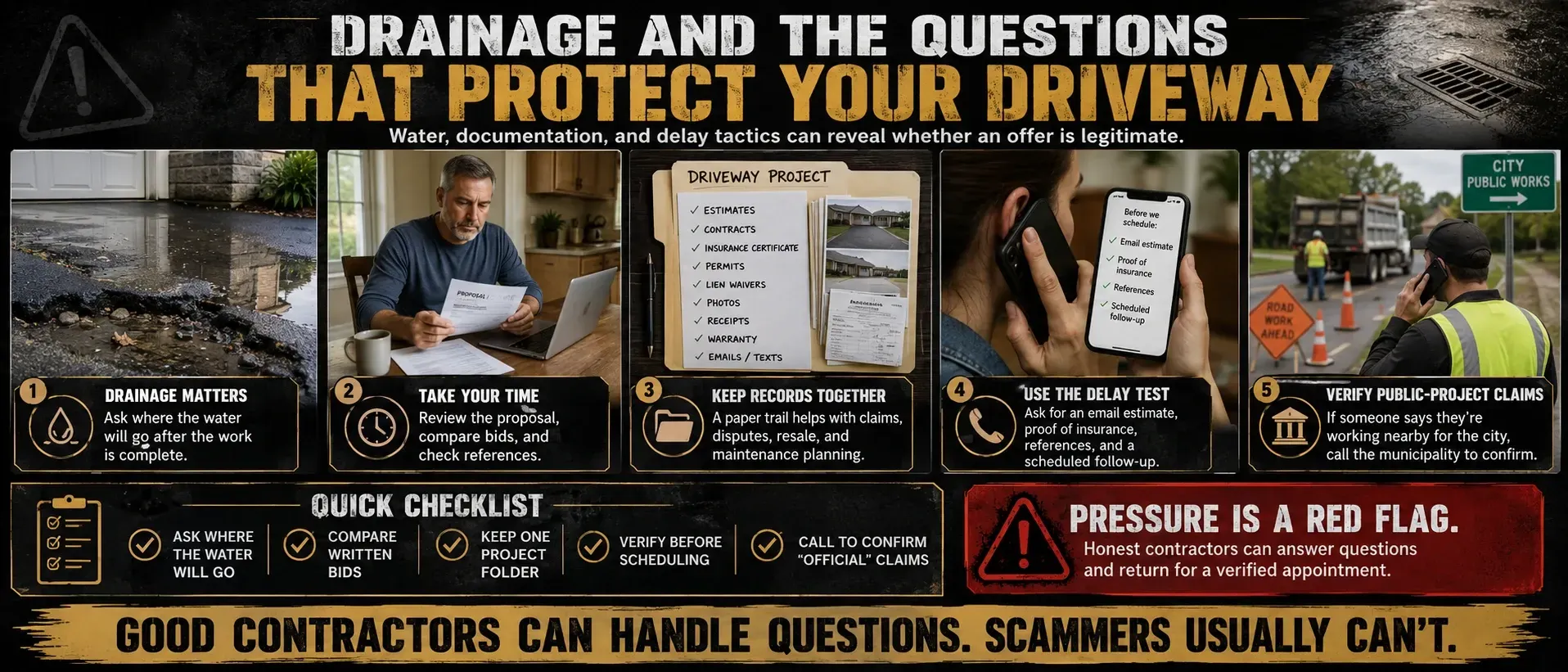
PCAA made this image for public use under the Creative Commons Attribution (CC BY) license.
Drainage and the Questions that Protect Your Driveway
Drainage deserves special attention because many pavement failures begin with water. If water sits on the driveway, runs toward the foundation, pools near the garage, washes out edges, or freezes in low spots, a cosmetic surface treatment may not solve the problem. A reputable contractor should discuss water movement honestly. A fraud crew may avoid drainage completely because fixing drainage takes evaluation, time, and accountability. Customers should ask where the water will go after the work is complete. If nobody can answer, the pavement may be inheriting the same problem under a fresher-looking surface. [DATCP HI]
People should not be embarrassed to ask a contractor for time. A major driveway or parking lot project is a significant investment. The customer should be able to review a proposal, talk to another household member, check references, and compare bids. If a contractor says that basic caution means the customer is difficult, that reaction is itself a reason to choose a different contractor. Cautious customers are harder to scam. Good contractors may be busy, but they do not need to panic to sell work. [BBB 2025]
Customers should keep all communications in one place. Create a folder for estimates, contracts, insurance certificates, photos, permits, lien waivers, receipts, warranty details, and email or text communication. For businesses, store the file with vendor records. For homeowners, keep it with the property documents. If the driveway performs well, the folder is simply good recordkeeping. If a problem appears, it becomes the difference between a clear claim and a disputed version of events that nobody can prove. [DATCP HI]
The same documentation helps when selling a property. A homeowner who can show when the driveway was replaced, who performed the work, what scope was completed, and what warranty existed may answer buyer questions more confidently. A parking lot owner may also need records for maintenance planning. Fraudulent work rarely comes with usable records. A legitimate project should leave behind a paper trail as well as pavement. That paper trail is part of the value of hiring a real company instead of a crew that does not provide written documentation. [DATCP HI]
If a customer is unsure whether an offer is legitimate, they can use a delay test. Ask the contractor to return for a scheduled appointment after the customer has verified the business. Ask for the estimate by email. Ask for proof of insurance. Ask for references. Ask for time to compare. Honest contractors may have scheduling limits, but they can engage with those requests. Fraudulent crews often cannot. The delay test is simple, and it works because fraud cannot survive a verified appointment. [BBB 2025] [DATCP 2023]
Community associations should publish a standard warning before road construction season and again before peak summer. Remind residents that real municipal contractors don't knock on doors selling private driveway work and demand cash. If someone claims to be working on a nearby government project, call the municipality and verify. Scammers borrow the look of public projects because cones, vests, and trucks read as official at a glance. One phone call to the city, village, or county shuts that tactic down.
[DATCP-2023]
Cited Resources
[DATCP 2023] Wisconsin Department of Agriculture, Trade and Consumer Protection, 'Consumer Alert: Traveling Asphalt Crews Reported in Southeastern Wisconsin,' September 8, 2023. https://datcp.wi.gov/Pages/News_Media/20230908ConsumerAlertAsphaltCrews.aspx
[BBB 2025] Better Business Bureau, 'BBB Scam Alert: Need a new driveway? Look out for asphalt paving scams,' updated May 14, 2025. https://www.bbb.org/article/news-releases/22795-bbb-scam-alert-need-a-new-driveway-look-out-for-asphalt-scams
[CBS58 2026] CBS 58, 'Better Business Bureau warns of asphalt paving scams targeting homeowners,' April 6, 2026. https://cbs58.com/news/better-business-bureau-warns-of-asphalt-paving-scams-targeting-homeowners
[CBS58 2023] CBS 58, 'Police warn of asphalt scam happening across Wisconsin,' June 8, 2023. https://www.cbs58.com/news/police-warn-of-asphalt-scam-happening-across-wisconsin
[TMJ4 2026] TMJ4 Milwaukee, 'A Franklin police dog is helping warn residents about shoddy asphalt paving work before they lose thousands of dollars,' April 27, 2026. https://www.tmj4.com/news/local-news/a-franklin-police-dog-is-helping-warn-residents-about-shoddy-paving-work-before-they-lose-thousands-of-dollars
[DATCP HI] Wisconsin DATCP, 'Home Improvement Consumer Tips.' https://datcp.wi.gov/Pages/Publications/HI-ConsumerTips136.aspx
[DATCP LIENS] Wisconsin DATCP, 'Liens.' https://datcp.wi.gov/Pages/Publications/Liens262.aspx
[WI ATCP 110.025] Wisconsin Administrative Code section ATCP 110.025, 'Lien waivers.' https://docs.legis.wisconsin.gov/code/admin_code/atcp/090/110/025
[DSPS DC] Wisconsin Department of Safety and Professional Services, 'Dwelling Contractor.' https://dsps.wi.gov/Pages/Professions/DwellingContractor/Default.aspx
[DSPS DCQ] Wisconsin Department of Safety and Professional Services, 'Dwelling Contractor Qualifier.' https://dsps.wi.gov/Pages/Professions/DwellingContractorQualifier/Default.aspx
[MD-NEWS] Montgomery County, Maryland Office of Consumer Protection, "Warning Homeowners of Rise in Driveway-Paving Scams," April 2024. https://www2.montgomerycountymd.gov/mcgportalapps/Press_Detail.aspx?Item_ID=45057
[MN AG 2025] Minnesota Attorney General Keith Ellison. February 11, 2025, press release announcing settlement requiring Brandon Michael Ferguson and Community Blacktop, LLC to dissolve and pay $100,000 in restitution to victims; investigation coordinated with law enforcement in Wisconsin and Michigan. https://www.ag.state.mn.us/Office/Communications/2025/02/11_CommunityBlacktop.asp
[FOX6-2023] FOX6 Milwaukee, "Traveling asphalt scam; scammers recently in Waukesha County: officials," September 2023. https://www.fox6now.com/news/traveling-asphalt-scam-waukesha-county-officials
[NC-AG] Winston-Salem Journal, "Walkertown man gets prison time in paving scam of elderly Winston-Salem woman," January 2018 (covering NC AG injunction and conviction of Lige "Larry" Bobby Boswell on charges of obtaining property by false pretenses and exploiting an elderly or disabled person). https://journalnow.com/news/crime/walkertown-man-gets-prison-time-in-paving-scam-of-elderly-winston-salem-woman/article_ba43a8eb-3496-5c2e-bc3d-7985a01b0732.html
[IN-NEWS] WRTV Indianapolis, "Driveway paving company operator pleads guilty to home improvement fraud," 2019 (Natalie Davis of "Awesome Asphalt," with $7,500 restitution to victim homeowners). https://www.wrtv.com/news/call-6-investigators/driveway-paving-company-operator-pleads-guilty-to-home-improvement-fraud
[CAPA] Colorado Asphalt Pavement Association. State-level industry consumer warnings; contractor vetting guidance for property owners. https://www.co-asphalt.com
[APAM] Asphalt Pavement Association of Michigan. State-level contractor verification standards and consumer warnings for the Great Lakes region. https://www.apa-mi.org
[WA AG] Washington State Attorney General. Enforcement actions documenting artificial-deadline pressure tactics; pattern reports from attempted scams used to justify multi-state investigations. https://www.atg.wa.gov
[IA AG] Iowa Attorney General. Consumer protection enforcement actions against traveling sealcoating and asphalt crews operating under multiple company names across county lines. https://www.iowaattorneygeneral.gov
[AARP FW] AARP Fraud Watch Network. Elder-targeting statistics for home improvement fraud; financial institution staff training for elder-targeted payment coercion. Helpline: 1-877-908-3360. https://www.aarp.org/money/scams-fraud/fraud-watch-network/
[NAPA STD] National Asphalt Pavement Association. Contractor verification standards; guidance on material specifications, compacted mat thickness, and mix design documentation. https://www.asphaltpavement.org
[FTC 2024] Federal Trade Commission. Consumer Sentinel Network Data Book 2024. Reports on home improvement fraud losses, payment method exploitation (wire transfer, check, cash), and consumer protections, including the Cooling-Off Rule and Unordered Merchandise Rule. https://www.ftc.gov/reports/consumer-sentinel-network
[EPA OIG] U.S. Environmental Protection Agency, Office of Inspector General. Public fraud alert on traveling pavement crews: cost-cutting through thinner mats, watered-down material, and skipped base preparation.
https://www.epa.gov/office-inspector-general/fraud-alert-asphalt-sealer-scam